The right PCB laminate decides loss, heat, and cost.
From standard FR-4 to ultra-low-loss AI-server cores, the PCB material you specify sets your signal loss, thermal limits, and price. This guide maps the material families — FR-4 grades, high-frequency, low-loss, and hybrid stackups — so you match the board to the data rate instead of overpaying or under-speccing.
Materials rank by Df (dissipation factor) — lower Df, less signal loss, higher cost. This is the spine of laminate selection.
How PCB material selection works
A PCB material — specifically the laminate — is the base dielectric that carries the copper layers, usually a glass-reinforced resin. Choosing it is a system decision that sets signal integrity, thermal reliability, manufacturability, and cost. Five parameters do most of the work: Dk (dielectric constant), Df (dissipation factor / loss), Tg (glass transition temperature), Td (decomposition temperature), and Z-axis CTE.
When choosing a PCB material, the dominant axis is loss. For designs under ~5 Gbps, standard FR-4 is fine. From 10–25 Gbps you move to mid-loss laminates; 56–112G channels need low- and ultra-low-loss cores; and RF and microwave move to PTFE-based materials. Higher performance means lower Df — and higher cost. The rest is matching Tg, CTE, and availability to your build.
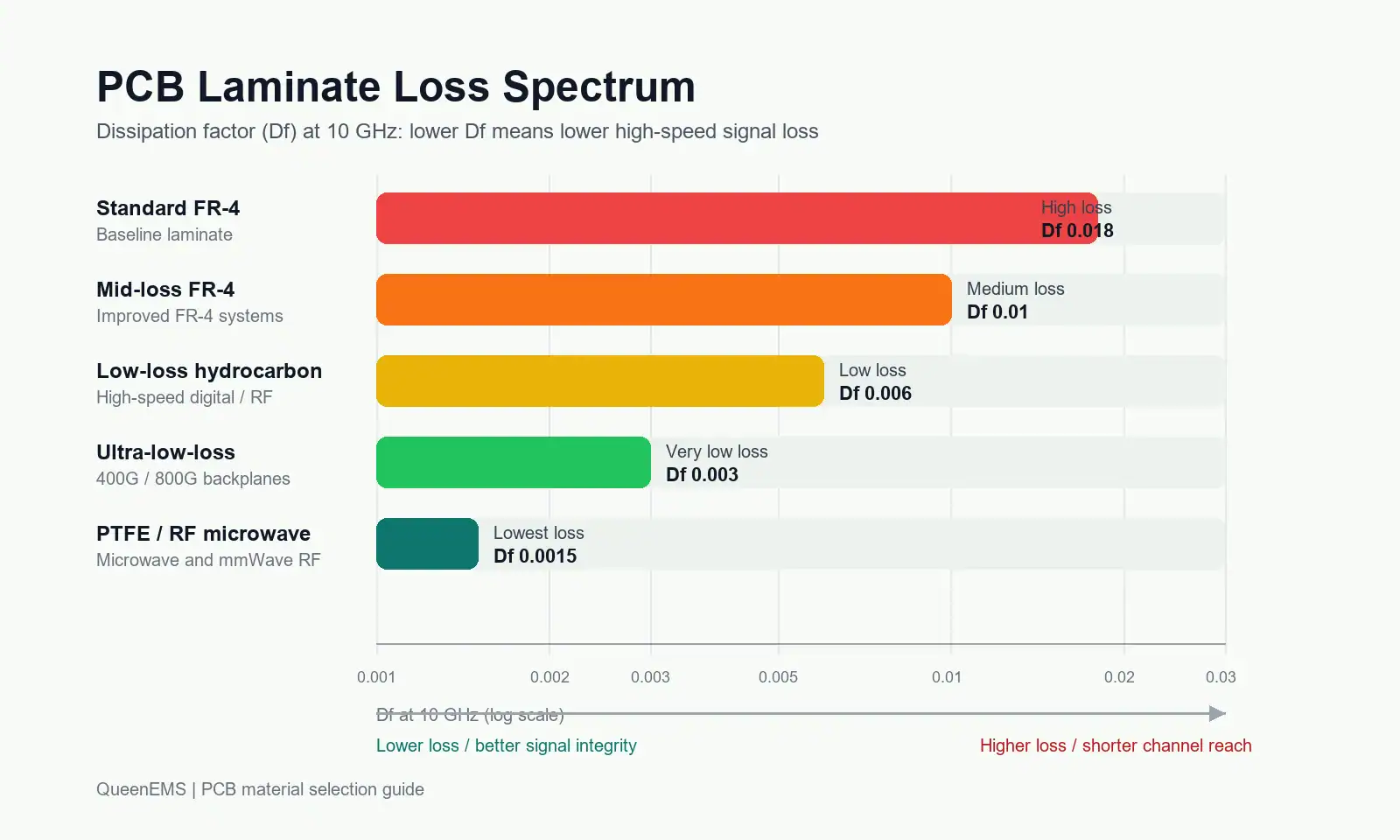
Because Dk and Df shift with frequency, temperature, and resin content, always verify against the manufacturer's latest datasheet. This guide organizes the material families; to compare exact parameters side by side, use the selector tool linked below.
FR-4 grades & brand equivalents
Most boards use an FR-4-class PCB material, but "FR-4" spans a wide range of Tg grades and brand-specific properties. These guides cover the Tg fundamentals and the specific ITEQ, Isola, TUC, Ventec, and Shengyi grades most designs actually spec — including halogen-free equivalents.
Show all FR-4 grades & brands
High-frequency & RF materials
RF, microwave, and antenna designs move off standard FR-4 to low-Dk, low-loss laminates — most often the Rogers families and PTFE-based materials. These guides cover the RO4000 and RO3000 families, PTFE processing, and the ceramic-filled options for millimeter-wave.
Show more high-frequency materials
AI-server & ultra-low-loss materials
112G channels, GPU accelerators, and AI-server backplanes push laminate to the ultra-low-loss frontier — the Megtron, Tachyon, and EM-series cores behind NVIDIA and hyperscaler stackups. These guides cover the M6/M7/M8 tiers, their specs, and the lead-time realities that come with them.
Show all AI-server & low-loss materials
Hybrid (mixed-material) stackups
Mixing a low-loss RF or high-speed core with FR-4 saves cost — but adds lamination, CTE, and impedance risk. These guides cover when a hybrid stackup pays off, how to draw and RFQ it, and the lamination and delamination checks that keep mixed materials manufacturable.
Halogen-free & special requirements
Halogen-free compliance, copper-foil roughness for high-speed loss, and lead-free-compatible grades each change which laminate you can use. These guides cover the special constraints that override a pure Dk/Df choice.
PCB material FAQ
What is the most important PCB material parameter?
When do I need to move off standard FR-4?
What laminate do AI-server boards use?
Can I mix Rogers and FR-4 in one board?
How do I compare laminates side by side?
Building with a specific laminate?
QueenEMS fabricates with standard FR-4, high-frequency, ultra-low-loss, and hybrid stackups — with free DFM review and stackup optimization. Send your material and we'll confirm manufacturability.
Get a quote with your material