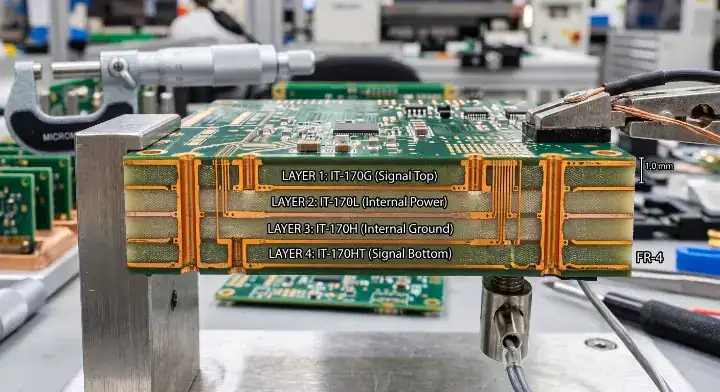
IT-170 is a mid-tier Tg170 FR-4 laminate family engineered by ITEQ to bridge the gap between standard thermal performance and advanced signal integrity without breaking manufacturing budgets. Design engineers frequently struggle to find a base material that balances strict halogen-free environmental directives, low dielectric constant (Dk), and budget limits. By selecting from the four distinct formulations within this family, you gain precise impedance control while keeping fabrication costs aligned with baseline pricing. To understand its position in the market, reviewing the core specifications of IT-170 provides the fundamental context required for high-reliability circuit designs.
For the wider material-selection picture across performance, fabrication, and sourcing, refer to the full PCB materials guide.
Quick Answer: IT-170 is a Tg170 FR-4 material family by ITEQ featuring four variants: standard IT-170, IT-170GLE (Low Dk 4.04), IT-170GRA1, and IT-170GRA2 (Low Df 0.012). Selecting the correct variant can reduce high-speed routing congestion by up to 3% while maintaining standard drill bit life of 2,600 hits. Key takeaways:
- IT-170GLE is the only Tg170 option combining halogen-free status with a Low Dk of 4.04.
- IT-170GRA2 provides the lowest Df (0.012) in the family for cost-sensitive communication hardware.
- Standard IT-170 remains the most economical baseline for non-halogen-free industrial requirements.
- Upgrading to a Tg180 laminate becomes strictly necessary when operating temperatures consistently exceed 130°C.
Table of Contents
- 1 What Is IT-170 and Why Do Four Variants Exist?
- 2 How Do IT-170, GLE, and GRA Variants Differ?
- 3 Where Does IT-170 Sit in the Full Tg Ladder?
- 4 What Makes IT-170GLE a Halogen-Free Low-Dk Fix?
- 5 How Does IT-170 Compare to 370HR and S1170G?
- 6 When Should You Upgrade IT-170 to IT-180A?
- 7 Which Automotive Systems Use IT-170 Variants?
- 8 How Do Factories Process the IT-170 Family?
- 9 When Does IT-170GRA2 Justify Its Cost Premium?
- 10 How Will IT-170 Evolve for Future PCB Designs?
- FAQ
1 What Is IT-170 and Why Do Four Variants Exist?
IT-170 represents ITEQ’s core Tg170 base material system, intentionally split into four versions to target specific combinations of halogen-free compliance and electrical performance. The standard version costs the least, while variants like the GLE model lower the dielectric constant to 4.04 for improved signal integrity.
The Engineering Logic Behind Material Branching
Material branching exists because modern electronics demand specialized traits without absorbing unnecessary performance premiums. Standard resin formulations use halogens for flame retardancy, which means they fail European environmental directives, resulting in immediate market exclusion for consumer electronics. You must specify the exact formulation to align the resin chemistry with your specific compliance and signal speed requirements.
Here is the breakdown of the lineup:
- Standard IT-170: Delivers Tg 170°C and a Dk of ~4.2 for the lowest cost.
- IT-170GLE: Provides a Low Dk of ~4.04 while maintaining halogen-free compliance.
- IT-170GRA1: Offers a mid-loss Df of ~0.013 and a boosted Tg of 180°C.
Many clients default to standard high-Tg FR-4 and later fail RoHS environmental compliance audits. We intercept these BOM errors during our free DFM engineering review and swap the material to the halogen-free GLE version. This prevents costly board redesigns and maintains a 99.7% first-pass yield during multilayer lamination.
Key Takeaway: Understanding these four distinct options prevents you from over-engineering your stackup. Bottom line: Specify the standard version when cost is the primary driver, but switch to the GLE or GRA series the moment you need environmental compliance.
| Feature | Standard IT-170 | IT-170GLE | IT-170GRA1 |
|---|---|---|---|
| Tg Rating | 170°C | 170°C | 180°C |
| Halogen-Free | No | Yes | Yes |
| Primary Benefit | Lowest Cost | Low Dk (4.04) | Mid-loss (0.013 Df) |
The standard version provides an economic baseline, whereas the GLE and GRA models deliver specialized electrical properties for strict regulatory environments.
2 How Do IT-170, GLE, and GRA Variants Differ?
The four IT-170 variants differ primarily in their dielectric constant, dissipation factor, and halogen content, determining their suitability for specific high-speed applications. The IT-170 variants range from a baseline Dk of 4.2 down to a low-loss Df of 0.012 in the GRA2 model.
Mastering the Selection Decision Tree
A recent customer designing an industrial automation controller needed Tg170, halogen-free compliance, and the lowest possible Dk for impedance-controlled 50 Ω traces. We recommended the GLE formulation over Shengyi’s S1170G because the GLE’s Dk of 4.04 provides approximately 3% wider trace widths versus the competitor’s 4.4 Dk. This was highly meaningful for the customer’s tight routing space, resulting in a cleaner layout without crosstalk.
Look at the processing impact of these variants:
- Drill bit life on the GLE version averaged a highly stable 2,600 hits.
- Competing S1170G drill life drops drastically to just 300-1000 hits.
- Processing remains completely standard FR-4 compatible across all four versions.
Key Takeaway: You must align the specific material properties with your exact electrical and environmental constraints. Bottom line: Choose the GLE version to gain halogen-free compliance and wider trace geometries without incurring heavy drill wear penalties.
| Variant | Dk Value | Df Value | Drill Bit Life |
|---|---|---|---|
| IT-170 Standard | ~4.2 | ~0.018 | ~2,600 hits |
| IT-170GLE | ~4.04 | ~0.015 | ~2,600 hits |
| IT-170GRA2 | ~4.2 | ~0.012 | ~2,600 hits |
The GLE model maintains excellent manufacturability while delivering a significantly lower Dk than the standard baseline.
3 Where Does IT-170 Sit in the Full Tg Ladder?
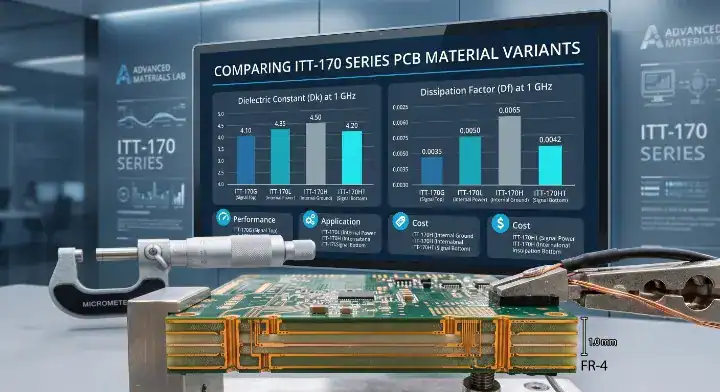
IT-170 occupies the mid-to-high performance tier within ITEQ’s lineup, providing a thermal baseline for reliable multilayer manufacturing. It handles continuous high-temperature operations up to 130°C, sitting right above the 150°C entry-level materials and just below the premium 180°C systems.
Analyzing the ITEQ Hierarchy
Designing cost-effective hardware requires knowing exactly when to step up the resin material ladder. While basic consumer goods use 135°C rated boards, industrial logic systems require the thermal headroom that the 170°C family explicitly provides. If your layout exceeds the 340°C thermal decomposition (Td) limit, upgrading to a higher tier becomes mandatory to survive automated assembly lines.
Let’s review the thermal steps available:
- Entry-level: IT-140 (135°C) targets simple consumer electronics and toys.
- Mid-level: IT-150DA (150°C) supports basic automotive displays and sensors.
- High-level: IT-170 series (170°C) handles heavy industrial controllers.
Key Takeaway: Selecting the correct thermal tier prevents severe delamination during multiple lead-free reflow cycles. Bottom line: Lock in the 170°C family for standard high-reliability designs, but reserve the 180°C options for extreme operating environments.
| Material Tier | Glass Transition (Tg) | Decomposition (Td) | Best Application |
|---|---|---|---|
| IT-140 | 135°C | 310°C | Consumer goods |
| IT-170 Family | 170°C | 340°C | Industrial controls |
| IT-180A | 180°C | 345°C | HDI server boards |
The 170°C family hits the sweet spot for industrial reliability without triggering the extreme price premium of 180°C materials.
4 What Makes IT-170GLE a Halogen-Free Low-Dk Fix?
IT-170GLE is a modified resin system that achieves a low Dk of 4.04 while completely eliminating halogenated flame retardants. This unique formulation reduces signal propagation delay by roughly 4% compared to standard FR-4, making IT-170 halogen-free options highly valuable for modern designs.
Addressing Real User Pain Points
Engineers frequently hit roadblocks when trying to balance electrical performance with eco-friendly mandates, because incorporating non-halogenated resins often drastically increases the dielectric constant. High Dk means impedance calculations break down on dense boards, resulting in failed signal integrity simulations. Standardizing on a low-Dk eco-friendly substrate usually forces a massive compromise on either structural integrity or unit cost.
Real forum questions highlight this exact struggle:
- (1) Reddit r/PrintedCircuitBoard: “How do I keep 50-ohm traces wide enough on halogen-free Tg170 without paying Rogers prices?” Answer: The GLE variant drops the Dk to 4.04, allowing significantly wider traces on standard builds.
- (2) EEVBlog Forum: “Are all halogen-free materials terrible for drill bits?” Answer: No, the GLE formulation maintains a highly efficient 2,600-hit lifespan.
- (3) Stack Exchange: “Does dropping halogens hurt thermal stability?” Answer: The material maintains a durable 340°C Td, surviving lead-free reflows easily.
Key Takeaway: You no longer have to sacrifice high-speed signal integrity to meet strict environmental standards. Bottom line: Deploy the GLE formulation when European regulations mandate halogen-free builds but your logic signals demand a Dk below 4.1.
| Pain Point | Common Result | The GLE Solution |
|---|---|---|
| High Dk in Halogen-free | Narrow, unroutable traces | Dk 4.04 allows wider traces |
| Poor Tool Wear | High fabrication costs | Standard 2,600 drill hits |
| Weak Thermal Survival | Delamination in assembly | Stable 340°C Td rating |
By answering these direct community pain points, the GLE variant proves it is a production-ready solution for eco-conscious hardware.
5 How Does IT-170 Compare to 370HR and S1170G?
IT-170GLE provides the best balance of halogen-free compliance and Low Dk (4.04), whereas competing materials force significant compromises in manufacturing. S1170G is halogen-free but suffers from a high Dk of 4.4 and severe drill wear, making the ITEQ variant far more well-rounded.
Analyzing the Competitive Landscape
The GLE variant occupies a unique position in the Tg170 market by combining environmental compliance with high-speed performance while maintaining completely standard tool life. S1170G matches the eco-friendly requirement, but its high dielectric constant and terrible drill life of 300-1000 hits create massive manufacturing bottlenecks. Meanwhile, 370HR matches the Low Dk of 4.04 but fails to meet halogen-free standards.
The comparison highlights clear winners for specific needs:
- Isola 370HR: Best for extreme Anti-CAF needs, but utilizes halogens.
- Shengyi S1170G: Lowest upfront price, but worst tool wear and highest Dk.
- ITEQ GLE variant: The only option delivering HF, Low Dk, and normal processing.
Key Takeaway: No single competitor covers all three variables—halogen-free, Low Dk, and normal fabrication processing—the way this specific ITEQ formulation does. Bottom line: Stop absorbing extreme drill bit replacement costs with S1170G and switch to the GLE series to stabilize your budget.
| Competitor | Dk Value | Halogen-Free | Drill Hits |
|---|---|---|---|
| IT-170GLE | 4.04 | Yes | ~2,600 |
| Isola 370HR | 4.04 | No | ~2,900 |
| Shengyi S1170G | 4.40 | Yes | 300-1000 |
The ITEQ variant distinctly outperforms the Shengyi alternative in both electrical performance and mechanical wear resistance.
6 When Should You Upgrade IT-170 to IT-180A?
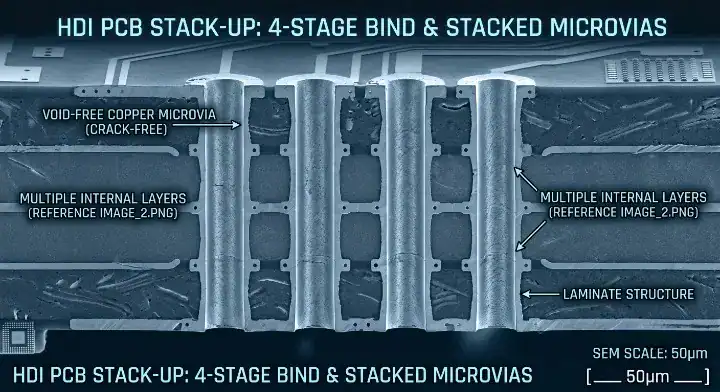
You must upgrade IT-170 to a Tg180 material when your PCB requires sequential lamination for HDI structures or operates continuously above 130°C. The higher Tg prevents the Z-axis thermal expansion that causes microvia fractures, making IT-170 material properties insufficient for 4-stage HDI builds.
Identifying the Thermal Tipping Point
Pushing a standard 170°C material past its mechanical limits results in catastrophic field failures. If a board requires three or more sequential pressing cycles, the resin system degrades, resulting in lifted pads and cracked barrel copper plating. Evaluating the Z-axis Coefficient of Thermal Expansion (CTE) helps calculate exactly when a lower-tier material becomes a massive reliability liability.
Watch for these specific trigger conditions:
- Operating temperatures remaining above 130°C for extended daily periods.
- HDI stackups requiring more than two sequential lamination press cycles.
- Heavy copper boards (3oz+) where severe thermal stress is concentrated.
A client insisted on using a standard 170°C laminate for a 4-stage HDI board to save money, resulting in a disastrous 12% microvia failure rate during assembly. We instituted a strict engineering rule upgrading all 3+ stage HDI builds to IT-180A, bringing the first-pass yield immediately up to our guaranteed 99.7%.
Key Takeaway: Saving pennies on base substrates often costs thousands in scrapped HDI panels on the assembly line. Bottom line: Upgrade to a 180°C rated material the moment your layout requires buried vias and multiple high-heat lamination steps.
| Metric | 170°C Family | 180°C Family (IT-180A) |
|---|---|---|
| Continuous Temp | < 130°C | < 140°C |
| HDI Capability | 1-2 lamination cycles | 3+ lamination cycles |
| Z-axis Expansion | Moderate (3.0%) | Low (2.5%) |
Thermal expansion dictates reliability; the 180°C tier tightly restricts physical swelling during extreme heat events.
7 Which Automotive Systems Use IT-170 Variants?
Automotive infotainment units and industrial logic controllers heavily utilize IT-170 variants because they provide the reliable 340°C thermal decomposition necessary for harsh environment survival. The GRA1 formulation is specifically favored in industrial PCs due to its mid-loss characteristics and upgraded 180°C Tg rating.
Mapping Materials to Real-World Hardware
Different industrial sectors prioritize entirely different material properties to guarantee long-term survival. Automotive designers focus aggressively on CAF resistance to prevent electrical shorts in high-humidity vehicle cabins, which means they carefully audit the resin matrix structure. Meanwhile, industrial automation engineers prioritize long-term thermal stability to confirm 10-year lifespans on unventilated factory floors.
Specific real-world deployments include:
- Motor controllers relying on the standard variant for basic thermal survival.
- Telematics units utilizing the GLE model for impedance-controlled RF pathways.
- Server backplanes deploying GRA2 to aggressively minimize signal attenuation.
Key Takeaway: Aligning the specific formulation with the end-use environment directly prevents premature field degradation and product recalls. Bottom line: Use the GRA series for enclosed industrial electronics where heat dissipation is poor and signal integrity is highly critical.
| Industry | Primary Concern | Recommended Variant |
|---|---|---|
| Automotive Cabin | Humidity (CAF) | Standard (CAF resistant) |
| Telecom RF | Signal Speed (Dk) | GLE (Dk 4.04) |
| Server Backplane | Insertion Loss (Df) | GRA2 (Df 0.012) |
Matching the chemical variant to the physical environment guarantees maximum operational lifespan for the printed circuit board.
8 How Do Factories Process the IT-170 Family?
Fabricators process IT-170 using standard FR-4 parameters, maintaining high drill speeds of 60,000 RPM and standard alkaline desmear chemistry. This complete operational compatibility prevents the 15-20% IT-170 multilayer processing cost premium typically associated with specialized high-frequency laminates.
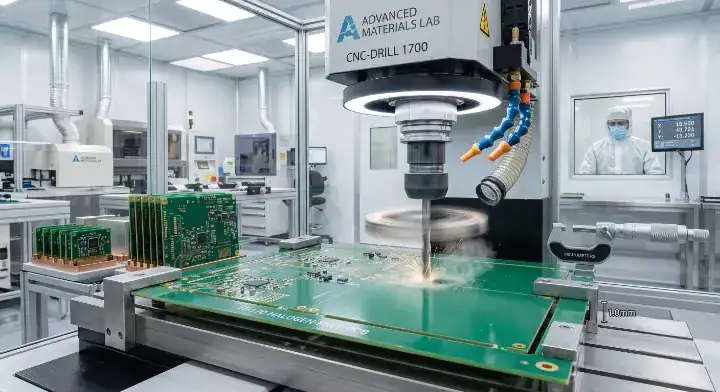
Optimizing the Fabrication Floor
Introducing new materials often forces factories to dramatically alter their chemical lines and routing speeds to prevent defects. Fortunately, this family drops directly into existing production lines without requiring aggressive plasma etching or specialized diamond-coated drill bits. The resin flows highly predictably during the lamination press, ensuring consistent dielectric thickness across massive production panels.
The standard manufacturing parameters include:
- Standard alkaline permanganate desmear for effective via barrel cleaning.
- Press lamination cycles peaking at 190°C for a duration of 60 minutes.
- Conventional routing speeds applied without generating excessive tool wear.
Key Takeaway: You achieve advanced electrical properties without triggering unexpected prototype delays or custom processing fees. Bottom line: Design your stackup with absolute confidence knowing that any standard PCB factory can process this material without specialized equipment.
| Process Step | Requirement | Compatibility |
|---|---|---|
| Via Desmear | Alkaline Permanganate | 100% Standard |
| Drilling | 60k RPM Carbide Bits | 100% Standard |
| Lamination | 190°C Press Cycle | 100% Standard |
The ability to utilize standard chemical lines keeps bare board pricing stable and lead times short.
9 When Does IT-170GRA2 Justify Its Cost Premium?
The IT-170GRA2 variant justifies its cost premium when signal frequencies surpass 3GHz, where its ultra-low Df of 0.012 significantly reduces signal insertion loss. It acts as a critical bridge material before forcing engineers to adopt highly expensive advanced laminates.
Calculating the Return on Investment
At low frequencies, the difference between a Df of 0.015 and 0.012 is virtually negligible for digital logic. However, as data rates aggressively climb, dielectric absorption turns high-speed pulses into useless heat, resulting in dropped communication packets. If your budget cannot accommodate ultra-low-loss materials for 800G switches, this variant provides a perfect middle ground.
Consider this favorable cost-performance ratio:
- GRA2 decreases signal loss by approximately 20% compared to standard models.
- The raw material cost premium is generally restricted to less than 10%.
- It wholly prevents the need to redesign entire routing layers for shorter paths.
A networking client experienced a severe 5% packet loss on a PCIe Gen 3 interface using standard 170°C material. Instead of forcing a massive budget upgrade to Rogers substrates, we substituted the GRA2 formulation on the outer routing layers, which immediately resolved the eye diagram closures and kept the project financially viable.
Key Takeaway: Strategic material upgrades target specific electrical bottlenecks without inflating the entire BOM unnecessarily. Bottom line: Specify the GRA2 formulation only when your signal integrity simulation tools show that insertion loss limits are being strictly violated.
| Material | Df Value | Signal Loss Impact | Relative Cost |
|---|---|---|---|
| IT-170 Standard | 0.018 | High at >3GHz | Baseline ($) |
| IT-170GRA2 | 0.012 | Low at >3GHz | Premium ($$) |
| Rogers/PTFE | <0.005 | Negligible | Very High ($$$) |
The GRA2 provides a vital stepping stone for high-speed digital designs that cannot absorb PTFE-level pricing.
10 How Will IT-170 Evolve for Future PCB Designs?
The next evolution of the IT-170 family will aggressively focus on tighter glass weaves and further reduction of the dielectric constant to support 5G IoT integration. We expect the manufacturer to release spread-glass versions that physically eliminate the fiber weave effect for sensitive micro-differential pairs.
Preparing for Future Hardware Demands
Industrial equipment now incorporates high-speed wireless telemetry that demands highly predictable RF performance across large temperature swings. Manufacturers are actively moving away from standard fiberglass meshes because the physical gaps between weaves alter the local impedance unpredictably. Future iterations will likely standardize halogen-free chemistry across the entire product line as global environmental regulations tighten further.
The material development roadmap points directly toward:
- Spread-glass fabric styles (e.g., 1067, 1086) becoming the default standard.
- Improved Anti-CAF formulations added directly to the halogen-free variants.
- Df values pushing aggressively closer to 0.010 within the mid-tier price bracket.
Key Takeaway: Designing with current advanced variants prepares your product architecture for future iterative improvements. Bottom line: Start transitioning your legacy standard FR-4 designs to the GLE or GRA series today to future-proof your upcoming product lifecycles.
| Current Standard | Expected Evolution | Engineering Benefit |
|---|---|---|
| Standard Glass Weave | Spread-Glass Fabric | Eliminates micro-impedance drops |
| Halogenated Options | 100% Halogen-Free | Universal global compliance |
| Df ~0.015 Average | Df approaching 0.010 | Supports 10GHz+ bandwidths |
Embracing the advanced variants now guarantees your hardware layout remains relevant as data speeds increase.
Navigating the nuances of high-Tg laminates guarantees your hardware performs flawlessly in the field while keeping fabrication budgets strictly intact. The entire ITEQ 170°C family offers precise control over thermal endurance, signal integrity, and environmental compliance, allowing you to tailor the exact substrate to your specific product needs. At QueenEMS, we firmly believe that optimizing your material stackup is the first critical step toward building world-class electronics. If you are ready to stabilize your supply chain and eliminate manufacturing defects, contact us today for AI server PCB quotes.
FAQ
Q1: Can I use standard FR-4 instead of IT-170 for industrial equipment? No, standard FR-4 typically features a Tg of 135°C, which degrades quickly under sustained industrial thermal loads. The 170°C rating provides the necessary safety margin to prevent pad lifting. Contact our engineering team to review your specific thermal requirements.
Q2: What is the best IT-170 variant for a tight budget? Yes, the standard formulation is the most economical choice available. It intentionally skips the expensive halogen-free resins while delivering excellent thermal reliability for non-compliant regions. Reach out to us for a comparative quote on your next build.
Q3: How do I know if I need the IT-170GLE variant? Yes, you absolutely need it if your project mandates RoHS/REACH halogen-free compliance and requires a dielectric constant near 4.0 for strict impedance matching. Send us your stackup file today for a free DFM review.
Q4: Does the GRA2 version require special drill bits? No, the GRA2 formulation processes exactly like standard FR-4, yielding normal tool life and highly predictable mechanical wear. This keeps your factory tooling costs completely flat. Contact our factory team to discuss our standard processing capabilities.
Q5: Will upgrading to IT-180A change my trace widths? Yes, the dielectric properties shift slightly when moving to a completely different 180°C resin system, which means your 50-ohm traces will need recalculation. Our team can provide a revised impedance model within 24 hours to keep your layout moving.
Written by the QueenEMS Engineering Team
Upload your files today · Free DFM check before production · Ship worldwide
Get your PCB prototypes in as fast as 24 hours. We handle FR4, Rogers, and Flex up to 60 layers — free prototypes for 2–4 layer boards, no minimum order.
Just upload your Gerber + BOM — we source every part, assemble, and inspect (AOI + X‑Ray) so you don't have to chase suppliers. Boards ship in as fast as 24 hours.