
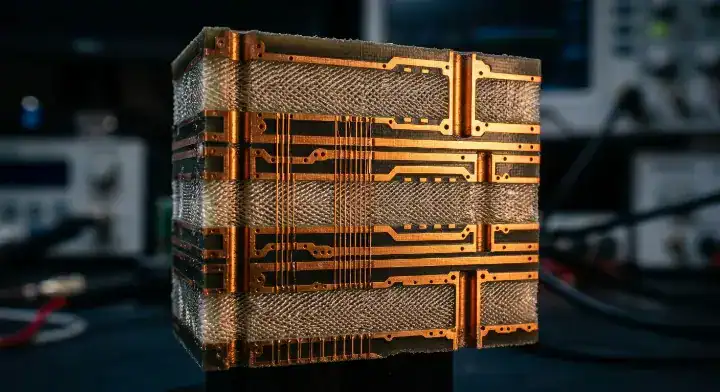
For the wider material-selection picture, including laminate properties, process constraints, and substitution risks, see our PCB materials guide.
Quick Answer: A Megtron 8 PCB uses Panasonic’s ultra-low-loss MEGTRON 8 laminate and prepreg family for high-speed, high-layer-count designs such as 800GbE networking, routers, switches, servers, AI servers, base stations, and semiconductor test equipment. Panasonic lists MEGTRON 8 values such as Dk 3.08 and Df 0.0012 at 14 GHz for the ultra-low Df glass cloth type, with Tg 220°C and T288 above 120 minutes.
Key takeaways
- Verify the exact Panasonic part family, not just the words “Megtron 8.”
- Use MEGTRON 8 when channel loss and stackup risk justify the cost.
- Pair the material decision with smooth copper, impedance rules, and test coupons.
- Ask for material traceability, stackup evidence, and fabrication controls before release.
A Megtron 8 PCB is not automatically better because the material name sounds premium. It is better only when your signal-integrity budget, layer count, speed class, and fabrication evidence actually require a very low-loss Panasonic laminate system.
That distinction matters for buyers. If the board only needs a moderate high-speed material, MEGTRON 8 can be overspecification. If the board carries 800GbE-class links, dense server routing, or long loss-sensitive channels, underspecifying the laminate can create insertion-loss, impedance, and reliability problems that cost far more than the material delta.
Table of Contents
- What Is a Megtron 8 PCB?
- Which Panasonic Specs Should Buyers Verify?
- When Is MEGTRON 8 Better Than MEGTRON 7?
- Why Do Copper Foil and Glass Style Matter?
- How Should Stackup and Impedance Be Specified?
- What Fabrication Risks Come with High Layer Counts?
- When Is MEGTRON 8 Worth the Cost?
- What Evidence Should a Supplier Provide?
- How Should AI Server Claims Be Used Safely?
- What Should QueenEMS Review Before Quotation?
What Is a Megtron 8 PCB?
A Megtron 8 PCB is a high-speed printed circuit board built with Panasonic MEGTRON 8 circuit-board materials, such as R-579Y, R-5795, R-579YS, or R-5795S laminate families with matching prepregs. The material is designed for low transmission loss and high heat resistance in multilayer networking and server boards.
Panasonic positions MEGTRON 8 for high-speed communication equipment, including routers, switches, optical transmission equipment, servers, AI servers, base stations, semiconductor test equipment, and probe cards. That application list does not mean every server board needs MEGTRON 8. It means the material family is intended for boards where signal loss, thermal reliability, and high layer counts are core constraints.
The buyer’s first job is to confirm the exact construction:
- laminate part family;
- prepreg part family;
- ultra-low Df glass cloth or low-Dk glass cloth type;
- copper foil profile;
- dielectric thickness and glass style;
- finished copper weight;
- impedance and insertion-loss test plan.
Do not accept “Megtron 8 equivalent” as a complete specification. Equivalence must be tied to Dk, Df, frequency, glass style, copper roughness, reliability values, availability, UL conditions, and your channel-loss target.
Which Panasonic Specs Should Buyers Verify?
Buyers should verify Dk, Df, Tg, T288, CTE, peel strength, water absorption, and the exact MEGTRON 8 part family. Panasonic’s product tables show that not every MEGTRON 8 option has the same Dk and Df.
Panasonic’s North America product page lists MEGTRON 8 materials including R-579Y(N)/R-569Y and R-579Y(U)/R-569Y. The ultra-low Df glass cloth type is listed at Dk 3.08 and Df 0.0012 at 14 GHz, while the low-Dk glass cloth type is listed at Dk 3.13 and Df 0.0016 at 14 GHz. Panasonic also lists Tg 220°C, Td 370°C, T288 above 120 minutes, and UL 94V-0 flammability for these options.
| Panasonic property | Why it matters to the buyer |
|---|---|
| Dk at 14 GHz | Sets impedance geometry and propagation behavior |
| Df at 14 GHz | Drives dielectric loss in high-speed channels |
| Tg 220°C | Supports thermal margin through multilayer lamination and assembly |
| T288 >120 min | Indicates resistance to delamination under high-temperature stress |
| Z-axis CTE | Helps assess via reliability through thermal cycling |
| H-VLP3 peel strength | Connects copper smoothness with manufacturability |
Panasonic’s global MEGTRON8 page also states that the above data are typical values and not guaranteed values. That sentence is important. Buyers should not copy typical table values into a contract as guaranteed production limits unless the supplier and material manufacturer confirm the test method, lot, and acceptance condition.
When Is MEGTRON 8 Better Than MEGTRON 7?
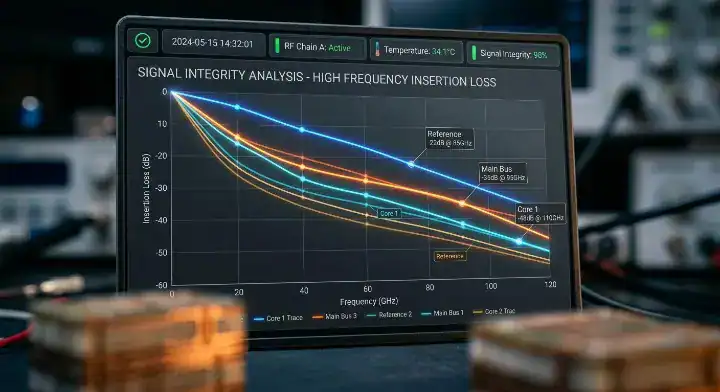
MEGTRON 8 is better than MEGTRON 7 when the channel-loss budget requires lower transmission loss, especially for 800GbE-class networking or long high-speed routes in high-layer-count boards. Panasonic states that MEGTRON 8 offers about a 30% improvement in transmission loss compared with MEGTRON 7 at 28 GHz.
That improvement is useful only when loss is the limiting factor. If the board has shorter links, slower interfaces, or a relaxed insertion-loss budget, a less expensive material may still meet the requirement. Siemens’ stackup-material guidance makes the same broader point: material selection should not be driven only by brand preference; it should match the electrical requirement and avoid overspending.
Use this comparison mindset:
- If the SI budget is comfortable, do not upgrade just for a premium material name.
- If the design is near the insertion-loss limit, evaluate MEGTRON 8 or another validated low-loss option.
- If the board has more than 20 layers, long channels, dense via fields, or high-speed backplane routing, material and fabrication evidence become more important.
- If the product must pass a customer-controlled channel model, request stackup and coupon evidence early.
MEGTRON 8 is not a generic replacement for engineering work. It reduces one part of the loss problem, but routing length, connector loss, via stubs, glass weave, copper roughness, return path, and manufacturing tolerance still decide whether the channel works.
Why Do Copper Foil and Glass Style Matter?
Copper foil and glass style matter because conductor loss and dielectric consistency can erase the advantage of a low-Df resin system. A Megtron 8 PCB must be specified as a stackup system, not as a laminate name alone.
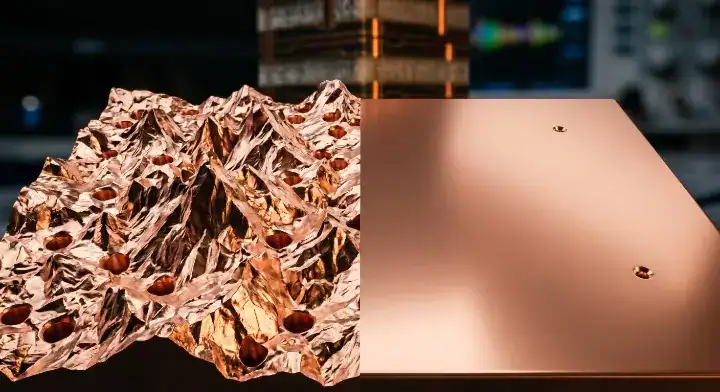
Panasonic’s MEGTRON 8 page lists peel strength values with H-VLP3 copper. Low-profile copper is important at high frequencies because rougher copper increases conductor loss. A buyer who pays for low-Df laminate but ignores copper roughness may still see avoidable loss in long or fast channels.
Glass style also matters. At high speed, the signal can see local dielectric variation from glass bundles and resin-rich areas. That can affect skew, impedance consistency, and pair-to-pair behavior. The practical buyer requirement is not to memorize every weave option, but to make sure the fabricator understands the routing class, skew risk, and material stackup target.
Ask for these details before quote approval:
- copper foil type and roughness class;
- dielectric thickness and glass style;
- resin content and prepreg selection;
- impedance target and tolerance;
- expected finished copper thickness;
- whether coupon testing will represent the routed structure.
If the supplier cannot define copper foil, glass style, and coupon strategy, the quote is not yet equivalent to a production-ready MEGTRON 8 build. When the same material choice intersects with plane continuity and return paths, QueenEMS’ PCB copper pour vs ground plane guide can help separate layout risk from laminate risk.
How Should Stackup and Impedance Be Specified?
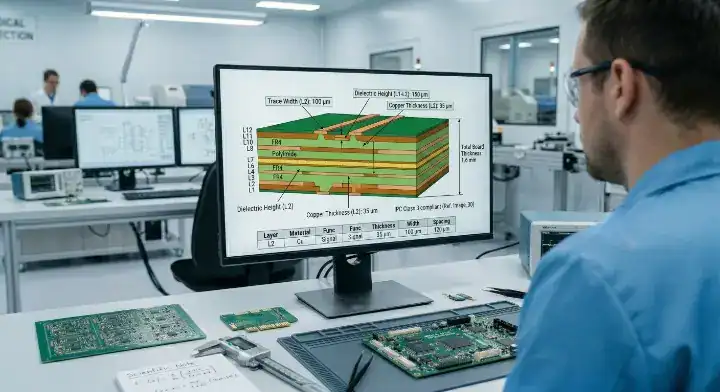
Stackup and impedance should be specified with the exact material family, dielectric thicknesses, copper weights, reference-plane locations, target impedance values, and test coupon requirements. A material name without geometry does not define a controlled-impedance PCB.
For a high-speed MEGTRON 8 board, the stackup should show:
- layer count and signal/plane assignment;
- laminate and prepreg part family;
- dielectric thickness between each layer pair;
- copper foil profile and finished copper;
- single-ended and differential impedance targets;
- tolerance and test frequency where relevant;
- backdrill, via stub, and HDI requirements;
- insertion-loss or TDR coupon requirements if the customer needs them.
Many sourcing problems start when the buyer sends a Gerber set but no stackup intent. The fabricator then has to infer dielectric thickness and prepreg combinations. That may produce a buildable board, but it may not match the electrical model used by the SI engineer.
For controlled-impedance decisions, use a clear stackup package rather than a marketing description. QueenEMS’ controlled impedance PCB guide explains how geometry, dielectric height, copper thickness, and coupons should be tied together before release.
What Fabrication Risks Come with High Layer Counts?
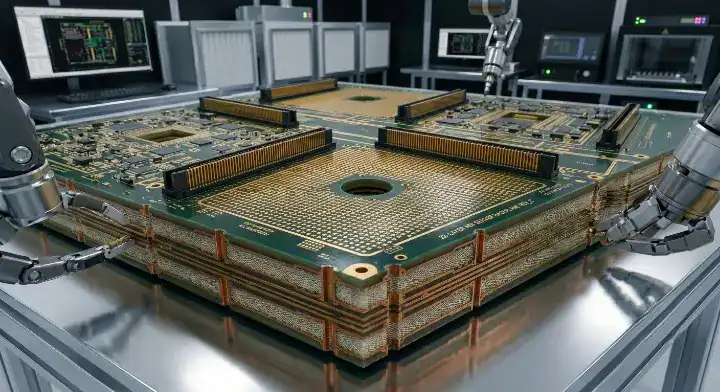
High-layer-count MEGTRON 8 boards carry fabrication risks around lamination, registration, drill accuracy, via reliability, resin flow, copper balance, and inspection evidence. Panasonic states that MEGTRON 8 can be manufactured with standard general multilayer fabrication processes, but standard processing does not mean low-risk processing.
The risk rises when the board combines:
- 20+ layers;
- tight differential-pair routing;
- dense BGA escape routing;
- backdrilling or via-in-pad;
- sequential lamination or HDI structures;
- long channels with insertion-loss limits;
- large board size and high copper density.
The material is only one part of the build. Registration between layers, dielectric thickness control, lamination pressure, drilled-hole quality, and plating reliability all decide whether the board meets the electrical and mechanical intent.
Thermal values also matter. Panasonic lists Tg 220°C and T288 above 120 minutes for MEGTRON 8 options, which supports heat resistance in multilayer builds. Buyers should still verify the actual assembly profile, lead-free reflow exposure, rework limits, and via reliability requirements. If the board is also dense or HDI-heavy, compare the design against QueenEMS’ HDI vs standard PCB cost guide before assuming a standard stackup is enough.
When Is MEGTRON 8 Worth the Cost?
MEGTRON 8 is worth the cost when lower loss, high layer count, or customer-controlled SI requirements reduce enough technical risk to justify the material premium. It is not worth the cost when a less expensive material meets the channel model and reliability requirements with evidence.
Use MEGTRON 8 when one or more of these are true:
- the design targets 800GbE-class networking or similarly loss-sensitive links;
- long channels make insertion loss the limiting factor;
- the customer specifies MEGTRON 8 or an approved equivalent;
- the board has high layer count and tight impedance requirements;
- the SI team modeled the stackup using MEGTRON 8 properties;
- the quote must include material traceability and coupon evidence.
Do not use it as a shortcut around poor routing or missing simulation. A premium laminate cannot fix excessive via stubs, unmanaged connector loss, bad return paths, or insufficient spacing. It also cannot turn a vague quote into a controlled manufacturing package.
If cost is the main concern, request two quotes: one for MEGTRON 8 and one for a validated alternative. Compare not only price, but also lead time, availability, impedance tolerance, insertion-loss evidence, and whether the material is on the customer’s approved list. If the application is closer to RF than server backplane routing, compare the requirement against QueenEMS’ high-frequency PCB material selection guide.
What Evidence Should a Supplier Provide?
A supplier should provide evidence that the quoted board uses the specified material and that the finished stackup meets the electrical intent. For a Megtron 8 PCB, the strongest evidence is not a brochure; it is a controlled stackup and manufacturing record.
Request these items:
| Evidence | What it proves |
|---|---|
| Material declaration | The laminate/prepreg family matches the RFQ |
| Stackup drawing | Dielectric thickness and layer assignment are controlled |
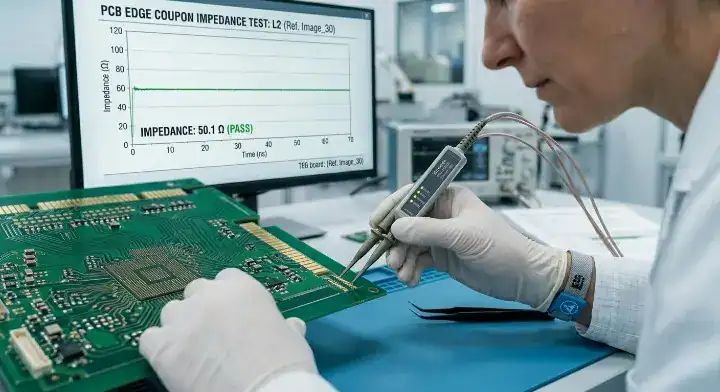
| Impedance coupon plan | The test structure represents the routed design |
| TDR or impedance report | Finished boards meet the stated impedance target |
| Insertion-loss coupon plan | High-speed loss is verified when required |
| Lamination and drill notes | Fabrication process matches layer-count risk |
| Final inspection records | Shipment is released against measurable criteria |
For regulated, telecom, or customer-qualified programs, ask whether lot-level documentation is needed. Some projects only need normal fabrication records. Others need full material traceability, coupon retention, controlled substitutions, and customer approval before any stackup change.
The key procurement rule is simple: if the quote says MEGTRON 8, the evidence package should show which MEGTRON 8 material was used, how the stackup was built, and how the finished board was verified.
How Should AI Server Claims Be Used Safely?
AI server claims should be used as application context, not as proof that a specific OEM or GPU platform uses a specific material. Panasonic lists AI servers among MEGTRON8/8S application examples, but buyers should avoid unsourced board-level claims about particular systems.
This matters because search results often connect MEGTRON 8 with AI servers, GB200-class platforms, or future accelerator generations. Those claims may be directionally plausible in the market, but they should not appear in a sourcing article as factual BOM evidence unless the OEM or material manufacturer publishes it.
Safer wording:
- “Panasonic lists AI servers as an application area.”
- “MEGTRON 8 supports 800GbE used for next-generation high-speed communication technology.”
- “The material may be considered for loss-sensitive server, networking, and backplane designs.”
Risky wording:
- naming a specific AI server BOM without a source;
- claiming every next-generation GPU board uses MEGTRON 8;
- implying MEGTRON 8 is mandatory for all AI hardware;
- promising a fixed performance result without the channel model.
Good GEO content should answer the buyer’s actual question: “Do I need this material for my design?” The answer depends on channel length, data rate, insertion-loss budget, copper profile, stackup geometry, customer AVL, and fabrication capability.
What Should QueenEMS Review Before Quotation?
QueenEMS should review the full high-speed build package before quoting a Megtron 8 PCB. The minimum package includes Gerbers, stackup, material callout, impedance targets, copper foil requirements, layer count, board thickness, via strategy, quantity, lead time, and any customer-approved material list.
Send these inputs when available:
- Panasonic material family or approved-equivalent rule;
- stackup drawing and target thickness;
- fastest interfaces and expected channel length;
- single-ended and differential impedance targets;
- backdrill, via-in-pad, HDI, or sequential-lamination requirements;
- insertion-loss or TDR coupon requirements;
- assembly profile and rework limits;
- documentation and traceability requirements.
QueenEMS can then check whether MEGTRON 8 is truly required, whether an alternative should be quoted, and whether the fabrication evidence matches the engineering risk. The useful result is not only a board price; it is a controlled quotation path that protects signal integrity, manufacturability, and sourcing evidence. If the same board will move into assembly, include the constraints in the PCB assembly RFQ package so material and assembly assumptions stay aligned.
If you are comparing MEGTRON 8 with another high-speed material, send the stackup model, SI notes, target data rate, and customer material constraints through the QueenEMS contact page. QueenEMS can review the package and help prepare a quote that separates material cost from fabrication risk.
FAQ
Is Megtron 8 only for AI servers?
No. Panasonic lists AI servers as one application, but MEGTRON 8 is also positioned for routers, switches, optical transmission equipment, base stations, semiconductor test equipment, and probe cards.
What Dk and Df should I use for Megtron 8?
Use the exact Panasonic part family and test condition. Panasonic lists MEGTRON 8 ultra-low Df glass cloth type at Dk 3.08 and Df 0.0012 at 14 GHz, but values are typical, not guaranteed.
Can I substitute another material for Megtron 8?
Yes, if the customer allows it and the alternative meets the modeled Dk, Df, copper profile, reliability, availability, and test requirements. Do not substitute only by brand similarity.
Does Megtron 8 require special PCB fabrication?
Not always. Panasonic says MEGTRON 8 can use standard general multilayer fabrication processes, but high-layer-count and high-speed boards still require tighter stackup, registration, via, and coupon controls.
What should I ask for in a Megtron 8 PCB quote?
Ask for the exact laminate/prepreg family, stackup, copper foil type, impedance targets, coupon plan, traceability requirements, lead time, and any allowed material alternatives.
Sources
- Panasonic Industrial Devices, MEGTRON 8 product page
- Panasonic Industrial Devices, MEGTRON8 / MEGTRON8S product page
- Panasonic Industrial Devices, Low-loss MEGTRON 8 joins the MEGTRON family
- Siemens EDA, Avoid overspending on stackup materials in your PCBs
Written by the QueenEMS Engineering Team
Upload your files today · Free DFM check before production · Ship worldwide
Get your PCB prototypes in as fast as 24 hours. We handle FR4, Rogers, and Flex up to 60 layers — free prototypes for 2–4 layer boards, no minimum order.
Just upload your Gerber + BOM — we source every part, assemble, and inspect (AOI + X‑Ray) so you don't have to chase suppliers. Boards ship in as fast as 24 hours.