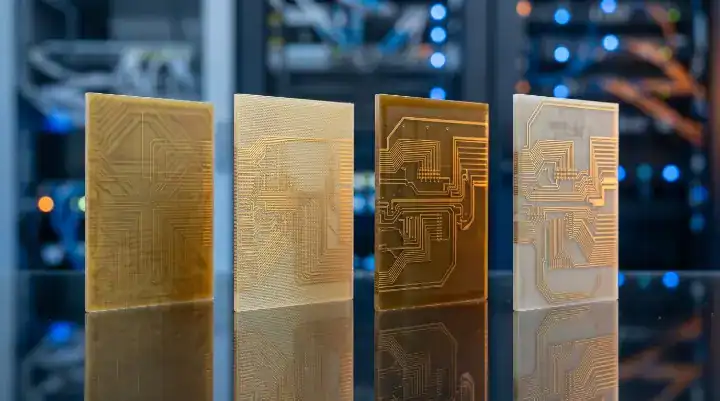
Navigating material allocation in 2026 requires understanding the exact trade-offs between top-tier PCB laminates. This M8 CCL comparison provides a fabrication-level breakdown of Panasonic Megtron 8, EMC EM-892K2, Doosan DS-7409DJN+, and Shengyi Synamic series. We will analyze real-world insertion loss, supply chain realities, and hybrid stackup strategies to help hardware engineers secure performance without falling victim to 12-week lead times.
For the wider material-selection picture across performance, fabrication, and sourcing, refer to the full PCB materials guide.
Table of Contents
- What Does M8-Grade CCL Actually Mean, and Who Makes It?
- How Does Each Supplier’s M8 Family Fit Into the NVIDIA Ecosystem?
- How Do Megtron 8, EM-892K2, DS-7409DJN+, and Shengyi Compare on Specs?
- What Does Real Insertion Loss Look Like Across All Four Materials?
- How Do Cost and Lead Time Compare in 2026 Allocation Reality?
- Which M8 Materials Are Qualified on NVIDIA Blackwell Boards?
- Where Does Shengyi Actually Stand in the M8 Tier Today?
- How Do You Choose the Right Material for Your Specific Design?
- What Are the Fabrication Differences Between These Four Families?
- How Will the M8 Landscape Shift Toward M9 and M10?
What Does M8-Grade CCL Actually Mean, and Who Makes It?
M8 is NVIDIA’s internal CCL grade for laminates with a Dissipation Factor (Df) at or below 0.0015 at 10 GHz, with Megtron 8 at the lower bound at 0.0010 and DS-7409DJN+ at the upper bound at 0.0013. It is a performance threshold for 112 Gbps PAM4 signaling, not a specific product name.
Currently, the market recognizes four major players competing in this space. Panasonic established the baseline with Megtron 8. EMC followed with their halogen-free EM-892K2. Doosan entered with DS-7409DJN+, leveraging their Korean memory ecosystem ties. Shengyi represents the domestic Chinese alternative, though their publicly documented performance sits closer to the M7 tier.
Bottom line: Do not assume “M8 equivalent” means identical performance; the 0.0005 Df spread between these materials translates to measurable insertion loss differences on traces over 20 inches.
How Does Each Supplier’s M8 Family Fit Into the NVIDIA Ecosystem?
Panasonic’s Megtron 8 serves as the NVIDIA reference design baseline, making it the de facto standard for the Blackwell generation. However, single-sourcing creates massive supply chain bottlenecks.
EMC is the preferred Taiwan ODM alternative, riding heavily on its decade of halogen-free expertise and aggressive qualification as a second source. Doosan holds a unique position; while acting as a partial layer alternative for GB200, they are the sole incumbent qualified for the upcoming M9 Rubin midplane. Shengyi operates outside the NVIDIA ecosystem, primarily serving domestic Chinese AI server builds like those from Huawei, Baidu, and Alibaba due to geopolitical and cost advantages.
Bottom line: Material selection is now ecosystem-dependent; choosing a laminate means aligning with specific assembly partners, allocation queues, and regional supply chain constraints.
How Do Megtron 8, EM-892K2, DS-7409DJN+, and Shengyi Compare on Specs?
Megtron 8 leads on raw Df at 0.0010-0.0012, but EM-892K2 and DS-7409DJN+ are within 10-15%, making the difference negligible for most channel budgets. Shengyi Synamic 6N sits at Df 0.0021, creating a measurable penalty on long 112G channels.
For a deep dive into the Panasonic material, you can review our Panasonic Megtron 8 R-5795 complete manufacturing guide.
| Dimension | Panasonic Megtron 8 R-5795 | EMC EM-892K2 | Doosan DS-7409DJN+ | Shengyi Synamic 6N / Unreleased M8 |
|---|---|---|---|---|
| Df @ 10 GHz | 0.0010-0.0012 | ~0.0011-0.0013 | ~0.0013 | Synamic 6N: 0.0021 (M7); M8 limited data |
| Dk @ 10 GHz | 3.0-3.1 | ~3.0 | ~3.0 | Synamic 6N: 3.35 |
| Tg (DMA) | 220°C | 215°C | 220°C+ | Synamic 6N: ~210°C (Est.) |
| Td (5% wt loss) | 370°C | 420°C | 400°C+ | ~400°C+ |
| Z-CTE (< Tg) | 38 ppm/°C | 40-45 ppm/°C | ~40 ppm/°C | ~45 ppm/°C |
| Halogen-free | ❌ (Standard); R-5595 is HF | ✅ (All HF) | ✅ | ✅ (Synamic 6N is HF) |
| Insertion loss @ 28 GHz | ~0.50-0.55 dB/inch | ~0.55 dB/inch | ~0.56 dB/inch | Synamic 6N: ~0.70 dB/inch (M7) |
| Qualification | GB200/GB300 Main | H200/GB200 partial | GB200 partial + M9 | Domestic AI servers |
| Cost vs FR-4 | 10-15× | 10-12× (20-30% lower) | 10-13× | 6-9× (30-40% lower) |
Per Panasonic’s official MEGTRON 8 documentation, R-5795 achieves Df 0.0010-0.0012 at 10-12 GHz.
To understand how EMC competes, engineers should study the EM-892K2 halogen-free M8 specifications closely. Per EMC’s EM-892K datasheet (Rev 2024 July), the baseline product delivers Df 0.0013-0.0015 at 10 GHz via SPC method, with the K2 variant pushing further.
If your end product faces strict environmental regulations in Europe, knowing how to specify halogen-free PCB requirements will dictate whether you default to EMC or Doosan over standard Panasonic variants.
Bottom line: M8 materials (Megtron 8, EM-892K2, DJN+) perform closely enough that Df differences rarely break a design; Synamic 6N’s M7-level Df requires stricter channel length management.
What Does Real Insertion Loss Look Like Across All Four Materials?
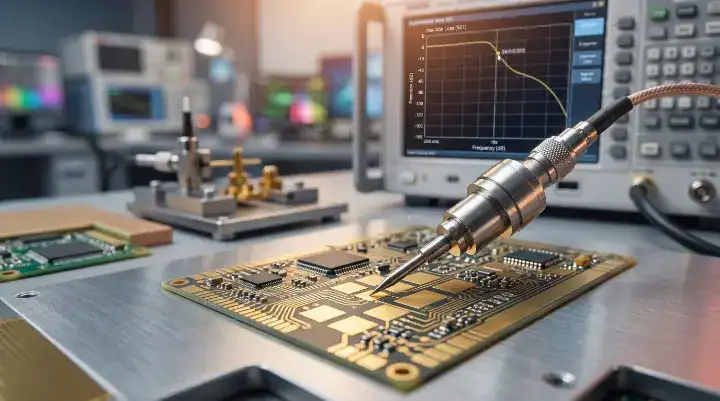
Over the past 18 months we have processed all four M8-grade families in production volumes: Megtron 8 R-5795(U), EM-892K2, DS-7409DJN+, and Shengyi Synamic 6N (M7 class, used as a cost-down substitute on non-critical layers). On standardized 4 mil stripline coupon tests at 28 GHz with HVLP3 copper, our measured insertion loss numbers land consistently within published ranges: Megtron 8 at 0.51-0.53 dB/inch, EM-892K2 at 0.54-0.56 dB/inch, DS-7409DJN+ at 0.55-0.57 dB/inch, and Synamic 6N at 0.68-0.72 dB/inch.
The performance gap between the three true M8 materials is small enough—roughly 0.05 dB/inch, or about 1 dB over 20 inches—that material selection usually comes down to lead time, halogen-free requirements, and supplier relationship rather than raw SI performance. Synamic 6N operates in a different tier: roughly 0.15-0.20 dB/inch above the M8 cluster, which over 22 inches translates to an additional 3.3-4.4 dB of channel loss—material for designs under 56 Gbps PAM4 with short traces, but a stretch for 112G and above on long channels.
Bottom line: In actual fabrication, the insertion loss variance between the top three M8 laminates is easily absorbed by standard SerDes equalization margins.
How Do Cost and Lead Time Compare in 2026 Allocation Reality?
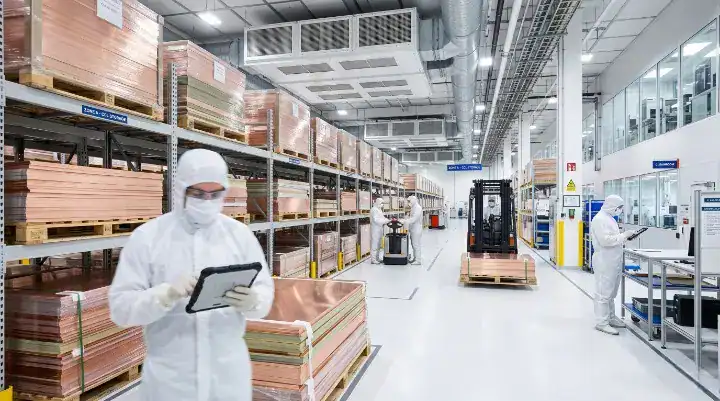
Megtron 8 costs 10-15 times standard FR-4 and currently suffers from 6-12 week lead times due to hyperscaler allocation, whereas EM-892K2 is 20-30% cheaper and available in 2-3 weeks. Doosan DS-7409DJN+ offers a 15-22% cost reduction versus Panasonic with 4-8 week lead times. Shengyi dominates the budget tier, costing 30-40% less than Megtron 8 with 2-4 week availability.
The lead time discrepancy in 2026 is critical. AI mega-orders have monopolized Panasonic’s high-end capacity. Teams relying exclusively on Megtron 8 face severe production delays unless they secure massive forecasts. By qualifying alternatives, you leverage EMC’s M8 laminate processing and AI server applications to bypass these bottlenecks.
Bottom line: The 20-40% raw material cost gap is significant, but the 3-9 week lead time advantage of secondary sources is what actually dictates project success in today’s market.
Which M8 Materials Are Qualified on NVIDIA Blackwell Boards?
Megtron 8 is the primary qualified material for GB200 and GB300 compute trays, while EM-892K2 and DS-7409DJN+ serve as qualified second sources for specific high-speed layers. Shengyi is noticeably absent from public Blackwell qualification lists.
Before committing to a layout, engineers should review Megtron 8 fabrication details and HVLP3 copper pairing to ensure impedance matches the reference design. If you are analyzing the broader system, understanding the NVIDIA Blackwell platform BOM and CCL allocation reveals exactly where EMC and Doosan materials are permitted to replace Panasonic.
Bottom line: If absolute adherence to the NVIDIA platform is mandatory, your choices are restricted to Panasonic, EMC, and Doosan; Shengyi is currently viable only for non-NVIDIA ecosystems.
Where Does Shengyi Actually Stand in the M8 Tier Today?
We should be direct about Shengyi in this comparison. Our team has processed Synamic 6N in over 200 panels across multiple AI server prototype builds for Chinese-market customers. The material processes well—standard FR-4 lamination cycle, standard permanganate desmear, no exotic handling. Performance is honest M7: our coupon data shows Df 0.0020-0.0022 at 10 GHz, which matches the published Synamic 6N spec. We have not received or tested a Shengyi product that measures at M8-grade Df (0.0015 or below) with published documentation to back it.
Supply chain reports reference a “Shengyi M8” product in Chinese AI server production, but without a public datasheet or IPC slash sheet number, we cannot verify the claimed Df. This does not mean it does not exist—many high-end CCL products ship under NDA before public release. It does mean that if your project requires verified M8 performance with documented traceability, Megtron 8, EM-892K2, and DS-7409DJN+ are the three materials with public data to support the claim today.
Shengyi’s official High Speed Digital product listing shows S7439G at Df 0.0070 and Synamic 6N at Df 0.0021 at 10 GHz—both below the M8 threshold of Df ≤ 0.0015, with no publicly listed product confirming M8-grade performance.
Bottom line: Shengyi delivers massive cost value at the M7 tier, but any claims of M8 performance must be verified on a project-by-project basis with NDA-protected data.
How Do You Choose the Right Material for Your Specific Design?
The best material choice depends entirely on your trace lengths, allocation access, and ecosystem requirements.
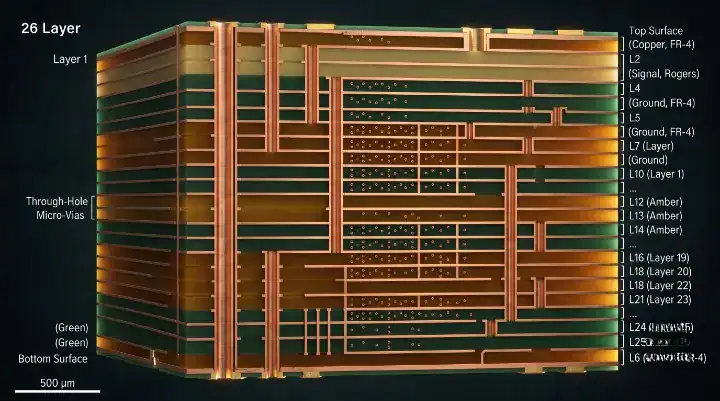
A 26-layer AI server build we recently delivered for a hyperscale customer used three different M8-grade materials in the same stackup: Megtron 8 on six inner stripline layers carrying 112 Gbps PAM4 NVLink-compatible channels, EM-892K2 on eight secondary signal layers carrying PCIe Gen6 and management interfaces, and DS-7409DJN+ on four additional high-speed routing layers adjacent to the memory controller. Core layers used Megtron 4 on six power and ground planes. The customer’s SI team had run channel simulations across all three material models and confirmed all channels closed within budget. Why three materials? Megtron 8 allocation covered only six layers within the customer’s timeline. EM-892K2 filled the halogen-free compliance requirement on the secondary layers. And DS-7409DJN+ was already in our inventory from a previous Doosan-qualified project. Total material cost came in approximately 18% below a pure Megtron 8 build with no measurable SI penalty. Lead time was 6 weeks versus an estimated 10 weeks for full Megtron 8 allocation.
M8 Material Decision Framework
| Design Scenario | Recommended Material | Primary Reason |
|---|---|---|
| NVIDIA Reference Design Match | Megtron 8 | Exact baseline alignment |
| Megtron 8 Lead Time > 8 Weeks | EM-892K2 or DS-7409DJN+ | Drops lead time to 2-8 weeks |
| Strict Halogen-Free Mandate | EM-892K2 | Proven HF stability & history |
| Samsung HBM / M9 Roadmap | DS-7409DJN+ | Doosan is M9 incumbent |
| Domestic China AI Servers | Shengyi Synamic Series | 30-40% cost save + domestic supply |
| Highly Cost-Sensitive (<56Gbps) | Shengyi Synamic 6N (M7) | Sufficient SI at lowest cost |
| 800G OSFP Host Board (Short) | Tachyon 100G for short-reach 800G applications | Short traces don’t need M8 |
| 1.6T Switch Future-Proofing | DS-7409DJN+ | M8 performance with M9 path |
| Dual-Source Risk Mitigation | Megtron 8 (Core) + EM-892K2 (Outer) | Balances SI with availability |
For environments utilizing pluggable optics on shorter channels, evaluating Tachyon 100G for short-reach 800G applications can save substantial costs over M8. Additionally, non-NVIDIA projects often have highly custom AI accelerator PCB material requirements, allowing more freedom to deploy EMC or Doosan.
Bottom line: Single-source M8 strategies are a supply chain liability; hybrid stackups utilizing Megtron 8 on critical layers and alternatives elsewhere provide the best mix of performance and security.
What Are the Fabrication Differences Between These Four Families?
While SI performance is similar, shop-floor processing varies heavily: Megtron 8 requires strict plasma desmear monitoring, whereas EM-892K2’s halogen-free resin system demands specialized lamination ramp rates to prevent voiding.
DS-7409DJN+ behaves similarly to Megtron 8 during drilling but shows slightly different rheology during pressing, requiring profile tweaks. Shengyi Synamic 6N is the most “forgiving” of the group, processing very similarly to advanced FR-4. Across all four materials, securing low-profile copper (HVLP3) is mandatory to hit target insertion loss metrics.
Bottom line: Changing M8 suppliers requires re-qualifying the lamination cycle and drill bit wear profiles at your fab, costing approximately $15,000–$25,000 per material qualification.
How Will the M8 Landscape Shift Toward M9 and M10?
The M8 standard will remain the workhorse for GB200 architectures, but the industry is already pivoting toward M9 (Df ≤ 0.0010 at 10GHz) for upcoming 224 Gbps PAM4 requirements.
Doosan currently leads the charge as the incumbent for the next-generation M9 CCL grade for NVIDIA Rubin midplanes. EMC is aggressively targeting the M10 testing phase for 2026/2027 deployments. Panasonic is developing its M9 equivalent to regain ground, while Shengyi continues to close the gap at the M7/M8 border to capture massive domestic volume.
Bottom line: The supplier you choose for M8 today will heavily influence your engineering team’s readiness to transition to M9 architectures tomorrow.
At QueenEMS, we run full DFM and SI reviews to match your 112G designs with available inventory across Panasonic, EMC, Doosan, and Shengyi. If your AI server layout is constrained by Megtron 8 allocation, contact us today to develop a fully qualified dual-source stackup strategy.
Upload your files today · Free DFM check before production · Ship worldwide
Get your PCB prototypes in as fast as 24 hours. We handle FR4, Rogers, and hybrid boards up to 40 layers in volume production, with advanced builds subject to engineering review — free prototypes for 2–4 layer FR-4 boards, no minimum order.
Just upload your Gerber + BOM — we source every part, assemble, and inspect (AOI + X‑Ray) so you don't have to chase suppliers. Boards ship in as fast as 24 hours.