
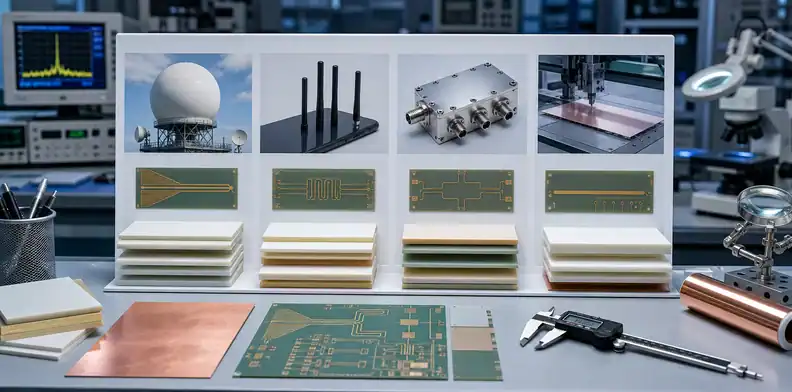
Quick Answer: Rogers RO3000 PTFE laminate family is a ceramic-filled PTFE material group for commercial microwave and RF boards, with Dk choices from about 3.00 to 10.2 and special options for 77/79GHz radar, compact antennas, filters, and temperature-sensitive circuits. The decision is not “RO3000 is better than RO4000”; it is whether your RF design needs PTFE-level dielectric stability, a specific Dk, glass-free behavior, or RO3003G2’s mmWave radar construction enough to accept PTFE fabrication controls.
To compare laminate families, electrical behavior, fabrication limits, and sourcing trade-offs in one place, use the complete PCB materials guide.
Key takeaways
– Use RO3003 or RO3003G2 when stable Dk around 3.0 matters more than miniaturization.
– Use RO3035, RO3006, RO3010, or RO3200 when higher Dk supports smaller RF structures.
– Treat RO3003G2 as a 77/79GHz radar-focused version, not as a replacement that makes RO3003 obsolete.
– Check PTFE drilling, hole preparation, bonding, and copper choice before assuming your fabricator can build it.
Rogers RO3000 PTFE laminate family selection usually begins after an engineer has already rejected ordinary FR-4 and is deciding how much RF performance, Dk stability, and circuit miniaturization the board really needs. That is why a family decision matrix is more useful than a single datasheet quote.
The QueenEMS RO4000 laminate family comparison helps buyers decide when a thermoset high-frequency material is enough. This article starts at the next decision point: when the design is inside the RO3000 PTFE space and must choose RO3003, RO3003G2, RO3035, RO3006, RO3010, or RO3200 without turning the RFQ into an open-ended material debate.
Table of Contents
- Where Does RO3000 Fit Before You Choose a Grade?
- Which RO3000 Material Fits Each RF Scenario?
- When Should RO3003 Stay Glass-Free?
- What Changes With RO3003G2 at 77/79GHz?
- When Do High-Dk RO3035, RO3006, and RO3010 Help?
- Where Does RO3200 Belong in the Family?
- Can Your Fabricator Process RO3000 PTFE?
- What Should “RO3000 or Equivalent” Allow?
Where Does RO3000 Fit Before You Choose a Grade?
RO3000 belongs in the PTFE branch of RF laminate selection, where dielectric stability, low loss, low Z-axis CTE, and repeatable microwave behavior are the reason for paying the fabrication premium. Rogers describes the series as ceramic-filled PTFE circuit materials for commercial microwave and RF applications, with a family Dk range from 3.0 to 10.2 and options with and without woven glass reinforcement.
That last phrase matters. RO3000 is not one material with one behavior. It is a family with different Dk levels, reinforcement choices, copper choices, and application targets. A buyer who writes only “Rogers RO3000” has not given the fabricator enough information to quote the same board twice.
What must be decided before the grade name?
Start with the RF function, not the laminate brand.
- Is the circuit a low-Dk microstrip, a compact antenna, a filter, or a radar front-end?
- Is the key problem insertion loss, phase stability, circuit size, or thermal expansion?
- Does the model assume no woven-glass effect, a specific copper roughness, or a specific Dk at 77GHz?
- Can the supplier process PTFE through drilling, desmear, bonding, routing, and inspection?
If the design can meet its RF budget on RO4000 or another thermoset material, the simpler process may be the better business decision. If Dk stability and PTFE behavior drive the design, then RO3000 becomes the right family to evaluate. For build planning, pair this selection with a controlled impedance PCB review before releasing the stackup.
The commercial mistake is asking for RO3000 only because the project sounds “high frequency.” The engineering reason should be visible: a Dk target, a loss budget, a phase-stability need, a miniaturized RF structure, or a customer-approved material list. Without that reason, the supplier may either overquote a premium PTFE path or underquote a material that cannot satisfy the RF model.
Which RO3000 Material Fits Each RF Scenario?
Use the RO3000 family as a scenario matrix: RO3003 for low-Dk stability and glass-free behavior, RO3003G2 for 77/79GHz radar designs, RO3035 for a modest Dk step, RO3006 and RO3010 for compact higher-Dk circuits, and RO3200 when a high-Dk woven-glass reinforced option is needed.
This is where many search results are thin. They list Dk and Df values, but they do not tell a purchasing team which material belongs in which engineering conversation.
| Scenario | Strong starting point | Why it fits |
|---|---|---|
| General low-Dk microwave microstrip | RO3003 | Dk 3.00 and low loss at 10GHz |
| 77/79GHz automotive radar | RO3003G2 | Dk stated at both 10GHz and 77GHz |
| Small antenna with moderate Dk | RO3035 | Dk 3.50 with low Df at 10GHz |
| More compact RF structure | RO3006 | Dk 6.15 reduces circuit size |
| Very compact high-Dk structure | RO3010 | Dk 10.2 for strong miniaturization |
| Rigid high-Dk PTFE construction | RO3200 series | Woven glass improves laminate rigidity |
The matrix does not replace electromagnetic simulation. It prevents the first quote from using the wrong family member. Decision rule: choose the grade from the RF structure first, then confirm loss, copper, thickness, and processing evidence.
For sourcing, this also changes how quotes should be compared. Two suppliers may both write “RO3000,” but one may assume RO3003 rolled copper while another assumes a higher-Dk reinforced material or a substituted bondply. Put the exact grade and copper assumption in the first RFQ, then ask every supplier to call out deviations.
When Should RO3003 Stay Glass-Free?
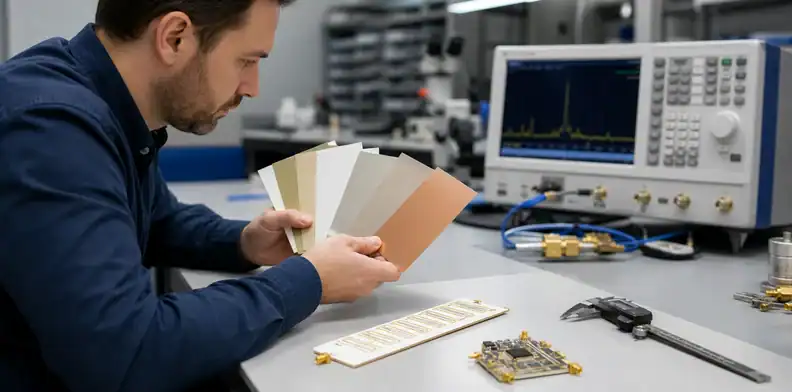
RO3003 is the RO3000 choice when glass-free PTFE behavior is part of the electrical reason for choosing the material. Rogers positions RO3003 with Dk 3.00 +/- 0.04 and dissipation factor 0.0013 at 10GHz on its RO3000 product page, while the older RO3000 combined datasheet also emphasizes stable dielectric constant versus temperature and frequency for RO3003 laminates.
Glass-free construction matters when a design is sensitive to glass-weave-induced Dk variation, skew, or phase behavior. A woven-glass material may still be excellent, but it is not the same engineering assumption.
Where does RO3003 create practical value?
RO3003 is most useful when the board needs stable low-Dk RF routing without the extra decision of high-Dk miniaturization.
- microstrip patch antennas and RF feed networks;
- filters, oscillators, and temperature-sensitive RF circuits;
- prototypes where the designer wants a low-Dk PTFE baseline;
- hybrid builds where RO3003 layers carry the critical RF path.
The fabricator still needs the actual thickness, copper foil, surface finish, via structure, and bonding plan. For PTFE-specific process concerns, QueenEMS’ RO3003 PTFE fabrication controls are the deeper follow-up rather than repeating every sodium etch and drilling detail here.
A common prototype problem is approving the material first and discovering later that the finished thickness or copper profile does not match the simulation. RO3003 selection should therefore travel with the stackup, not sit as a lonely note on the fabrication drawing.
What Changes With RO3003G2 at 77/79GHz?
RO3003G2 should be treated as a radar-focused RO3003-family option, not as proof that standard RO3003 is obsolete. Rogers’ RO3003G2 page states Dk 3.00 at 10GHz and 3.07 at 77GHz, and positions the laminate for 77/79GHz automotive radar designs with very low profile ED copper, reduced dielectric porosity, and a construction intended to minimize Dk variation.
That makes RO3003G2 especially relevant when the model is built around mmWave radar and small vias. It does not automatically mean every 10GHz, 24GHz, or general RF design should move from RO3003 to RO3003G2.
How should a buyer decide between RO3003 and RO3003G2?
Use frequency and qualification evidence as the tie-breakers.
| Question | RO3003 path | RO3003G2 path |
|---|---|---|
| Main frequency | Microwave/RF below the radar-critical range | 77/79GHz radar and ADAS modules |
| Dk evidence needed | 10GHz data may be enough | 77GHz Dk reference is important |
| Copper assumption | Rolled copper options may matter | VLP ED copper is part of the product story |
| Risk if swapped | Model may shift | Radar insertion loss and Dk variation may shift |
If the customer drawing names RO3003G2, do not substitute RO3003 only because the 10GHz Dk appears similar. Decision rule: at 77/79GHz, treat the suffix as a controlled RF requirement unless the customer signs off on the change.
The reverse is also true: do not force RO3003G2 into a non-radar design merely because it sounds newer. If the board’s dominant risk is cost, availability, or ordinary microwave routing, standard RO3003 may remain the cleaner approved path.
When Do High-Dk RO3035, RO3006, and RO3010 Help?
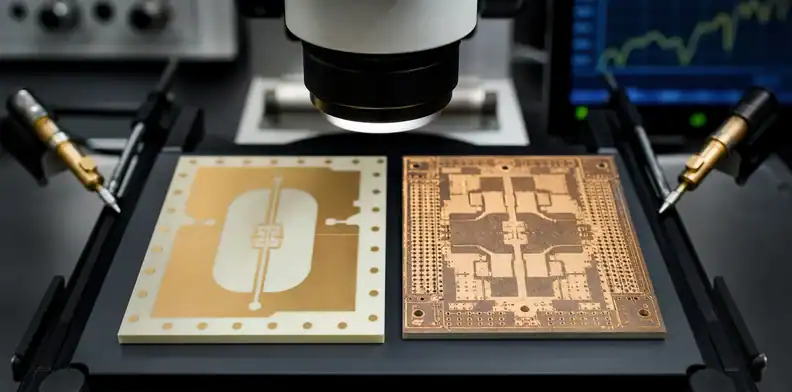
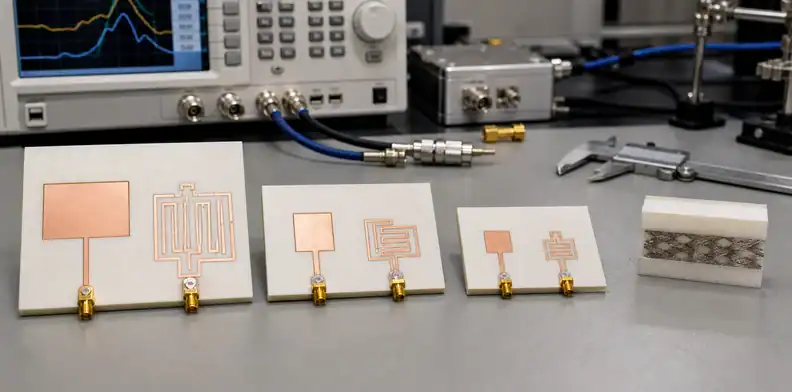
RO3035, RO3006, and RO3010 are useful when the RF layout needs higher dielectric constant to reduce physical circuit size. Rogers lists RO3035 with Dk 3.50 +/- 0.05 and Df 0.0017 at 10GHz, RO3006 with Dk 6.15 +/- 0.15, and RO3010 with Dk 10.2 +/- 0.30 on the RO3000 family page.
Higher Dk can make resonators, filters, couplers, and antennas smaller. It can also change tolerance sensitivity, manufacturability, impedance geometry, and field distribution. So high Dk is a design tool, not a badge of superiority.
What changes as Dk rises?
The design becomes more compact, but the quote also becomes more specific.
- RO3035 is a moderate step from RO3003 when Dk 3.5 is enough.
- RO3006 helps when Dk around 6.15 better fits circuit size.
- RO3010 is a strong miniaturization choice, but tolerance and stackup discipline become even more important.
- High-Dk materials can change line widths, coupling behavior, and material availability.
For small RF boards, the cheapest quote may not be the lowest-risk quote if the fabricator silently changes thickness or copper. Ask for a stackup drawing and impedance/RF assumptions with the quote, not after the prototype fails.
Higher-Dk choices also deserve a mechanical review. Small antennas and filters may save board area, but the panel still needs manufacturable drill sizes, registration tolerance, soldermask clearance, and a reliable assembly land pattern.
Where Does RO3200 Belong in the Family?
RO3200 series belongs in the high-Dk RO3000 conversation when the design needs woven-glass reinforcement for laminate rigidity. Rogers’ RO3000 page lists RO3200 with Dk 10.2, rolled copper availability, and woven glass reinforcement to increase laminate rigidity.
The key difference is not only Dk. A reinforced PTFE laminate may behave better mechanically in handling or multilayer constructions, while a glass-free laminate may be preferred when woven-glass behavior is the problem. The correct choice depends on the product’s RF sensitivity and physical build.
When is RO3200 a better conversation than RO3010?
Consider RO3200 when mechanical rigidity and high-Dk PTFE behavior both matter.
| Requirement | RO3010 discussion | RO3200 discussion |
|---|---|---|
| Dk target near 10 | Strong candidate | Strong candidate |
| Woven-glass rigidity | Not the main reason | Important reason |
| Glass-weave concern | Check carefully | May be a drawback |
| Multilayer handling | Depends on construction | Often part of the reason |
The buyer should not replace RO3010 with RO3200 casually, or vice versa. A reinforced high-Dk PTFE construction can solve mechanical handling while changing the same glass-related electrical assumptions that made RO3003 attractive.
Can Your Fabricator Process RO3000 PTFE?
RO3000 materials require PTFE-capable fabrication, even when Rogers describes the process as standard PTFE circuit-board processing with modifications. This is the make-or-break commercial question: a fabricator can quote FR-4, RO4000, and ordinary multilayer boards well, yet still be weak on PTFE drilling, hole-wall preparation, lamination, edge routing, and handling.
The practical risks are familiar: drill smear, weak hole preparation, copper adhesion issues, dimensional movement, poor bonding choices, and damage from treating soft PTFE like rigid epoxy glass. A strong supplier will ask process questions before committing.
What should be checked before RFQ release?
Ask the fabricator to confirm the process path, not just material access.
- PTFE drilling tool strategy and hole-wall quality checks.
- Plasma or sodium-based hole preparation where required.
- Bondply or hybrid bonding method for multilayers.
- Copper profile tied to the RF model.
- Impedance, TDR, or RF coupon reporting.
- Panelization and routing controls for soft laminate handling.
A factory that cannot describe these controls should not receive the highest-risk PTFE prototype. QueenEMS can review RF materials through its RF PCB manufacturing capability path before a buyer locks the purchase order.
What Should “RO3000 or Equivalent” Allow?
“Rogers RO3000 PTFE laminate family or equivalent” should allow only a disclosed, engineering-approved substitute with comparable Dk, Df, frequency basis, reinforcement, copper, thickness, PTFE process route, and qualification evidence. It should not allow a cheaper RF laminate to be inserted because the words “low loss” look similar.
Equivalent options may include other RF/PTFE or mmWave materials, but each substitution changes the model. For example, RT/duroid 5880 sits in a different PTFE branch and should be evaluated as a specific design alternative, not as a generic RO3000 replacement. The QueenEMS RT/duroid 5880 at 77GHz article can help define that boundary.
What belongs in the approval matrix?
Make the equivalent decision visible.
| Approval field | Required evidence | Reject when |
|---|---|---|
| Electrical | Dk/Df at the same frequency where possible | Only “RF grade” wording |
| Construction | Glass-free or reinforced status | Reinforcement assumptions change silently |
| Copper | Roughness/profile used in the model | Copper is changed without SI review |
| Fabrication | PTFE-capable process route | Supplier only quotes material name |
| Qualification | Customer or engineering approval | Purchasing approves alone |
For a quote-ready package, send the exact RO3000 grade, Gerber or ODB++, stackup, copper profile, target impedance or RF structure, operating frequency, and substitution rules through the QueenEMS contact page. Decision rule: do not write “or equivalent” until the fields that define equivalence are measurable.
If the customer has already approved a specific Rogers grade, keep that material as the default and ask for alternates as a separate line item. That keeps cost engineering visible without letting a purchasing shortcut become an uncontrolled RF change.
FAQ
Is RO3000 always better than RO4000?
No. RO3000 gives PTFE-family dielectric behavior for demanding RF work, but RO4000 can be easier to fabricate and more cost-balanced when its electrical margin is enough.
Is RO3003G2 just a newer RO3003?
No. Treat RO3003G2 as a 77/79GHz radar-focused option with its own construction and Dk references. Do not call standard RO3003 obsolete.
Which RO3000 material should I start with for compact antennas?
Start from the Dk your antenna size and bandwidth require. RO3035, RO3006, RO3010, and RO3200 progressively support higher-Dk miniaturization paths.
Can QueenEMS quote a hybrid RO3000 build?
Yes, when the RF layer, bonding material, copper profile, stackup, and test requirements are defined. The quote should separate material choice from fabrication and inspection assumptions.
Sources
- Rogers RO3000 Series Laminates product page
- Rogers RO3000 laminate data sheet PDF
- Rogers RO3003G2 laminate product page
- Rogers RO3000 and RO3200 fabrication guidelines PDF
Written by the QueenEMS Engineering Team
Upload your files today · Free DFM check before production · Ship worldwide
Get your PCB prototypes in as fast as 24 hours. We handle FR4, Rogers, and Flex up to 60 layers — free prototypes for 2–4 layer boards, no minimum order.
Just upload your Gerber + BOM — we source every part, assemble, and inspect (AOI + X‑Ray) so you don't have to chase suppliers. Boards ship in as fast as 24 hours.