
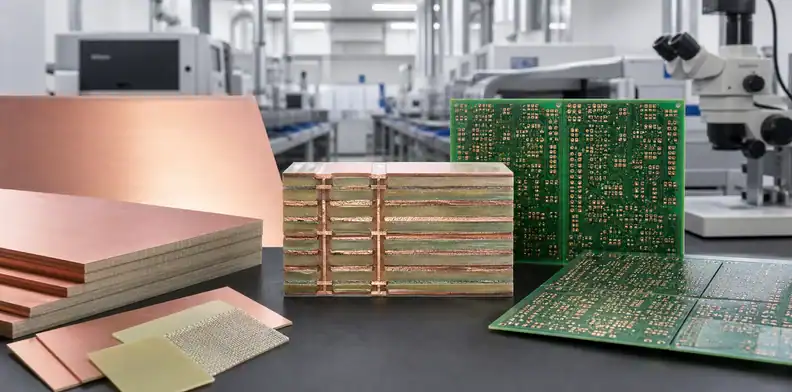
Quick Answer: KB-6160 is a Kingboard FR-4 laminate family with construction-specific electrical data published for cores from 0.076 mm to 1.499 mm. The official March 2022 line-up reports 1 GHz Dk values from 4.0 to 4.5 and Df values from 0.013 to 0.018 for the listed cores, so designers should qualify the exact glass style, resin content, thickness, factory, and current thermal datasheet rather than treating one catalog number as a complete stack-up.
Key takeaways: – Use the Kingboard line-up as construction data, not as one universal Dk/Df value. – Ask for current Tg, Td, T260/T288, expansion, UL, and halogen evidence for the quoted grade and site. – Keep laminate identity, PCB stack-up, assembly profile, and substitution rules in one release package. – Choose a higher-temperature or lower-loss material only when a measured requirement calls for it.
Official source: Read the Kingboard KB-6160 core/prepreg electrical line-up (PDF). Use the construction-specific values for screening, then confirm the current grade, site, thermal datasheet, and approved stack-up with the quoting fabricator.
A low-cost FR-4 quote can become expensive when the material callout says only “KB-6160 or equivalent.” That wording leaves the glass style, resin content, pressed thickness, dielectric model, factory, and approval path open. The QueenEMS FR-4 material and Tg selection guide explains why a family name or nominal Tg cannot release a PCB by itself.
For the wider material-selection picture across performance, fabrication, and sourcing, refer to the full PCB materials guide.
Table of Contents
- What Is KB-6160 and What Does Kingboard Publish?
- Which Electrical Values Matter for a Stack-Up?
- Where Does This Grade Fit in a Material Strategy?
- How Does Kingboard’s Vertical Supply Chain Affect Risk?
- How Does KB-6160 Compare with Other Standard FR-4?
- When Should You Move to a Higher-Temperature Grade?
- Which PCB Applications Are a Sensible Starting Point?
- How Should a Fabricator Qualify the Construction?
- What Should Procurement Put in the RFQ?
- How Do You Release and Control the Material?
What Is KB-6160 and What Does Kingboard Publish?
KB-6160 is a Kingboard copper-clad FR-4 laminate listed with companion KB-6060 prepreg data. Kingboard’s official line-up, version 1.1 dated March 9, 2022, covers 20 core constructions from 3 mil to 59 mil and several 1080, 3313, 2116, 1506, and 7628 prepregs.
Which facts are directly documented?
The line-up publishes nominal thickness, glass lay-up, Dk, and Df from 1 GHz through 10 GHz. Kingboard also publishes a current VDE certificate naming KB-6160 and manufacturing sites, but it does not establish every performance value needed for a PCB.
- core thickness range in the line-up: 0.076-1.499 mm;
- listed core Dk at 1 GHz: 4.0-4.5;
- listed core Df at 1 GHz: 0.013-0.018;
- separate prepreg values by glass style, resin content, and pressed thickness;
- a 2025 VDE certificate naming KB-6160 as FR-4.
What remains a supplier confirmation?
The 2022 electrical line-up does not provide a complete thermal property table. Ask the quoting fabricator or authorized source for the current controlled technical datasheet, applicable suffix, manufacturing site, Tg method, Td definition, T260/T288, z-axis expansion, flammability file, and environmental declarations.
| Evidence | What it supports | What it does not prove |
|---|---|---|
| 2022 electrical line-up | Construction-specific Dk/Df screening | Current thermal limits or stock |
| 2025 VDE certificate | Listed FR-4 type and named sites | Project approval or every thickness |
| Supplier stack-up | Proposed cores and prepregs | Finished-board performance until verified |
Key Takeaway — Bottom line: Treat KB-6160 as a material family that becomes usable only after the exact construction and current evidence are named.
Which Electrical Values Matter for a Stack-Up?
The useful KB-6160 electrical values are the values for the chosen construction, not a single “Dk 4.4” label. In the official core table, 1 GHz Dk spans 4.0-4.5 and Df spans 0.013-0.018; frequency and glass lay-up change those numbers.
Why does construction change Dk and Df?
Dk is the relative permittivity used to model field propagation in a dielectric. Glass and resin have different electrical behavior, which means glass style, resin content, cured thickness, and frequency influence the effective value used by the fabricator’s impedance solver.
For example, the listed 3 mil 1080 core has 1 GHz Dk/Df of 4.0/0.018, while the 7.5 mil 7628 core has 4.4/0.013. Neither construction is “more correct”; they are different physical builds within the same published family.
Which values belong on the stack-up review?
- glass style and ply count for each dielectric;
- resin content and target pressed thickness for every prepreg;
- design Dk at the solver frequency and the source of that value;
- Df used for loss estimation, including frequency and test method;
- copper type and roughness model for controlled-impedance or loss work.
| Construction example | 1 GHz Dk | 1 GHz Df | Review point |
|---|---|---|---|
| 3.0 mil, one 1080 ply | 4.0 | 0.018 | Thin dielectric, higher listed loss |
| 5.0 mil, one 2116 ply | 4.2 | 0.015 | Confirm available resin content |
| 7.5 mil, one 7628 ply | 4.4 | 0.013 | Coarser glass can affect local fields |
The table is screening data from one vendor line-up, not a finished-board guarantee. Coupon results should close the loop between the design model and the pressed board.
Key Takeaway — Bottom line: Use the construction row that matches the proposed stack-up, then verify it with the fabricator’s impedance model and coupon plan.
Where Does This Grade Fit in a Material Strategy?
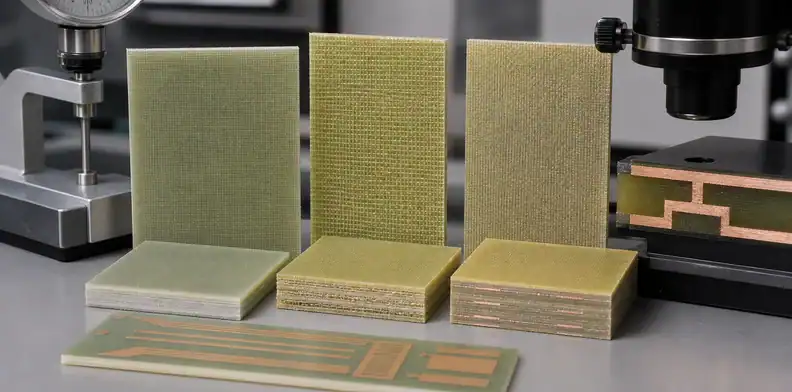
KB-6160 fits the standard FR-4 part of a material strategy when the board’s thermal, electrical, mechanical, compliance, and supply requirements can be met by a currently documented construction. It should not be placed in a product ladder by model number alone because Kingboard’s suffixes and companion prepregs need current supplier interpretation.
How should you classify the requirement first?
Start from board stress rather than brand preference. A simple controller, a thick high-layer-count board, and a long high-speed channel may all be called FR-4, but they do not ask the dielectric to do the same job.
- Standard thermal duty: conventional assembly history and plated-through-hole structure;
- Higher thermal duty: repeated reflow, repair, thick boards, or demanding via geometry;
- Lower-loss duty: long channels with an insertion-loss budget;
- Compliance-led duty: halogen, railway, automotive, medical, or customer-listed requirements.
What is the safest substitution rule?
Do not write “any Tg130 FR-4.” Define the properties and records that an alternate must match: test methods, construction-specific Dk/Df, thermal endurance, expansion, flammability, environmental status, manufacturing site, and available glass styles.
| Material callout | Risk | Better control |
|---|---|---|
| KB-6160 | Can restrict supply without naming construction | Add stack-up and approved site |
| KB-6160 or equivalent | Leaves equivalence undefined | Add a property and evidence matrix |
| Approved material list | Can age silently | Add revision and change notice |
The QueenEMS PCB Material Selector can organize early trade-offs; the controlled drawing and supplier stack-up still govern production.
Key Takeaway — Bottom line: Classify the board’s actual stress first, then approve KB-6160 only against that requirement set.
How Does Kingboard’s Vertical Supply Chain Affect Risk?
Kingboard’s official history documents vertical integration in CCL raw materials, including copper foil, glass yarn, glass fabric, wood-pulp paper, and epoxy resin. That structure may support scale and supply coordination, but it does not guarantee a price, allocation, lead time, PCB yield, or suitability for a specific order.
What can buyers reasonably infer?
The company says it began its first CCL factory in Shenzhen in 1988, listed Kingboard Laminates in Hong Kong in 2006, and operates more than 20 plants in southern and eastern China. Its factory list and VDE certificate also identify multiple FR-4 manufacturing locations.
These facts support questions about capacity and site options. They do not prove that every site makes the same construction or that a fabricator has local stock.
Which supply questions still need written answers?
- Which Kingboard legal entity and factory will manufacture the laminate?
- Is the quoted suffix covered by the same datasheet and approval set?
- Which core, prepreg, and copper combinations are stocked locally?
- What change notice applies to resin, glass, copper, site, or formulation changes?
- Which records identify the material lot on the finished-board traveler?
| Supply claim | Evidence to request | Decision owner |
|---|---|---|
| Local availability | Dated stock and lead-time quote | Purchasing |
| Same construction at another site | Site-specific qualification comparison | Engineering |
| Approved environmental status | Current declaration for exact grade | Quality |
Key Takeaway — Bottom line: Use vertical integration as a sourcing question, never as a substitute for site-specific material evidence.
How Does KB-6160 Compare with Other Standard FR-4?
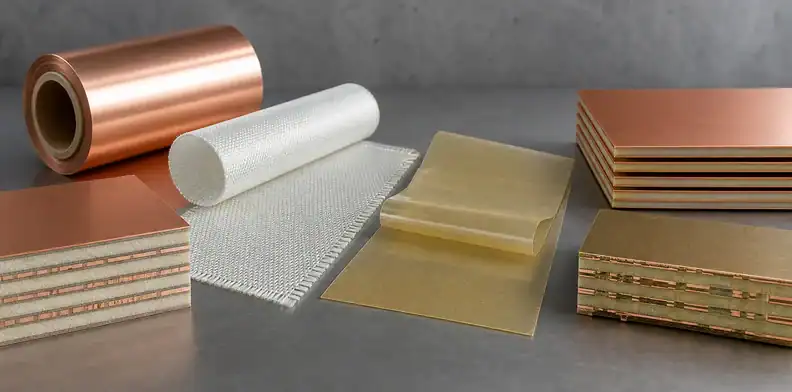
KB-6160 can be compared with S1141, NP-140, or other standard FR-4 only when the same methods and constructions are available. Nominal Tg labels and brand names do not show dielectric loss, z-axis expansion, T288 behavior, halogen status, or supply controls.
What makes a fair comparison?
Give each supplier the same stack-up, assembly profile, impedance table, compliance requirements, and forecast. Ask for the same fields, revision date, and manufacturing site.
- Tg by DSC and TMA, clearly separated;
- Td definition, heating rate, and test method;
- T260/T288 and total z-axis expansion;
- Dk/Df by frequency, glass style, resin content, and method;
- UL recognition, IPC slash sheets, environmental status, and site;
- available cores, prepregs, copper types, lead time, and alternates.
The QueenEMS review of Shengyi S1141 electrical limits and the NP-140 material guide show why method context and current evidence matter.
How should unknown values be shown?
| Comparison field | KB-6160 evidence in hand | Required next action |
|---|---|---|
| Electrical construction data | 2022 line-up | Match the proposed stack-up |
| Thermal endurance | Not in that line-up | Obtain current controlled TDS |
| Site recognition | 2025 VDE certificate | Match the quoted factory |
| Commercial price and lead time | Not a material constant | Use a dated quotation |
An empty field is better than a guessed figure.
Key Takeaway — Bottom line: Compare controlled constructions and evidence packages, not marketing categories such as “China default” or “lowest cost.”
When Should You Move to a Higher-Temperature Grade?
Move beyond KB-6160 when the current construction cannot show enough margin for the actual assembly and field stresses. Common triggers include repeated lead-free thermal cycles, thick multilayers, demanding plated holes, sequential lamination, or a customer requirement that the available evidence cannot meet.
Which signals deserve a material review?
Tg marks a change in polymer behavior, but it is not a complete reliability score. Td, T260/T288, z-axis expansion, moisture uptake, copper adhesion, cure state, board thickness, and via geometry can be more directly tied to a failure mechanism.
- more than one severe reflow plus repair exposure;
- high aspect-ratio plated holes or stacked reliability demands;
- thick copper that changes heating and resin flow;
- sequential lamination or resin-starved regions;
- a tight loss budget that standard FR-4 cannot meet;
- missing current thermal or compliance documentation.
How should an upgrade be justified?
Write the failed requirement first. Then compare a higher-temperature or lower-loss candidate using the same methods and a buildable stack-up. The QueenEMS S1000-2M material discussion provides context for applications where higher thermal margin may matter, but the final choice still depends on the board.
| Trigger | Evidence | Possible response |
|---|---|---|
| Hole-wall risk | Microsection and thermal-cycling results | Lower expansion or revised via design |
| Reflow margin | Assembly profile and T288/Td data | Higher thermal endurance |
| Channel loss | Modeled and measured insertion loss | Lower-loss dielectric |
Key Takeaway — Bottom line: Upgrade only when a named risk, test, or requirement shows that the approved KB-6160 construction lacks margin.
Which PCB Applications Are a Sensible Starting Point?
KB-6160 is a sensible starting candidate for conventional FR-4 boards with moderate thermal and electrical demands, provided the exact construction passes the project review. The material name alone cannot approve an LED driver, consumer controller, industrial interface, or any other product class.
What does a lower-risk candidate look like?
- 2- to 8-layer control and interface boards;
- short digital channels with verified impedance and loss margin;
- mainstream consumer or industrial assemblies without severe thermal cycling;
- prototypes whose volume construction and approved alternate are already defined.
Which applications need deeper qualification?
High-layer-count backplanes, dense HDI, long high-speed channels, safety-related products, harsh automotive environments, and repeated thermal exposure require construction-specific evidence.
| Board characteristic | Review depth | Main evidence |
|---|---|---|
| Conventional 4-layer controller | Standard qualification | Stack-up, profile, coupons |
| Thick multilayer with small holes | Elevated | Thermal stress and microsections |
| Long multi-gigabit channel | Elevated | Field solver and loss measurement |
For complex builds, QueenEMS’ multilayer PCB fabrication capabilities provide a useful discussion point for stack-up and coupon planning.
Key Takeaway — Bottom line: Approve the application from its stress profile and qualification results, never from a generic end-use label.
How Should a Fabricator Qualify the Construction?
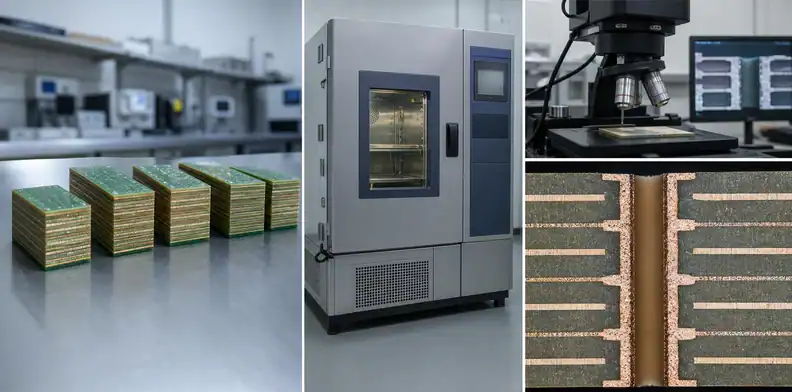
A fabricator should qualify KB-6160 as a complete material-and-process combination. Incoming identity, storage, lamination, drilling, desmear, plating, thermal stress, microsections, impedance, and electrical test all need acceptance criteria tied to the proposed stack-up.
What belongs in pre-production engineering?
The fabricator should issue a stack-up naming each core and prepreg, glass style, resin content, copper, pressed thickness, design Dk, impedance geometry, Kingboard site, and current documents.
Before the first lot, review resin flow, glass availability, drill aspect ratio, annular ring, desmear, plating, and assembly. Thin dielectrics and coarse glass deserve attention when impedance or skew is sensitive.
Which records close the qualification loop?
- incoming certificate and lot traceability;
- press profile and finished thickness map;
- first-article microsections before and after thermal stress;
- hole-wall copper and defect acceptance;
- controlled-impedance coupon results;
- continuity, isolation, and any project reliability test.
| Stage | Record | Pass condition |
|---|---|---|
| Incoming | Grade, suffix, site, lot, expiry | Matches approved material |
| Lamination | Profile, thickness, registration | Within drawing limits |
| Drilling/plating | Tool record and microsection | Hole acceptance met |
| Electrical | Coupon and net test | Design limits met |
Key Takeaway — Bottom line: Release production only when the actual KB-6160 construction and the fabricator’s process records meet the same approved criteria.
What Should Procurement Put in the RFQ?
The RFQ should force every bidder to quote the same KB-6160 construction, evidence, test coverage, and substitution rights. Otherwise, two prices can represent different sites, prepregs, copper foils, impedance assumptions, inspections, and delivery risks.
Which technical fields prevent ambiguity?
Attach the fabrication data, stack-up, thickness, copper weights, impedance, vias, assembly profile, compliance needs, and tests. Ask the supplier to return its material stack with revisions and sites.
- exact laminate and prepreg grade, including suffixes;
- current datasheet and electrical line-up revision;
- glass style, resin content, pressed thickness, and design Dk;
- copper type, roughness assumption, and controlled-impedance tolerance;
- UL, environmental, customer, and site requirements;
- approved-equivalent matrix and change-notification period.
Which commercial fields belong beside them?
State quantities, forecast, panel constraints, lead time, quote validity, tooling, tests, material minimums, and who owns excess material. Require written approval before any grade, site, construction, or copper change.
| RFQ item | Supplier response | Buyer decision |
|---|---|---|
| Material identity | Exact grade, suffix, site | Approve or query |
| Stack-up | Buildable construction and Dk | Model and sign off |
| Alternate | Property/evidence comparison | Approve before use |
| Delivery | Dated lead time and stock basis | Plan order timing |
Key Takeaway — Bottom line: Make the returned stack-up and evidence package part of the quotation, not an informal follow-up after price approval.
How Do You Release and Control the Material?
Release KB-6160 through one controlled package that joins the drawing, stack-up, current supplier evidence, test plan, approved manufacturing site, and substitution rules. A revision or site change should trigger a defined review rather than a silent purchasing decision.
What belongs in the release package?
The design record should separate catalog Dk/Df, solver values, and coupon results. It should record approved resin contents, glass styles, copper, thicknesses, thermal limits, compliance files, and test evidence.
- signed fabrication drawing and stack-up revision;
- current datasheet, line-up, certificates, and declarations;
- impedance model, coupon design, and acceptance limits;
- assembly profile and thermal qualification evidence;
- approved vendor, Kingboard site, alternates, and notice rules;
- deviation authority and requalification triggers.
When should the material be reopened?
Reopen approval after a grade, resin, glass, copper, site, construction, document, assembly, field-performance, or compliance change.
| Change | Minimum review | Possible test |
|---|---|---|
| New core/prepreg construction | Stack-up and impedance | Coupon build |
| New manufacturing site | Document and process equivalence | First article |
| New assembly profile | Thermal margin | Reflow and microsection |
Send the fabrication package through QueenEMS’ free PCB DFM review. For a quote, contact QueenEMS with the Gerber files and state whether a controlled alternate is allowed.
Key Takeaway — Bottom line: Keep KB-6160 approved only while its identity, construction, process, evidence, and change history remain traceable.
FAQ
Can I use one Dk value for every KB-6160 stack-up?
No. The official 2022 core line-up lists 1 GHz Dk values from 4.0 to 4.5 depending on thickness and glass lay-up. Use the fabricator’s construction-specific design Dk and verify controlled impedance with coupons.
What is the best way to compare KB-6160 with S1141?
Compare the same Tg/Td methods, T260/T288, expansion, construction-specific Dk/Df, UL and environmental records, available stack-ups, site, lead time, and change controls. Similar nominal labels do not prove equivalence.
How do I know whether KB-6160 is suitable for lead-free assembly?
Request the current thermal datasheet and compare its Tg, Td, T260/T288, expansion, moisture, and vendor process guidance with the real assembly profile and via structure. The electrical line-up alone cannot answer that question.
Can my fabricator substitute another standard FR-4?
Yes, but only after the alternate passes the approved property, construction, compliance, site, and test matrix. Written approval should precede production use.
What files should I send for a material review?
Send Gerber or ODB++ data, the proposed stack-up, impedance table, copper weights, finished thickness, via details, assembly profile, compliance requirements, quantities, and the current material datasheet. That package supports a board-specific decision.
Sources
- Kingboard KB-6160/KB-6060 Line Up, version 1.1, March 9, 2022
- Kingboard Laminates company background
- Kingboard Laminates factory list
- Kingboard KB-6160 VDE certificate, updated June 16, 2025
Written by the QueenEMS Engineering Team
Upload your files today · Free DFM check before production · Ship worldwide
Get your PCB prototypes in as fast as 24 hours. We handle FR4, Rogers, and Flex up to 60 layers — free prototypes for 2–4 layer boards, no minimum order.
Just upload your Gerber + BOM — we source every part, assemble, and inspect (AOI + X‑Ray) so you don't have to chase suppliers. Boards ship in as fast as 24 hours.