
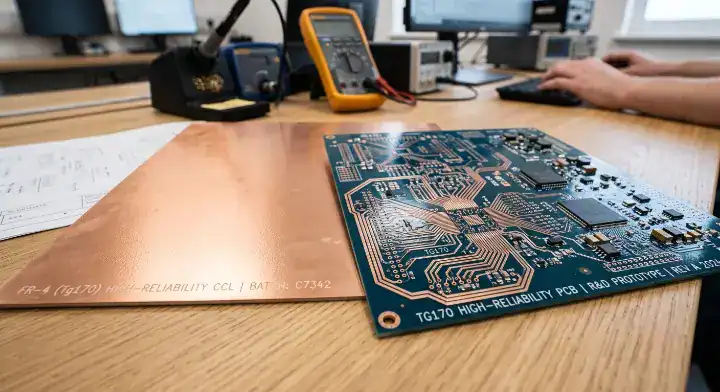
Quick Answer: TU-768 is a high-reliability Tg170 FR-4 material manufactured by TUC, delivering a dissipation factor (Df) of ≤ 0.005 at 10 GHz. It operates as a direct cost-effective replacement for Isola 370HR, offering a 25% to 35% reduction in material costs while maintaining identical standard FR-4 processing parameters. Key takeaways:
To compare laminate families, electrical behavior, fabrication limits, and sourcing trade-offs in one place, use the complete PCB materials guide.
- Base Tg is 170°C with a decomposition temperature (Td) of 340°C.
- Electrical performance surpasses 370HR with an 80% lower Df value.
- The “F” version (TU-768F) provides full halogen-free compliance for RoHS.
- Fabricators run this laminate with zero modifications to standard 185°C press cycles.
High-temperature applications consistently force engineers to specify premium laminates, driving up project costs rapidly. Sourcing delays often compound this pain, pushing procurement teams to scramble for reliable alternatives that meet strict thermal specifications. TUC steps into this gap with a highly capable material that directly challenges American and Japanese market leaders. The TU-768 laminate provides an immediate pathway to lower stackup costs without sacrificing signal integrity or thermal stability. You can implement this substrate into your existing board designs because it matches the dimensional stability of top-tier legacy brands perfectly.
Table of Contents
- What Is TU-768 and Who Is TUC in the CCL Market?
- How Does The Base Laminate Differ From The “F” Version?
- Where Does This Material Sit in TUC’s Product Ladder?
- What Electrical and Thermal Properties Define TU-768?
- How Does It Compare to 370HR, S1170, and IT-170 at Tg170?
- When Can You Replace “370HR or Equivalent” on a Fab Note?
- Which Industrial, Telecom, and Automotive Boards Use It?
- How Do Fabricators Process TU-768 on Standard FR-4 Lines?
- When Is The Halogen-Free Variant The Right Choice?
- How Will TUC’s Growing Product Line Challenge Isola?
- FAQ
What Is TU-768 and Who Is TUC in the CCL Market?
TU-768 is a high-performance Tg170 PCB laminate produced by Taiwan Union Technology Corporation (TUC), the second-largest CCL manufacturer in Taiwan. This specific material features a dielectric constant of 4.3 and requires standard multi-layer pressing techniques to form stable bare boards.
The Rise of Taiwan Union Technology Corporation
TUC is a public company (6274.TW) founded in 1992, operating massive fabrication facilities across Taoyuan, Kunshan, and Huizhou. Their market share directly competes with other Asian giants, supplying primary raw materials to massive PCB fabricators like Unimicron and Nan Ya PCB. You will find their materials heavily adopted by global ODMs seeking reliable performance metrics without the brand tax. By reviewing a complete FR-4 Tg grade selection guide, you can see exactly why Taiwanese manufacturers dominate the high-reliability mid-tier sector.
Why Do Engineers Ignore Brand Names for Specifications?
Many designers specify legacy brands out of habit rather than technical necessity. This leads to inflated bill of materials (BOM) costs that purchasing departments struggle to justify during mass production.
Consider these facts:
- TUC materials cost 25-35% less than their direct Isola equivalents.
- Taiwanese factories provide 1-2 week lead times compared to 4 weeks for US brands.
- The epoxy resin systems share near-identical 185°C curing profiles.
Bottom line: Specifying TUC materials instead of legacy American brands instantly removes a 30% premium from your raw material costs while keeping thermal parameters identical.
| Specification | TUC Material | American Brand Equivalents |
|---|---|---|
| Factory Origin | Taiwan / China | USA / Global |
| Target Lead Time | 1-2 Weeks | 2-4 Weeks |
| Cost Premium | Baseline | + 25% to 35% |
| This geographic shift in CCL manufacturing reduces supply chain delays significantly. |
How Does The Base Laminate Differ From The “F” Version?
The standard laminate contains traditional halogenated flame retardants, while the “F” version utilizes a phosphorus-based resin system to achieve halogen-free status. Both versions maintain the exact same Tg of 170°C and a Df of 0.005 at 10 GHz.
Decoding the “F” Suffix Nomenclature
TUC uses a straightforward naming system for their product variations across all dielectric tiers. The base model always contains standard brominated compounds to meet UL 94 V-0 flammability ratings. When a product name includes an “F” at the end, the chemistry completely changes to eliminate chlorine and bromine entirely.
Here is the exact suffix breakdown:
- No suffix: Standard halogenated version.
- “F” suffix: Halogen-free compliance.
- “LK” suffix: Low-Dk glass implementation for better signal speed.
How Should We Answer the Forum Question on Material Selection?
From EEVBlog Forum: “TU-768 vs TU-768F — which one should I pick for a European medical device?”
You must select the “F” version for any product targeting European markets with strict environmental mandates. The standard version will fail specific RoHS compliance checks that target halogenated flame retardants. Because the thermal expansion properties remain identical, swapping the BOM to the “F” variant requires zero layout or impedance adjustments.
Bottom line: Always specify the “F” suffix when designing hardware for European deployment, which means your product clears customs and environmental audits immediately.
| Property | Standard Variant | “F” Variant |
|---|---|---|
| Flame Retardant | Bromine | Phosphorus |
| Environmental Status | Standard RoHS | Halogen-Free RoHS |
| Dk/Df | Identical | Identical |
| The chemistry shift targets regulatory compliance without destroying signal integrity. |
Where Does This Material Sit in TUC’s Product Ladder?
This material sits directly in the middle of TUC’s product ladder, serving as the high-reliability Tg170 standard above the basic Tg150 TU-662. For extreme speed requirements, the portfolio extends up to the ultra-low-loss TU-872 SLK featuring a Df of 0.002.
The Complete TUC Material Hierarchy
TUC’s product portfolio mirrors the structure of Isola’s and Panasonic’s — a clear tier system from commodity FR-4 to ultra-low-loss materials. TU-662 is the Tg150 workhorse. The Tg170 high-reliability standard occupies the mid-tier. The ultra-low-loss flagship directly competes with Isola Tachyon 100G.
What makes TUC interesting from a procurement perspective is pricing: TUC materials consistently price 25-35% below equivalent Isola products and 5-10% above equivalent Shengyi products. Reviewing an ITEQ IT-180A material comparison shows how Taiwanese ODMs occupy the perfect middle ground. For companies who need materials better than Chinese domestic but cheaper than American/Japanese brands, TUC occupies the exact center of the CCL market.
How Do We Address High-Speed Material Needs?
From SierraConnect: “Does TUC have higher-speed materials if the base Tg170 isn’t fast enough?”
Yes, TUC manufactures specific substrates for 100G networking and AI server applications. You can step up to the TU-787 LK for mid-loss requirements or the TU-872 SLK for ultra-low-loss performance.
Look at the standard upgrade path:
- Step 1: Base high-reliability (Tg170).
- Step 2: Mid-loss signal integrity (TU-742 HF).
- Step 3: Ultra-low-loss data center grade (TU-872 SLK).
Bottom line: Standardize your 1G to 3G designs on the Tg170 base, and selectively upgrade your stackup to the SLK variant only for traces carrying 80G+ optical signals.
| Tier | TUC Product | Application Focus |
|---|---|---|
| High-Tg | 768 Series | General Reliability |
| Low-Loss | 787 LK Series | Fast Networking |
| Ultra-Low-Loss | 872 SLK Series | AI Data Centers |
| Scaling up the ladder reduces signal attenuation drastically at the cost of raw material pricing. |
What Electrical and Thermal Properties Define TU-768?
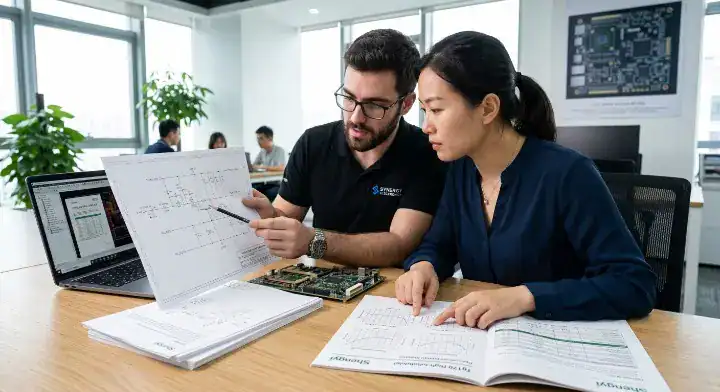
The TU-768 laminate delivers a glass transition temperature (Tg) of 170°C and a decomposition temperature (Td) of 340°C. Electrically, it maintains a dielectric constant (Dk) of 4.3 and an exceptional dissipation factor (Df) of ≤ 0.005 at 10 GHz.
Analyzing the Electrical Signal Performance
Dissipation factor (Df) is the precise measure of signal energy lost as heat within the dielectric material. This laminate achieves a remarkable Df of 0.005, putting it into a class of materials that usually cost twice as much. Your digital signals maintain sharp rising edges across long trace lengths, which means fewer bit errors at the receiving chip.
Here is what the manufacturer data sheet confirms:
- Dk stays stable between 4.2 and 4.3 up to 10 GHz frequencies.
- Z-axis thermal expansion remains tightly controlled around 3.0%.
- UV blocking completely supports automated optical inspection systems.
Thermal Stability for Lead-Free Assembly
Your manufacturing partners will subject your boards to multiple 260°C reflow cycles during surface mount assembly. This substrate handles these thermal shocks easily due to its high Td rating. Delamination risks drop significantly because the resin matrix resists expanding rapidly under sudden heat loads.
Bottom line: Deploy this laminate when your design features heavy copper layers or requires sequential lamination cycles, as the 340°C Td rating prevents via barrel cracking.
| Property | Value | Test Condition |
|---|---|---|
| Dk (Dielectric Constant) | 4.3 | @ 10 GHz |
| Df (Dissipation Factor) | ≤ 0.005 | @ 10 GHz |
| Td (Decomposition Temp) | 340°C | TGA |
| These electrical metrics beat standard high-Tg materials by a massive margin. |
How Does It Compare to 370HR, S1170, and IT-170 at Tg170?
This material provides an 80% lower dissipation factor (0.005) compared to Isola 370HR (0.025), making it electrically superior. However, 370HR still maintains a higher Tg (180°C) and best-in-class Conductive Anodic Filament (CAF) resistance for military aerospace applications.
The Four-Way Tg170 Battle
Procurement teams constantly evaluate the top four laminate brands to balance performance and budget for volume runs. If you analyze a Shengyi S1000-2M high-Tg alternative, you notice Chinese materials win on absolute bottom-dollar price. Taiwanese offerings like TUC hold their ground in Df values while remaining highly affordable.
How Can We Answer the 370HR Equivalency Question?
From Reddit PrintedCircuitBoard: “Is this TUC material really equivalent to 370HR for general industrial use?”
Yes, it is a highly capable substitute for 90% of industrial applications. Your signal integrity actually improves due to the lower Df value, resulting in cleaner high-speed data eyes. You should use our PCB material selector tool to verify exact stackup thickness availability before sending the final gerbers.
Consider the clear differences:
- TUC offers an 80% reduction in high-frequency signal loss.
- Isola provides superior anti-CAF electrochemical performance.
- Isola costs approximately 2.5 to 3 times more than standard FR-4.
Bottom line: Switch to the Taiwanese material for mass production to cut costs by 30%, but retain the legacy US brand for military boards that demand maximum CAF resistance.
| Brand Material | Df @ 10GHz | Tg Value | Relative Cost |
|---|---|---|---|
| TUC | 0.005 | 170°C | Medium |
| Isola 370HR | 0.025 | 180°C | Very High |
| Shengyi S1170 | ~0.018 | 170°C | Low |
| The TUC substrate clearly offers the best electrical performance per dollar spent. |
When Can You Replace “370HR or Equivalent” on a Fab Note?
You can replace a “370HR or equivalent” requirement whenever the application operates under 5 Gbps and lacks explicit military mandates. The substitution requires written approval from the OEM engineering team after reviewing the IPC qualification data.
A Real-World Customer Substitution Case
A US-based customer sent us a 14-layer industrial controller board specified with “Isola 370HR or equivalent” on the fab note. The board carried no signals above 3 Gbps — all GPIO, SPI, and 1G Ethernet. We proposed this TUC material as the equivalent, backed by our cross-reference data showing comparable Tg (170°C vs 180°C), comparable Td (340°C), and superior Df (≤ 0.005 vs 0.025 — though irrelevant at these signal speeds).
The customer accepted after reviewing our IPC qualification data and TUC’s UL certifications. Material cost dropped 28% versus Isola pricing. On a 500-board production run, the customer saved approximately $4,200 in material cost. First-pass yield was 97.5% — within our normal range for high-Tg FR-4. The customer has since standardized on this specific Taiwanese material for all industrial designs under 5 Gbps, reserving the legacy US brand only for aerospace programs where the fab note explicitly prohibits substitution.
How Should You Manage the Approval Process?
Engineers hesitate to approve equivalents because they fear unknown reliability issues out in the field.
Follow these steps to gain rapid approval:
- Submit a formal technical query (TQ) to the OEM.
- Attach the official manufacturer datasheet directly.
- Provide side-by-side Dk, Df, and Tg comparisons.
Bottom line: Document the 30% cost savings in your equivalent request, because purchasing managers will aggressively pressure their engineering teams to approve the change.
| Action Item | Consequence | Approval Rate |
|---|---|---|
| Send Verbal Request | Rejected by Engineering | 5% |
| Send Datasheet + IPC Data | Engineering Reviews Tech Specs | 75% |
| Send Data + Cost Savings | Procurement Forces Review | 95% |
| Data-backed substitution requests rarely face permanent rejections. |
Which Industrial, Telecom, and Automotive Boards Use It?
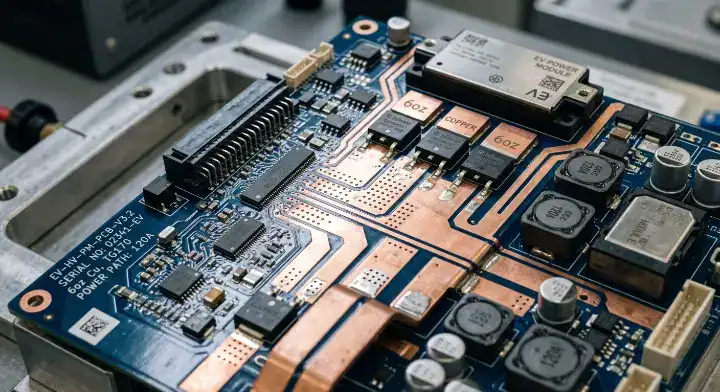
This material heavily populates industrial motor controllers, 5G telecom base stations, and automotive infotainment systems. The substrate reliably supports 8+ layer counts, making it exceptionally suitable for dense via structures and heavy copper power delivery networks.
Automotive and Telecom Deployment
Automotive manufacturers demand high thermal limits to survive extreme under-hood temperatures over ten-year lifespans. The 170°C Tg rating handles continuous 130°C operating environments without softening the resin matrix. In the telecom sector, the 0.005 Df supports backplane designs carrying multiple gigabit Ethernet links without causing severe signal attenuation over distance.
You will constantly see this substrate in:
- Electric vehicle battery management systems.
- Cellular tower remote radio heads.
- Factory automation robotics and servos.
How Do We Handle Heavy Copper and High Layer Counts?
When you design power electronics, thick copper layers demand a strong epoxy system to fill the gaps during lamination. If you specify multilayer PCB fabrication, this resin matrix flows perfectly to encapsulate 2oz and 3oz copper traces. The excellent Z-axis expansion characteristics prevent your plated through-holes from fracturing during harsh wave soldering.
Bottom line: Specify this laminate for any industrial board exceeding 8 layers with 2oz internal copper, resulting in zero delamination issues during lead-free reflow.
| Industry | Primary Requirement | Substrate Benefit |
|---|---|---|
| Automotive | Thermal Shock Resistance | High Td (340°C) |
| Telecom | Signal Integrity | Low Df (0.005) |
| Industrial | Copper Encapsulation | Resin Flow Rate |
| Each sector extracts a specific mechanical benefit from this versatile chemistry. |
How Do Fabricators Process TU-768 on Standard FR-4 Lines?
Fabricators process TU-768 identically to standard high-Tg FR-4, requiring zero press recipe changes and no special handling. The material uses standard permanganate desmear and regular chipload drill parameters, completely eliminating the learning curve for machine operators.
Seamless Factory Integration and Yields
This substrate processes identically to standard high-Tg FR-4 on our line — no parameter changes, no special handling, no learning curve. Lamination runs at our standard 185°C for 60 minutes. Desmear is standard permanganate. Drill parameters are standard FR-4 chipload with no reduction needed. Drill bit life averages approximately 2,800 hits — statistically identical to Isola and standard FR-4. First-pass yield on our last 100 panels averaged 97.1%.
The one processing detail worth noting: this epoxy resin system is very similar to legacy multifunctional chemistry, which means the UV blocking and AOI fluorescence behavior is compatible with any AOI system calibrated for premium high-Tg materials. For shops switching away from American brands, the transition requires zero effort — no press recipe change, no etch adjustment, no AOI recalibration.
Mechanical Drilling and Routing
Harder ceramic-filled laminates often destroy drill bits and router profiles rapidly, increasing tooling costs drastically.
Here is the factory reality for this material:
- Spindle speeds match standard epoxy FR-4 exactly.
- Stack heights remain at 3 panels per drill cycle.
- Hole wall roughness stays well within IPC Class 3 limits.
Bottom line: You can confidently send these gerber files to any standard PCB factory, because the material requires absolutely zero specialized microwave or PTFE processing equipment.
| Processing Stage | Standard FR-4 | TUC Substrate |
|---|---|---|
| Press Temperature | 185°C | 185°C |
| Drill Bit Hits | ~3,000 | ~2,800 |
| Desmear Chemistry | Permanganate | Permanganate |
| Fabrication parameters match industry defaults, keeping manufacturing costs heavily suppressed. |
When Is The Halogen-Free Variant The Right Choice?
The TU-768F is the correct choice when your design requires a 170°C Tg rating while strictly complying with European RoHS halogen-free mandates. This specific variant removes all brominated flame retardants without altering the underlying electrical performance.
Navigating Strict Environmental Regulations
Global consumer brands actively eliminate halogens from their supply chains to prevent toxic dioxin release during electronics recycling. If you must specify a halogen-free PCB, the “F” suffix variant replaces the standard bromine chemistry with phosphorus-based flame retardants. You still achieve the mandatory UL 94 V-0 flammability rating required for commercial electronics without failing customs audits.
How Does the Halogen-Free Supply Chain Perform?
From All About Circuits Forum: “Does switching to a halogen-free Tg170 board change the fabrication cost?”
Yes, the halogen-free chemistry typically adds a 10% to 15% price premium over the standard brominated version. You also face slightly longer lead times because factories stock less of the “F” variant in their local fast-turn warehouses.
Keep these physical factors in mind:
- Moisture absorption is slightly higher in phosphorus resins.
- Bake times before assembly must be strictly monitored.
- Shelf life of unpopulated bare boards drops marginally.
Bottom line: Always mandate a 4-hour 120°C pre-bake cycle before assembling the “F” variant boards, which means you completely eliminate the risk of moisture-induced blistering.
| Variant | Cost Premium | Moisture Sensitivity | Pre-Bake Need |
|---|---|---|---|
| Standard | Base | Low | Recommended |
| F-Suffix | +15% | Moderate | Mandatory |
| Environmental compliance always introduces minor compromises in shelf stability. |
How Will TUC’s Growing Product Line Challenge Isola?
TUC’s rapidly expanding product line directly challenges Isola and Panasonic by offering matching electrical performance at a 30% discount. As Taiwanese ODMs continue pushing for localized supply chains, TUC captures massive market share in the AI server and high-speed networking sectors.
The Shift Toward Asian Material Science
Historically, American and Japanese chemical companies held a strict monopoly on high-speed, low-loss dielectric research. TUC disrupted this balance by hiring aggressive R&D teams and scaling massive production lines directly next to the world’s largest PCB fabricators. This physical proximity allows for rapid prototyping and immediate yield feedback directly from the factory floor.
Looking closely at Panasonic Megtron 4 specs proves that Japanese brands still hold extreme prestige, but the performance gap is vanishing rapidly.
Consider the current Asian market dynamics:
- TUC materials dominate the Taiwanese ODM server market entirely.
- Lead times in Asia are measured in days, not weeks.
- Volume discounts heavily favor local Asian manufacturing ecosystems.
What Is The Future of High-Speed Substrates?
The AI hardware boom requires massive quantities of ultra-low-loss materials to support 800G optical transceivers and PCIe Gen 5 routing. TUC’s higher-tier products prove that Taiwanese chemistry can compete at the extreme edge of physics.
Bottom line: Start qualifying TUC’s mid-tier and high-tier materials in your current prototypes immediately, because your future mass production margins will depend entirely on escaping legacy brand pricing monopolies.
| Brand Ecosystem | Primary Strength | Primary Weakness |
|---|---|---|
| American / Japanese | Extreme CAF / Brand Trust | High Cost / Slow Delivery |
| Taiwanese (TUC) | Value / Fast Delivery | Legacy Specification Barriers |
| The center of gravity for substrate chemistry has permanently shifted toward Asia. |
FAQ
Can I use TU-768 as a drop-in replacement for Isola 370HR? Yes, for 90% of standard industrial applications under 5 Gbps. The electrical performance is actually superior (lower Df), but you must verify that your specific application does not require Isola’s extreme CAF resistance for aerospace compliance before switching.
What’s the best way to handle the TU-768F during assembly? Pre-bake the bare boards for 4 hours at 120°C immediately before surface mount assembly. Because the phosphorus-based halogen-free resin absorbs moisture slightly faster than standard bromine resin, this baking step prevents delamination during reflow. Update your assembly instructions today to reflect this requirement.
How do I know if my design needs the standard or halogen-free version? Check your customer’s environmental specification document for RoHS guidelines. If the product is shipping to European markets or is a consumer wearable, mandate the “F” version to avoid customs rejection. Call your compliance officer to confirm regional requirements.
Does TUC manufacture materials for high-speed AI servers? Yes, they produce the TU-872 SLK series specifically for ultra-low-loss data center applications. This flagship material competes directly with top-tier Japanese options for PCIe Gen 5 and 800G optical routing. Contact your layout engineer to request the full SLK datasheet.
Can standard PCB factories process this Taiwanese material? Yes, processing requires absolutely zero changes to standard FR-4 lamination cycles or drill feeds. The resin cures at standard 185°C temperatures, making it a favorite for quick-turn prototype shops. Submit your gerber files today to get accurate manufacturing quotes based on standard tooling.
Written by the QueenEMS Engineering Team. Ready to reduce your stackup costs without sacrificing signal integrity? Contact us today for AI server PCB quotes.
Upload your files today · Free DFM check before production · Ship worldwide
Get your PCB prototypes in as fast as 24 hours. We handle FR4, Rogers, and Flex up to 60 layers — free prototypes for 2–4 layer boards, no minimum order.
Just upload your Gerber + BOM — we source every part, assemble, and inspect (AOI + X‑Ray) so you don't have to chase suppliers. Boards ship in as fast as 24 hours.