
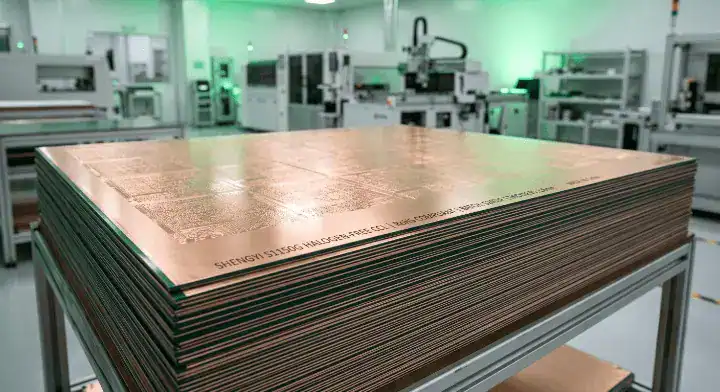
Quick Answer: Shengyi S1150G is a halogen-free Tg155°C FR-4 material featuring a T288 thermal survival time of 45 minutes and a high Comparative Tracking Index (CTI) of ≥600V. It operates as the direct lead-free upgrade for standard S1141 boards, increasing manufacturing thermal safety by 22.5 times while remaining fully compliant with strict European RoHS environmental regulations. Key takeaways:
For the wider material-selection picture across performance, fabrication, and sourcing, refer to the full PCB materials guide.
- T288 rating is 45 minutes, solving the critical 2-minute delamination limit of basic S1141.
- CTI ≥600V (Class 0) makes it uniquely qualified for 400V+ industrial and EV applications.
- Halogen-free chemistry removes bromine and antimony, replacing them with phosphorus resins.
- Directly competes with IT-150DA, NP-150, and TU-662 as top-tier Tg150 manufacturing options.
Many engineering teams face catastrophic manufacturing scrap rates when attempting to run cheap Tg130 boards through double-sided surface mount ovens. This thermal limitation forces layout designers to scramble for emergency board upgrades, often overspending on ultra-high-Tg materials they do not actually need. S1150G perfectly fills this gap, offering massive lead-free safety margins while satisfying strict environmental mandates. By reviewing standard FR-4 Tg grade selection parameters, you will quickly understand why upgrading to this specific substrate completely eliminates blistering during complex assembly processes.
Table of Contents
- What Is S1150G and Why Is It Shengyi’s Practical Halogen-Free FR-4?
- How Does S1150G Differ from Standard S1150 on Halogen-Free Chemistry?
- Where Does S1150G Sit in Shengyi’s Tg Series from S1141 to S1000-2M?
- Why Does S1150G’s T288 of 45 Minutes Fix S1141’s Lead-Free Problem?
- How Does S1150G Compare to IT-150DA, NP-150, and TU-662 at Tg150?
- Why Is S1150G’s CTI ≥600V Critical for High-Voltage Applications?
- Which Consumer, Industrial, and Automotive Designs Use S1150G?
- How Do Fabricators Process S1150G on Standard FR-4 Lines?
- When Should You Upgrade from S1150G to S1170G or S1000-2M?
- How Will Halogen-Free Tg150 Materials Evolve Under Strict Rules?
- FAQ
What Is S1150G and Why Is It Shengyi’s Practical Halogen-Free FR-4?
Shengyi S1150G is an advanced mid-Tg copper-clad laminate delivering a DSC Tg of 155°C and a Td of 355°C. It functions as the industry’s primary halogen-free workhorse, offering a 0.10% water absorption rate and a dielectric constant of approximately 4.5 at 1 GHz.
The Foundation of Green Electronics
This laminate dominates the green electronics supply chain because it completely eliminates toxic brominated flame retardants. Engineers select it aggressively for consumer goods shipping to the European Union, which means the final product bypasses strict customs holds related to RoHS and REACH directives.
You must consider these primary benefits:
- Exceptional thermal decomposition (Td) measuring 355°C.
- Anti-CAF formulation preventing electrochemical migration.
- Ultra-low moisture absorption holding at just 0.10%.
Replacing Legacy Materials
Many procurement teams default to this material when they realize legacy brominated substrates carry hidden regulatory risks. The phosphorus-based resin matrix achieves the exact same UL 94 V-0 flammability rating without relying on harmful halogens.
Bottom line: Specify this laminate whenever your consumer electronics target global markets, because the environmentally friendly chemistry directly prevents expensive regulatory rejection at the border.
| Material Parameter | Measured Value | Standard Testing Condition |
|---|---|---|
| Glass Transition (Tg) | 155°C | DSC Method |
| Decomposition (Td) | 355°C | TGA Method |
| Water Absorption | 0.10% | D-24/23 |
| These baseline metrics establish the laminate as a highly stable mid-tier performer. |
How Does S1150G Differ from Standard S1150 on Halogen-Free Chemistry?
The S1150G variant completely removes bromine, antimony, and red phosphorus, utilizing a specialized organic phosphorus resin that pushes its decomposition temperature (Td) to 355°C. In contrast, the standard S1150 relies on traditional brominated flame retardants, resulting in a lower Td of 325°C and standard moisture absorption.
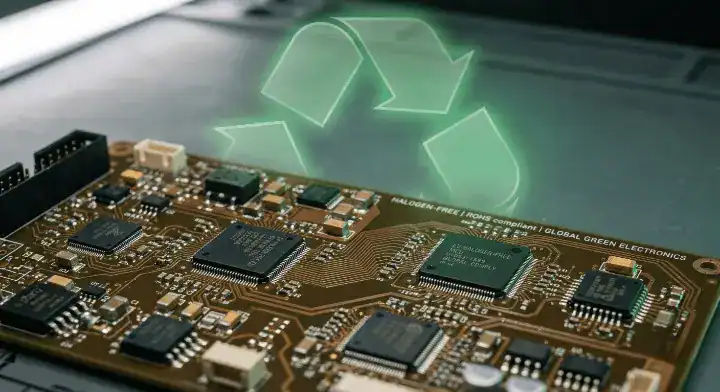
Understanding the Chemical Substitution
From EEVBlog Forum: “Which Tg150 halogen-free is best for European medical devices, S1150 or S1150G?”
You must select S1150G, because the standard S1150 still contains bromine which violates strict European environmental directives for medical wearables. The “G” suffix indicates a fully green, halogen-free molecular structure.
The physical differences manifest primarily in thermal durability. Because the S1150G uses inorganic fillers alongside the phosphorus resin, its Z-axis thermal expansion drops to a very stable 2.8%. The standard S1150 exhibits a slightly higher 3.0% expansion rate.
Making the Procurement Decision
If your product stays entirely within markets that do not enforce halogen-free mandates, the standard S1150 remains highly viable. It costs approximately 10% to 15% less than the green variant while offering identical Tg150 processing characteristics on the factory floor.
Bottom line: Pay the 15% price premium for the “G” variant only when legal compliance requires it or when your thick heavy-copper board demands the superior 355°C Td rating.
| Specification | Standard S1150 | S1150G (Halogen-Free) |
|---|---|---|
| Flame Retardant | Bromine | Organic Phosphorus |
| Td Value | 325°C | 355°C |
| Z-Axis Expansion | 3.0% | 2.8% |
| The halogen-free resin inherently provides better resistance to thermal decomposition. |
Where Does S1150G Sit in Shengyi’s Tg Series from S1141 to S1000-2M?
S1150G occupies the critical middle ground in the Shengyi material product hierarchy, functioning as the mainstream Tg155°C upgrade path above the basic Tg135°C S1141. It handles demanding multi-layer assemblies before forcing engineers to pay for premium Tg175°C materials like S1000-2M.
Navigating the Supplier Portfolio
Shengyi structures its FR-4 product catalog to capture every possible price and performance tier in global electronics manufacturing. S1141 dominates the absolute bottom tier for simple single-sided consumer goods. S1150G captures the massive mid-market requirement for double-sided smartphones, routers, and automotive infotainment systems.
When you need extreme reliability, the ladder continues upward:
- S1170 steps into the Tg170°C standard category.
- S1000-2M dominates high-layer-count server power delivery.
- Synamic series targets ultra-low-loss high-speed digital routing.
The Sweet Spot for Cost and Performance
Engineers frequently over-specify substrate materials, defaulting to Tg175°C when Tg155°C would perform identically in their specific operating environment. This material sits exactly at the point of diminishing returns for standard FR-4 processing.
Bottom line: Lock this substrate in as your default choice for 4-to-6 layer hardware, resulting in the perfect balance between lead-free thermal safety and aggressive bill of materials cost reduction.
| Shengyi Product | Tg Rating | Primary Market Position |
|---|---|---|
| S1141 | 135°C | Basic Consumer Electronics |
| S1150G | 155°C | Mainstream Halogen-Free |
| S1000-2M | 175°C | High-Reliability Power |
| Moving up the ladder requires precise justification to avoid wasting manufacturing budget. |
Why Does S1150G’s T288 of 45 Minutes Fix S1141’s Lead-Free Problem?
The S1150G substrate delivers a T288 rating of 45 minutes, representing a massive 22.5-time improvement over S1141’s razor-thin 2-minute margin. This specific upgrade guarantees that the resin matrix will not blister or delaminate when subjected to the severe cumulative heat of multiple lead-free reflow cycles.
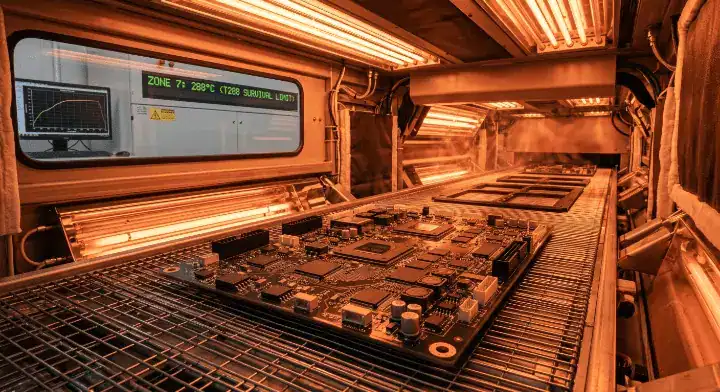
The Hidden Dangers of SMT Assembly
From Reddit PrintedCircuitBoard: “Why did my 4-layer S1141 board blister on the second side during SMT?”
Your board blistered because S1141’s 2-minute T288 thermal survival limit was completely consumed during the first pass and the subsequent pre-heating phase. Lead-free SAC305 solder requires 260°C peak temperatures, which physically destroys base Tg130 epoxy bonds.
T288 is the exact measure of time a substrate survives at 288°C before physical delamination occurs. A 45-minute window means your factory can process the top side, flip the board to process the bottom side, and still perform localized hot-air rework on failed components without risking via barrel cracking.
Eliminating Factory Floor Scrap
A customer building a dual-sided SMT consumer IoT gateway on S1141 experienced intermittent delamination after the second reflow pass. Cross-section showed micro-cracks at via barrels — S1141’s T288 of 2 minutes left zero margin for the double reflow and touch-up rework their assembly line required.
We recommended S1150G. The switch increased material cost by 18% but eliminated all delamination issues, jumping T288 from 2 to 45 minutes. After the switch, zero delamination events occurred across 3,000 boards over 6 months, and the assembly line gained rework capability. Net cost impact: +$0.12 per board on material, -$0.85 per board on scrap reduction = $0.73 net saving per board.
Bottom line: Always upgrade to this Tg155 material for double-sided surface mount assemblies, because the extended thermal buffer guarantees your vias survive the reflow oven perfectly intact.
| Substrate | T288 Time | Assembly Safety Margin |
|---|---|---|
| S1141 (Tg130) | 2+ min | Dangerous for Double-Sided |
| S1150G (Tg150) | 45 min | Safe for Double-Sided + Rework |
| S1000-2M (Tg175) | 20+ min | Very Safe for Heavy Copper |
| The jump in T288 time is the single most important factor for lead-free survival. |
How Does S1150G Compare to IT-150DA, NP-150, and TU-662 at Tg150?
S1150G outperforms its Tg150 competitors by providing a dominant 45-minute T288 survival time and a CTI of ≥600V. While ITEQ IT-150DA, Nanya NP-150, and TUC TU-662 all offer similar ~3.0% Z-axis expansion rates, Shengyi’s formulation provides a significantly wider safety margin for intense thermal rework.
Analyzing the Asian Laminate Ecosystem
You can easily compare Tg150 PCB materials to see how closely these four chemical formulations track each other in electrical performance. All four utilize modern resin systems to achieve acceptable dielectric constants around 4.3 to 4.5.
However, they differ sharply in physical survival limits:
- Shengyi delivers the absolute highest Td at 355°C.
- ITEQ’s IT-150DA provides a solid 10-minute T288 limit.
- TUC’s TU-662 wins on aggressive volume pricing strategies.
Making the Substitution Choice
We stock S1150G, IT-150DA, and TU-662 in our Tg150 inventory, and processing is identical across all three: same press recipe (170°C, 50 min), same desmear, and same drill parameters. The engineering difference is in thermal reliability: S1150G’s T288 at 45 minutes is the standout, while IT-150DA runs approximately 10 minutes.
For products requiring multiple reflow cycles or localized rework, Shengyi provides the widest safety margin. For pure cost optimization on single-side SMT consumer products, TU-662 is approximately 12% cheaper. IT-150DA becomes the default when the customer’s ecosystem is heavily ITEQ-based.
Bottom line: Write “Halogen-Free Tg150 FR-4” on your fabrication drawing rather than a specific brand, which allows your factory to utilize their lowest-cost local material while maintaining thermal integrity.
| Brand Material | T288 Rating | Td Value | Primary Strength |
|---|---|---|---|
| Shengyi S1150G | 45 min | 355°C | Thermal Safety Margin |
| ITEQ IT-150DA | ~10 min | 325°C | Ecosystem Compatibility |
| TUC TU-662 | Not Specified | 340°C | Lowest Raw Cost |
| Thermal survival times dictate which material can handle sequential lamination. |
Why Is S1150G’s CTI ≥600V Critical for High-Voltage Applications?
S1150G achieves a Comparative Tracking Index (CTI) of ≥600V, placing it in the highest IEC Class 0 safety category for high-voltage isolation. This metric is absolutely critical for 400V+ industrial drives and EV chargers, where standard Tg150 materials with a CTI of ≥175V would suffer catastrophic electrical shorting.
Defining Comparative Tracking Index
CTI is the voltage threshold where a material’s surface breaks down into a conductive carbon track when exposed to moisture and electrical stress. When you design power electronics, a high CTI allows you to route high-voltage traces significantly closer together without violating strict IEC safety creepage rules.
From Electronics Stack Exchange: “Can I use standard FR4 for 400V DC traces on a motor controller?”
No, standard FR-4 (like S1141) only guarantees CTI ≥175V, meaning your 400V traces require massive physical separation to prevent arcing. S1150G’s Class 0 rating solves this instantly.
Real-World High-Voltage Deployment
S1150G’s CTI of ≥600V makes it our default recommendation for any board carrying voltages above 100V DC. A recent industrial VFD (variable frequency drive) controller used S1150G on all 6 layers because the 400V DC bus traces required CTI ≥600V per the customer’s safety certification (IEC 61800-5-1).
Standard S1141 at CTI ≥175V would have failed the test outright, and the alternative specialty high-CTI material would have cost 3× more. S1150G delivered the required CTI at only a 15% premium over basic materials, which the customer accepted without hesitation. If you check IT-180A equivalent specifications, you will see many high-Tg materials do not naturally possess this high-voltage capability.
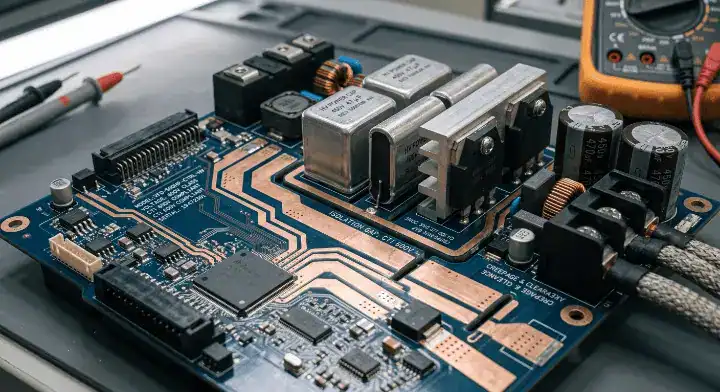
Bottom line: Deploy this specific laminate for all battery management systems and solar inverters, resulting in immediate compliance with high-voltage creepage and clearance safety standards.
| CTI Class | Voltage Rating | Typical Application |
|---|---|---|
| Class IIIa | ≥ 175V | Basic USB Chargers (S1141) |
| Class I | ≥ 400V | Telecom Power Supplies |
| Class 0 | ≥ 600V | EV Chargers & VFDs (S1150G) |
| High CTI ratings drastically shrink the required physical footprint of power delivery boards. |
Which Consumer, Industrial, and Automotive Designs Use S1150G?
S1150G dominates the manufacturing of smart home IoT hubs, industrial automation sensors, and automotive cabin control modules. The substrate handles demanding environmental conditions perfectly while meeting global halogen-free manufacturing mandates for next-generation hardware.
Supporting Dense Consumer Electronics
When designers pack powerful processors into tight plastic enclosures, the ambient temperature near the PCB rises rapidly. The 155°C Tg rating handles continuous 110°C operating environments effortlessly, preventing the copper traces from lifting away from the resin matrix.
You will constantly see this substrate powering:
- High-end dual-band Wi-Fi 6 routers.
- Smart thermostats and security camera mainboards.
- European medical monitoring wearables.
The Automotive Cabin Environment
Automotive Tier-1 suppliers specify this laminate for non-critical cabin electronics because it offers excellent Anti-CAF properties. The low water absorption rate (0.10%) means the board resists electrochemical migration, even when exposed to high humidity and continuous DC bias inside a vehicle dashboard.
Bottom line: Use this material confidently for any device operating in high-humidity or moderately warm environments, which means you secure a 10-year reliable lifespan without paying aerospace-level material premiums.
| Industry | Typical Application | Key Material Benefit |
|---|---|---|
| Consumer IoT | Smart Home Hub | Halogen-Free Compliance |
| Industrial | Automation Sensor | CTI ≥600V |
| Automotive | Cabin Infotainment | Anti-CAF Reliability |
| This versatile chemistry adapts perfectly to multiple mid-tier engineering challenges. |
How Do Fabricators Process S1150G on Standard FR-4 Lines?
Fabricators process S1150G using standardized high-Tg press recipes, typically running lamination cycles at 170°C for 50 minutes. The material requires zero specialized mechanical drilling tools or exotic desmear chemistry, making it completely frictionless for mass production environments.
Factory Integration and Drill Wear
This phosphorus-based resin behaves predictably on the factory floor. Because it does not contain tough ceramic fillers, machine operators use standard chipload parameters for mechanical drilling. A standard drill bit routinely achieves 2,500 to 3,000 hits before requiring resharpening, keeping tooling costs completely suppressed.
The automated optical inspection (AOI) process is similarly straightforward:
- The resin blocks UV light perfectly.
- Trace contrast remains sharp for optical cameras.
- False failure rates stay below standard industry thresholds.
Managing Moisture Before Assembly
While the overall water absorption rate is low, halogen-free phosphorus resins can absorb surface moisture faster than traditional brominated boards if left unpackaged in a humid warehouse.
Bottom line: Mandate a 4-hour pre-bake cycle at 120°C if the bare boards sit unsealed for more than 48 hours, resulting in the total elimination of trapped moisture before the reflow oven.
| Processing Stage | Standard Parameter | Tooling Wear Level |
|---|---|---|
| Lamination Press | 170°C for 50 min | N/A |
| Mechanical Drill | ~2,500 hits/bit | Low (Standard) |
| Desmear Cycle | Standard Time | Normal Etch Rate |
| Standardized processing translates directly to highly competitive fabrication quotes. |
When Should You Upgrade from S1150G to S1170G or S1000-2M?
You must abandon S1150G and upgrade to a premium material whenever your design requires internal heavy copper exceeding 2oz, exceeds 12 routing layers, or utilizes complex HDI microvias. Upgrading to an S1000-2M high-Tg FR-4 upgrade secures a 175°C Tg rating capable of surviving multiple sequential lamination press cycles.
Recognizing the Mid-Tier Limits
S1150G is incredibly capable, but its resin system does not possess the melt-flow characteristics required to encapsulate massive 3oz copper power planes without leaving microscopic voids. When pressing thick 14-layer boards, the extended time inside the lamination press can over-cure the Tg155 resin, causing it to become brittle.
You must upgrade your material if your design features:
- Operating environments consistently exceeding 130°C.
- Sequential lamination cycles (blind/buried vias).
- Military or aerospace compliance mandates.
The Thermal Expansion Trap
As board thickness increases past 2.4mm, the Z-axis expansion during lead-free soldering becomes a massive mechanical threat to via barrels. A Tg175°C material naturally restricts this expansion far better than a Tg155°C material simply because it stays rigid at higher temperatures.
Bottom line: Mandate an immediate transition to a high-Tg 175°C substrate for any design exceeding 12 layers, because the enhanced Z-axis stability completely prevents internal via cracking during wave soldering.
| Design Requirement | S1150G Capability | Required Upgrade |
|---|---|---|
| Double-Sided SMT | Excellent | None |
| > 2oz Heavy Copper | High Risk | S1000-2M (Tg175) |
| HDI Sequential Lam | Guaranteed Failure | S1000-2M / Synamic |
| Knowing the exact breaking point of a substrate prevents catastrophic field failures. |
How Will Halogen-Free Tg150 Materials Evolve Under Strict Rules?
As global regulatory bodies aggressively tighten restrictions on electronic waste, halogen-free Tg150 materials like S1150G will permanently replace standard brominated FR-4 as the default baseline for all commercial manufacturing. High-volume ODMs are actively rewriting their internal design guidelines to ban halogenated materials entirely.
The Death of Traditional FR-4
The European Union’s continuous expansion of REACH and WEEE directives targets the toxic dioxins released when traditional FR-4 burns or enters landfills. Major consumer brands like Apple and Samsung banned brominated flame retardants years ago, and that standard is rapidly trickling down to basic industrial automation and smart home devices.
Watch for these upcoming supply chain shifts:
- Legacy Tg130 materials facing steep volume declines.
- Phosphorus-based resins achieving price parity with bromine.
- Factories stocking Halogen-Free laminates as their standard default.
Actionable Steps for Procurement
If you are still sending fabrication notes specifying generic “FR-4 Tg130,” you are actively building legacy hardware that will soon face regulatory headwinds and localized thermal failures.
Bottom line: Update your company’s standard fabrication templates today to mandate “Halogen-Free Tg150” as the minimum acceptable baseline, which means you instantly future-proof your supply chain against both thermal and legal risks.
| Industry Trend | Impact on S1150G | Impact on Standard S1141 |
|---|---|---|
| Tighter EU RoHS | Massive Growth | Rapid Decline |
| EV High-Voltage | High Adoption (CTI 600V) | Disqualified |
| Lead-Free SMT | Default Standard | High Scrap Risk |
| The industry standard is rapidly shifting toward green, thermally stable chemistries. |
FAQ
Can I use S1150G to replace S1141 for a double-sided SMT board? Yes, this is the exact intended use case. S1150G increases the T288 thermal survival time from 2 minutes to 45 minutes, meaning your board will easily survive the cumulative heat of two separate lead-free reflow passes without any risk of resin blistering.
Is S1150G suitable for 400V industrial power supplies? Yes, it is exceptionally qualified. The material features a Comparative Tracking Index (CTI) of ≥600V, placing it in IEC Class 0. This allows you to route high-voltage traces much closer together safely, unlike standard FR-4 which typically maxes out at a CTI of 175V.
Does switching from standard S1150 to S1150G change my fabrication costs? Yes, you should expect a 10% to 15% increase in raw material costs. This premium covers the advanced organic phosphorus resin required to achieve halogen-free status and the higher 355°C Td rating, but processing costs remain exactly the same.
How do I know if my design requires the halogen-free “G” variant? Check the environmental compliance requirements for your target market. If your product is a consumer wearable, a medical device, or is shipping anywhere within the European Union, you must mandate the halogen-free variant to bypass strict customs audits and RoHS mandates.
Can I use S1150G for a 14-layer heavy copper server board? No, you must upgrade to a Tg175°C material like S1000-2M. While S1150G is highly reliable for standard 4-to-8 layer boards, its resin flow characteristics and Tg of 155°C are not strong enough to survive the intense lamination pressures and Z-axis expansion of thick, heavy-copper multi-layer designs.
Written by the QueenEMS Engineering Team. Ready to upgrade your legacy layouts to highly reliable halogen-free substrates? Contact us today for rapid quotes.
Upload your files today · Free DFM check before production · Ship worldwide
Get your PCB prototypes in as fast as 24 hours. We handle FR4, Rogers, and Flex up to 60 layers — free prototypes for 2–4 layer boards, no minimum order.
Just upload your Gerber + BOM — we source every part, assemble, and inspect (AOI + X‑Ray) so you don't have to chase suppliers. Boards ship in as fast as 24 hours.