
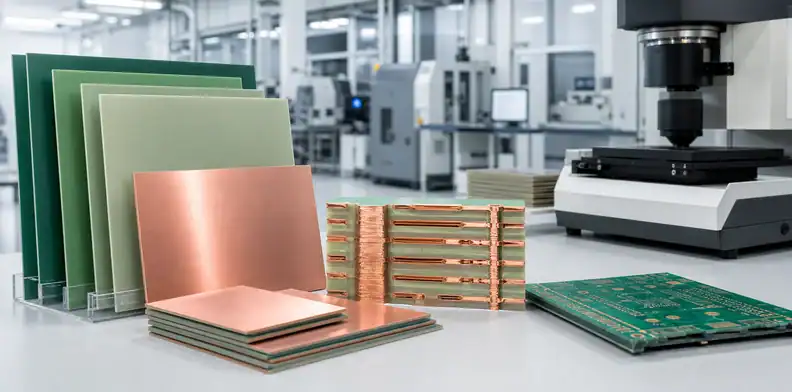
Quick Answer: NP-140 is a brominated, Dicy-cured FR-4 laminate documented in a December 2007 Nan Ya specification. The archived sheet reports typical DSC/TMA Tg values of 140 +/- 5°C / 130°C, plus construction-dependent 1 GHz Dk and Df values. Use those figures for initial screening, but release a PCB only after the fabricator confirms the current grade, construction, datasheet, and qualification evidence.
Key takeaways: – Treat the 2007 sheet as reference data, not a current purchasing specification. – Compare DSC with DSC, TMA with TMA, and electrical values under matched test conditions. – Qualify the actual core, prepreg, copper, and pressed stack-up rather than a grade name alone. – Approve a current alternate before production if NP-140 availability or documentation is uncertain.
A quotation that says only “Nan Ya FR-4” or “Tg135 FR-4” leaves too many decisions open. You still do not know the material revision, available constructions, dielectric inputs, manufacturing site, or substitution rules. The QueenEMS FR-4 material and Tg selection guide explains why a Tg label cannot release a production stack-up by itself.
For the wider material-selection picture across performance, fabrication, and sourcing, refer to the full PCB materials guide.
This guide separates what the archived NP-140 sheet can prove from what your supplier must confirm today. It also shows where the material may fit, when to consider an alternative, and what to include in an RFQ.
Table of Contents
- What Is NP-140 and What Does the Archived Sheet Prove?
- Which Electrical and Thermal Properties Matter Most?
- Can This Material Still Be Specified for a New PCB?
- Does a Corporate Relationship Reduce Qualification Risk?
- How Does NP-140 Compare with Current FR-4 Options?
- When Should You Choose a Higher-Reliability Material?
- Which PCB Applications Are a Reasonable Fit?
- How Should a Fabricator Process and Qualify the Laminate?
- What Should Buyers Put in the RFQ?
- How Should Engineering Release and Control NP-140?
What Is NP-140 and What Does the Archived Sheet Prove?
NP-140 is identified in an archived Nan Ya sheet as a medium-Tg, multifunctional epoxy laminate and prepreg system meeting an FR-4 classification. The document lists a Dicy curing agent, a brominated flame-retardant mechanism, and an IPC-4101/21 reference. Its December 2007 revision establishes historical product identity, not current orderability.
What can you safely take from the old sheet?
Use the sheet to understand the material family and to prepare questions for the supplier. It can support an initial comparison of thermal and electrical properties, provided every value stays attached to its test method and construction.
It cannot prove that the same designation is still manufactured, that every historical construction remains available, or that a present quotation uses the archived formulation. It also cannot establish current UL recognition, environmental declarations, customer approval, or inventory.
| Evidence | Useful for | Still needs current proof |
|---|---|---|
| December 2007 NP-140 sheet | Historical identity and screening values | Current grade, revision, and availability |
| FR-4 and IPC-4101/21 references | Documented classification context | Project-specific approval |
| Dicy and bromine entries | Cure and flame-retardant context | Current compliance documents |
The practical result is simple: keep the archived sheet in the engineering record, but make the current supplier package control the order.
Which Electrical and Thermal Properties Matter Most?
The most useful NP-140 values are not standalone numbers. They are values tied to a method, frequency, thickness class, resin system, and test condition. Without that context, a comparison can make two materials look equivalent when they are not.
How should you read Tg and decomposition data?
The sheet reports typical glass-transition temperature (Tg) values of 140 +/- 5°C by differential scanning calorimetry (DSC) and 130°C by thermomechanical analysis (TMA). These methods observe different material responses, so neither number should be silently converted into a generic “Tg135” value.
Thermal decomposition (Td) also changes with the definition and heating rate. Record whether the number represents onset or 5% weight loss, and whether the test ran at 10°C or 20°C per minute.
Which archived values belong in screening?
| Property | Archived value | How to use it |
|---|---|---|
| Tg, DSC / TMA | 140 +/- 5°C / 130°C | Compare only with the same method |
| Td onset, 10 / 20°C per min | 305°C / 320°C | Keep the heating rate attached |
| Td at 5% loss, 10 / 20°C per min | 312°C / 324°C | Match the decomposition definition |
| Dk at 1 GHz | 3.84 or 4.13 | Identify the thickness class and construction |
| Df at 1 GHz | 0.013 or 0.012 | Use construction-specific design data |
| UL94 | V-0 typical; V-1 minimum | Confirm the supplied construction |
For impedance or loss work, ask the fabricator for the design Dk used in its field solver. Also request the glass style, resin content, pressed thickness, and copper roughness behind that value. The catalog number is a starting point, not a finished-board guarantee.
Can This Material Still Be Specified for a New PCB?
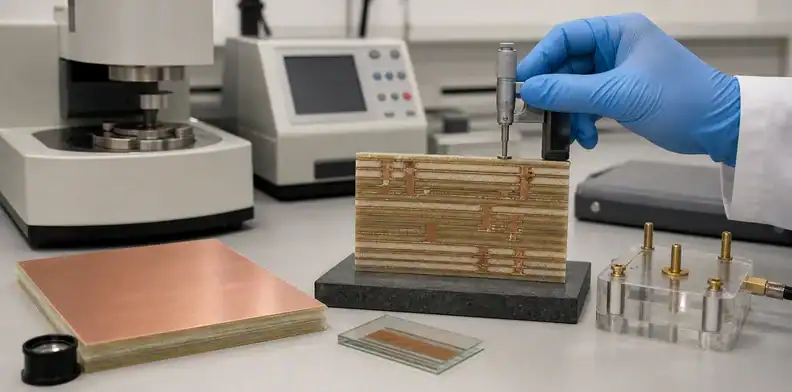
You can specify the material only if the supplier can turn the old designation into a current, controlled construction. It must provide a current sheet, available cores and prepregs, compliance documents, and a traceable supply path. Without them, treat NP-140 as a historical reference rather than a production-ready callout.
What should the supplier confirm?
Ask for a compact identity package before completing the stack-up:
- exact laminate and prepreg designations, including suffixes;
- current controlled datasheet and manufacturing site;
- available glass styles, resin contents, copper types, and thicknesses;
- applicable UL, environmental, and customer documents;
- substitution, change-notification, and lot-traceability rules.
Then compare the available construction with the board’s assembly profile, via structure, impedance plan, field environment, and compliance requirements. A familiar name has no value if the available build cannot meet those conditions.
If your supplier is quoting NP-140 from an archived or incomplete specification, pause before approving the material or an alternate. Send the current datasheet, proposed stack-up, and assembly profile through QueenEMS’ PCB DFM review for a construction-specific assessment.
Does a Corporate Relationship Reduce Qualification Risk?
No. A relationship between a laminate supplier and a PCB manufacturer may improve access to technical contacts. It still does not prove that NP-140 is current, automatically selected, available, or qualified for your board.
What should procurement verify instead?
Ask the quoting fabricator to identify the exact material manufacturer, grade, revision, manufacturing site, and construction. The quotation or quality agreement should also name who handles material questions, traceability, change notifications, deviations, and failure analysis.
A practical review should answer three questions before the material is approved:
- Identity: Does the quotation name the same grade, site, and construction shown in the proposed stack-up?
- Evidence: Are the datasheet, compliance documents, process limits, and test records current and relevant to that construction?
- Authority: Who may approve a deviation, alternate, or site change, and what notice and requalification evidence are required?
If an answer relies on a corporate relationship instead of these records, treat the point as unverified.
Keep commercial assurances separate from engineering proof. Pricing, allocation, lead time, and forecast support belong in the quotation or supply agreement. Stack-up details, compliance documents, process capability, coupons, and test evidence belong in the engineering release package. Neither set of records can replace the other.
A close supplier relationship may make communication easier, but it cannot authorize a material substitution or demonstrate finished-board performance. Approval still depends on the controlled construction, current evidence, defined responsibilities, approved alternates, and a documented change path. If those items are missing, keep the material provisional regardless of the companies involved.
How Does NP-140 Compare with Current FR-4 Options?
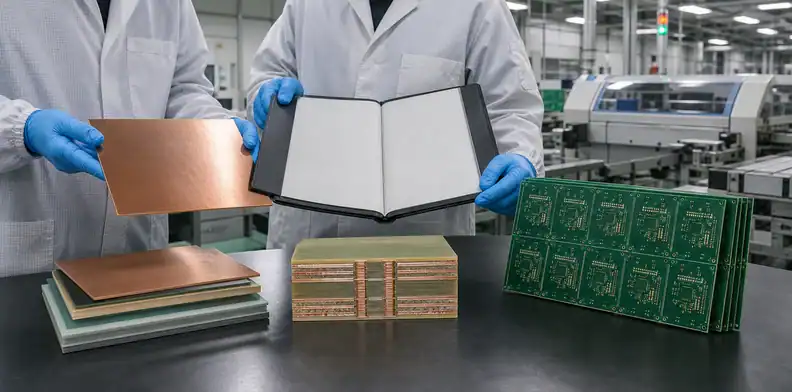
Compare NP-140 with other FR-4 materials only after normalizing the test methods and available constructions. A one-row comparison of nominal Tg values cannot show electrical loss, expansion, thermal endurance, compliance, supply continuity, or fabrication experience.
What belongs in a fair comparison?
Give each candidate supplier the same board requirements and ask for the same evidence:
- exact grade, revision, manufacturing site, and available constructions;
- Tg method, Td definition, T260/T288 method, and z-axis expansion;
- Dk/Df frequency, method, resin content, and glass style;
- halogen status, UL recognition, slash-sheet reference, and customer approvals;
- current cores, prepregs, copper options, lead time, and approved alternates.
| Material | Evidence already reviewed | Main open item |
|---|---|---|
| NP-140 | Archived brominated Dicy FR-4 sheet | Current grade and construction |
| S1141 | Current supplier information must control | Method-matched construction data |
| IT-140 | Archived material information exists | Current grade and approvals |
| KB-6160 | Construction-dependent electrical data exists | Matched thermal and supply data |
The QueenEMS analysis of Shengyi S1141 electrical limits illustrates why construction context matters. Keep unknowns visible instead of filling them with assumptions about brand reputation or nominal Tg.
When Should You Choose a Higher-Reliability Material?
Choose another material when the proposed NP-140 construction cannot show enough margin for assembly, via reliability, channel loss, environment, compliance, or supply continuity. The decision should be tied to a failed requirement, not to the idea that a higher Tg number is automatically better.
Which conditions deserve a closer look?
- repeated lead-free reflow, repair, or selective-solder exposure;
- thick boards, high layer counts, high aspect-ratio holes, or demanding via structures;
- long high-speed channels or a tight insertion-loss budget;
- halogen-free or customer-specific material restrictions;
- missing controlled data, unavailable constructions, or weak change support.
The archived sheet reports T288 values of 2-5 minutes and z-axis expansion of 4.2% or 4.4%. Those values do not automatically reject the material, but they make the actual assembly history and plated-through-hole structure important parts of qualification.
The QueenEMS comparison of IT-180A and standard Dicy FR-4 shows the right decision pattern. Identify the risk, compare a construction that addresses it, and verify the result. If standard FR-4 already passes with margin, a premium grade may add cost without reducing a real risk.
Which PCB Applications Are a Reasonable Fit?
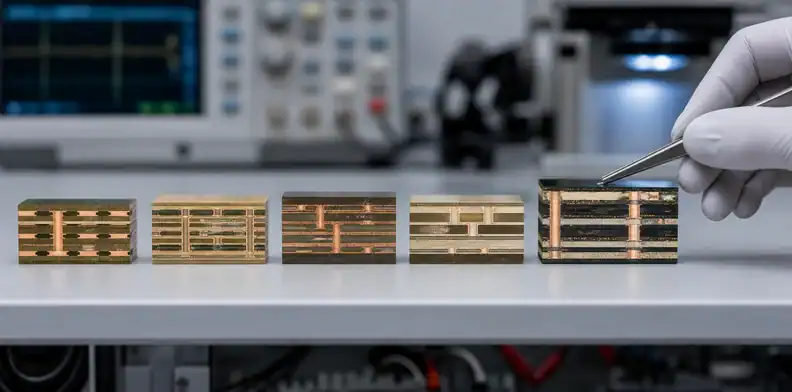
NP-140 may be a reasonable candidate for conventional FR-4 boards when the exact construction meets electrical, thermal, structural, environmental, and compliance requirements. The archived evidence does not identify current named customers or products, so application fit must come from the board’s stress profile.
What does a lower-risk candidate look like?
A practical candidate uses familiar FR-4 processing, moderate electrical demands, and a qualified lead-free assembly profile. Examples may include control and interface boards, ordinary consumer or computing assemblies, and multilayer products with proven plated-through-hole structures.
The application label is less useful than the questions behind it. If phase or impedance margin is tight, this FR-4 permittivity discussion points to a relevant concern: use condition-specific dielectric data. For digital links above 2 GHz, this manufacturability discussion also matters. Model channel length, geometry, loss, and fabrication tolerance instead of judging by frequency alone.
Use deeper qualification for safety-related products, harsh automotive exposure, repeated thermal cycling, demanding HDI, high-layer-count backplanes, or long low-loss channels. These are not automatic failures. They are cases where an archived sheet cannot carry the decision by itself.
How Should a Fabricator Process and Qualify the Laminate?
The archived sheet says common plated-through-hole parameters can be used and includes press-cycle guidance. A fabricator should still control the actual lamination, drilling, desmear, plating, and test process for the supplied construction.
What belongs in the pre-production review?
Confirm the core and prepreg constructions, resin contents, cured thicknesses, copper types, shelf life, storage rules, and press guidance. For a complex multilayer PCB build, review material and stack-up together because resin content and glass style affect pressed thickness, impedance, drilling, and copper balance.
Which records show that the process is controlled?
| Stage | Evidence | Decision it supports |
|---|---|---|
| Incoming material | Grade, lot, storage, and expiry | Identity and traceability |
| Lamination | Press profile and thickness results | Stack-up conformance |
| Hole preparation | Drill and desmear review | Hole-wall quality |
| Plating | Microsection and copper thickness | Via acceptance |
| Electrical test | Impedance, continuity, or loss coupon | Model-to-build agreement |
Match the records to the board’s actual risks. A standard process statement is not enough when the construction, via geometry, or test requirement is unusual.

What Should Buyers Put in the RFQ?
The RFQ should make every supplier quote the same technical and commercial requirement. Otherwise, two prices may represent different materials, stack-ups, factories, substitution rights, and test coverage.
What information prevents an ambiguous quote?
Include:
- exact material callout or a clearly defined approved-equivalent rule;
- Gerber or ODB++ data, layer stack, finished thickness, and copper weights;
- glass styles, resin content, impedance requirements, and copper type where controlled;
- assembly profile, expected thermal cycles, via structure, and reliability tests;
- environmental, flammability, customer, and manufacturing-site requirements;
- quantity forecast, lead-time expectation, change notice, and alternate approval process.
Ask the supplier to identify the current datasheet revision and available construction on the returned stack-up. The QueenEMS PCB Material Selector can organize early trade-offs, but the quotation and approved stack-up must become the controlled release records.
This approach also makes price comparisons more meaningful. Material cost without construction, testing, factory, and change-control context is not a comparable production price.
For an early prototype, state whether a controlled equivalent is permitted and who may approve it. For volume production, add forecast quantities, deviation approval, lot-traceability expectations, and the evidence required before a supplier can change the material or manufacturing site.
How Should Engineering Release and Control NP-140?
Release NP-140 only as one controlled construction with current evidence and a defined change path. Preserve the archived sheet for traceability. Do not let the historical grade name override the supplier’s current material identity, measured results, or approved stack-up.
What belongs in the final release package?
| Release item | Required record | Pass condition |
|---|---|---|
| Material | Current grade, datasheet, and site | Exact identity confirmed |
| Stack-up | Cores, prepregs, copper, and pressed thickness | Build matches the design |
| Performance | Thermal, electrical, via, and coupon evidence | Required margin documented |
| Compliance | Current declarations and approvals | Project requirements matched |
| Change control | Alternate, notice, and approval owners | Substitution path defined |
Separate catalog, design, and measured Dk/Df values in the record. Also state who approves a material revision, manufacturing-site change, or alternate construction. That gives engineering, purchasing, and the fabricator one shared decision instead of three informal assumptions.
For a production quotation, send QueenEMS the Gerber files and PCB requirements. Include the stack-up, quantities, copper weights, assembly profile, material callout, and required tests. If the material is not fixed, the same package can support an engineer comparison with a current qualified alternative.

FAQ
Can I still specify NP-140 on a new PCB?
Yes, if the supplier confirms the exact current grade, construction, manufacturing site, and documentation. Use the 2007 sheet to guide the review, not to replace the controlled supplier package.
How do I know which Tg value to use?
Use the value measured by the method required by your comparison or specification. The archived sheet gives typical DSC/TMA values of 140 +/- 5°C / 130°C, and combining them into one number removes important test context.
What’s the best way to compare it with another FR-4?
Compare matched Tg and Td methods, construction-specific Dk/Df, thermal-endurance tests, expansion, compliance documents, available stack-ups, and supply controls. A nominal Tg or brand name cannot establish equivalence.
Can a fabricator substitute another Tg130 material?
No, not without an approved equivalence review. The alternate can change dielectric behavior, expansion, thermal endurance, halogen status, available prepregs, and process results.
What information is needed for a material decision?
Provide the board data, proposed stack-up, impedance table, copper weights, assembly profile, compliance requirements, quantities, and proposed material callout. Those inputs allow the material decision to be tested against the actual PCB rather than a generic datasheet.
Sources
- Nan Ya NP-140 specification sheet, revision December 2007 (archived manufacturer document reviewed for this article)
Written by the QueenEMS Engineering Team
Upload your files today · Free DFM check before production · Ship worldwide
Get your PCB prototypes in as fast as 24 hours. We handle FR4, Rogers, and Flex up to 60 layers — free prototypes for 2–4 layer boards, no minimum order.
Just upload your Gerber + BOM — we source every part, assemble, and inspect (AOI + X‑Ray) so you don't have to chase suppliers. Boards ship in as fast as 24 hours.