
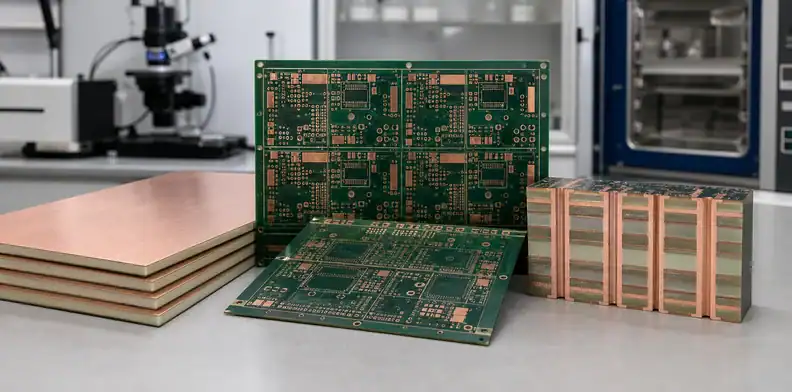
Quick Answer: VT-47 is a phenolic-cured, lead-free-compatible high-Tg FR-4 laminate from Ventec. Its official March 2020 datasheet lists typical Tg of 180°C by DSC/TMA, Td of 355°C, T288 above 30 minutes, total z-axis expansion of 2.3%, and 1 GHz Dk/Df of 4.27/0.016 at 50% resin content; the August 2025 process guide adds construction-specific impedance values and fabrication guidance.
Key takeaways: – Use the official datasheet values with their methods, limits, and revision dates. – Select Dk/Df by core or prepreg construction, not from the headline property table alone. – Treat Ventec’s certifications and global service network as supplier evidence, not proof that any named OEM mandates the material. – Qualify lamination, drilling, desmear, moisture handling, and assembly as one controlled process.
Official source: Read the Ventec VT-47 technical datasheet (PDF). The published values depend on test method and construction; confirm the current revision and proposed core/prepreg stack-up before release.
A drawing that says “high-Tg FR-4” can still produce mismatched quotations. One supplier may model a 2116 construction, another may use 7628, and a third may substitute a different resin system. That changes dielectric thickness, impedance, loss, pressing behavior, and qualification evidence even when each quote carries a similar Tg label.
To compare laminate families, electrical behavior, fabrication limits, and sourcing trade-offs in one place, use the complete PCB materials guide.
Table of Contents
- What Is VT-47 and Which Claims Are Documented?
- Which Thermal and Electrical Properties Matter Most?
- Where Does This Material Fit in Ventec’s Portfolio?
- How Does Ventec’s Global Structure Affect Qualification?
- How Does VT-47 Compare with Other High-Tg FR-4?
- When Should You Choose a Different Material Family?
- Which PCB Applications Fit the Published Capability?
- How Should Fabricators Process and Test the Laminate?
- What Should a High-Tg Material RFQ Include?
- How Do You Release VT-47 for Production?
What Is VT-47 and Which Claims Are Documented?
VT-47 is a Ventec high-Tg FR-4 laminate and prepreg system intended for lead-free assembly. Ventec identifies it as phenolic-cured, CAF-resistant, UV-blocking, and low in z-axis CTE, with UL file E214381 and IPC-4101E slash-sheet references /97, /98, /99, /101, and /126.
What does the current source package contain?
The official product page publishes a March 2020 datasheet and an August 2025 process guide. Together they cover properties, availability, storage, pressing, drilling, desmear, baking, and construction-specific design Dk/Df.
- core thickness from 0.002 to 0.200 inch;
- copper foil from 1/4 oz to 12 oz;
- common glass styles from 106 through 7628;
- typical and specification columns for the main property table;
- process guidance that fabricators must adapt to their own equipment.
Which marketing claims should be excluded?
Ventec’s official corporate page says the holding company was established in the Cayman Islands, is listed on the Taiwan Stock Exchange, and has manufacturing facilities in Taiwan and China. It does not support the brief’s “Swiss headquarters” claim, “only European-headquartered Asian CCL supplier” claim, or assertions that Siemens, ABB, Schneider, or Bosch specify VT-47.
| Claim | Evidence status | Safe use |
|---|---|---|
| High-Tg phenolic FR-4 | Official datasheet | State with revision |
| Taiwan/China manufacturing | Official company page | State as corporate footprint |
| Named European OEM use | Not verified | Exclude |
Key Takeaway — Bottom line: Base the VT-47 specification on Ventec’s product records, not on unsupported headquarters or customer stories.
Which Thermal and Electrical Properties Matter Most?
VT-47’s main thermal screening values are typical Tg 180°C by DSC and TMA, typical Td 355°C, T260 above 60 minutes, T288 above 30 minutes, and total z-axis expansion of 2.3% from 50°C to 260°C. These values remain test- and construction-dependent and do not replace finished-board qualification.
How should you read typical and minimum values?
The datasheet separates specification limits from typical results. DSC Tg has a 170°C minimum and 180°C typical value; Td has a 340°C minimum and 355°C typical value; T288 has a 15-minute minimum and a typical result above 30 minutes.
Use minimum values for procurement limits and typical values for engineering estimates. A typical result is not guaranteed unless the purchase specification adopts it.
Which electrical value belongs in the solver?
The headline table reports 1 GHz Dk/Df of 4.27/0.016 at 50% resin content under IPC-TM-650 2.5.5.9. The 2025 guide then lists design values by core or prepreg construction; for cores, 1 GHz Dk ranges from 3.75 to 4.35 and Df from 0.014 to 0.017.
| Property | Minimum specification | Typical value |
|---|---|---|
| Tg by DSC | 170°C | 180°C |
| Td by ASTM D3850 | 340°C | 355°C |
| T288 | 15 minutes | >30 minutes |
| Total z-axis expansion | 3.0% maximum | 2.3% |
| Dk/Df at 1 GHz, 50% RC | 5.2 / 0.035 limits | 4.27 / 0.016 |
The headline table screens the resin system; the construction table supports the stack-up model.
Key Takeaway — Bottom line: Put specification limits in purchasing controls and construction-specific design values in the impedance model.
Where Does This Material Fit in Ventec’s Portfolio?
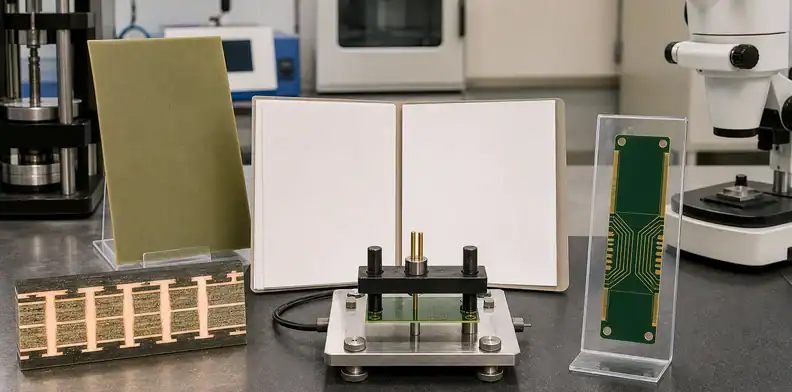
VT-47 occupies Ventec’s lead-free high-Tg FR-4 category, not its polyimide or low-loss signal-integrity families. The official site lists VT-901 under polyimide, so it should not be described as a simple high-Tg FR-4 upgrade from VT-47.
Which nearby options require separate qualification?
Ventec publishes VT-47 LT and VT-481 in lead-free groups, VT-447 grades in halogen-free groups, and tec-speed families for signal-integrity or RF work. Similar names do not establish equal properties or processing.
- choose a halogen-free family when the compliance requirement is explicit;
- choose a lower-loss family when channel analysis shows a loss problem;
- choose polyimide only when its thermal or mechanical behavior is required;
- choose a related VT-47 variant only after reviewing its own datasheet.
How should the requirement map to a family?
| Design driver | Material question | Evidence to compare |
|---|---|---|
| Lead-free thermal margin | Can VT-47 meet the profile and via risk? | Tg, Td, T288, expansion |
| Halogen restriction | Which approved halogen-free grade fits? | IEC/UL declaration and TDS |
| Long high-speed channel | Is standard FR-4 loss acceptable? | Construction Dk/Df and loss model |
| Extreme thermal duty | Is polyimide justified? | Field stress and process qualification |
The QueenEMS PCB Material Selector can help organize these drivers before a stack-up is built. The current Ventec datasheet for the chosen family must control the final decision.
Key Takeaway — Bottom line: Keep VT-47 in the high-Tg FR-4 lane and change families only for a documented compliance, loss, or thermal need.
How Does Ventec’s Global Structure Affect Qualification?
Ventec’s global structure can improve access to manufacturing, service, and technical contacts, but it does not guarantee OEM approval or identical availability. The company lists four manufacturing facilities in Asia and service centers across several regions.
What does the official footprint show?
Ventec lists locations in Taiwan, China, Europe, and North America. Its certification page lists site-specific ISO 9001, IATF 16949, AS9100, and environmental certificates.
Those records support a supplier audit, but each certificate must be matched to the relevant site and activity.
Which governance questions matter to an OEM?
- Which Ventec manufacturing site made the laminate and prepreg?
- Which quality and environmental certificates cover that site?
- Which UL and IPC references cover the exact construction?
- Who provides change notice, technical support, and failure-analysis records?
- How are lots traced from laminate shipment to finished PCB?
| Audit area | Useful Ventec evidence | Project evidence still needed |
|---|---|---|
| Quality system | Site-specific certificates | Fabricator’s own certification |
| Material identity | Datasheet and UL file | Lot certificate and traveler |
| Regional support | Office and service-center list | Contracted response path |
Key Takeaway — Bottom line: Use Ventec’s global records to identify accountable sites and contacts, then audit the actual supply path for the PCB.
How Does VT-47 Compare with Other High-Tg FR-4?
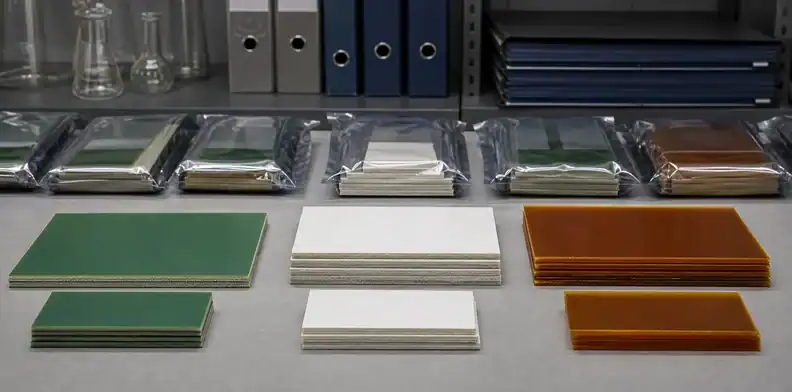
VT-47 should be compared with 370HR, S1170G, IT-170, TU-768, NP-170, or other high-Tg FR-4 with method-matched data and buildable constructions. A seven-brand table with mixed revisions and undefined test methods creates false precision.
Which fields make the comparison useful?
Start with the stack-up and assembly profile. Request matched definitions, frequencies, resin contents, glass styles, copper, sites, compliance documents, and commercial assumptions.
- Tg by DSC and TMA, not one merged number;
- Td method and percentage mass-loss definition;
- T260/T288, CTE before and after Tg, and total expansion;
- construction Dk/Df from 1-10 GHz where relevant;
- CAF evidence, moisture absorption, UL, IPC, and halogen status;
- available cores, prepregs, copper, lead time, and approved sites.
QueenEMS’ S1170G and S1000-2M comparison and IT-170 variant guide show why a family or suffix matters. The TU-768 material guide provides another internal decision framework, not independent proof of equivalence.
How should the decision matrix look?
| Decision field | VT-47 source | Pass question |
|---|---|---|
| Thermal endurance | 2020 official TDS | Does the minimum meet the profile? |
| Design Dk/Df | 2025 process guide | Does the proposed construction match? |
| Site certification | Current Ventec certificate page | Does it cover the supply site? |
| Price/lead time | Dated quotation | Is it valid for this quantity and region? |
Key Takeaway — Bottom line: Compare verified evidence and buildable stack-ups; do not rank brands with unmatched catalog numbers.
When Should You Choose a Different Material Family?
Choose a different material family when VT-47 cannot meet a named requirement for loss, halogen status, thermal exposure, mechanical behavior, certification, or available construction. Do not change solely because another material has a higher Tg label.
Which triggers point away from standard high-Tg FR-4?
A long channel may fail its loss budget despite passing thermal tests. A halogen-free rule can reject a grade regardless of reflow margin. Extreme thermal duty may justify polyimide after trade-offs are modeled.
- measured or modeled loss exceeds the channel budget;
- the customer specification requires a documented halogen-free grade;
- repeated high-temperature exposure exceeds the qualified process window;
- the required glass style, resin content, copper, or thin core is unavailable;
- a site or certification requirement cannot be satisfied;
- field cycling or via testing shows insufficient margin.
What is the right upgrade test?
Define the failure mechanism, select a candidate that addresses it, then compare coupons or representative boards. A Tg increase without lower expansion, better T288, suitable construction, or verified process control may not reduce the real risk.
| Failed requirement | Candidate direction | Verification |
|---|---|---|
| Channel loss | Lower-loss tec-speed family | Modeled and measured insertion loss |
| Halogen rule | Documented halogen-free family | Current declaration and TDS |
| Via thermal margin | Lower expansion or changed design | Cycling and microsections |
For a halogen-led decision, use QueenEMS’ halogen-free PCB specification guide to define the compliance and manufacturing requirements.
Key Takeaway — Bottom line: Change families only when the replacement fixes a measured or documented gap in the VT-47 construction.
Which PCB Applications Fit the Published Capability?
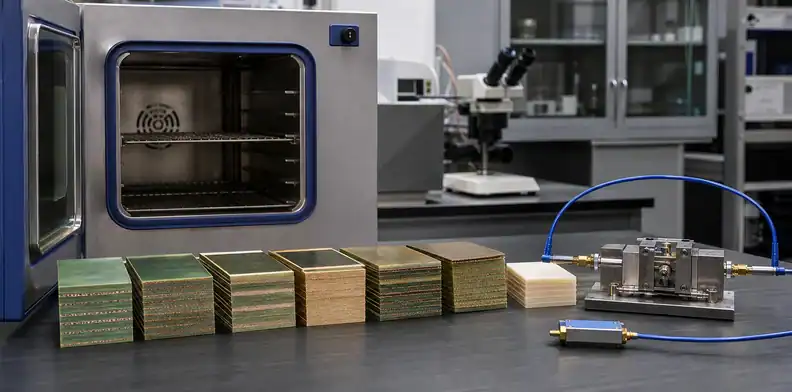
VT-47 is a credible candidate for lead-free multilayer boards in computing, communications, instrumentation, server, router, automotive, medical, and related applications listed by Ventec. Those categories show intended use, not automatic approval for a safety class, environment, layer count, or OEM.
What does a reasonable starting application look like?
A good candidate needs higher thermal margin, a buildable VT-47 core/prepreg set, and a controlled lead-free profile. The published expansion and T288 results support further plated-through-hole qualification.
- multilayer industrial controls exposed to lead-free assembly;
- communication or computing boards with moderate channel lengths;
- automotive or medical electronics where the full quality plan is separately approved;
- thick or thermally demanding boards that pass coupon and microsection review.
What should not be inferred from the application list?
Do not infer functional safety, regulatory approval, OEM approval, signal integrity, or unlimited reflow cycles. Those decisions need product standards, assembly data, tests, and qualified sites.
| Application question | Datasheet contribution | Missing project evidence |
|---|---|---|
| Can it survive assembly? | Thermal property screening | Actual profile and board test |
| Can it meet impedance? | Construction design Dk | Geometry and coupons |
| Is it approved for the product? | UL/IPC context | Customer and regulatory approval |
QueenEMS’ multilayer PCB manufacturing page gives a starting point for discussing stack-up, via, and test requirements.
Key Takeaway — Bottom line: Use the application list to begin qualification, then approve the exact board against its own standards and stress profile.
How Should Fabricators Process and Test the Laminate?
Fabricators should process VT-47 with a controlled recipe based on Ventec’s 2025 guide and their own qualified equipment. The guide recommends more than 60 minutes above 185°C material temperature, full pressure of at least 250-300 psi, and continued vacuum to above 140°C, but these are vendor starting points rather than a universal press program.
Which process controls deserve attention?
Ventec advises checking oxide compatibility, controlling brown-oxide peel strength above 2 lb/in, tuning drilling by diameter, and adjusting desmear because VT-47 removes more slowly than conventional FR-4.
- store prepreg below 23°C and 55% RH for up to three months, or below 5°C for up to six months;
- reseal opened prepreg if it will not be consumed within 48 hours;
- control glass direction, thin-core handling, resin content, and pressed thickness;
- qualify drill chip load and hit count on the actual stack-up;
- adjust desmear, then verify resin removal and hole-wall condition.
Which tests should close the loop?
| Process stage | Control record | Verification |
|---|---|---|
| Incoming/storage | Lot, expiry, temperature, humidity | Material identity and condition |
| Lamination | Material-temperature profile and pressure | Thickness, registration, cure |
| Drill/desmear | Tool and chemistry parameters | Hole-wall microsection |
| Plating | Copper process record | Copper thickness and defects |
| Electrical | Solver data and coupons | Impedance and continuity |
Ventec recommends baking finished boards at 125°C for 4-8 hours before packaging. The fabricator must reconcile that advice with finishes, components, customer rules, and its validated process.
Key Takeaway — Bottom line: Start with Ventec’s guide, then lock the recipe only after representative VT-47 panels pass thickness, microsection, and electrical checks.
What Should a High-Tg Material RFQ Include?
A VT-47 RFQ should define the exact construction, supplier site, document revisions, board stress, and approval path. Without those fields, a bidder may quote a different high-Tg FR-4, a different glass/resin combination, or a different test package while appearing to meet the same material note.
Which technical inputs should the buyer attach?
Send the fabrication data, stack-up, thickness, copper, impedance, holes, assembly and rework profile, compliance needs, and tests. Ask for a returned stack-up with core/prepreg codes and design values.
- exact VT-47 laminate and prepreg callout;
- Ventec datasheet and process-guide revision;
- manufacturing site and applicable UL/certification records;
- glass style, resin content, pressed thickness, and copper type;
- design Dk/Df, frequency, solver assumptions, and coupon plan;
- approved alternates, notification period, and requalification triggers.
Which commercial answers affect engineering risk?
Price and lead time should be dated and tied to quantity, construction, region, and site. Ask whether prototypes and volume use the same build and who bears material minimums.
| RFQ response | Why it matters | Approval owner |
|---|---|---|
| Exact site and lot path | Traceability and certificates | Quality |
| Buildable stack-up | Thickness and impedance | Engineering |
| Assembly/test plan | Reliability evidence | Engineering/quality |
| Dated commercial terms | Supply planning | Purchasing |
Key Takeaway — Bottom line: Require the supplier to return a complete, buildable VT-47 proposal before comparing price or delivery.
How Do You Release VT-47 for Production?
Release VT-47 through a controlled package connecting material identity, stack-up, process, assembly, tests, site, and change rules. The name alone is not a release record.
What belongs in the signed release?
Separate catalog typicals, construction design values, and measured coupon results. Name the document revisions, cores, prepregs, copper, site, UL file, certificates, and acceptance tests.
- signed drawing and stack-up with revision control;
- current supplier documents and site-specific approvals;
- impedance model, coupon geometry, and result limits;
- lamination, drill, desmear, plating, and storage controls;
- lead-free assembly profile and reliability evidence;
- alternate-material matrix and written deviation authority.
Which changes reopen qualification?
Reopen the decision after a resin, glass, copper, site, construction, assembly, document, performance, moisture, or compliance change.
| Change | Review | Typical evidence |
|---|---|---|
| Different VT-47 construction | Electrical and thickness model | Impedance coupon |
| Different Ventec site | Document and process equivalence | First article |
| New reflow profile | Thermal margin | Reflow and microsection |
Send the proposed stack-up and assembly profile through QueenEMS’ free PCB DFM review when the material decision is still open. For a production quotation, contact QueenEMS with the full fabrication package and state whether VT-47 is mandatory or a controlled equivalent may be proposed.
Key Takeaway — Bottom line: Keep VT-47 approved only while the exact construction, supplier site, process, test evidence, and change history remain controlled.

FAQ
Can I use 4.27 as the Dk for every VT-47 layer?
No. The 4.27 figure is a 1 GHz typical value at 50% resin content in the headline datasheet table. Use the 2025 construction table and the fabricator’s stack-up-specific design Dk, then verify impedance with coupons.
What is the best number to use for VT-47 Tg?
Use the value and method required by the specification. The official datasheet states a 170°C minimum and 180°C typical Tg by DSC, while TMA also shows a 180°C typical result.
How do I know if VT-47 can survive my reflow profile?
Compare the actual profile, number of cycles, board thickness, moisture condition, and via structure with the minimum Td/T260/T288/expansion requirements, then test representative panels. Catalog data is screening evidence rather than finished-board proof.
Can I specify VT-47 for a halogen-free PCB?
Not without current documentation showing that the exact supplied grade meets your halogen requirement. Ventec lists separate halogen-free product families, so qualify the correct grade rather than inferring status from “FR-4.”
What should I send a fabricator for a VT-47 quote?
Send the Gerber or ODB++ package, proposed stack-up, impedance table, copper weights, hole details, finished thickness, assembly profile, compliance requirements, quantity, tests, and material substitution rule. This allows a construction-specific quote.
Sources
- Ventec VT-47 official datasheet, published March 19, 2020
- Ventec VT-47 official process guide, published August 12, 2025
- Ventec company overview
- Ventec global locations
- Ventec approvals and accreditations
Written by the QueenEMS Engineering Team
Upload your files today · Free DFM check before production · Ship worldwide
Get your PCB prototypes in as fast as 24 hours. We handle FR4, Rogers, and Flex up to 60 layers — free prototypes for 2–4 layer boards, no minimum order.
Just upload your Gerber + BOM — we source every part, assemble, and inspect (AOI + X‑Ray) so you don't have to chase suppliers. Boards ship in as fast as 24 hours.