
Table of Contents
- What Is Megtron 7 and Why Is It the Bridge Between M6 and M8?
- Which of the Four Megtron 7 Variants Should You Spec?
- Where Does Megtron 7 Sit in Panasonic’s Four-Tier Lineup?
- Which H200 and 800G Designs Still Run on Megtron 7 Today?
- How Does Megtron 7 Compare to Tachyon 100G at the M7 Grade?
- When Should You Upgrade from Megtron 6 or Jump to Megtron 8?
- What Stackup Rules Apply to Megtron 7 High-Layer-Count Boards?
- How Do Fabricators Process Megtron 7 vs Megtron 6 and Megtron 8?
- What Are the Halogen-Free and Cost-Down Alternatives to Megtron 7?
- How Will Megtron 7 Evolve as 1.6T and 224G Become Mainstream?
- Frequently Asked Questions (FAQ)
What Is Megtron 7 and Why Is It the Bridge Between M6 and M8?
Panasonic Megtron 7 (R-5785) is an ultra-low-loss PCB laminate built on a proprietary polyphenylene ether (PPE) resin system. Boasting a Dissipation Factor (Df) of 0.0015 at 10 GHz, it sits in the highly competitive M7 material grade category.
For the wider material-selection picture, including laminate properties, process constraints, and substitution risks, see our PCB materials guide.
In the hardware hardware evolution timeline, Megtron 7 serves a highly specific, strategic purpose: it is the primary bridge material connecting the 400G/H100 era (dominated by Megtron 6) and the emerging 1.6T/GB200 era (which demands Megtron 8). For 800G Ethernet switches and NVIDIA H200 SXM modules, Megtron 7 provides the exact channel margin required for 56 Gbps and 112 Gbps PAM4 signaling without incurring the extreme cost premiums of next-generation M8 laminates.
Which of the Four Megtron 7 Variants Should You Spec?
When engineers refer to “Megtron 7,” they are usually talking about one specific variant, but Panasonic officially offers four configurations under the R-5785 / R-5680 (prepreg) umbrella. Specifying the wrong one can either compromise your SI budget or inflate your BOM cost unnecessarily.
| Variant | Laminate / Prepreg | Glass Style | Copper Foil | Primary Use Case |
|---|---|---|---|---|
| Megtron 7(GN) | R-5785(GN) / R-5680(GN) | Low-Dk glass | H-VLP | The Default: Lowest loss configuration, used in 90% of designs. |
| Megtron 7(GE) | R-5785(GE) / R-5680(GE) | Standard E-glass | H-VLP | Cost-Down: Slightly higher Dk (~3.4), but 15-20% cheaper material cost. |
| Megtron 7(N) | R-5785(N) / R-5680(N) | Low-Dk glass | Standard (RTF) | Niche applications where H-VLP copper is not required. |
| Megtron 7(R) | R-5785(R) | Low-Dk glass | Buried Resistor | Specialized designs requiring embedded resistors (DDR termination). |
Engineering Bottom Line: For 800G switches and AI accelerators, R-5785(GN) is the true “Megtron 7N” industry standard. If your 56G PAM4 channels are short and you are under pressure to cut costs, stepping down to the (GE) variant is a viable strategy.
Where Does Megtron 7 Sit in Panasonic’s Four-Tier Lineup?
Understanding Megtron 7 requires context within the broader Panasonic ecosystem.
| Tier | Panasonic Product | Df @ 10 GHz | Typical Application | NVIDIA Platform Equivalent |
|---|---|---|---|---|
| M4 | Megtron 4 (R-5725) | ~0.005 | Server core/power layers | GB200/GB300 core logic |
| M6 | Megtron 6 (R-5775) | ~0.004 | 400G switches | H100 baseboards |
| M7 | Megtron 7 (R-5785) | 0.0015 | 800G switches | H200 SXM modules |
| M8 | Megtron 8 (R-5795) | 0.0010-0.0012 | 1.6T / 224G | GB200 Bianca boards |
When Panasonic designed the Megtron family, they engineered each tier to cover a specific generation of networking and computing: Megtron 4 for the 10G era, Megtron 6 for 25G-100G, Megtron 7 for 56G-112G, and Megtron 8 for 112G-224G. What makes the Panasonic stack unique is that all four tiers use the same PPE resin family with incremental modifications — lower-polarizability variants of the same base chemistry. For fabricators, this means the press recipe, desmear cycle, and handling procedures are nearly identical across all four generations. If your fab runs Megtron 6 at production yield, qualifying Megtron 7 is a one-lot engineering exercise. The drill parameter shift from M6 to M7 is roughly 15% chipload reduction. From M7 to M8, another 7%. From a supply chain perspective, all four tiers come from the same Panasonic factories in Japan, through the same distributor network. This backward compatibility across tiers is why Panasonic dominates multi-generation product lines where a customer’s boards span M6 through M8 in a single equipment rack.
You can view the full lineup on the Panasonic Megtron Series official page.
Which H200 and 800G Designs Still Run on Megtron 7 Today?
Megtron 7 is currently experiencing its peak deployment phase. It is the dominant material for 800G Ethernet switch line cards (such as those based on Tomahawk 5 and Spectrum-4 ASICs), InfiniBand NDR (Quantum-2) network switches, and 5G AAU digital basebands running eCPRI 25-112G.
A recent project we built approximated an H200-era compute module — a 22-layer construction with 16 signal layers of Megtron 7(GN) carrying a mix of 56 Gbps PAM4 SerDes, PCIe Gen5, and 100G Ethernet interfaces, plus 6 power and ground layers using Megtron 4 equivalent. The customer’s SI team had modeled all high-speed channels against Megtron 7(GN) Dk/Df values, and our coupon measurements confirmed insertion loss at 0.68 dB/inch at 28 GHz on 4 mil stripline with H-VLP copper. On the longest 56G PAM4 channel at 16 inches, total channel loss measured 10.9 dB — within the 14 dB budget with 3.1 dB margin. First-pass yield landed at 94% across 30 panels. Material lead time was 6 weeks through our authorized Panasonic distributor. The customer noted this board would have been impossible on Megtron 6 — the same 16-inch channel on Megtron 6 would have consumed approximately 13.5 dB, leaving less than 0.5 dB of margin — not production-viable.
How Does Megtron 7 Compare to Tachyon 100G at the M7 Grade?
The fiercest rivalry in the M7 material space is between Megtron 7 and Isola Tachyon 100G. Both are engineered for 100Gbps/lane performance, but they attack the problem differently.

| Feature | Panasonic Megtron 7(GN) | Isola Tachyon 100G |
|---|---|---|
| Df @ 10 GHz | 0.0015 | 0.0021 |
| Dk @ 10 GHz | ~3.3 | 3.02 |
| Tg (DSC) | ~185-190°C | 215°C |
| Z-CTE | ~40-45 ppm/°C | 45 ppm/°C |
| Copper Type | H-VLP / HVLP2 | HVLP / HVLP3 |
| Insertion Loss @ 28 GHz | ~0.65-0.70 dB/inch | ~0.60-0.65 dB/inch |
| Astra MT77 Hybrid | ⚠️ Not official design intent | ✅ Officially CTE-matched |
| Price vs FR-4 | 6-9× | 3-5× |
We ran a head-to-head build for a customer designing an 800G switch line card — identical 20-layer stackup, one set on Megtron 7(GN) and one set on Tachyon 100G, both with H-VLP copper on the twelve signal layers. Insertion loss at 28 GHz on the Megtron 7(GN) stripline traces measured 0.67 dB/inch versus 0.62 dB/inch on the Tachyon 100G build — a 7% difference that on the customer’s 18-inch worst-case channel translated to roughly 0.9 dB of additional loss on Megtron 7. Both closed the 14 dB channel budget. The cost story was the more decisive factor: Megtron 7(GN) material cost ran approximately 65% higher than Tachyon 100G on a per-panel basis. For the customer’s 500-board production run, switching from Megtron 7 to Tachyon 100G saved approximately $42,000 in material cost alone, with a 0.9 dB loss penalty they considered acceptable against a 2.8 dB budget margin. The customer chose Tachyon 100G for production and reserved Megtron 7 for a follow-on design where the link was 24 inches and the tighter margin justified the premium.
For a deeper dive into the Isola alternative, review the Isola Tachyon 100G ultra-low-loss specifications.
When Should You Upgrade from Megtron 6 or Jump to Megtron 8?
Hardware architects face a constant dilemma: stick with legacy materials or pay the premium for next-gen laminates. Here is the bidirectional decision framework:
When to Upgrade from Megtron 6 to Megtron 7:
- Your fastest signals transition from 28 Gbps NRZ to 56 Gbps PAM4.
- Your longest link lengths exceed 15 inches operating near 28 GHz Nyquist frequencies.
- Your SI modeling shows your channel budget margin dropping below 3 dB on Megtron 6.
- You need an H200-class reference design equivalent.
When to Jump from Megtron 7 to Megtron 8:
- Your signaling speed leaps to 112 Gbps PAM4 or emerging 224G PAM4.
- You require link lengths exceeding 18 inches at extreme frequencies.
- You are aligning with the NVIDIA Blackwell platform PCB material allocation (GB200/GB300), which establishes Megtron 8 as the baseline.
- Your SI simulation demands an additional 2-3 dB margin that Megtron 7 cannot physical yield.
If your product lifecycle is >18 months and you are targeting 1.6T infrastructure, skipping M7 and going straight to Megtron 8 M8-grade manufacturing and AI server applications is the more future-proof strategy.
What Stackup Rules Apply to Megtron 7 High-Layer-Count Boards?
Megtron 7 is routinely pressed into 20 to 30+ layer high-density interconnect (HDI) constructions. Because it utilizes a PPE resin blend that complies with standard IPC-4101E specs, it handles sequential lamination exceptionally well.
For 800G switches, hybrid stackups are common. To control material costs, signal layers utilize R-5785(GN), while internal power and ground layers use standard Megtron 4 or high-Tg FR-4. Due to the ~40-45 ppm/°C Z-axis CTE, Megtron 7 provides excellent reliability for deep plated through-holes (PTH) and multiple microvia structures. For these complex builds, partnering with an experienced provider of HDI PCB fabrication for 30+ layer designs ensures proper registration and via-in-pad plating.
How Do Fabricators Process Megtron 7 vs Megtron 6 and Megtron 8?
From the fabrication floor perspective, the transition between Panasonic tiers is heavily focused on mechanical drilling, not chemical processing.
- Lamination & Desmear: Megtron 6, 7, and 8 all use nearly identical lamination cycles (approx. 200°C for 60-90 minutes). Standard alkaline permanganate desmear processes work efficiently; no exotic plasma etching is required.
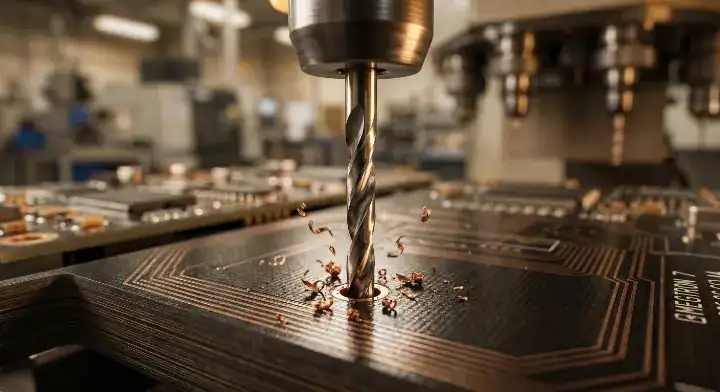
- Drilling Differences: Because Megtron 7 uses a denser PPE matrix and Low-Dk glass compared to Megtron 6, drill chiploads must be reduced by roughly 15%. Consequently, drill tool life drops from ~2500 hits on M6 to about ~2000 hits on M7. Advancing to Megtron 8 requires an additional 7% chipload reduction, capping drill life near ~1800 hits.
Compared to Tachyon 100G processing and HVLP3 copper pairing, Megtron 7 processing feels remarkably familiar to any factory already accustomed to the Panasonic Megtron ecosystem.
What Are the Halogen-Free and Cost-Down Alternatives to Megtron 7?
Megtron 7 R-5785 is standard, meaning it uses halogenated flame retardants to achieve its UL 94 V-0 rating. If European environmental regulations mandate a halogen-free design for your 800G hardware, Megtron 7 is disqualified.
For Halogen-Free applications requiring M7/M8 performance, engineers typically pivot to materials like the EM-892K2 halogen-free M8 laminate from EMC, which offers 112G-capable loss characteristics without the halogens.
For Cost-Down strategies without leaving the Panasonic family, specifying the R-5785(GE) variant (Standard E-glass instead of Low-Dk glass) can reduce raw material costs by up to 20% while maintaining the Megtron 7 resin system.
How Will Megtron 7 Evolve as 1.6T and 224G Become Mainstream?
While Megtron 7 dominates the current H200 and 800G network rollout, its reign at the bleeding edge is limited. As data centers push toward 1.6T Ethernet and 224 Gbps PAM4 lane speeds, the industry is already rapidly adopting Megtron 8, and researchers are evaluating the next-generation M9 CCL grade for AI server platforms.
Megtron 7 will not disappear; instead, it will displace Megtron 6 as the “mid-tier” high-performance default for enterprise routers, high-end workstations, and edge AI servers over the next 3 to 5 years.
Frequently Asked Questions (FAQ)
Should I use Megtron 7 or Tachyon 100G for an 800G switch?
Both are M7-grade materials. Megtron 7(GN) has a lower Df (0.0015) than Tachyon 100G (0.0021), meaning lower signal loss. However, Megtron 7 can be up to 65% more expensive. If budget allows and you are in the Panasonic ecosystem, use Megtron 7. If cost is critical or you need a hybrid stackup matched with Astra MT77, Tachyon 100G offers better ROI.
Which Megtron 7 variant should I actually specify on my fabrication drawing?
For 90% of high-speed digital designs, you should specify R-5785(GN). This combines Low-Dk glass with H-VLP copper to achieve the lowest possible insertion loss. If you are highly cost-sensitive and can sacrifice slight impedance performance, specify R-5785(GE) to use standard E-glass.
Can Megtron 7 handle 112G PAM4 signals?
Yes, but with caveats. For short-reach 112G PAM4 links (under 15 inches), Megtron 7(GN) provides adequate margin. However, for long-reach links exceeding 18 inches at 112G speeds, Megtron 7 reaches its physical limits, and you must upgrade to Megtron 8 to safely close the channel budget.
How does Megtron 7 processing differ from Megtron 6?
The lamination and desmear cycles are nearly identical, making it easy for fabricators to adopt. The main difference is mechanical: Megtron 7 requires a 15% reduction in drill chipload compared to Megtron 6, and drill tool life drops from roughly 2500 hits down to 2000 hits due to the denser PPE resin matrix.
Should I skip Megtron 7 and go directly from M6 to M8?
If your next design leap targets 1.6T infrastructure or 224G PAM4, absolutely skip Megtron 7 and jump to Megtron 8. If your product cycle is targeting immediate 800G deployment over the next 18 months, Megtron 7 is the appropriate, cost-optimized choice.
If you are finalizing your 800G stackup or need help modeling impedance on R-5785(GN) materials, contact us today to review your Dk/Df calculations before cutting tooling.
Written by the QueenEMS Engineering Team
Upload your files today · Free DFM check before production · Ship worldwide
Get your PCB prototypes in as fast as 24 hours. We handle FR4, Rogers, and hybrid boards up to 40 layers in volume production, with advanced builds subject to engineering review — free prototypes for 2–4 layer FR-4 boards, no minimum order.
Just upload your Gerber + BOM — we source every part, assemble, and inspect (AOI + X‑Ray) so you don't have to chase suppliers. Boards ship in as fast as 24 hours.