
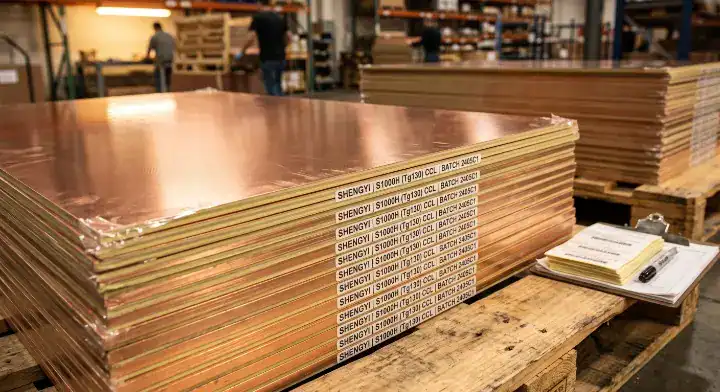
Quick Answer: Shengyi S1141 is the global manufacturing standard for Tg130 FR-4, delivering a dielectric constant (Dk) of 4.4 and a glass transition temperature of 135°C. While highly cost-effective for single-sided SMT boards, its extreme limitation is a T288 thermal rating of just 2+ minutes, making it completely unsafe for heavy copper designs over 2oz or multiple lead-free reflow cycles. Key takeaways:
For the wider material-selection picture, including laminate properties, process constraints, and substitution risks, see our PCB materials guide.
- T288 rating is only 2 minutes, the lowest acceptable margin for lead-free assembly.
- Electrical properties show a Df of ~0.020 at 1 GHz, restricting it to sub-1Gbps digital signals.
- Directly competes with IT-140 and KB-6160 as functionally identical Tg130 alternatives.
- Fabricators run this laminate daily, but it fails IPC Class 2 inspections if subjected to rework.
Many procurement managers mistakenly assume all standard FR-4 materials behave identically during assembly, pushing engineers to select the absolute cheapest option for high-volume consumer electronics. This cost-cutting strategy frequently collapses on the factory floor when boards blister and delaminate after passing through the surface mount oven a second time. Shengyi S1141 stands as the world’s highest-volume Tg130 material, yet its specific thermal boundaries remain widely misunderstood. By defining exactly where this substrate succeeds and where its resin matrix fractures, you can stop throwing away scrapped boards and specify the exact material grade your assembly process demands.
Table of Contents
- What Is S1141 and Why Is It Still the World’s Most Used Standard FR-4?
- What Electrical and Thermal Properties Define This Substrate?
- Where Does S1141 Fit in Shengyi’s Full Product Ladder?
- Why Does The T288 of 2 Minutes Limit Lead-Free Assembly?
- How Does It Compare to IT-140, NP-140, and KB-6160 at Tg130?
- When Must You Upgrade to S1150 or S1000-2M?
- Which Consumer, LED, and Industrial Applications Still Use It?
- How Do Fabricators Process S1141 on Standard FR-4 Lines?
- Why Is This Substrate Not Suitable for 5G, RF, or High-Speed Digital?
- How Will Market Share Shift as Lead-Free Standards Tighten?
- FAQ
What Is S1141 and Why Is It Still the World’s Most Used Standard FR-4?
Shengyi S1141 is a standard Tg135°C copper-clad laminate that holds the largest global market share for basic FR-4 production, utilized primarily for 2-to-4 layer boards. It carries a decomposition temperature (Td) of 310°C and is engineered strictly for low-cost, low-complexity manufacturing where thermal stresses remain minimal.
The Foundation of Asian PCB Manufacturing
Shengyi Technology dominates the global CCL market by producing massive volumes of this specific formulation across their Dongguan and Shaanxi facilities. Every printed circuit board factory in Asia stocks this material because it cures predictably and costs less than almost any competing product.
When you review basic fabrication notes from consumer electronics designers, they almost universally imply this specific laminate when they type “Standard FR-4” on the drawing.
Here are the primary reasons fabricators default to it:
- Raw material pricing hits the absolute floor for mass production.
- Factory operators require zero specialized training to press it.
- Supply chain availability is measured in hours, not weeks.
Correcting Market Misinformation
Many online supplier directories publish generic descriptions claiming this substrate works for “advanced electronics and high-frequency radar.” This is factually incorrect and highly dangerous for your design.
This is a basic brominated epoxy resin system. It absorbs moisture at standard rates and expands rapidly under heat. It does not possess the modified polyphenylene ether (PPE) resins required to stabilize high-frequency signals.
Bottom line: Specify this laminate only when building basic 2-layer or 4-layer boards intended for single-sided assembly, which means you extract maximum cost savings without risking catastrophic thermal failure.
| Feature | S1141 Reality | Marketing Myth |
|---|---|---|
| Signal Speed | < 1 Gbps | “High Speed Data” |
| Reflow Cycles | 1 Cycle | “Complex HDI Assembly” |
| Frequency | < 1 GHz | “5G Infrastructure” |
| Understanding the chemical reality prevents expensive manufacturing failures. |
What Electrical and Thermal Properties Define This Substrate?
The material exhibits a dielectric constant (Dk) of approximately 4.4 and a dissipation factor (Df) of 0.020 when measured at 1 GHz. Thermally, the pre-Tg Z-axis coefficient of thermal expansion (CTE) measures between 60-65 ppm/°C, expanding by roughly 3.5-4.0% when heated from 50°C to 260°C.
Analyzing the Electrical Limitations
Dielectric constant (Dk) is the measure of a material’s ability to store electrical energy in an electric field. At 4.4, this laminate forces your traces to act like small capacitors, slowing down signal propagation speeds significantly compared to low-Dk materials. The Df of 0.020 translates to immediate signal attenuation if you attempt to push gigabit data through the traces.
You must design within these boundaries:
- Maintain digital clock speeds below 1 GHz.
- Keep trace lengths short to prevent excessive signal loss.
- Avoid using it for controlled impedance lines tighter than ±10%.
Thermal Expansion Risks
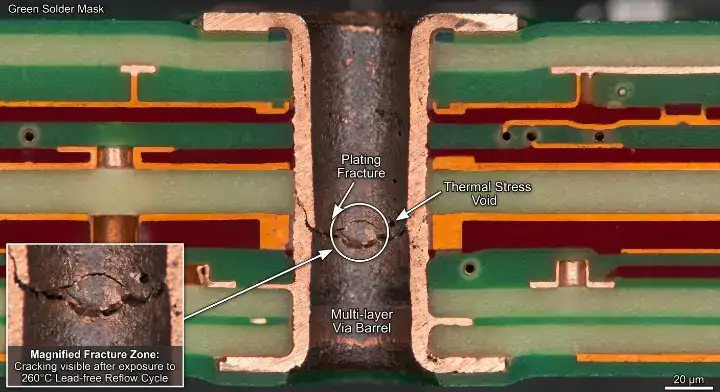
The 3.5% Z-axis expansion rate creates significant mechanical stress on copper via barrels when the board enters the reflow oven. Because the epoxy resin expands roughly three times faster than the copper plating, thick boards with small vias face extreme risk of barrel cracking.
Bottom line: Restrict your via aspect ratios to 8:1 maximum when using this substrate, resulting in plated through-holes that survive the expansion cycle without fracturing.
| Metric | Measured Value | Standard Testing Condition |
|---|---|---|
| Dielectric Constant (Dk) | ~4.4 | @ 1 GHz |
| Dissipation Factor (Df) | ~0.020 | @ 1 GHz |
| Z-Axis Expansion | 3.5% – 4.0% | 50°C to 260°C |
| These metrics define a baseline material suitable only for standard processing. |
Where Does S1141 Fit in Shengyi’s Full Product Ladder?
This substrate anchors the absolute bottom of Shengyi’s high-volume product ladder, serving as the entry-level Tg130 standard below the Tg150 S1150. While reviewing a Shengyi PCB material overview, you can see how the company scales up to ultra-low-loss materials like Synamic 6N, leaving this entry-level product purely for commodity hardware.
Understanding the Tiered Architecture
Shengyi intentionally segments their resin chemistry to force engineers to pay for only the thermal stability they actually need. The base tier uses standard dicyandiamide (Dicy) curing agents. The mid-tier shifts to phenolic (PN) curing for better heat resistance.
Your procurement strategy should follow this path:
- Use Tg130 for toys, LED drivers, and basic IoT.
- Move to Tg150 for double-sided PC motherboards.
- Jump to Tg175 for multi-layer industrial controllers.
Recognizing the End of the Line
This base material represents the absolute limit of what standard Dicy-cured epoxy can achieve before lead-free temperatures destroy the molecular bonds. You cannot push this chemistry any further without adding ceramic fillers or changing the curing agent entirely.
Bottom line: Treat this material as your default baseline for cost calculations, upgrading to higher tiers only when your assembly house specifically flags thermal risks in your design.
| Product Tier | Material Name | Tg Rating | Curing Agent |
|---|---|---|---|
| Entry Level | S1141 | 135°C | Dicy |
| Mid-Tier | S1150 | 150°C | Phenolic (PN) |
| High-Reliability | S1000-2M | 175°C | Phenolic (PN) |
| Moving up the ladder requires fundamentally different chemical cross-linking. |
Why Does The T288 of 2 Minutes Limit Lead-Free Assembly?
The T288 rating of this material is a critically short 2+ minutes, meaning the resin matrix begins blistering and delaminating if held at 288°C for longer than 120 seconds. This razor-thin thermal margin makes it highly dangerous for thick boards undergoing multiple lead-free reflow cycles or localized manual rework.
The Hidden Danger of Lead-Free Solder
T288 is the time to delamination test, measuring exactly how long the substrate survives extreme heat before catastrophic failure. Standard SAC305 lead-free solder requires peak reflow temperatures around 245°C to 260°C, pushing this substrate terrifyingly close to its absolute breaking point.
When you send a board through the oven twice (for top and bottom components), the thermal degradation is cumulative.
From Electronics Stack Exchange: “Why did my 4-layer Tg130 board delaminate during the second SMT pass?”
Your board delaminated because the T288 margin of 2 minutes was entirely consumed during the first reflow and the pre-heating of the second pass. The resin bonds simply gave up.
Factory Experience with Thermal Failure
S1141’s T288 of 2+ minutes is the tightest thermal margin of any material we stock. On a recent 4-layer consumer IoT board, single-side SMT reflow passed without issue — the 288°C peak exposure was approximately 15-20 seconds, well within the 2-minute window.
But when the customer asked to add components on the bottom side (requiring a second reflow), cross-section analysis after the second pass showed micro-delamination at 3 of 40 via locations. Not a catastrophic failure, but enough to fail IPC Class 2 inspection. We recommended switching to S1150 (Tg150) for double-sided assembly — T288 jumps from 2 to 10+ minutes, eliminating the issue entirely. Material cost increased approximately 8%. On a 5,000-board run, the $400 material premium was insignificant compared to the $3,000+ cost of scrapping delaminated boards.
Bottom line: Never specify this substrate for double-sided surface mount assemblies, because the cumulative thermal shock guarantees via micro-cracking and resin delamination.
| Substrate | T288 Time | Assembly Safety Margin |
|---|---|---|
| Tg130 (Base) | 2+ Minutes | Dangerous for Double-Sided |
| Tg150 (Mid) | 10+ Minutes | Safe for Double-Sided |
| Tg175 (High) | 20+ Minutes | Safe for Heavy Rework |
| The T288 metric defines the physical survival limit of the bare board. |
How Does It Compare to IT-140, NP-140, and KB-6160 at Tg130?
S1141 delivers a 135°C Tg and ~0.020 Df, which perfectly matches the electrical and thermal performance of ITEQ IT-140, Nanya NP-140, and Kingboard KB-6160. These four substrates are functionally identical chemical formulations competing purely on supply chain proximity, local pricing, and factory ecosystem preferences.

The Reality of Commodity Formulations
When you design a standard 4-layer control board, agonizing over which specific Tg130 brand to use is a waste of engineering time. All four major Asian manufacturers use nearly identical Dicy-cured epoxy resins and standard E-glass weaves. If you consult our PCB material selector tool, you will see that their Z-axis expansion rates and dielectric constants mirror each other completely.
If you compare this tier to an ITEQ IT-180A material overview, the difference is massive, but within the Tg130 bracket, the products are clones.
Managing Factory Floor Substitutions
We process all four Tg130 materials — S1141, IT-140, NP-140, and KB-6160 — and they are functionally interchangeable on our line. Same press recipe, same drill parameters, same etch chemistry, same yield (97-98%).
The choice comes down to supply chain: Shengyi is our default because their Dongguan facility is one hour away. IT-140 comes in when the customer specifies the ITEQ ecosystem. KB-6160 appears on orders from customers using Kingboard-affiliated fab shops in Guangdong. NP-140 is rare in our facility but common in Taiwan-based production. For engineers writing fab notes, specifying “Tg130 FR-4, IPC-4101/21” rather than a specific brand gives the fab shop flexibility to use whichever Tg130 they stock, saving lead time and cost.
Bottom line: Write “Tg130 FR-4 per IPC-4101/21” on your fabrication drawing instead of a specific brand name, which means your factory can source the lowest-cost local material instantly.
| Material Brand | Td Value | Dk @ 1GHz | Primary Market |
|---|---|---|---|
| Shengyi (S1141) | 310°C | ~4.4 | Global Default |
| ITEQ (IT-140) | 310°C | ~4.4 | Taiwanese Ecosystem |
| Kingboard (KB-6160) | 310°C | ~4.4 | Low-Cost Mainland |
| Brand loyalty matters very little at the commodity entry level. |
When Must You Upgrade to S1150 or S1000-2M?
You must upgrade to a higher-tier material whenever your design requires double-sided SMT assembly, heavy copper exceeding 2oz, or operating environments above 85°C. Moving to S1150 (Tg150) secures a 10-minute T288 window, while upgrading to S1000-2M high-Tg FR-4 provides a 20-minute thermal buffer for complex sequential lamination.
Defining the Breaking Point
Engineers often try to squeeze high-current power designs onto cheap Tg130 substrates to hit aggressive cost targets. This fails spectacularly when the factory attempts to press 3oz copper layers together using weak resin that cannot handle the encapsulation pressure.
You must abandon the base material immediately if your board features:
- High-Density Interconnect (HDI) microvias.
- Overall board thickness exceeding 2.4mm.
- Any requirement for localized hot-air rework.
The Decision Matrix for Procurement
From Reddit PrintedCircuitBoard: “Is it safe to use standard Tg130 for an 8-layer board with 2oz inner copper?”
No, it is highly unsafe. The inner heavy copper layers require a high-flow, high-Tg resin to fill the gaps without leaving voids, and the 8-layer structure requires a high Td to survive the extended lamination press cycle.
Bottom line: Mandate an immediate upgrade to Tg175 material for any design exceeding 6 layers, resulting in a thermally stable resin matrix that completely prevents internal via barrel separation.
| Design Requirement | Base Material (135°C) | Required Upgrade |
|---|---|---|
| Single-Side SMT | Safe | None |
| > 2oz Heavy Copper | Highly Unsafe | S1000-2M (Tg175) |
| HDI Microvias | Guaranteed Failure | S1000-2M (Tg175) |
| Knowing when to upgrade prevents massive scrap rates during complex assembly. |
Which Consumer, LED, and Industrial Applications Still Use It?
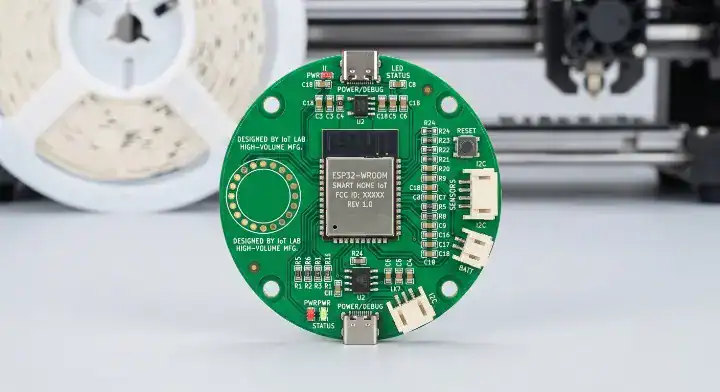
This entry-level substrate dominates the manufacturing of basic LED lighting strips, disposable consumer electronics, and low-speed industrial relays. It performs perfectly in these environments because the applications require maximum surface area at minimum cost, with zero requirement for high-speed signal integrity or extreme thermal survival.
Dominating the Cost-Sensitive Sectors
When a manufacturer produces one million smart plugs or basic USB chargers, saving ten cents on raw PCB material equals $100,000 in direct profit. This substrate captures these markets entirely. The 135°C Tg rating is perfectly adequate for a device sitting in a climate-controlled living room processing slow 100kHz switching signals.
You will constantly find this material inside:
- Basic remote controls and keyboards.
- Washing machine front-panel interfaces.
- Non-critical HVAC thermostat controllers.
Why Industrial Relays Accept Lower Specs
Industrial relays and slow-moving robotics servos often use thick, wide traces to carry current rather than high-speed data. The Df value of 0.020 does not matter when your signal is a simple 5V DC pulse turning on a motor. As long as the operating environment stays below 85°C, the chemical structure remains entirely stable for a decade.
Bottom line: Deploy this substrate confidently for any low-voltage consumer gadget operating at room temperature, which means you achieve the lowest possible BOM cost without compromising product lifespan.
| Industry | Typical Device | Primary Reason for Use |
|---|---|---|
| Consumer IoT | Smart Plug | Absolute Lowest Cost |
| Lighting | LED Driver Board | Simple 2-Layer Routing |
| Appliance | Washer Control | Slow Signal Speeds |
| The material succeeds perfectly when matched with low-stress operating environments. |
How Do Fabricators Process S1141 on Standard FR-4 Lines?
Fabricators process S1141 using the industry’s default baseline parameters, requiring a standard 175°C to 185°C press cycle and standard permanganate desmear chemistry. Machine operators use baseline chipload drill speeds because the soft epoxy and standard glass weave cause minimal wear on mechanical tooling.
The Zero-Friction Factory Experience
This material defines what “standard processing” means in a PCB factory. Every piece of equipment, from the lamination press to the automated optical inspection (AOI) machine, is originally calibrated using this exact type of substrate.
Because the resin is relatively soft compared to ceramic-filled materials:
- Drill bits last for 3,000+ hits before requiring replacement.
- Router bits cut clean profiles without excessive chatter.
- Desmear chemistry etches the via walls predictably in exactly 5 minutes.
Controlling the Lamination Press
The press cycle is incredibly forgiving. The Dicy-cured epoxy flows easily during the melt phase, encapsulating standard 1oz copper traces perfectly. As long as the press reaches 175°C for the specified curing time, the cross-linking completes successfully. This wide processing window is why quick-turn prototype shops love using it.
Bottom line: Send your standard 2-layer and 4-layer gerber files to any factory globally without special instructions, because every manufacturer has mastered this specific resin chemistry for decades.
| Process Step | Standard Parameter | Tooling Wear Level |
|---|---|---|
| Lamination Press | 175°C – 185°C | N/A |
| Mechanical Drill | 3,000 hits/bit | Very Low |
| Desmear Cycle | Standard Time | Normal Etch Rate |
| Standardized processing translates directly to lower fabrication quotes. |
Why Is This Substrate Not Suitable for 5G, RF, or High-Speed Digital?
S1141 is completely unsuitable for 5G infrastructure, radar systems, or high-speed digital routing because its dissipation factor (Df) of 0.020 causes massive signal attenuation at frequencies above 1 GHz. The standard woven fiberglass construction also causes severe glass-weave skew, completely destroying the timing synchronization of differential pairs.
Debunking the High-Frequency Marketing
Many low-tier suppliers aggressively push this cheap material for every application, claiming it can handle “modern communications.” This is a severe engineering misstep.
If you attempt to route a 5 GHz Wi-Fi antenna trace over this substrate, the 0.020 Df means the epoxy resin absorbs most of your signal energy and turns it into heat. For comparison, true RF materials like Rogers RO4350B feature a Df of 0.0037 — nearly six times lower signal loss.
From EEVBlog Forum: “Can I use standard FR-4 for a 2.4GHz Bluetooth antenna board?”
Yes, you can barely get away with it for short 2.4GHz traces if you calibrate your matching network perfectly, but for anything operating at 5GHz or higher, the signal loss across the board will cripple your transmission range.
The Problem with Digital Skew
When routing PCIe Gen 3 or faster signals, the physical weave of the fiberglass bundle matters. This standard material uses loose 7628 glass weaves. If one trace of a differential pair rides over a glass bundle (Dk ~6.1) while the other trace rides over pure resin (Dk ~3.2), the signals travel at different speeds and arrive out of phase.
Bottom line: Never use this substrate for traces carrying signals faster than 1 Gbps, resulting in immediate avoidance of critical timing failures and bit-error-rate (BER) spikes.
| Signal Type | Substrate Df Target | S1141 Compatibility |
|---|---|---|
| Basic SPI/I2C | < 0.025 | Perfect |
| 5GHz Wi-Fi / RF | < 0.005 | Guaranteed Signal Loss |
| Automotive Radar | < 0.002 | Complete Failure |
| High-frequency energy requires specialized low-loss molecular structures. |
How Will Market Share Shift as Lead-Free Standards Tighten?
As global manufacturing regulations strictly enforce high-temperature lead-free assembly and halogen-free compliance, the market share for S1141 is permanently shrinking. Top-tier ODMs are rapidly standardizing their base designs on Tg150 phenolic-cured materials to eliminate the risk of T288 thermal failures during complex multi-stage assembly.
The Slow Death of Dicy-Cured Resins
The transition away from standard Dicy-cured epoxy is accelerating. Ten years ago, Tg130 made up 70% of standard production. Today, as boards become denser and require more rework capability, factories are pushing clients toward Tg150.
The math is simple: the cost of a delaminated board at the end of the SMT line far exceeds the few pennies saved by specifying the cheapest raw material.
Watch for these industry shifts:
- Automotive suppliers banning Tg130 entirely.
- European RoHS directives pushing toward halogen-free equivalents.
- High-volume consumer brands standardizing on Tg150 to reduce scrap.
What Should Procurement Do Today?
If you are building simple, single-sided LED boards, keep using the baseline material to maximize your margin. But if you are designing anything with a BGA component or requiring double-sided reflow, you need to change your internal company standards.
Bottom line: Update your company’s standard fabrication notes today to mandate Tg150 as the absolute minimum requirement, which means you permanently insulate your supply chain against lead-free assembly failures.
| Assembly Trend | Impact on Tg130 | Future Standard |
|---|---|---|
| Double-Sided SMT | Highly Negative | Tg150 Minimum |
| Halogen-Free RoHS | Disqualified | Phosphorous Resin |
| High-Density BGA | Thermal Risk | Tg175 Required |
| The baseline standard for electronics manufacturing is moving upward rapidly. |
FAQ
Can I use S1141 for a double-sided SMT board? No, it is highly risky. The T288 rating is only 2 minutes, which means the cumulative heat from two separate 260°C lead-free reflow passes will likely cause the resin to blister and delaminate. Switch to a Tg150 material like S1150 to gain a safe 10-minute thermal buffer.
Is Shengyi S1141 the exact same thing as ITEQ IT-140? Yes, functionally they are identical. Both are standard Dicy-cured Tg135°C epoxy resins with a Dk of ~4.4. You can allow your fabricator to substitute one for the other without any changes to your layout, impedance calculations, or assembly thermal profiles.
Why do some websites say S1141 is good for 5G and radar? Those websites are publishing incorrect, AI-generated marketing fluff. With a dissipation factor (Df) of 0.020, this material will absorb and destroy high-frequency RF signals. You must use specialized substrates like Rogers or Shengyi’s Synamic series for any true 5G infrastructure.
How thick can I make an S1141 board before I run into problems? Keep your board thickness below 1.6mm and your via aspect ratio below 8:1. Because this material has a high Z-axis expansion rate (3.5% to 4.0%), pressing a thick 2.4mm board will result in the internal copper via barrels tearing apart during the heat of the soldering process.
If my fab note says “Standard FR-4,” is this what I will get? Yes, 95% of the time, Asian factories will use this exact Shengyi material or the Kingboard equivalent when you specify “Standard FR-4.” If your design actually requires higher thermal stability, you must explicitly write “Tg150 minimum” or “Tg175 minimum” on your drawing.
Written by the QueenEMS Engineering Team. Ready to stop guessing and get expert DFM review on your next multi-layer design? Contact us today for rapid prototype quotes.
Upload your files today · Free DFM check before production · Ship worldwide
Get your PCB prototypes in as fast as 24 hours. We handle FR4, Rogers, and Flex up to 60 layers — free prototypes for 2–4 layer boards, no minimum order.
Just upload your Gerber + BOM — we source every part, assemble, and inspect (AOI + X‑Ray) so you don't have to chase suppliers. Boards ship in as fast as 24 hours.