
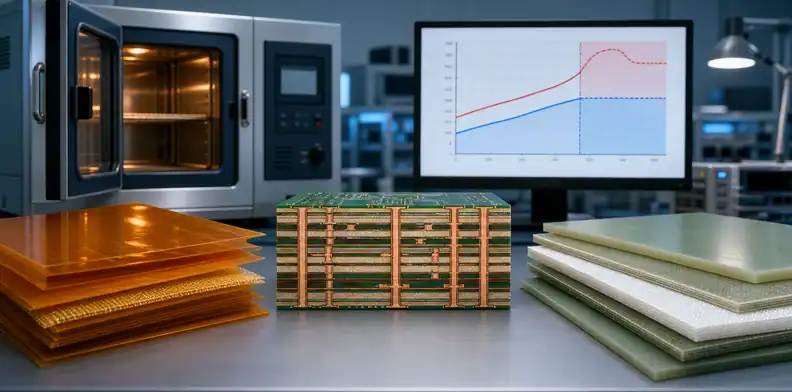
Quick Answer: Ventec VT-901 PCB material is a polyimide laminate system, not high-Tg FR-4. Its current technical data sheet reports a typical Tg of 250°C by TMA, a Td of 395°C, 1.4% total Z-axis expansion from 50°C to 260°C, and a UL maximum operating temperature (MOT) of 140°C; therefore, Tg alone does not approve continuous operation at 150°C.
Key takeaways – VT-901 is a UL V-0 polyimide system listed to IPC-4101E /40, /41, and /42. – The official sheet gives Tg by TMA, while the DSC Tg field is blank. – “Meets NASA requirements for no visible bromine” is not a blanket halogen-free or outgassing certification. – A safe equivalent-material clause controls chemistry, properties, construction, qualification, and customer approval.
Ventec VT-901 PCB material is relevant when a board needs polyimide’s thermal and dimensional behavior, but the material name is often surrounded by unsafe shortcuts. Search results may call it FR-4, treat 250°C Tg as an operating-temperature rating, or convert one material approval into approval for any finished board.
For a broader comparison of laminate families, electrical properties, processing limits, and sourcing choices, see our PCB materials guide.
This guide separates those concepts using current Ventec data. It helps designers, buyers, and fabricators decide whether VT-901 fits the application, which values belong in the specification, and what evidence an alternate must provide.
Table of Contents
- What Is Ventec VT-901 and Is It FR-4?
- Which VT-901 Datasheet Values Control the Design?
- Can VT-901 Run Continuously at 150°C?
- How Do the VT-901 Family Materials Differ?
- Is VT-901 Halogen-Free or NASA Approved?
- When Should VT-901 Replace High-Tg FR-4?
- What Does QPL Status Actually Prove?
- Which Applications Fit Ventec VT-901?
- How Should a Fabricator Process VT-901?
- What Does “VT-901 or Equivalent” Permit?
What Is Ventec VT-901 and Is It FR-4?
VT-901 is a polyimide laminate and prepreg system; it should not be described as a high-Tg FR-4 grade. Both families can be used in rigid multilayer PCBs, and both may survive lead-free assembly, but their resin systems, process windows, qualification history, and cost structure are not interchangeable.
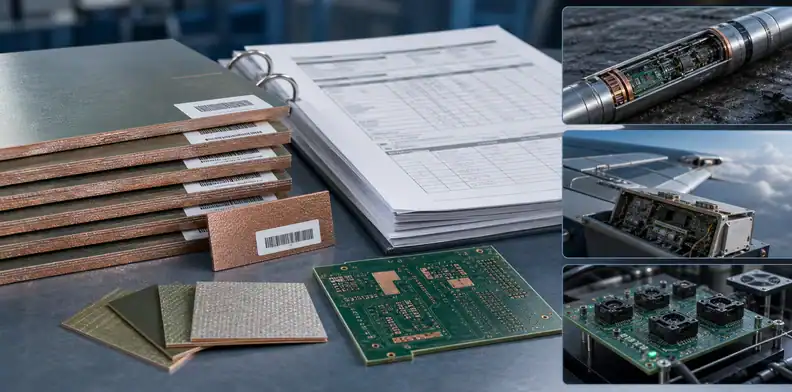
Ventec positions VT-901 for chip-manufacturer tooling, engine and flight controls, power supplies and backplanes, military and aerospace electronics, burn-in boards, and downhole drilling. The application list is only a screening signal. It does not replace board-level thermal, mechanical, electrical, and compliance analysis.
The distinction also changes sourcing language. A drawing that says only “high-Tg material” may allow an epoxy system even when the program intended polyimide. Conversely, specifying polyimide by habit can add process difficulty without solving a documented failure mode. Compare the design against the FR-4 Tg grade selection guide before making resin chemistry a mandatory characteristic.
For a controlled VT-901 purchase, identify the laminate and matching prepreg, the applicable IPC slash sheet, copper weight, core and prepreg constructions, finished thickness, required approvals, and substitution rule. The material decision then becomes auditable instead of relying on a family name.
Which VT-901 Datasheet Values Control the Design?
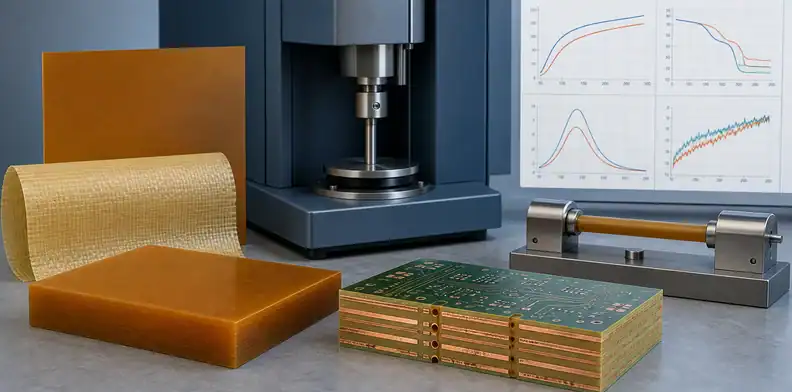
The controlling values are method- and condition-specific: typical Tg is 250°C by thermomechanical analysis (TMA), Td is 395°C, T260 and T288 are both greater than 60 minutes, and total Z-axis expansion from 50°C to 260°C is 1.4%. The same sheet lists a maximum operating temperature of 140°C under its UL 94 table.
| Property | Published typical value | Correct use |
|---|---|---|
| Tg by TMA | 250°C | Glass-transition indicator under the stated method |
| Tg by DSC | Not listed | Do not invent or substitute a DSC value |
| Td by TGA | 395°C | Decomposition indicator, not a service-temperature rating |
| T260 / T288 | >60 / >60 min | Thermal endurance under defined tests |
| Z-axis CTE before / after Tg | 50 / 150 ppm/°C | Input to expansion and via-risk review |
| Total Z expansion, 50–260°C | 1.4% | Thermal-excursion screening value |
| X-Y CTE | 11–12 ppm/°C | Dimensional and interface review |
| MOT | 140°C | Published continuous-use boundary to respect |
| Thermal conductivity | 0.7 W/mK | Heat-flow input, not evidence of heat-spreader behavior |
This method discipline matters because even Google’s AI Overview has summarized VT-901 as having a Tg above 250°C by differential scanning calorimetry (DSC). Ventec’s current sheet does not support that statement: the DSC field contains a dash, while the TMA typical value is 250°C. A purchase specification should therefore state “Tg 250°C typical by TMA” rather than copying an unqualified web summary.
Ventec also publishes Dk 4.05 and Df 0.012 at 1 GHz for 40% resin content. Those values help electrical screening, but a field solver needs the fabricator’s construction-specific effective or design Dk for the selected glass style, resin content, copper, and frequency. Use the PCB material selector to compare material classes, then request data tied to the actual stack-up.
Can VT-901 Run Continuously at 150°C?
Do not approve continuous 150°C operation from the 250°C Tg value. Ventec’s current VT-901 sheet lists MOT at 140°C, so a stated 150°C continuous environment exceeds that published rating and requires a different material or a documented program-specific qualification decision.
Tg describes a transition in polymer behavior under a particular test. Td indicates decomposition onset under another test. T260, T288, and a 288°C thermal-stress result describe short-duration thermal endurance. None of these values automatically becomes an allowable continuous service temperature.
The thermal requirement should separate at least four conditions:
- Normal continuous board temperature at the laminate.
- Short-duration operating peaks and their frequency.
- Non-operating storage or transportation extremes.
- Assembly excursions, including the number and profile of reflow cycles.
Then include local hot spots, copper distribution, enclosure airflow, component heat paths, mechanical loads, humidity, voltage bias, and expected life. A 150°C ambient condition may produce a higher laminate temperature near power components, while an externally measured component case temperature may not equal the board temperature.
If the laminate is part of a larger CTE problem, review the PCB CTE mismatch failure guide and model the complete interconnect. Low total Z expansion is useful, but barrel geometry, plating quality, drill damage, resin condition, and thermal-cycle range still influence via life.
How Do the VT-901 Family Materials Differ?
VT-901 family names describe different product functions, so the suffix cannot be treated as a cosmetic purchasing detail. Ventec’s current family page separates standard VT-901, VT-90H, VT-901HW, VT-901N, and other low- or no-flow products.
| Product | Publicly stated role | Tg / notable distinction |
|---|---|---|
| VT-901 | Standard UL V-0 polyimide laminate/prepreg | Tg 250°C; /40, /41, /42 |
| VT-90H | UL HB polyimide family | Tg 250°C; different flame classification |
| VT-901HW | Ceramic-filled polyimide prepreg | Thick-copper clearance and hole filling |
| VT-901N | Low/no-flow polyimide prepreg | Tg 200°C; rigid-flex and flow control |
| VT-901 PP NF/LF LCTE | No/low-flow prepreg family | Tg 200°C; controlled flow applications |
VT-901HW is intended to improve filling around heavy copper, clearance holes, and vias while reducing shrinkage and cracking risk. VT-901N includes an epoxy component to control flow and support bond strength; Ventec positions it for rigid-flex bonding. Neither product is a drop-in substitute for standard VT-901 in every layer.
VT-90H also has an UL HB classification rather than the V-0 classification stated for VT-901. If the drawing or end-product file requires a particular flammability classification, substituting between them can create a compliance failure even when the published Tg matches.
Specify the exact product, form, glass style, resin content or flow requirement, copper interface, and slash sheet. For a complex multilayer PCB build, let the approved stack-up identify where each core and prepreg is used instead of allowing one family label to cover every bonding function.
Is VT-901 Halogen-Free or NASA Approved?
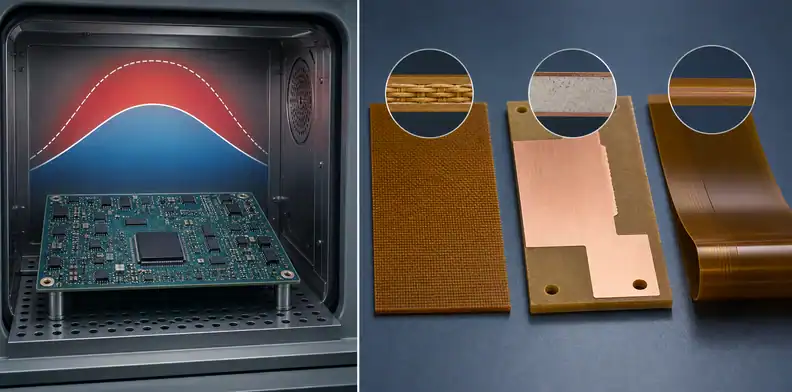
The defensible statement is narrow: Ventec says VT-901 “meets NASA requirements for no visible bromine.” That wording should not be rewritten as “halogen-free,” “NASA outgassing approved,” or “NASA certified” without separate evidence naming the test, limit, revision, product, and production scope.
“No visible bromine” addresses a particular bromine observation requirement. A halogen-free declaration normally controls quantitative chlorine and bromine limits under a named standard or customer specification. Outgassing is another distinct topic, commonly involving measured mass loss and collected volatile condensable material. One claim cannot stand in for the others.
The finished PCB also contains more than the base laminate. Solder mask, legend ink, bonding materials, surface finish chemistry, adhesives, and assembly materials may fall within the customer’s restricted-substance or outgassing scope. Request declarations that cover the required bill of materials and manufacturing site rather than assuming the laminate statement qualifies the complete board.
For aerospace or controlled programs, put the exact acceptance evidence on the purchase order: applicable material specification, certificate of conformance, lot and date-code traceability, required test reports, and customer-specific approvals. If a program invokes a NASA or agency requirement, cite that document directly and obtain evidence against it.
When Should VT-901 Replace High-Tg FR-4?
VT-901 should replace high-Tg FR-4 when a documented requirement calls for its polyimide system, qualification status, dimensional behavior, or process performance—not merely because 250°C is a larger Tg number. Many boards can meet assembly and operating requirements with a qualified high-Tg epoxy system.
Begin with the actual failure mode. If repeated thermal excursions threaten plated through-holes, compare total Z expansion and the qualified board construction. If continuous service temperature drives the decision, compare the published MOT and program evidence rather than Tg alone. If compliance drives the decision, verify the required slash sheet, QPL entry, flammability class, and manufacturing-site scope.
The nearby comparisons have different purposes. Ventec VT-47 is an established high-Tg FR-4 option; Isola 370HR and ITEQ IT-180A are other high-Tg epoxy references. They should be compared using the same methods, construction availability, assembly profile, compliance scope, and reliability plan.
Do not put a fixed “polyimide costs four times more” rule in a design standard. Price and lead time vary with thickness, copper, glass style, quantity, region, qualification, supplier allocation, and fabrication yield. Obtain current quotations for the same stack-up and evidence package. The proper upgrade threshold is the lowest-risk material that passes all requirements, not a universal temperature or price multiplier.
If the choice remains uncertain, send the thermal profile, service temperature, stack-up, via structures, compliance documents, and planned test regime through the QueenEMS engineering contact page for a material and design-for-manufacturing review.
What Does QPL Status Actually Prove?
Ventec lists VT-901 on its IPC-4101 Qualified Products Listing (QPL) information, which is useful material-level supply-chain evidence. It does not mean every fabricator, production site, stack-up, or finished PCB made with VT-901 is automatically qualified for a military, aerospace, or government program.
IPC-4101 defines requirements for base materials used in rigid and multilayer printed boards, and its slash sheets identify property sets. A QPL entry links a named product and qualification scope to the validation program. At procurement, verify the current listing, product identity, slash sheet, manufacturing location, and certificate status rather than relying on an old marketing screenshot.
The qualification chain may still require:
- An approved laminate manufacturing site and traceable material lot.
- An approved PCB fabricator and controlled process.
- Certificates of conformance and retained records.
- Coupons, microsections, electrical tests, or source inspection.
- Customer or agency approval for the specific part number.
Ventec has also reported European Space Agency approval for VT-901 within ACB Belgium’s production process. The wording illustrates why scope matters: it names a material, a particular fabricator, and a manufacturing process. It should not be generalized to every VT-901 board made anywhere.
Use QPL status as one verified link in the release chain. The drawing, purchase order, approved supplier list, and quality plan must connect that material evidence to the actual production board.
Which Applications Fit Ventec VT-901?
The strongest candidates are applications Ventec itself identifies—engine and flight controls, military and aerospace electronics, burn-in boards, downhole drilling, chip-manufacturer tooling, and demanding power or backplane systems—provided their temperature and qualification requirements align with the published limits.
Downhole electronics may face elevated temperature, vibration, pressure, and long service intervals. Engine-control electronics add local hot spots, cycling, vibration, fluids, and strict traceability. Burn-in boards experience repeated exposure while carrying dense sockets and test interfaces. In each case, the use-category label is only the beginning of the qualification plan.
For power electronics, do not confuse polyimide’s temperature capability with high thermal conductivity. The published 0.7 W/mK is useful for a thermal model, but it does not make VT-901 equivalent to an aluminum nitride or alumina substrate. When heat spreading and electrical isolation dominate, compare the architecture with a ceramic PCB solution rather than assuming a resin upgrade solves the heat path.
An application fit review should include laminate temperature, excursions, insulation, via structures, vibration, humidity or chemicals, assembly cycles, service life, and qualification evidence. Add a representative coupon or first article when failure consequences justify it.
The release decision is therefore evidence-based: VT-901 fits when its material properties, rated operating boundary, controlled fabrication process, and program approvals all support the same use case.
How Should a Fabricator Process VT-901?
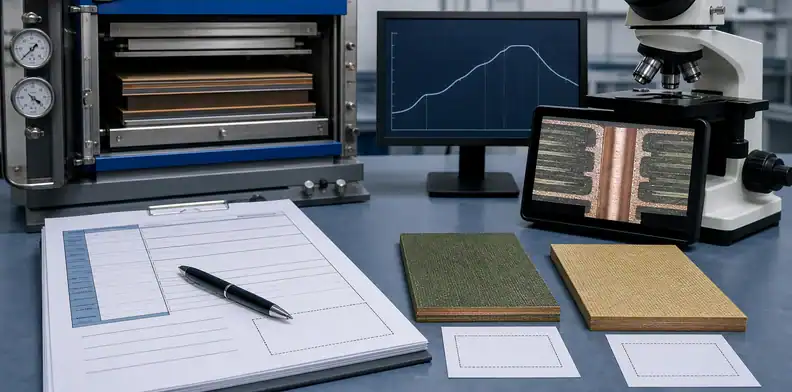
VT-901 requires a material-specific process traveler built from the current Ventec processing guide and the fabricator’s qualified equipment. Polyimide experience matters because lamination heating, cure, drilling, desmear, plating, and moisture control interact with the actual board construction.
Ventec’s guide gives starting windows rather than a universal recipe. It calls for a programmable heating rate of 1.5–3.0°C per minute or 3–6°C per minute in a manual press, with 120–150 minutes above 218°C material temperature depending on thickness. It lists full pressure of at least 320 psi, continued vacuum above 200°C, and a 100 psi cold press for 60 minutes. Boards thicker than 3 mm may require longer cure time.
Those values must be translated through platen performance, vacuum capability, panel size, copper distribution, stack height, thermocouple location, resin flow, and the fabricator’s qualification data. They should not be copied blindly onto the customer drawing as machine commands.
For common 0.3–1.0 mm drills, the guide provides broad starting ranges for spindle speed, feed, retract rate, and chip load. Hole-wall results still control: inspect smear, glass protrusion, resin recession, nail-heading, registration, and plating coverage on representative coupons. Ventec also says desmear adjustments are required and directs users to the chemistry supplier, so an ordinary FR-4 desmear cycle should not be presumed adequate.
Before production, approve the material certificates, press profile, drill study, desmear and plating results, dimensional behavior, thermal stress results, and microsections. The fabricator should own a controlled window with revision and lot traceability, not rely on a one-time successful panel.
What Does “VT-901 or Equivalent” Permit?
Without added criteria, “VT-901 or equivalent” gives purchasing and fabrication too much discretion. A candidate might match Tg while differing in resin chemistry, MOT, total expansion, flammability, slash sheet, QPL scope, glass styles, copper availability, processing, or environmental evidence.
A safer equivalence clause names both measurable requirements and the approval path. At minimum, require:
- The alternate manufacturer and exact product designation.
- Polyimide chemistry when polyimide is a design requirement.
- Method-bound Tg, Td, T260/T288, CTE, total expansion, and MOT limits.
- Required IPC-4101 slash sheets, flammability, QPL, and site-specific evidence.
- Available core, prepreg, glass, resin, copper, and finished-thickness constructions.
- A compatible qualified lamination, drilling, desmear, and plating process.
- Revalidation of impedance, thermal analysis, coupons, and reliability tests as applicable.
- Written customer approval before substitution on controlled designs.
Avoid “same or better” unless every comparison method and acceptance boundary is defined. A higher Tg does not compensate for a lower MOT; a lower expansion number does not replace the required slash sheet; and a material-level QPL claim does not qualify the finished board.
For an accurate quotation, send Gerbers or ODB++, stack-up, copper and glass constraints, via structures, continuous and peak temperature profiles, assembly cycles, IPC and customer specifications, required certificates, test plan, annual volume, and approved-substitution policy through QueenEMS quotation support. That package supports a VT-901 build decision and exposes any alternate that needs engineering approval before pricing or release.
FAQ
Is Ventec VT-901 a high-Tg FR-4 material?
No. VT-901 is a polyimide laminate and prepreg system; its 250°C typical Tg by TMA does not change the resin classification to FR-4.
Can I use VT-901 continuously at 150°C?
No, not from the public data alone. The current Ventec sheet lists MOT at 140°C, so continuous 150°C exceeds that published rating and needs another material or documented program-specific qualification.
Does VT-901 have a 250°C DSC Tg?
No. The current sheet shows a dash for DSC Tg and a typical 250°C value by TMA; always preserve the test method when quoting Tg.
Is “no visible bromine” the same as halogen-free?
No. It is a narrower manufacturer statement and does not replace quantitative halogen limits, an outgassing report, or a complete-board environmental declaration.
How do I know whether an equivalent is acceptable?
Require the named alternate, method-matched properties, construction availability, qualification scope, compatible fabrication evidence, required revalidation, and written approval before substitution.
Sources
- Ventec VT-901 technical data sheet, February 2024
- Ventec VT-901 processing guidelines, Rev B7
- Ventec polyimide product family
- Ventec approvals and accreditations
- IPC-4101 specification overview
Written by the QueenEMS Engineering Team
Upload your files today · Free DFM check before production · Ship worldwide
Get your PCB prototypes in as fast as 24 hours. We handle FR4, Rogers, and Flex up to 60 layers — free prototypes for 2–4 layer boards, no minimum order.
Just upload your Gerber + BOM — we source every part, assemble, and inspect (AOI + X‑Ray) so you don't have to chase suppliers. Boards ship in as fast as 24 hours.