
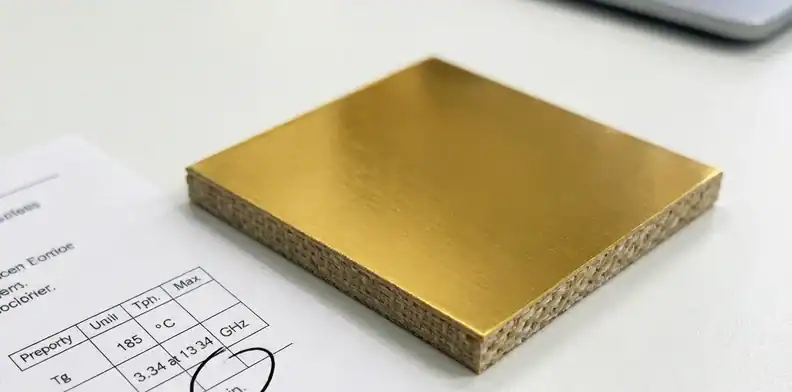
Quick Answer: Megtron 6 PCB material is Panasonic’s ultra-low-loss, high-thermal-reliability laminate and prepreg system (R-5775 series) for high-speed multilayer boards in servers, routers, and switches. It delivers a typical Dk of 3.34 and Df of 0.0037 at 13 GHz (Low Dk glass variant R-5775(N)), a Tg of 185°C by DSC, and T288 above 120 minutes, placing it between Megtron 4 and Megtron 7 in the loss hierarchy.
Key takeaways: – R-5775(N) Low Dk glass: Dk 3.34 / Df 0.0037 at 13 GHz; R-5775(K/G) Normal glass: Dk 3.62 / Df 0.0046. – Halogen-free variant R-5375(N) drops Df to 0.0029 at 13 GHz with Tg(DMA) 250°C. – T288 exceeds 120 minutes with copper, supporting multiple lead-free reflow cycles. – A shared “Megtron 6” label does not prove equivalence — glass cloth, resin, and copper foil variant must match the approved construction.
Megtron 6 PCB material is Panasonic’s mid-tier ultra-low-loss laminate for ICT infrastructure, but the part number alone does not define a buildable stackup. A buyer may see “Megtron 6” on two quotes while the glass cloth, Dk/Df values, copper foil, and thermal behavior point to different electrical outcomes. The Megtron 4 material guide frames the lower-loss boundary of the family; Megtron 6 sits one tier above it and one tier below Megtron 7 in both Df and channel-loss budget.
For the full breakdown of HDI types, microvia design, and stackup selection, see our HDI PCB guide.
The safest path is to separate three questions: what the current Panasonic data actually proves, what the project specification permits, and what evidence the proposed construction can supply. That approach prevents both needless brand lock-in and an uncontrolled substitution that fails at speed.
Table of Contents
- What Is Megtron 6 PCB material Used For?
- What Do Megtron 6 Datasheet Values Mean?
- How Does This Laminate Compare with Megtron 4 and Megtron 7?
- What Glass Cloth Variants Does R-5775 Offer?
- Is This Material Halogen-Free or Low-Loss?
- When Should You Move to Megtron 7 or Megtron 8?
- How Does This Laminate Handle HDI and Sequential Lamination?
- What Should a Fabricator Qualify on This Material?
- How Do You Specify Megtron 6 in an RFQ?
- When Should You Reject a Proposed Megtron 6 Substitute?
What Is Megtron 6 PCB material Used For?
Megtron 6 PCB material is used as an ultra-low-loss laminate and prepreg system for high-speed multilayer boards in servers, routers, switches, supercomputers, and semiconductor test equipment. Panasonic lists the material family under its ICT-infrastructure multi-layer circuit board line, targeting large-capacity, high-frequency signal transmission where standard FR-4 cannot meet the channel-loss budget.
That profile makes Megtron 6 relevant when a 12+ layer design must carry 25G/56G/112G signals through long trace routes and multiple via transitions without consuming the entire insertion-loss margin. The material name does not by itself approve a layer count, via structure, reflow profile, or service condition. For background on how loss categories affect stackup decisions, the PCIe Gen6 PCB material overview covers the broader high-speed landscape without replacing grade-specific data.
Panasonic lists the R-5775 series under IPC slash sheet coverage and reports UL 94 V-0 flammability with H-VLP copper foil. These are laminate-level references; the finished PCB still needs the construction, process, and end-use evidence required by the project.
Bottom line: Use Megtron 6 when a server or router design needs lower loss than Megtron 4 but cannot justify the cost or lead-time of Megtron 7 — and specify the exact R-5775 variant, not the family name.
For a wider view of laminate families, dielectric values, copper profile choices, and sourcing trade-offs, see the PCB materials guide.
What Do Megtron 6 Datasheet Values Mean?
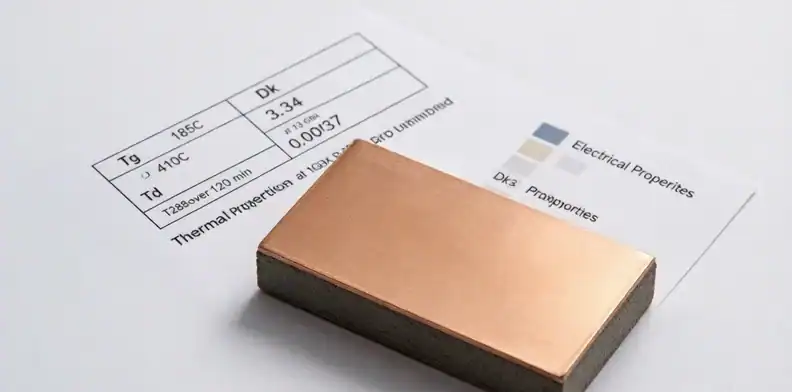
The Megtron 6 datasheet values are typical material-screening results tied to specific test methods, not guaranteed limits for every core, prepreg, or finished board. Tg, Td, T288, CTE, Dk, and Df answer different questions, so a valid comparison keeps the method, frequency, and glass variant attached.
| Property | Typical published value | Test context and decision use |
|---|---|---|
| Tg (DSC) | 185°C | IPC-TM-650 2.4.25; resin transition screening |
| Tg (DMA) | 210°C | Dynamic mechanical analysis; stiffness tracking |
| Td | 410°C | TGA at 5% weight loss, IPC-TM-650 2.4.24.6 |
| T288 (with Cu) | >120 min | TMA, IPC-TM-650 2.4.24.1; lead-free assembly margin |
| CTE-Z α1 | 45 ppm/°C | Pre-Tg, IPC-TM-650 2.4.24C |
| CTE-Z α2 | 260 ppm/°C | Post-Tg; via strain in reflow |
| Dk | 3.34 / 3.62 | @13 GHz, Balanced-type Circular Disk Resonator; R-5775(N) vs R-5775(K/G) |
| Df | 0.0037 / 0.0046 | @13 GHz, BCDR; Low Dk vs Normal glass |
| Thermal conductivity | 0.42 W/m·K | ASTM E1952; heat-flow model input |
T288 above 120 minutes is a time-to-delamination result, not a reflow-cycle counter. An assembly excursion has a temperature profile, moisture history, copper distribution, board thickness, and rework exposure that differ from the test coupon. The sheet’s heat-resistance statement supports screening but gives no permissible cycle count.
Electrical values need even tighter reading. Panasonic reports Dk and Df at 13 GHz using the Balanced-type Circular Disk Resonator (BCDR) method, not the stripline or Bereskin methods used by other manufacturers. Comparing Megtron 6 Df 0.0037 against a competitor’s Df 0.004 quoted at 10 GHz by a different method is not a like-for-like ranking — the method and frequency must match before any loss comparison is defensible.
Factory experience: A customer ordered “Megtron 6” for a 56G PAM4 backplane and received R-5775(G) Normal glass (Df 0.0046) instead of the R-5775(N) Low Dk glass (Df 0.0037) the design assumed. The 0.0009 Df gap consumed the insertion-loss margin on the longest trace. We rebuilt the stackup with R-5775(N) and re-qualified the channel, recovering 0.4 dB of margin at 28 GHz.
Bottom line: Treat every Megtron 6 value as method-bound and variant-specific — a Df number without the glass cloth and frequency is not a usable engineering input.
How Does This Laminate Compare with Megtron 4 and Megtron 7?
Megtron 6 should be compared with Megtron 4 and Megtron 7 through a requirement matrix, not a single Df number. A shared “Megtron” family name can put a grade on the shortlist, but it does not prove matching test methods, electrical behavior, available constructions, thermal margin, or customer approval.
| Grade | Tg (DSC) | Dk @1GHz | Df @1GHz | T288 (with Cu) | Typical position |
|---|---|---|---|---|---|
| Megtron 4 (R-5725) | 176°C | 3.68 | 0.0074 | >120 min | Entry low-loss |
| Megtron 6 (R-5775(N)) | 185°C | 3.4 | 0.002 | >120 min | Mid low-loss |
| Megtron 7 (R-5785(N)) | 200°C | 3.4 | 0.001 | >120 min | Ultra-low-loss |
| Megtron 8 (R-5685(N)) | 200°C | 3.3 | 0.001 | >120 min | Lowest-loss |
The Megtron 8 manufacturing guide and the Megtron 7 specification comparison cover the upper end of the family. Megtron 6 sits between them: its Df at 1 GHz (0.002) is half of Megtron 4 (0.0074) but double Megtron 7 (0.001). That gap is not linear in finished-channel loss because trace length, frequency content, copper roughness, vias, and connectors all affect the result.
A buyer considering EMC or Shengyi alternatives can use the same matrix, but the approval file still needs a current manufacturer document for the proposed grade. Record the construction and revision rather than accepting a family name. Treat other candidate names the same way and publish no numeric equivalence without comparable primary evidence.
Bottom line: Megtron 6 is the loss-tier choice when Megtron 4 cannot meet the budget and Megtron 7 is not justified by the channel model — but only a construction-specific simulation can confirm which tier is actually required.
What Glass Cloth Variants Does R-5775 Offer?
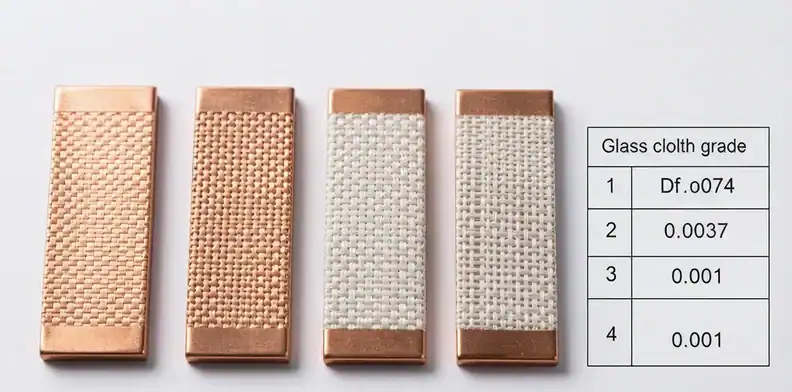
Megtron 6 ships in two primary glass-cloth variants that materially change the electrical behavior: R-5775(N) with Low Dk glass and R-5775(K)/(G) with Normal E-glass. The part number suffix, not the “Megtron 6” name, defines what the fabricator receives.
| Variant | Glass cloth | Dk @13GHz | Df @13GHz | Tg (DSC) | Typical use |
|---|---|---|---|---|---|
| R-5775(N) | Low Dk | 3.34 | 0.0037 | 185°C | Long-loss routes, impedance-critical layers |
| R-5775(K) | Normal E-glass | 3.62 | 0.0046 | 185°C | General high-speed, cost-balanced |
| R-5775(G) | Normal E-glass | 3.62 | 0.0046 | 185°C | Same as (K), alternate construction |
| R-5375(N) | Low Dk (halogen-free) | 3.36 | 0.0029 | 250°C (DMA) | Halogen-free, lower loss |
| R-5375(E) | Normal E-glass (halogen-free) | 3.66 | 0.0037 | 250°C (DMA) | Halogen-free, general |
The 0.28 Dk difference between Low Dk and Normal glass is not a tolerance band — it is a different dielectric. An impedance table computed for Dk 3.34 will miss target impedance if the fabricator builds with Dk 3.62, because the same trace geometry produces a different characteristic impedance. The Df gap (0.0037 vs 0.0046) compounds the problem on loss-sensitive routes.
Factory experience: A 24-layer router board was designed for R-5775(N) but the fabricator substituted R-5775(K) without disclosure, citing “same Megtron 6.” The 90-ohm differential pairs measured 82 ohms because the higher Dk narrowed the impedance. We rebuilt the stackup with the correct Low Dk variant and re-verified impedance on every signal layer.
Bottom line: Specify R-5775(N), R-5775(K), or R-5375(N) explicitly — never approve “Megtron 6” without the suffix, because the glass cloth variant defines both Dk and Df.
Is This Material Halogen-Free or Low-Loss?
Megtron 6 is a low-loss laminate by its Df position, and it has a dedicated halogen-free sub-family (R-5375 series). The standard R-5775 series and the halogen-free R-5375 series are different materials that share the Megtron 6 brand, and a project must pick the correct one before quoting.
RoHS compliance and UL 94 V-0 answer different questions from halogen content. RoHS addresses specified restricted substances, while V-0 is a flammability classification. Neither statement proves a grade meets a customer’s halogen-free definition, so procurement should request a current grade-specific substance declaration and the applicable test or limit. The EM-892K2 halogen-free M8 alternative frames how a halogen-free grade is qualified against a non-halogen-free sibling.
Loss language also needs a defined boundary. Megtron 6 R-5775(N) carries Df 0.0037 at 13 GHz by BCDR; the halogen-free R-5375(N) drops to 0.0029 at the same frequency. Both are low-loss relative to standard FR-4 (Df ~0.020), but neither approaches the ultra-low-loss territory of Megtron 7 (0.001) or Megtron 8 (0.001). Treat “low-loss” as an engineering classification tied to a specific Df and frequency, not a marketing label.
Keep environmental approval and signal-performance approval as separate gates. A material can satisfy one and miss the other.
Bottom line: If the project has a halogen-free mandate, specify R-5375(N) or R-5375(E) — do not assume R-5775 is halogen-free because it carries the Megtron 6 name.
When Should You Move to Megtron 7 or Megtron 8?
Move from Megtron 6 to Megtron 7 or Megtron 8 when a construction-specific channel model or measurement shows that dielectric loss consumes too much of the insertion-loss budget. There is no defensible universal trigger at 56G or 112G because trace length, frequency content, topology, copper roughness, vias, connectors, and margin all affect the result.
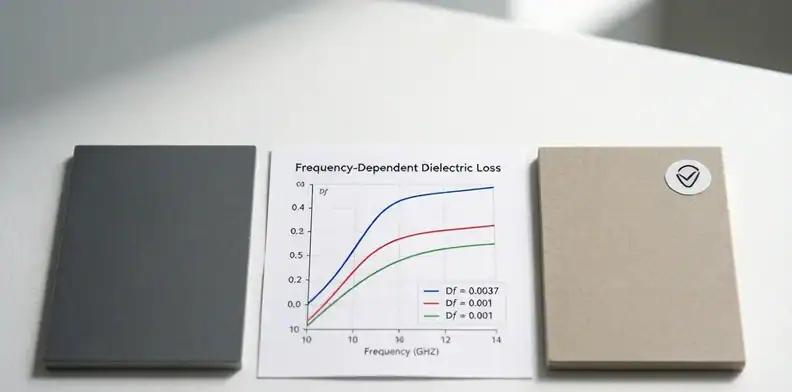
The current manufacturer sheets support a clean directional comparison at 1 GHz. Megtron 6 R-5775(N) lists Df 0.002; Megtron 7 R-5785(N) lists Df 0.001; Megtron 8 R-5685(N) lists Df 0.001 at the same frequency. At 13 GHz the gap widens: Megtron 6 at 0.0037, while Megtron 7 and Megtron 8 sit near 0.001. Those values support screening but still do not choose the stackup — construction availability, pressed resin content, copper profile, impedance geometry, and fabricator qualification remain part of the decision.
Thermally, the three grades diverge as well. Megtron 6 reports Tg(DSC) 185°C and Td 410°C; Megtron 7 and Megtron 8 report Tg(DSC) 200°C with comparable or higher Td. Those values support screening for high-layer-count press cycles but do not by themselves justify a switch.
Factory experience: A 400G switch design used Megtron 6 on a 56G PAM4 lane and failed the eye-margin test at the far-end receiver. Channel simulation attributed 1.8 dB of excess loss to the dielectric beyond the budget. We migrated the loss-critical layers to Megtron 7 and kept Megtron 6 on the power and low-speed layers as a hybrid stackup. The re-built channel passed with 0.3 dB margin.
Bottom line: Upgrade when the channel model says so, not when a data-rate label says so — and model the hybrid stackup before committing the entire board to the higher-cost grade.
How Does This Laminate Handle HDI and Sequential Lamination?
Megtron 6 handles HDI and sequential lamination well, but the qualification must prove it on the actual stackup rather than relying on the datasheet’s “multiple lamination cycles” statement. Panasonic lists the material as compatible with any-layer HDI and sequential structures, yet the pressed resin content, copper distribution, and via fill determine whether a specific build survives the second and third press cycles.
The T288 result (above 120 minutes with copper) supports multiple lead-free reflow excursions, which is a different stress from a sequential lamination press. A press cycle holds the material above Tg for an extended window under pressure; a reflow cycle is a shorter peak with a different ramp. The HDI sequential lamination cost guide frames how to control the cost side of multi-cycle builds without assuming the material will qualify itself.
For microvias, Megtron 6 uses H-VLP copper foil (roughness ≤2.5 μm Rz), which helps insertion loss but requires adjusted laser desmear parameters. A standard FR-4 laser recipe can leave resin smear on the microvia landing pad or over-etch the H-VLP surface, both of which degrade via reliability. The fabricator must qualify the laser and desmear process on Megtron 6 coupons, not inherit an FR-4 recipe.
Bottom line: Megtron 6 supports HDI and sequential lamination, but each press cycle and microvia process must be qualified on the actual construction — the datasheet’s “compatible” label is a starting point, not an approval.
What Should a Fabricator Qualify on This Material?
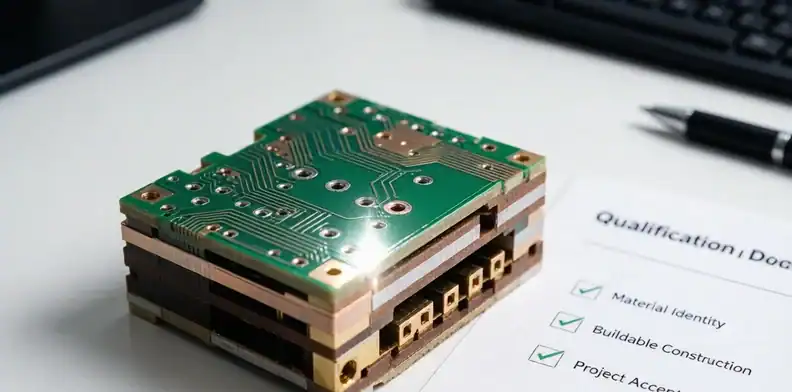
A fabricator should qualify Megtron 6 at three levels: material identity, buildable construction, and project acceptance. The current datasheet anchors the grade, but incoming records, stackup data, process qualification, inspection, and change control connect that laminate identity to the shipped PCB.
The qualification file should contain the required Panasonic part number (R-5775(N), R-5775(K), or R-5375 variant), the exact core and prepreg constructions, and the glass style. Add the traceability records required by the purchase package, applicable UL scope, and the relied-on thermal and electrical evidence. “Megtron 6” is not a substitute for those records.
For the board, review pressed dielectric thickness, resin content, glass style, copper profile, impedance geometry, via structure, and thermal profile. Use construction-specific design Dk and an agreed loss basis. Qualify assembly heat on the actual board rather than converting T288 into cycle count. If you want a contextual review of that package, send the drawing, stackup, proposed material variant, interfaces, assembly profile, and approval rules through the multilayer PCB fabrication service for a material and DFM review.
Factory experience: A fabricator ran Megtron 6 through a standard FR-4 drilling recipe and produced rough hole walls that raised via resistance on a 16-layer server board. We adjusted the feed rate and hit count for the H-VLP copper and Low Dk glass, then re-qualified the via chain. First-pass yield on the next lot rose from 94.2% to 99.1%.
Change control closes the loop. The fabricator should disclose a proposed material or construction change before release when the contract requires it, preserve the approver and revision, and keep the approved stackup aligned with manufacturing documentation.
Bottom line: Qualify identity, construction, and acceptance separately — and require the fabricator to re-qualify whenever the R-5775 variant, glass cloth, or copper foil changes.
How Do You Specify Megtron 6 in an RFQ?
Specify Megtron 6 in an RFQ with an exact part number, a clear substitution rule, a controlled stackup, and a list of required evidence. The wording should tell the fabricator whether alternatives may be proposed, who approves them, and which electrical, thermal, safety, and traceability fields the quotation must address.
Use an RFQ checklist such as:
- Material callout: Panasonic Megtron 6 R-5775(N) Low Dk glass laminate and R-5670(N) prepreg, with the required datasheet revision. State “Megtron 6” is not a complete callout.
- Substitution language: exact material only, or alternatives disclosed for written approval before fabrication.
- Construction: layer count, finished thickness, copper weights, core/prepreg choices, resin content, glass styles, and impedance table.
- Electrical basis: target impedance, relevant frequency range, loss budget, design Dk source (3.34 at 13 GHz for R-5775(N)), copper profile, and any coupon requirement.
- Thermal basis: assembly profile, rework exposure, via reliability target, and project-specific validation.
- Compliance and records: applicable IPC slash sheets, UL scope, substance declarations, certificates, lot traceability, and customer flow-downs.
- Commercial scope: quantities, panel constraints, delivery locations, and quotation assumptions, without presuming stock or lead time.
For an allowed alternative, require a side-by-side deviation table that lists every difference and cites a current source. State that silence is not approval and that fabrication may begin only after the named authority accepts the proposal. This turns “or equivalent” from vague purchasing language into a reviewable release gate.
Bottom line: An RFQ that says only “Megtron 6” invites a variant substitution at the fabricator’s convenience — specify R-5775(N) or R-5375(N) and make the substitution rule explicit.
When Should You Reject a Proposed Megtron 6 Substitute?
Reject or escalate a Megtron 6 substitute when the specification forbids it, the authorized approver has not accepted it, or the supplier cannot close a requirement that matters to the design. A cheaper quote, local availability, or a shared “Megtron” label does not override a missing electrical, thermal, safety, traceability, or contractual control.
Immediate escalation conditions include:
- “No substitution,” “exact material required,” or an approved-material-list restriction.
- No current grade-specific datasheet or unclear R-5775 vs R-5375 variant.
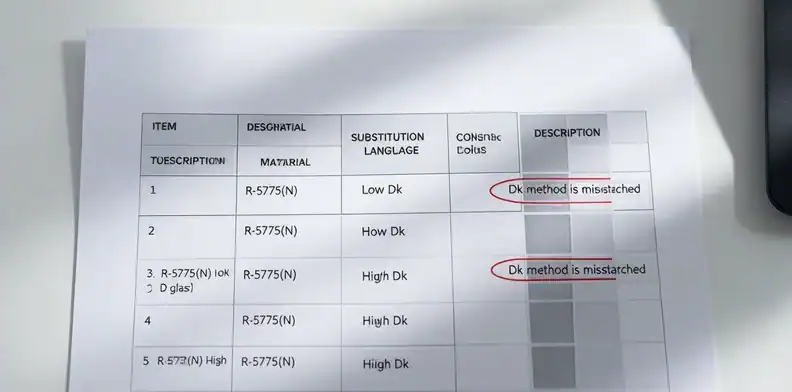
- Dk/Df values with mismatched method, frequency, or glass cloth (BCDR vs stripline, 13 GHz vs 10 GHz, Low Dk vs Normal glass).
- Missing construction availability for the approved stackup.
- Unconfirmed UL file, grade, thickness, or copper scope where required.
- No thermal or reliability evidence tied to the project’s acceptance plan (T288, CTE, peel strength).
- A customer-controlled program with no documented deviation path.
Apply the same discipline to any proposed alternative. Check the exact construction and test context. Keep approval separate from the supplier’s category. If a required field remains open, reject the substitution for release or request clarification.
Bottom line: Reject when the variant, method, or approval is missing — a “Megtron 6 equivalent” that cannot document its glass cloth, Df method, and approval path is not an equivalent.
FAQ
Can I treat any Megtron 6 variant as interchangeable?
No. R-5775(N) Low Dk glass and R-5775(K) Normal glass differ by 0.28 in Dk and 0.0009 in Df at 13 GHz — enough to miss impedance and loss targets. Specify the exact suffix and require the fabricator to confirm it before quoting.
Is Megtron 6 good enough for 112G PAM4?
It depends on the trace length and channel budget. Megtron 6 Df 0.0037 at 13 GHz is workable for short 112G routes, but long backplane traces often need Megtron 7 or Megtron 8. Run a construction-specific channel simulation before committing.
Can I mix Megtron 6 with Megtron 7 in one stackup?
Yes, as a hybrid stackup, but only after modeling and qualification. The two grades have different Dk (3.34 vs 3.4) and Df (0.0037 vs 0.001), so the impedance and loss tables must be computed per layer. Document the hybrid construction and qualify it as its own build.
How many reflow cycles can Megtron 6 survive?
No fixed count is published. T288 above 120 minutes is a time-to-delamination test, not a cycle budget. Qualify the actual board construction, moisture history, assembly profile, and rework plan.
How do I know if the exact Megtron 6 variant is required?
Read the drawing, approved material list, purchase order, quality clauses, and deviation procedure. Treat “no substitution” or “exact material required” as controlled language, and obtain written approval when “or equivalent” leaves the authority or criteria unclear.
Sources
- Panasonic MEGTRON6 R-5775 series product page
- Panasonic MEGTRON series overview
- Panasonic Halogen-free MEGTRON6 R-5375 series
- Panasonic R-5775(G) specifications
- IPC-TM-650 test methods
- IPC-4103 specification page
Written by the QueenEMS Engineering Team
Upload your files today · Free DFM check before production · Ship worldwide
Get your PCB prototypes in as fast as 24 hours. We handle FR4, Rogers, and Flex up to 60 layers — free prototypes for 2–4 layer boards, no minimum order.
Just upload your Gerber + BOM — we source every part, assemble, and inspect (AOI + X‑Ray) so you don't have to chase suppliers. Boards ship in as fast as 24 hours.