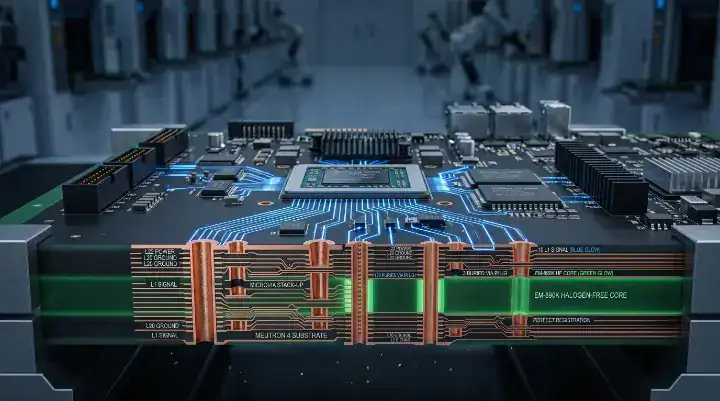
Quick Answer: EM-890K is EMC’s flagship M7-grade halogen-free laminate featuring a low dielectric constant (Dk) of 3.0 and a dissipation factor (Df) of 0.0025 at 10 GHz. For 56G PAM4 designs under 15 inches, downgrading from M8-grade EM-892K2 to EM-890K reduces raw material costs by 25–35% while maintaining strict halogen-free compliance. Key takeaways:
For the wider material-selection picture across performance, fabrication, and sourcing, refer to the full PCB materials guide.
- Delivers Dk 3.0 and Df 0.0025 @ 10 GHz with Low-Dk glass
- The only true halogen-free M7 option against Tachyon 100G
- Cuts material costs by 30% when replacing M8 in 56G designs
- Processes on standard FR-4 parameters with 2,200-hit drill life
Table of Contents
- 1. What Is EM-890K and Why Is It EMC’s Halogen-Free M7 Sweet Spot?
- 2. What Electrical and Thermal Properties Define EM-890K?
- 3. What Does the “K” Suffix Mean and How Does It Change Performance?
- 4. Where Does EM-890K Sit Between EM-528K and EM-892K2?
- 5. How Does EM-890K Compare to Tachyon 100G and Megtron 7?
- 6. When Can You Downgrade from EM-892K2 to EM-890K and Save 30%?
- 7. Why Is EM-890K the Only Halogen-Free M7 Material Available?
- 8. How Do Fabricators Process EM-890K on Standard FR-4 Lines?
- 9. What Stackup Strategies Work Best with EM-890K Hybrid Builds?
- 10. How Will EM-890K Evolve as EMC Pushes Toward M9 and M10?
- 11.FAQ
Hardware engineering teams building 400G and 800G network switches face an escalating cost dilemma. Signal integrity requirements push designers toward ultra-low-loss M8 laminates, driving PCB fabrication costs up by 400% compared to standard materials, while European environmental mandates strictly forbid halogenated flame retardants. The solution lies in specifying EM-890K, the exact material that bridges the gap between M6 affordability and M8 performance. By utilizing this laminate as a step-down alternative to an EM-892K2 halogen-free M8 laminate, engineers satisfy both strict loss budgets and green compliance standards simultaneously.
1. What Is EM-890K and Why Is It EMC’s Halogen-Free M7 Sweet Spot?
EM-890K is a high-performance M7-grade printed circuit board laminate developed by Elite Material Co. (EMC), delivering a Df of 0.0025 at 10 GHz. It stands out in the industry as the primary ultra-low-loss material that successfully achieves this specific attenuation target while maintaining 100% halogen-free chemistry.
The Role of M7 Grade in Network Hardware
M7 grade CCL is a specific material classification defining laminates with dissipation factors between 0.0015 and 0.0029.
Here is the reality:
- It supports 56G PAM4 signals effortlessly across mid-range backplanes.
- It costs 3 to 5 times more than standard FR-4.
- It fills the distinct performance void for 400G switch short-reach links.
Key Takeaway: Engineering teams select EM-890K when their signal speeds exceed the 0.004 Df limit of M6 materials but do not justify the severe price premium of 112G-capable M8 laminates. Bottom line: Specify EM-890K directly for 56G PAM4 channels under 15 inches where halogen-free compliance is a mandatory project requirement.
| Specification | Value | Industry Impact |
|---|---|---|
| M-Grade Classification | M7 | Fills the 56G PAM4 gap |
| Df @ 10 GHz | 0.0025 | Eliminates need for M8 in short traces |
| Halogen Status | 100% Halogen-Free | Meets EU environmental mandates |
This baseline defines why EM-890K captures a unique segment of the high-speed laminate market.
2. What Electrical and Thermal Properties Define EM-890K?
EM-890K exhibits a dielectric constant (Dk) of 3.0 and a dissipation factor (Df) of 0.0025 measured at 10 GHz via cavity resonator (RC 50%). Thermally, it provides a highly stable glass transition temperature (Tg) of 200°C and a decomposition temperature (Td) of 400°C, supporting multiple sequential lamination cycles.
Analyzing the Core Metrics
A low dielectric constant is a material property that dictates how fast an electrical signal travels through the PCB substrate. At Dk 3.0, EM-890K accelerates signal propagation significantly compared to standard high-Tg FR-4 (Dk 4.0), minimizing phase skew on tightly coupled differential pairs.
Consider these thermal boundaries:
- Z-axis CTE measures ~35-40 ppm/°C below Tg.
- Total Z-expansion stays tightly capped at ~2.5% between 50°C and 260°C.
- These metrics prevent microvia fracturing during severe lead-free reflow profiles.
Key Takeaway: The combination of Dk 3.0 and Tg 200°C creates a highly predictable physical substrate that maintains tight impedance tolerances even after four press cycles. Bottom line: Rely on EM-890K’s 400°C Td when designing complex 20+ layer boards that require extensive thermal excursions during surface mount assembly.
| Property | EM-890K Value | Test Method / Condition |
|---|---|---|
| Dk | 3.0 | @ 10 GHz, Cavity Resonator |
| Df | 0.0025 | @ 10 GHz, Cavity Resonator |
| Tg (Glass Transition) | ~200°C | DSC |
The core electrical and thermal parameters validating its M7 status.
3. What Does the “K” Suffix Mean and How Does It Change Performance?
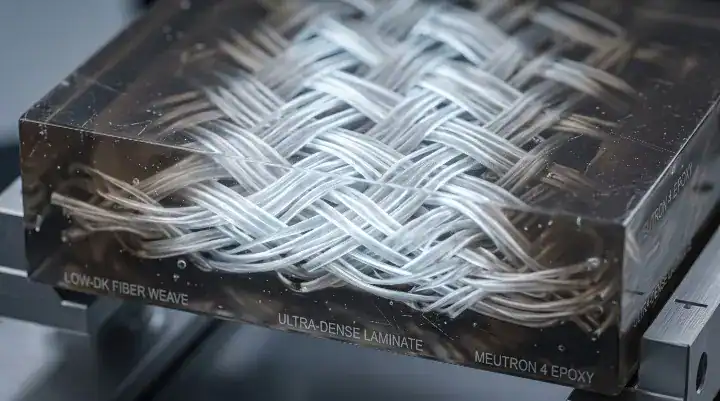
The “K” suffix in EM-890K indicates the specific integration of Low-Dk glass (NER series) into the resin matrix, as opposed to the standard E-glass used in the base EM-890 product. This glass upgrade reduces the base dielectric constant from 3.4 down to 3.0 and drops the dissipation factor from 0.004 to 0.0025.
The Physics of Low-Dk Glass
Low-Dk glass is an engineered fiberglass weave that utilizes customized silica compositions to minimize signal absorption at high frequencies. Because standard E-glass dominates the Dk/Df ratio in a cured laminate, replacing it with Low-Dk glass directly upgrades the entire material system from an M6 classification to a solid M7.
Look at the direct improvements:
- Insertion loss at 28 GHz drops to ~0.58-0.62 dB/inch.
- Skew variation across the glass weave minimizes significantly.
- The resin-to-glass ratio exerts less negative influence on high-speed traces.
Key Takeaway: You are effectively buying the exact same reliable PPO/epoxy resin system as the standard EM-890, but supercharging its RF performance purely through advanced glass reinforcement. Bottom line: Always verify the “K” suffix on your manufacturer’s stackup sheet, as missing that single letter results in a massive 60% increase in signal loss.
| Metric | EM-890 (E-glass) | EM-890K (Low-Dk glass) | Performance Shift |
|---|---|---|---|
| Dk @ 10 GHz | 3.4 | 3.0 | Improved by 0.4 |
| Df @ 10 GHz | 0.004 | 0.0025 | Improved by 37.5% |
| M-Grade Category | M6 | M7 | Full tier upgrade |
Details the exact engineering impact of the Low-Dk glass integration.
4. Where Does EM-890K Sit Between EM-528K and EM-892K2?
EM-890K acts as the precise M7 middle ground in EMC’s ultra-low-loss portfolio, positioned directly above the M6-grade EM-528K (Df 0.004) and below the M8-grade EM-892K2 (Df 0.0013). It provides hardware teams with a granular stepping stone when comparing M8 CCL lead times and managing strict fabrication budgets.
The EMC Product Hierarchy
Navigating material upgrades requires understanding the vendor’s internal roadmap. If a trace fails loss targets on EM-528K, moving straight to EM-892K2 incurs a massive price penalty. EM-890K intercepts this upgrade path, offering exactly enough performance for mid-length 56G PAM4 links.
Consider the stackup logic:
- EM-528K handles standard PCIe Gen4 protocols easily.
- EM-890K takes over for 400G switch interconnects and 56G runs.
- EM-892K2 is reserved strictly for 112G PAM4 and heavy NVLink paths.
Key Takeaway: EMC designed this specific lineup to allow fluid material scaling without forcing engineers to overpay for unneeded dielectric performance on every single board iteration. Bottom line: Use EM-890K to protect your project budget when signal integrity simulations show EM-528K failing by less than 1.5 dB per channel.
| EMC Material | Df Value | M-Grade | Target Protocol |
|---|---|---|---|
| EM-528K | 0.004 | M6 | PCIe Gen4 |
| EM-890K | 0.0025 | M7 | 56G PAM4 |
| EM-892K2 | 0.0013 | M8 | 112G PAM4 |
Maps the exact strategic positioning within the Elite Material catalog.
5. How Does EM-890K Compare to Tachyon 100G and Megtron 7?
EM-890K (Df 0.0025) competes directly against Isola’s Tachyon 100G (Df 0.0021) and Panasonic’s Megtron 7 (Df 0.0015), offering the unique advantage of 100% halogen-free chemistry that its rivals lack. While Megtron 7 wins on absolute signal loss, EM-890K matches Tachyon 100G in pricing while satisfying European eco-mandates.
The Head-to-Head Loss Battle
When engineers evaluate the Tachyon 100G ultra-low-loss laminate, they prioritize raw attenuation over environmental chemistry. Tachyon 100G yields ~0.60-0.65 dB/inch at 28 GHz, while EM-890K performs similarly at ~0.58-0.62 dB/inch, making them functionally identical for 56G PAM4 signal paths up to 12 inches.
The Pricing and Lead Time Factors
- Megtron 7 commands a 6-9× price multiple over standard FR-4.
- EM-890K and Tachyon 100G sit much lower at 3-5× FR-4.
- Insulectro routinely stocks EM-890K in North America, keeping lead times at 2-4 weeks.
Key Takeaway: The decision rarely comes down to a tiny fraction of a decibel; it depends entirely on whether your end product requires RoHS compliance coupled with strict halogen-free certification. You can analyze these differences further using an interactive PCB material selector tool to chart exact trace attenuation. Bottom line: Select Megtron 7 for maximum 56G performance length, choose Tachyon 100G for Isola ecosystem compatibility, but specify EM-890K exclusively when halogen-free status is required.
| Feature | EMC EM-890K | Isola Tachyon 100G | Panasonic Megtron 7 |
|---|---|---|---|
| Df @ 10 GHz | 0.0025 | 0.0021 | 0.0015 |
| Halogen-Free | ✅ Yes | ❌ No | ❌ No |
| Price vs FR-4 | 3-5× | 3-5× | 6-9× |
Directly contrasts the top three M7 contenders in the global market.
6. When Can You Downgrade from EM-892K2 to EM-890K and Save 30%?
You can safely downgrade from EM-892K2 (M8) to EM-890K (M7) when your design operates at 56G PAM4 speeds and trace lengths remain under 15 inches, instantly cutting raw material costs by 25% to 35%.
A Real-World Cost Reduction Case
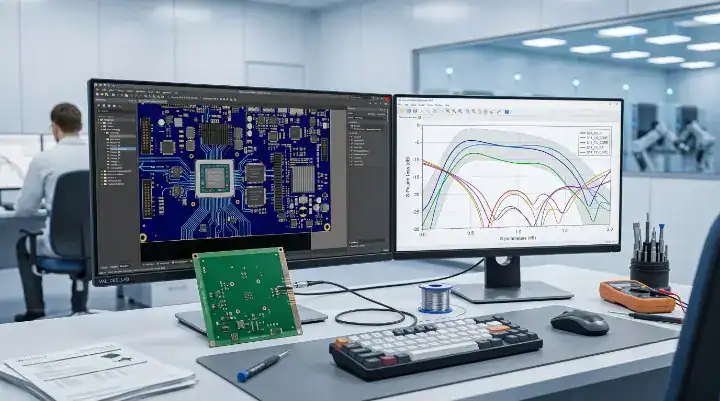
A customer brought us a 22-layer 400G switch board originally specified entirely in flagship M8 class materials. The board carried 14 signal layers at 56G PAM4 across 12-inch maximum traces. We ran channel loss simulation: EM-892K2 at 28 GHz delivered 0.53 dB/inch × 12 inches = 6.4 dB total, against a 14 dB budget—leaving a massive 7.6 dB margin.
Here is what the math revealed:
- EM-890K simulation showed 0.60 dB/inch × 12 inches = 7.2 dB total.
- The design still retained a highly safe 6.8 dB operating margin.
- Material cost dropped from $1,680 to $1,190 per panel.
Key Takeaway: The 0.8 dB difference was mathematically irrelevant to the channel budget, allowing the customer to save $490 per panel—totaling $14,700 on the first 30-panel lot—while shipping two weeks faster due to better stock availability. Bottom line: Never over-specify M8 materials for 56G interconnects; always run S-parameter simulations to prove that EM-890K can handle the link budget at a fraction of the cost.
| Signal Speed | Trace Length | Downgrade to EM-890K? | Justification |
|---|---|---|---|
| 56G PAM4 | < 15 inches | ✅ Yes | Vastly overkill on M8 |
| 56G PAM4 | > 18 inches | ⚠️ Marginal | Validate with simulation |
| 112G PAM4 | Any length | ❌ No | Strict M8 requirement |
Provides the engineering boundaries for executing a safe material downgrade.
7. Why Is EM-890K the Only Halogen-Free M7 Material Available?
EM-890K operates as a functional anomaly because achieving a Df of 0.0025 typically requires brominated compounds for thermal stability, making EM-890K the only mainstream M7 laminate that achieves ultra-low-loss performance while satisfying strict IEC 61249-2-21 halogen-free criteria.
The Environmental Compliance Gap
Here is a fact that most engineers miss: if your design requires both halogen-free compliance and M7-grade loss performance, EM-890K is essentially your only option. While designers regularly review halogen-free PCB manufacturing rules, they frequently discover that competing materials like Tachyon 100G and Megtron 7 rely heavily on halogens for flame retardancy.
Consider the market alternatives:
- Tachyon 100G: Contains halogens.
- Megtron 7: Contains halogens.
- TerraGreen 400G2: Halogen-free, but sits at M7-M8 edge and costs 30% more.
Key Takeaway: For European telecom deployments where halogen-free status is non-negotiable and the design runs 56G PAM4 channels, EM-890K fills a specific gap that no other single material covers accurately. Bottom line: Lock EM-890K into your bill of materials early if your 400G hardware targets European data centers or eco-conscious consumer network infrastructure.
| Material Contender | Halogen-Free Status | Df Performance | M-Grade |
|---|---|---|---|
| EM-890K | ✅ Yes | 0.0025 | M7 |
| Megtron 7 | ❌ No | 0.0015 | M7 |
| TerraGreen 400G2 | ✅ Yes | 0.0015 | Edge M8 |
Demonstrates the severe lack of halogen-free options within the M7 sector.
8. How Do Fabricators Process EM-890K on Standard FR-4 Lines?
Fabricators process EM-890K seamlessly using standard 200°C lamination press cycles for 60 minutes, achieving approximately 2,200 hits per carbide drill bit with an excellent first-pass yield rate of 95.3% on high-layer-count constructions.
Real Factory Processing Data
EM-890K processes identically to EM-892K2 on our line because both utilize EMC’s established PPO/epoxy hybrid resin family. During typical HDI PCB sequential lamination services, we run standard permanganate desmear with absolutely no expensive plasma etching required to prepare the via walls for plating.
Look at the fabrication metrics:
- Drill chipload is reduced by just 15% from the FR-4 baseline.
- Drill bit life hits 2,200 actuations before requiring replacement.
- First-pass yield on our last 60 panels averaged 95.3%.
Key Takeaway: This material behaves incredibly predictably on the shop floor, meaning factories will not penalize your quotes with the severe manufacturing upcharges usually associated with Teflon-based PTFE laminates. Bottom line: You can specify EM-890K without worrying about extending your standard high-Tg fabrication lead times or causing catastrophic yield drops during the drilling phase.
| Manufacturing Step | Parameter / Metric | Comparison to FR-4 |
|---|---|---|
| Lamination Press | 200°C for 60 mins | Identical |
| Drill Tool Life | ~2,200 hits | Slightly lower (2,800 baseline) |
| Desmear Process | Standard Permanganate | Identical (No Plasma) |
Highlights the aggressive factory-floor compatibility of this PPO resin system.
9. What Stackup Strategies Work Best with EM-890K Hybrid Builds?
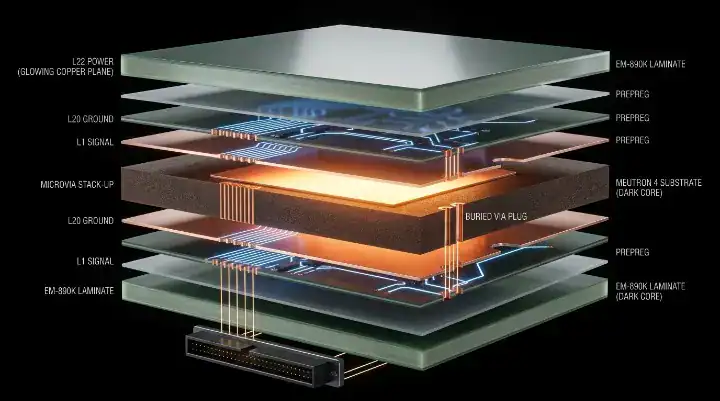
The optimal stackup strategy for EM-890K involves utilizing it purely on the high-speed signal layers while aggressively integrating EM-370(D) or standard high-Tg FR-4 cores on the internal power and ground planes to drastically reduce overall panel costs.
Leveraging Prepreg Compatibility
A hybrid stackup is a design technique where expensive ultra-low-loss materials are mixed with cheaper standard materials inside the same PCB to balance cost and performance. The practical fabrication advantage of staying in the EMC ecosystem is that EM-890K shares the same fundamental resin chemistry as lower-tier EMC laminates.
These hybrid rules dictate success:
- Use EM-890K core strictly for the 56G differential pairs.
- Use EM-370 core for thick copper DC power distribution layers.
- Bond the entire structure using EMC’s matched EM-89BK prepreg family.
Key Takeaway: Keeping the prepreg family identical across the entire sublamination guarantees uniform resin flow during the press cycle, eliminating the risk of localized delamination. Bottom line: Never mix an EM-890K core with a competing vendor’s prepreg like Tachyon 100G; always execute hybrid stackups using materials sourced from the exact same chemical family.
| Layer Function | Material Choice | Goal Achieved |
|---|---|---|
| 56G Signal Layers | EM-890K Core | Signal Integrity |
| Power/Ground Planes | EM-370(D) Core | Massive Cost Reduction |
| Bonding Material | EM-89BK Prepreg | Controlled Resin Flow |
Outlines the standard hybrid material allocation for 400G server hardware.
10. How Will EM-890K Evolve as EMC Pushes Toward M9 and M10?
As EMC develops M9 and M10 materials to support emerging 224G PAM4 architectures, EM-890K will transition from a bleeding-edge switch material into the baseline commodity laminate for mid-tier enterprise servers and advanced 5G infrastructure.
The Shift in Market Positioning
Every ultra-low-loss material eventually cascades down the technology hierarchy as processor speeds double. What serves as the core of a flagship 400G switch today will become the standard requirement for basic network interface cards (NICs) within three years.
Consider the trajectory:
- Legacy 10G gear will migrate from FR-4 up to M4/M6.
- Current 400G edge computing will standardize entirely on M7 (EM-890K).
- AI training clusters will monopolize the new M9/M10 capacity.
Key Takeaway: Because EM-890K is already highly manufacturable and heavily stocked by distributors like Insulectro, its price will naturally compress as M8 adoption widens. Bottom line: Build your next-generation 5G base station architectures around EM-890K now, as its cost curve will drop significantly just as your hardware hits peak mass production volumes.
| Network Era | Target Hardware | EM-890K’s Evolving Role |
|---|---|---|
| Present (400G) | Datacenter Switches | Primary Signal Carrier |
| Near Future (800G) | High-End Edge Servers | Mid-Tier Routing |
| Future (1.6T) | 224G Architectures | Legacy Low-Speed Bus |
Forecasts the life cycle and future pricing dynamics of M7 laminates.
Conclusion
Mastering ultra-low-loss PCB design is no longer just about picking the material with the lowest Df on a datasheet; it requires balancing signal integrity, environmental compliance, and raw fabrication economics. EM-890K solves this complex equation perfectly by delivering robust M7 performance inside a 100% halogen-free chemistry. By strategically downgrading from M8 where appropriate and utilizing hybrid stackup architectures, you can aggressively protect your project margins. If you need a partner to review your 400G stackup or simulate your material transition, contact us today for PCB manufacturing and request a free engineering evaluation.
At QueenEMS, we believe that true engineering excellence means deploying the exact right material for the trace—not wasting budget on specs your hardware will never use.
FAQ
Can I run 112G PAM4 signals on EM-890K? No, you cannot. 112G PAM4 requires a Nyquist frequency of 28 GHz, which induces too much insertion loss on EM-890K’s 0.0025 Df profile for any trace longer than 3 inches. You must upgrade to an M8-grade material like EM-892K2 or Megtron 8.
Is EM-890K fully compatible with standard FR-4 lead-free assembly? Yes, it is entirely compatible. EM-890K boasts a decomposition temperature (Td) of 400°C, which easily survives the standard 260°C peak temperatures of lead-free surface mount reflow profiles without blistering or delamination.
Why does EM-890K cost more than standard high-Tg FR-4? The premium stems entirely from the specialized chemistry. EM-890K utilizes an advanced polyphenylene oxide (PPO) resin blend and specialized Low-Dk glass weaves, both of which cost significantly more to synthesize and weave than standard epoxy and E-glass.
Can I mix EM-890K with Isola materials in the same board? No, mixing resin families is highly dangerous. While you can build hybrid boards, you should only mix EM-890K signal cores with EMC-manufactured power cores (like EM-370) and EMC prepregs to ensure the resin flows uniformly during the lamination press cycle.
What makes EM-890K unique among M7 laminates? It is the only prominent M7-grade material that operates entirely halogen-free. Competing materials like Tachyon 100G and Megtron 7 rely on halogens for flame retardancy, making EM-890K mandatory for high-speed hardware shipping into European markets with strict eco-mandates.
Written by the QueenEMS Engineering Team
Upload your files today · Free DFM check before production · Ship worldwide
Get your PCB prototypes in as fast as 24 hours. We handle FR4, Rogers, and Flex up to 60 layers — free prototypes for 2–4 layer boards, no minimum order.
Just upload your Gerber + BOM — we source every part, assemble, and inspect (AOI + X‑Ray) so you don't have to chase suppliers. Boards ship in as fast as 24 hours.