
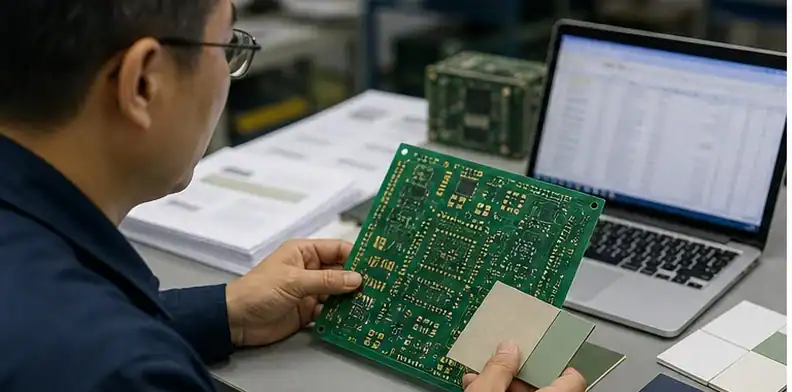
Quick Answer: Decision: Rogers-FR4 hybrid cost model. Controlled object: quote comparison that separates laminate area, panel utilization, lamination cycles, drilling and preparation, yield allowance, testing, material minimums, and scrap. Design-owned boundary: performance-critical Rogers locations, approved FR-4 support material, finished construction, evidence, and exclusions that price pressure may not remove. Supplier discretion: cost proposals that preserve the released electrical and reliability constraints and expose every changed assumption. Stop rule: a cheaper quote omitting required evidence, changing critical material, hiding minimum buys, or assuming a panel utilization that the design cannot achieve.
For the wider material-selection picture across performance, fabrication, and sourcing, refer to the full PCB materials guide.
- Keep the page focused on cost boundary, quote comparison, and approval risk, not a generic Rogers material overview.
- Separate real material savings from extra lamination, test, scrap, and lead-time assumptions.
- Ask the supplier to show what is included, excluded, or substituted before the PO.
- Treat the cheapest quote as unsafe when it removes evidence or changes the approved stackup silently.
The practical question behind a Rogers FR4 hybrid PCB is whether the cost saving survives manufacturing reality. A mixed stackup may reduce premium laminate area, but it can also add lamination control, material procurement, impedance verification, cross-section review, or repeat-order risk.
A clear cost record helps engineering and purchasing avoid arguing about different offers. It also prevents later cost pressure from removing the very control that made the first hybrid build acceptable.
Table of Contents
- Separate RF performance value from FR4 support
- Check whether the saving survives lamination risk
- Compare quotes by included controls
- Define what price pressure may not remove
- Tie evidence to the cost risk
- Decide when Rogers FR4 is not the cheaper route
- Compare prototype savings against production repeatability
- Make the quote show what cost pressure may not remove
- Use RFQ wording that makes savings and exclusions visible
Separate RF performance value from FR4 support
The first useful step for a Rogers FR4 hybrid PCB quote is to identify where the Rogers material creates real value. RF feeds, antennas, phase-sensitive paths, microwave structures, and selected high-speed routes may justify low-loss material. Mechanical support layers, low-speed control, or some plane layers may not.
That separation protects both performance and budget. Engineering gets a clear statement of which layers are protected for electrical reasons, while purchasing can ask whether the remaining layers can use FR4 without changing impedance, flatness, thermal exposure, or assembly reliability.
Cost signal: The hybrid choice is justified when the quote protects the performance layers and proves which layers can safely use FR4.
Check whether the saving survives lamination risk
| Cost item | Why it changes the decision | Buyer check |
|---|---|---|
| Rogers material area | Reduces premium laminate use | Which layers truly need Rogers? |
| FR4 support layers | Lowers material cost | Does FR4 affect reference planes or thickness? |
| Lamination control | Adds process planning | Is extra review included or excluded? |
| Test evidence | Proves the saving did not change function | Which reports are included in price? |
| Repeatability | Protects the second lot | Is the approved stackup locked? |
This is where a cheap quote can become expensive. If the supplier excludes impedance evidence, cross-section review, material alternates, or first-lot approval, the buyer may save on the quotation and pay later through rework, delay, or a receiving dispute.
Compare quotes by included controls
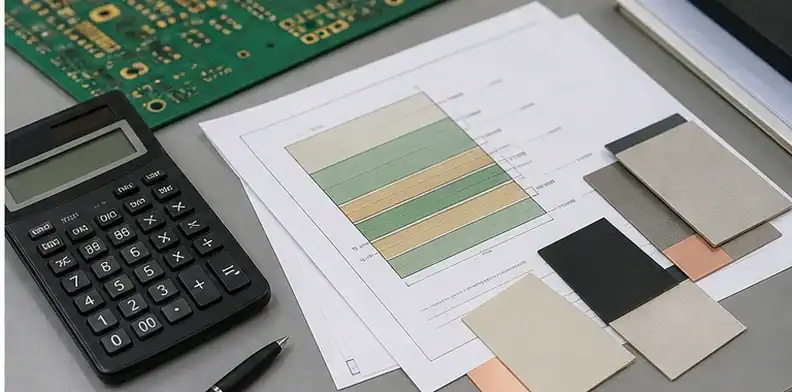
A Rogers FR4 hybrid PCB quote should be compared by included controls, not by headline unit price. Two suppliers may both quote Rogers plus FR4, but one may include material availability checks, impedance coupons, surface-finish review, and stackup signoff while the other only prices the bare board.
The quote should show whether trace-width tuning, reference-plane changes, copper foil, prepreg alternates, coupon placement, and finished thickness are controlled. If those items are silent, purchasing cannot tell whether the lower price is a true saving or a missing assumption.
Comparison rule: The better Rogers FR4 quote is the one with visible assumptions, not always the one with the lowest material line.
Define what price pressure may not remove
Cost pressure usually appears after the first quote, when purchasing asks what can be removed or relaxed. A good Rogers FR4 hybrid PCB review defines which items are negotiable and which need engineering approval before they disappear from the offer.
A supplier may reasonably propose an available prepreg, a different panel utilization, or a modified coupon plan. The buyer should not accept silent removal of critical Rogers layers, controlled impedance verification, finished thickness control, surface finish requirements, or first-lot evidence when those items protect the reason for using hybrid construction.
| Cost reduction proposal | Can be acceptable when | Needs engineering approval when |
|---|---|---|
| Alternate prepreg | Electrical and thickness impact is documented | Dk, Df, Tg, or thickness changes materially |
| Fewer test coupons | Risk is low and approved | Critical layer pair evidence disappears |
| Different copper foil | Loss impact is reviewed | RF or high-speed behavior may change |
| Removed first-lot review | Product is low risk | The hybrid stackup is new or unproven |
Approval boundary: Price pressure may reduce optional controls, but it should not remove the controls that justified the hybrid stackup.
Tie evidence to the cost risk
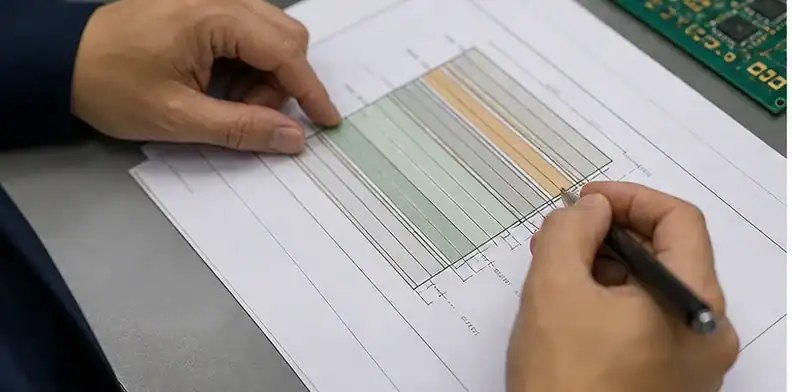
Evidence rule: Ask for the proof that protects the cost decision, not a large document set that avoids the real Rogers FR4 risk.
Decide when Rogers FR4 is not the cheaper route
A Rogers FR4 hybrid PCB is not automatically the cheaper route. If the low-loss area is large, the lamination sequence is difficult, material lead time is unstable, evidence requirements are heavy, or the supplier has limited mixed-material process experience, a full-premium or simpler material choice may be more predictable.
The decision should compare total build risk, not just laminate cost. A slightly higher quote that includes stackup signoff, material availability, impedance evidence, and first-lot review may be safer than a cheaper quote that leaves those items open.
| Decision path | Choose it when | Watch for |
|---|---|---|
| Rogers FR4 hybrid | Only selected layers need low-loss behavior | Mixed-material controls must be included |
| Full Rogers or low-loss stackup | Most layers are performance-critical | Material cost and lead time may rise |
| FR4 or high-speed FR4 family | Requirements are moderate | Do not underspec real RF or loss needs |
Route rule: Rogers FR4 hybrid is cheaper only when the material saving is larger than the added process, evidence, and repeatability risk.
Compare prototype savings against production repeatability
Make the quote show what cost pressure may not remove
Use RFQ wording that makes savings and exclusions visible
A Rogers FR4 quote should not only ask for the cheapest hybrid option. It should make the saving visible while also showing what is excluded. The buyer needs to know whether the price includes material availability review, lamination control, impedance testing, cross-section evidence, and any first-lot approval work.
Practical wording can say: quote a Rogers FR4 hybrid PCB using Rogers material only on the listed RF or high-speed layers and FR4 or approved compatible material on non-critical layers. Separate material, lamination, impedance test, evidence, and lead-time assumptions where possible, and identify any excluded inspection or qualification cost.
That wording helps a buyer avoid a common trap. One supplier may quote a lower number because it assumes standard FR4 processing and no extra evidence. Another may include stackup signoff and TDR coupon data. Those are not equivalent quotes even if the board outline and layer count match.
The buyer should also ask what cannot be removed later under cost pressure. If the RF layer material, low-profile copper, impedance evidence, or cross-section approval is essential to the design, it should be written as a protected requirement. If it is optional, it can be priced as an alternate.
| Quote field | Why it matters | Buyer decision |
|---|---|---|
| Included test evidence | Shows whether the low price includes proof | Accept, add, or price as an option |
| Material availability | Separates savings from schedule risk | Approve stocked equivalent only if engineering agrees |
| Exclusions | Reveals what the cheaper quote removed | Compare against the protected requirement list |
Savings rule: Rogers FR4 hybrid PCB savings are useful only when the quote also shows which controls are included, excluded, or protected.
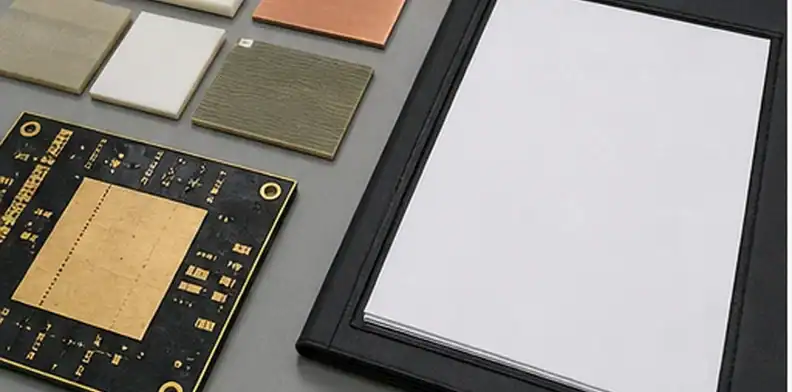
For production approval, separate one-time savings from repeatable savings. A prototype quote may look attractive because the supplier is willing to absorb extra review or use available material. A production quote should show whether the same Rogers FR4 hybrid PCB construction can be repeated with stable material supply, coupon strategy, and inspection scope.
The buyer should also ask whether a cheaper alternate changes risk ownership. If the supplier proposes a different Rogers grade, a different FR4 system, or a reduced evidence package, the quote should say whether that is an equivalent build or a cost-reduction deviation. That distinction keeps savings from becoming an unapproved reliability experiment.
Production record for the Rogers-FR4 hybrid cost model
Controlled object
Controlled object: quote comparison that separates laminate area, panel utilization, lamination cycles, drilling and preparation, yield allowance, testing, material minimums, and scrap.
Failure boundary
Failure boundary: apparent laminate savings erased by low panel yield, added processing, scarce bondply, warpage control, test cost, or unstable repeat sourcing.
Design-owned conditions
Design-owned conditions: performance-critical Rogers locations, approved FR-4 support material, finished construction, evidence, and exclusions that price pressure may not remove.
Supplier discretion
Supplier discretion: cost proposals that preserve the released electrical and reliability constraints and expose every changed assumption.
Required proof
Required proof: panel and lamination basis, material availability, yield assumptions, included tests, prototype charges, and production repricing conditions.
Production stop
Production stop: a cheaper quote omitting required evidence, changing critical material, hiding minimum buys, or assuming a panel utilization that the design cannot achieve.
Repeat-order baseline
Repeat-order baseline: costed construction, panel map, material lots or minimums, cycle count, yield history, test scope, exceptions, and volume price reset.
RFQ inputs
RFQ inputs: approved stackup, board dimensions, material grades, annual and lot quantities, panel constraints, test needs, acceptable alternates, target lead time, and repeat forecast.
FAQ
Can the supplier decide the Rogers-FR4 hybrid cost model?
Discretion for Rogers-FR4 hybrid cost model: cost proposals that preserve the released electrical and reliability constraints and expose every changed assumption. Engineering control for Rogers-FR4 hybrid cost model: performance-critical Rogers locations, approved FR-4 support material, finished construction, evidence, and exclusions that price pressure may not remove.
What stops this Rogers-FR4 hybrid cost model?
Stop rule for Rogers-FR4 hybrid cost model: a cheaper quote omitting required evidence, changing critical material, hiding minimum buys, or assuming a panel utilization that the design cannot achieve. Disposition owner for Rogers-FR4 hybrid cost model: the named engineering approver.
Which proof closes the Rogers-FR4 hybrid cost model?
Evidence for Rogers-FR4 hybrid cost model: panel and lamination basis, material availability, yield assumptions, included tests, prototype charges, and production repricing conditions. Revision link for Rogers-FR4 hybrid cost model: the quoted dataset.
What survives into the next order?
Reorder baseline for Rogers-FR4 hybrid cost model: costed construction, panel map, material lots or minimums, cycle count, yield history, test scope, exceptions, and volume price reset.
For a focused Rogers-FR4 hybrid cost model, send QueenEMS approved stackup, board dimensions, material grades, annual and lot quantities, panel constraints, test needs, acceptable alternates, target lead time, and repeat forecast. Redline request: Rogers-FR4 hybrid cost model. Open assumptions: Rogers-FR4 hybrid cost model. Approver: Rogers-FR4 hybrid cost model owner.
Written by the QueenEMS Engineering Team
Sources
Upload your files today · Free DFM check before production · Ship worldwide
Get your PCB prototypes in as fast as 24 hours. We handle FR4, Rogers, and Flex up to 60 layers — free prototypes for 2–4 layer boards, no minimum order.
Just upload your Gerber + BOM — we source every part, assemble, and inspect (AOI + X‑Ray) so you don't have to chase suppliers. Boards ship in as fast as 24 hours.