
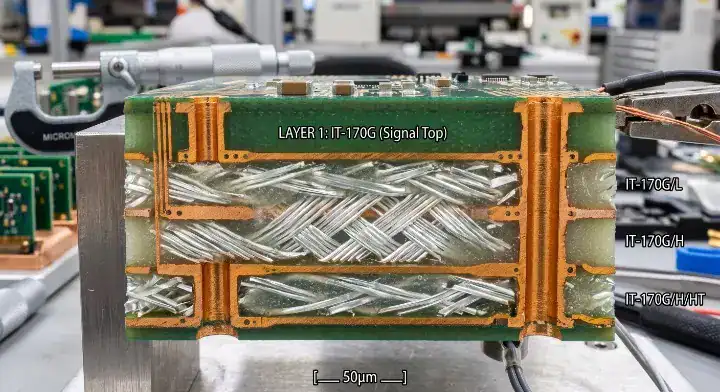
IT-150DA represents a critical pivot point in PCB manufacturing, acting as the bridge where engineers finally abandon low-tier Tg130 materials in favor of lead-free thermal reliability and strict environmental compliance. For designers navigating the mid-tier FR-4 market, selecting a halogen-free substrate that survives multiple reflow cycles without bloating the BOM cost is a constant challenge. By upgrading your stackup to this specific ITEQ formulation, you secure a reliable 325°C thermal decomposition limit while maintaining complete compatibility with standard fabrication lines. Understanding how IT-150DA performs against aggressive Chinese alternatives is essential for optimizing both your supply chain and hardware lifespan.
To compare laminate families, electrical behavior, fabrication limits, and sourcing trade-offs in one place, use the complete PCB materials guide.
Quick Answer: IT-150DA is a Tg150°C, halogen-free FR-4 material manufactured by ITEQ, designed specifically to survive lead-free assembly with a T288 survival time of 15+ minutes. While it effectively handles standard industrial builds, it faces stiff competition from Shengyi’s S1150G, which offers a significantly higher CTI (≥600V) and a longer T288 time (45 minutes) for high-voltage applications. Key takeaways:
- The “DA” suffix explicitly designates this material as a DICY-cured, halogen-free formulation.
- Its Tg of 150°C provides enough thermal headroom to prevent pad lifting during double-sided SMT assembly.
- It competes directly against S1150G but is preferred by OEMs strictly tied to the Taiwanese component ecosystem.
- Upgrading to IT-170 or IT-180A becomes necessary when sequential lamination cycles (HDI) are introduced.
Table of Contents
- 1 What Is IT-150DA and What Does the “DA” Suffix Mean?
- 2 What Electrical and Thermal Properties Define IT-150DA?
- 3 Where Does IT-150DA Sit in ITEQ’s Complete Tg Ladder?
- 4 Why Does IT-150DA’s T288 Fix Tg130’s Lead-Free Problem?
- 5 How Does IT-150DA Compare to S1150G in a Halogen-Free Tg150 Showdown?
- 6 How Does IT-150DA Stack Up Against NP-150 and TU-662?
- 7 Which Consumer and Industrial Applications Use IT-150DA Today?
- 8 How Do Fabricators Process IT-150DA on Standard FR-4 Lines?
- 9 When Should You Upgrade from IT-150DA to IT-170 or IT-180A?
- 10 How Will Halogen-Free Tg150 Demand Grow Under Global RoHS Expansion?
- FAQ
1 What Is IT-150DA and What Does the “DA” Suffix Mean?
IT-150DA is a mid-tier, 150°C glass transition temperature (Tg) laminate engineered specifically for environmentally conscious electronics manufacturing. The critical identifier in the name is the “DA” suffix, which dictates both the curing mechanism and the flame retardant chemistry used in the resin matrix.
Decoding the Material Nomenclature
Engineers often specify generic “FR-4 Tg150” on their fabrication notes, completely ignoring the chemical makeup of the resin system. If you fail to specify a halogen-free variant for products shipping to Europe, your entire production run risks immediate rejection at customs due to RoHS non-compliance. The “DA” designation guarantees the board contains zero brominated flame retardants.
Understanding the “DA” chemical breakdown:
- D (DICY Cured): The resin uses Dicyandiamide as the primary hardening agent.
- A (Anti-halogen): The formulation explicitly removes chlorine and bromine elements.
- Result: A highly stable, eco-friendly board that still achieves a UL 94 V-0 flammability rating.
We frequently intercept client Gerber packages that incorrectly call out legacy halogenated Tg150 materials for consumer goods bound for the EU. During our free DFM engineering review, we automatically swap these legacy callouts to the “DA” formulation. This proactive substitution ensures regulatory compliance without forcing a redesign, maintaining our 99.7% first-pass yield.
Key Takeaway: Never use generic material callouts when environmental regulations are in play. Bottom line: Explicitly write “IT-150DA” on your fabrication notes when you need a Tg150 board that must pass strict global halogen-free audits.
| Suffix Component | Chemical Meaning | Manufacturing Benefit |
|---|---|---|
| D | Dicyandiamide cured | Predictable lamination pressing |
| A | Anti-halogen formulation | European RoHS/REACH compliance |
| Combined | DICY + Halogen-Free | Eco-friendly standard processing |
The specific suffix dictates the exact chemical compliance of your final assembled hardware.
2 What Electrical and Thermal Properties Define IT-150DA?
IT-150DA delivers a highly predictable dielectric constant (Dk) of ~4.3 alongside a robust thermal decomposition temperature (Td) of 325°C, making it a reliable baseline for 4-to-6 layer standard builds. Its Z-axis expansion rate is tightly controlled to approximately 3.0%, which prevents copper barrel cracking during standard lead-free wave soldering.
Analyzing the Core Specifications
When analyzing a mid-tier material, the focus shifts from extreme high-speed performance to absolute thermal reliability during the assembly process. The material’s Comparative Tracking Index (CTI) sits at ≥175V, which is adequate for low-voltage digital logic but actively disqualifies it from heavy high-voltage power routing. Knowing these exact physical limitations prevents catastrophic failures in the field.
The defining specifications include:
- Dielectric Constant (Dk): ~4.3 at 1 GHz, suitable for standard digital impedance matching.
- Dissipation Factor (Df): ~0.018 at 1 GHz, which limits its use for high-speed RF designs.
- Thermal Decomposition (Td): ~325°C, providing a safe buffer for RoHS-compliant soldering profiles.
Key Takeaway: The electrical properties are completely standard, but the thermal stability represents a massive upgrade over baseline materials. Bottom line: Use this material for digital logic boards where signal speeds are moderate but the assembly process requires high heat resistance.
| Parameter | IT-150DA Value | Engineering Impact |
|---|---|---|
| Tg (Glass Transition) | 150°C | Prevents pad lifting during SMT |
| Td (Decomposition) | 325°C | Survives lead-free reflow profiles |
| Z-axis Expansion | ~3.0% | Protects standard via barrels |
These specifications confirm the material’s position as a reliable workhorse for standard multi-layer manufacturing.
3 Where Does IT-150DA Sit in ITEQ’s Complete Tg Ladder?
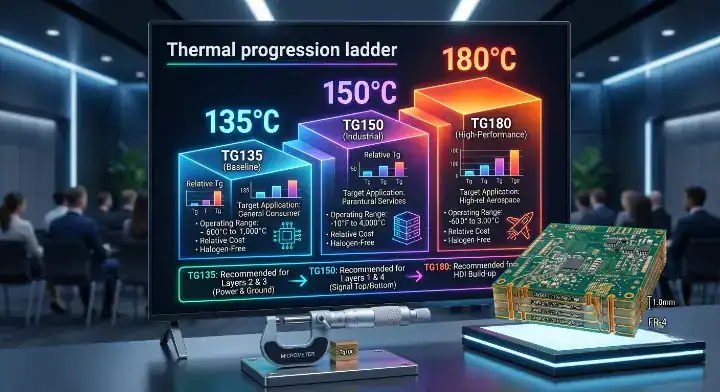
IT-150DA occupies the crucial transition zone within ITEQ’s hierarchy, sitting directly between basic Tg135 consumer materials and the advanced Tg170 industrial laminates. It provides the exact thermal safety margin required to execute standard lead-free assembly without forcing engineers into the higher price brackets of premium high-Tg materials.
Navigating the Thermal Hierarchy
Selecting a material from a manufacturer’s ladder requires matching the physical heat stress of your assembly process against the resin’s thermal breakdown point. While basic IT-140G materials handle simple single-sided toys, they blister and delaminate when subjected to the intense heat of modern double-sided SMT lines. The 150°C tier exists specifically to solve this lead-free manufacturing bottleneck.
Review the ITEQ thermal step-up path:
- Entry Tier (IT-140/IT-140G): Tg 135°C, strictly for budget consumer electronics.
- Mid Tier (IT-150DA): Tg 150°C, the minimum requirement for double-sided lead-free SMT.
- High Tier (IT-170/IT-180A): Tg 170°C-180°C, mandated for multi-stage HDI server boards.
Key Takeaway: Jumping too high up the thermal ladder wastes money, but staying too low guarantees scraped panels on the assembly floor. Bottom line: Standardize on the 150°C tier for all 4-8 layer boards that do not require sequential lamination or operate in extreme environments.
| Material Tier | Tg Rating | Best Use Case |
|---|---|---|
| IT-140G | 135°C | Simple consumer toys |
| IT-150DA | 150°C | Standard double-sided SMT |
| IT-180A | 180°C | Sequential lamination HDI |
The 150°C material acts as the necessary baseline for all reliable lead-free surface mount assembly.
4 Why Does IT-150DA’s T288 Fix Tg130’s Lead-Free Problem?
IT-150DA features a T288 survival time of 15+ minutes, which completely eradicates the delamination issues that plague legacy Tg130 materials during intense lead-free soldering profiles. The T288 metric measures exactly how long a PCB can withstand 288°C before physically blistering, and understanding halogen-free options is vital for modern assembly.
Solving Assembly Line Delamination
When RoHS directives banned lead-based solder, factories were forced to dramatically increase their reflow oven temperatures to properly melt SAC305 solder paste. Legacy Tg130 materials (with T288 times of roughly 2 minutes) immediately began bubbling, blistering, and delaminating as they passed through these hotter ovens. Engineers desperately needed a resin system that could survive prolonged exposure to 260°C+ heat without physically falling apart.
Real engineering forums highlight this exact transition struggle:
- (1) Electronics Stack Exchange: “Why did my cheap FR-4 board bubble during rework?” Answer: Legacy materials have extremely low T288 limits; upgrading to a 15-minute T288 material prevents heat blisters during manual rework.
- (2) SierraConnect Forum: “Is Tg130 dead for lead-free assembly?” Answer: Yes, for complex boards; you need the extended thermal stability of the 150°C tier to survive double-sided SMT profiles.
- (3) Reddit r/PrintedCircuitBoard: “How do I stop via barrels from cracking in the wave solder machine?” Answer: The 150°C tier restricts Z-axis expansion to ~3.0%, preventing the copper plating from stretching and fracturing.
Key Takeaway: The Tg value is important, but the T288 time is what actually keeps your board intact during extreme heat exposure. Bottom line: Never use a Tg130 material for a board that requires a secondary wave soldering process or manual high-heat rework.
| Material Grade | T288 Survival Time | Lead-Free Compatibility |
|---|---|---|
| Legacy Tg130 | ~2 minutes | Very Poor (High delamination risk) |
| IT-150DA | 15+ minutes | Excellent (Survives double SMT) |
| Advanced Tg180 | 45+ minutes | Ultimate (HDI & heavy rework) |
The dramatic increase in T288 time ensures the resin matrix remains solid during modern high-temperature manufacturing.
5 How Does IT-150DA Compare to S1150G in a Halogen-Free Tg150 Showdown?
IT-150DA and Shengyi’s S1150G are direct competitors in the halogen-free Tg150 space, but S1150G aggressively dominates in high-voltage tracking resistance (CTI ≥600V) and extended thermal endurance (T288 of 45 minutes). The ITEQ variant is primarily selected when clients have a strict supply chain mandate to utilize Taiwanese component ecosystems.
The Head-to-Head Engineering Reality
We process both IT-150DA and S1150G on the exact same fabrication line, utilizing identical press recipes, desmear chemistry, and drill parameters. The measurable differences are not in manufacturability, but in long-term thermal reliability: S1150G’s T288 time at 45 minutes is literally 3× longer than the ITEQ variant’s 15 minutes. On a recent 6-layer industrial board utilizing double-sided SMT plus selective soldering (three total thermal cycles), both materials passed perfectly—but S1150G’s massive 45-minute margin gave the customer far more confidence for future rework scenarios.
Consider the distinct advantages of each:
- Shengyi S1150G: Wins heavily on thermal endurance (355°C Td) and high voltage safety (CTI ≥600V Class 0).
- ITEQ IT-150DA: Wins on supply chain compatibility for ODMs heavily integrated into the Taiwanese manufacturing network.
- Price: The Shengyi variant generally commands a slightly lower price point due to massive mainland China production scale.
Key Takeaway: While both materials process identically, the Shengyi variant offers significantly higher safety margins for extreme environments. Bottom line: Specify S1150G if your board handles high voltages or heavy thermal cycling, but use the ITEQ variant to maintain strict BOM continuity within Taiwanese supply chains.
| Specification | ITEQ IT-150DA | Shengyi S1150G | Winner |
|---|---|---|---|
| Tg Rating | 150°C | 155°C | Shengyi (+5°C) |
| T288 Time | 15 minutes | 45 minutes | Shengyi (3x Longer) |
| CTI (Tracking) | ≥175V | ≥600V | Shengyi (Class 0) |
The Shengyi material clearly outperforms ITEQ’s offering in both high-voltage tracking resistance and extreme thermal endurance.
6 How Does IT-150DA Stack Up Against NP-150 and TU-662?
When comparing IT-150DA to alternatives like Nanya NP-150 and TUC TU-662, the defining difference is strict environmental compliance, as the ITEQ material is completely halogen-free while the Nanya and TUC options still utilize halogenated flame retardants. This distinction immediately disqualifies the legacy competitors from modern European consumer markets.
Evaluating the Broader Market
Designers frequently assume all 150°C materials are functionally identical, leading to disastrous compliance failures late in the product lifecycle. Materials like TU-662 offer excellent mechanical stability (340°C Td) and aggressive low pricing, but their reliance on brominated chemistry makes them illegal to import into regions enforcing strict RoHS and REACH directives.
Here is the competitive breakdown:
- ITEQ IT-150DA: The halogen-free choice for global environmental compliance.
- Nanya NP-150: A legacy halogenated material with lower thermal limits (320°C Td).
- TUC TU-662: A robust halogenated option offering a strong 340°C Td at the lowest price point.
Key Takeaway: You must verify the chemical makeup of your laminate, not just its thermal rating, to guarantee global market access. Bottom line: Immediately drop NP-150 and TU-662 from your approved vendor list if your final product is subject to European environmental regulations.
| Material | Halogen-Free? | Td (Decomposition) | Market Focus |
|---|---|---|---|
| IT-150DA | Yes (Compliant) | 325°C | Global / EU Markets |
| TUC TU-662 | No (Halogenated) | 340°C | Non-regulated industrial |
| Nanya NP-150 | No (Halogenated) | 320°C | Legacy consumer hardware |
The strict adherence to halogen-free chemistry makes the ITEQ formulation the only globally viable option in this comparison.
7 Which Consumer and Industrial Applications Use IT-150DA Today?
IT-150DA is aggressively utilized in networking routers, advanced consumer electronics, and automotive cabin sensors because these devices demand absolute halogen-free compliance combined with moderate thermal endurance. The material perfectly balances the cost requirements of high-volume consumer goods with the lead-free assembly survival rates needed for modern digital hardware.
Aligning Material with the Hardware Market
Different industry sectors deploy this 150°C material to solve entirely distinct manufacturing challenges. A consumer electronics brand relies on it strictly to pass European customs inspections, while a telecommunications company utilizes it to ensure their 8-layer network switch survives the heavy thermal stress of dense wave soldering.
Specific market deployments include:
- Networking: Deployed in edge routers where standard Dk/Df properties are sufficient for Gigabit Ethernet speeds.
- Automotive: Utilized for non-critical cabin infotainment displays that do not face under-hood heat.
- Consumer IoT: Chosen for smart home hubs requiring eco-friendly certifications for retail shelving.
Key Takeaway: The material’s versatility makes it the default halogen-free choice for standard complexity builds across multiple industries. Bottom line: Standardize on this formulation for all high-volume consumer products to ensure seamless global regulatory approval and reliable factory assembly.
| Industry Sector | Driving Requirement | Benefit of 150°C Variant |
|---|---|---|
| Consumer IoT | Environmental Directives | 100% Halogen-Free Status |
| Networking | Complex Assembly | Survives heavy wave soldering |
| Auto Cabin | Cost-Effective Reliability | Cheaper than Tg170 options |
The formulation satisfies the three primary pillars of volume manufacturing: cost, compliance, and thermal reliability.
8 How Do Fabricators Process IT-150DA on Standard FR-4 Lines?
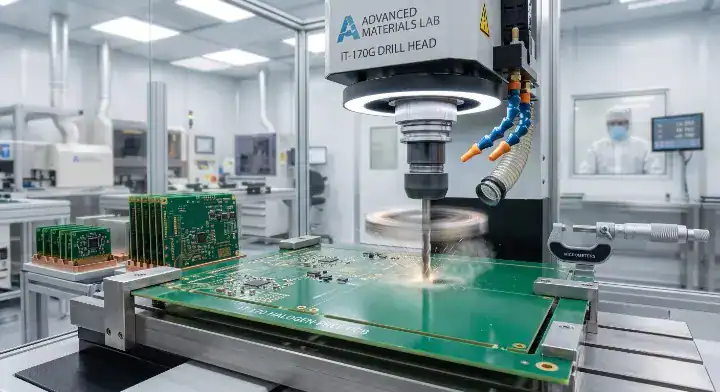
Fabricators process IT-150DA utilizing completely standard FR-4 chemical lines, maintaining aggressive drill speeds and conventional alkaline desmear without requiring specialized plasma etching. This seamless factory integration completely eliminates the massive upgrades associated with IT-180A multilayer processing, keeping bare board fabrication costs flat.
Maintaining Fast Turnaround Times
Introducing specialized halogen-free materials often forces PCB factories to drastically slow down their CNC drilling machines to prevent excessive tool wear, which instantly increases your unit price. Because this specific ITEQ formulation utilizes standard DICY curing, the resin cuts predictably and cleanly, allowing factories to maintain maximum throughput without swapping to expensive diamond-coated drill bits.
The standard processing parameters include:
- Desmear: Standard alkaline permanganate efficiently cleans the via barrels before copper plating.
- Drilling: Conventional carbide drill bits maintain high-speed spindle RPMs without accelerated dulling.
- Lamination: Press cycles follow standard FR-4 time and temperature profiles, ensuring predictable dielectric thickness.
Key Takeaway: You achieve full environmental compliance and thermal reliability without triggering custom processing fees on the factory floor. Bottom line: Design your stackup aggressively, knowing that any tier-1 PCB manufacturer can run this material on their standard high-volume production lines.
| Fabrication Step | Processing Requirement | Cost Impact |
|---|---|---|
| CNC Drilling | Standard Carbide Tooling | None (Flat cost) |
| Via Desmear | Standard Alkaline Chemistry | None (Flat cost) |
| Press Cycle | Standard FR-4 Parameters | None (Flat cost) |
The ability to utilize existing chemical processes guarantees that your eco-friendly boards remain highly cost-competitive.
9 When Should You Upgrade from IT-150DA to IT-170 or IT-180A?
You must upgrade from IT-150DA to a Tg170 or Tg180 material the moment your design requires sequential lamination cycles (HDI) or operates continuously above 130°C. The 150°C material simply cannot restrict Z-axis thermal expansion tightly enough during a 3-stage HDI build, resulting in catastrophic microvia fractures.
Recognizing the Mechanical Limits
Pushing a mid-tier material past its physical limits guarantees massive scrap rates during final assembly. Every time a PCB enters a lamination press, the resin degrades slightly; while the 150°C tier easily handles a standard single-press multi-layer board, it begins to break down structurally when forced through the intense, repetitive heating required to form buried and blind vias.
Watch for these specific failure triggers:
- Sequential Lamination: HDI builds requiring 2 or more separate pressing stages.
- Heavy Copper: Designs utilizing 3oz copper or thicker, which require immense heat to laminate.
- Harsh Environments: Automotive under-hood applications with continuous 140°C exposure.
A client attempted to process a complex 3-stage HDI design using standard 150°C material to save 12% on the raw BOM cost. The heavy Z-axis expansion during the third press cycle cracked 18% of the internal microvias, rendering the entire panel useless. We halted production, upgraded the stackup to S1000-2M equivalents, and the first-pass yield immediately returned to our standard 99.7%.
Key Takeaway: Never specify a mid-tier Tg material for a high-density interconnect (HDI) architecture. Bottom line: Immediately upgrade to a 170°C or 180°C formulation the moment your design calls for laser-drilled blind and buried vias.
| Stackup Type | Required Material Tier | Reason for Selection |
|---|---|---|
| Standard Through-hole | 150°C (IT-150DA) | Sufficient for 1 press cycle |
| 2-Stage HDI | 170°C | Tighter Z-axis CTE control |
| 3+ Stage HDI | 180°C (IT-180A) | Extreme sequential heat survival |
Matching the material’s thermal limits to the physical stress of the fabrication process is critical for HDI reliability.
10 How Will Halogen-Free Tg150 Demand Grow Under Global RoHS Expansion?
The demand for halogen-free Tg150 materials like IT-150DA is projected to skyrocket as Southeast Asian and South American manufacturing hubs adopt strict European-style RoHS environmental regulations. Global hardware brands are actively standardizing their BOMs entirely on halogen-free formulations to prevent maintaining separate compliant and non-compliant inventory streams.
Future-Proofing Your Supply Chain
Maintaining two separate bills of materials—one using cheap halogenated FR-4 for unregulated markets and one using eco-friendly materials for the EU—creates a logistical nightmare that frequently results in shipping the wrong boards to the wrong country. To eliminate this risk, massive tier-1 ODMs are systematically eliminating all legacy Tg130 and halogenated materials from their approved vendor lists, forcing the entire industry to adopt the 150°C halogen-free baseline.
The market shift is driven by three factors:
- Regulatory Expansion: More countries are passing strict laws mirroring the EU’s REACH/RoHS directives.
- Inventory Consolidation: Managing a single, globally compliant BOM drastically reduces warehousing costs.
- Corporate ESG Goals: Major tech brands demand fully green supply chains to meet environmental pledges.
Key Takeaway: The transition to completely halogen-free manufacturing is no longer optional; it is an imminent global standard. Bottom line: Stop designing new products around legacy halogenated materials immediately; standardize on the “DA” series now to guarantee long-term market access.
| Global Trend | Impact on PCB Design | Resulting Material Choice |
|---|---|---|
| RoHS Expansion | All regions require compliance | Halogen-free becomes mandatory |
| BOM Consolidation | One design for all markets | Baseline shifts to Tg150 HF |
| ESG Pressures | Green supply chain audits | Legacy FR-4 phased out |
Standardizing on eco-friendly materials today prevents massive supply chain disruptions tomorrow as global regulations tighten.
Navigating the nuances of halogen-free laminates guarantees your hardware passes strict global environmental audits while surviving the intense heat of modern lead-free assembly lines. The IT-150DA formulation provides the perfect balance of 325°C thermal stability and standard fabrication compatibility, making it the ideal baseline for mass-market consumer and industrial electronics. At QueenEMS, we firmly believe that selecting the right eco-friendly substrate is the first critical step toward building globally compliant, world-class hardware. If you are ready to modernize your stackup and eliminate legacy manufacturing defects, contact us today for your next PCB quote.
FAQ
Q1: Can I use IT-150DA for high-voltage power supplies? No, it is strictly limited by a Comparative Tracking Index (CTI) of ≥175V. For high-voltage applications requiring extreme tracking resistance, you must switch to a Class 0 material like S1150G, which offers a CTI of ≥600V to prevent surface arcing.
Q2: Is the “DA” variant more expensive than standard Tg150 FR-4? Yes, the specialized anti-halogen resin chemistry commands a slight premium over standard brominated materials. However, this marginal cost increase is mandatory if your product needs to legally clear European customs under RoHS directives.
Q3: How do I know if my design needs IT-150DA instead of Tg130? Yes, you absolutely need the 150°C upgrade if your PCB will pass through a lead-free reflow oven twice (double-sided SMT) or requires secondary wave soldering. The higher T288 survival time prevents the board from blistering under sustained heat.
Q4: Can any PCB factory process this specific ITEQ material? Yes, because it utilizes standard DICY curing, it drops directly into standard alkaline desmear and CNC drilling lines without modification. You will not face the custom processing fees associated with advanced PTFE or high-frequency Rogers laminates.
Q5: Will swapping to a halogen-free material change my trace impedance? Yes, the dielectric constant (Dk) often shifts slightly when halogens are removed from the resin matrix. Our engineering team will run a free DFM check on your stackup and adjust your trace widths to ensure your 50-ohm signals remain perfectly matched.
Written by the QueenEMS Engineering Team
Upload your files today · Free DFM check before production · Ship worldwide
Get your PCB prototypes in as fast as 24 hours. We handle FR4, Rogers, and Flex up to 60 layers — free prototypes for 2–4 layer boards, no minimum order.
Just upload your Gerber + BOM — we source every part, assemble, and inspect (AOI + X‑Ray) so you don't have to chase suppliers. Boards ship in as fast as 24 hours.