
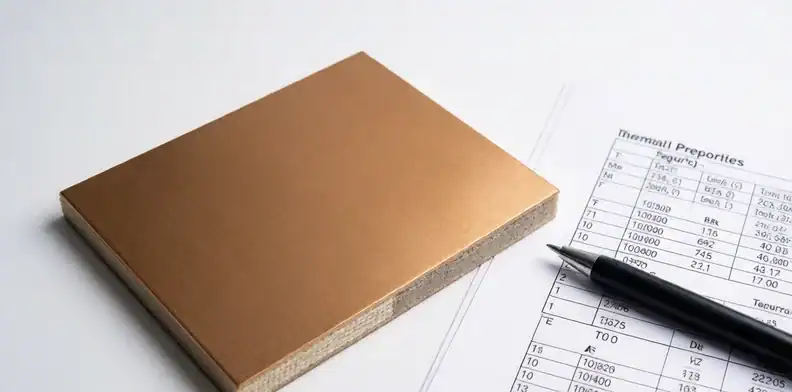
Quick Answer: Isola 370HR PCB material is a multifunctional epoxy FR-4 laminate and prepreg system with a typical 180°C Tg by DSC, 340°C Td at 5% weight loss, and 30 minutes at T288. Use those values to screen thermal suitability, but accept an “equivalent” only after its exact grade, test conditions, construction, electrical loss, approvals, and change-control path match the project.
Key takeaways: – The datasheet values are typical, not finished-board guarantees. – A shared Tg label or IPC slash sheet does not prove equivalence. – The current Isola sheet does not claim halogen-free status. – FR408HR is the clearer Isola upgrade when channel loss drives the choice.
Isola 370HR PCB material is a thermally capable FR-4 choice, but the words “or equivalent” turn a simple material callout into an engineering and contract decision. A buyer may see the same nominal Tg on two datasheets while the signal-loss data, glass constructions, UL scope, and approval history point to different risks.
For the wider material-selection picture, including laminate properties, process constraints, and substitution risks, see our PCB materials guide.
The safest path is to separate three questions: what the current Isola data actually proves, what the project specification permits, and what evidence the proposed construction can supply. That approach prevents both needless brand lock-in and an uncontrolled substitution.
Table of Contents
- What Is Isola 370HR PCB material Used For?
- What Do Isola 370HR Datasheet Values Mean?
- Why Do Some Specifications Name the Exact Laminate?
- How Does Isola 370HR Compare with Tg170 Options?
- Is Isola 370HR Halogen-Free or Low-Loss?
- When Should You Move from Isola 370HR to FR408HR?
- What Does “Isola 370HR or Equivalent” Permit?
- When Should You Reject a Proposed Substitute?
- How Should a Fabricator Qualify Isola 370HR?
- How Do You Specify Isola 370HR in an RFQ?
What Is Isola 370HR PCB material Used For?
Isola 370HR PCB material is used as a thermally capable FR-4 laminate and prepreg system for multilayer printed wiring boards. Isola describes it as lead-free compatible, CAF resistant, compatible with FR-4 processing, and capable of multiple reflows, while its current sheet reports a typical 180°C glass-transition temperature by differential scanning calorimetry (DSC).
That profile makes the material relevant when a multilayer design needs more thermal margin than a lower-Tg FR-4 system, particularly where plated-through-hole strain, assembly heat, and conductive anodic filament (CAF) resistance are part of the qualification plan. The material name does not by itself approve a layer count, via structure, reflow profile, or service temperature. For background on how Tg categories affect sourcing, the FR-4 Tg grade selection guide covers the broader decision without replacing grade-specific data.
Isola lists IPC-4101 /98, /99, /101, and /126 in the 370HR datasheet. It also lists UL file E41625, grade PCL-FR-370HR, UL 94 V-0, and a 130°C relative thermal index under UL 796. These are laminate-level references; the finished PCB still needs the construction, process, and end-use evidence required by the project.
What Do Isola 370HR Datasheet Values Mean?
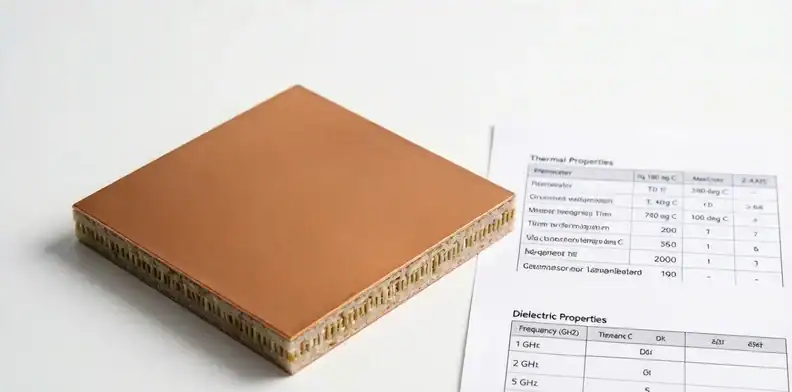
The Isola 370HR datasheet values are typical material-screening results tied to specific test methods, not guaranteed limits for every core, prepreg, or finished board. Tg, Td, T260, T288, coefficient of thermal expansion (CTE), dielectric constant (Dk), and dissipation factor (Df) answer different questions, so a valid comparison keeps the method and frequency attached.
| Property | Typical published value | Test context and decision use |
|---|---|---|
| Tg | 180°C | DSC, IPC-TM-650 2.4.25C; resin transition screening |
| Td | 340°C | TGA at 5% weight loss, IPC-TM-650 2.4.24.6 |
| T260 / T288 | 60 / 30 min | TMA with copper removed, IPC-TM-650 2.4.24.1 |
| Z-axis CTE | 45 / 230 ppm/°C | Pre-Tg / post-Tg, IPC-TM-650 2.4.24C |
| Z-axis expansion | 2.8% | 50–260°C, IPC-TM-650 2.4.24C |
| Thermal conductivity | 0.4 W/m·K | ASTM E1952; heat-flow model input |
T288 is the time to delamination in a standardized thermal-mechanical analysis at 288°C. It is not a reflow-cycle counter because an assembly excursion has a temperature profile, moisture history, copper distribution, board thickness, and rework exposure that differ from the test coupon. The sheet’s “multiple reflows” statement is qualitative and gives no permissible cycle count.
Electrical values need even tighter reading. The sheet reports typical Dk/Df of 4.17/0.0161 at 1 GHz, but the listed Dk and Df methods differ; at 2 GHz it reports 4.04/0.0210, again with separate listed methods. At 5 and 10 GHz, both typical Dk 3.92 and Df 0.0250 use the Bereskin stripline method. Use those values for early screening, then model the actual glass, resin content, copper profile, and geometry.
Why Do Some Specifications Name the Exact Laminate?
Specifications name Isola 370HR when the approved design basis, qualification record, customer material list, UL scope, or change-control plan is tied to that grade. The name is a control point, not proof that a general aerospace, medical, defense, or quality framework universally mandates one laminate.
An exact callout can preserve several linked decisions at once: approved core and prepreg constructions, impedance calculations, fabrication history, assembly qualification, traceability records, and customer acceptance. Replacing the resin system may force a fresh review even if the proposed material carries similar IPC-4101 classifications. The cost of that review is project-specific and should not be replaced by an assumed savings percentage or lead-time claim.
AS9100, DO-254, and ISO 13485 provide quality or assurance context; ITAR and DFARS apply through controlled scope and contract terms. None of those authority sources, by itself, states that Isola 370HR must be used.
Read the hierarchy in the actual purchase package: customer drawing, approved material list, purchase order, quality clauses, deviation process, and contract flow-downs. If it says “exact material required” or “no substitution,” quote the named grade or obtain written deviation approval from the authorized party before fabrication.
How Does Isola 370HR Compare with Tg170 Options?
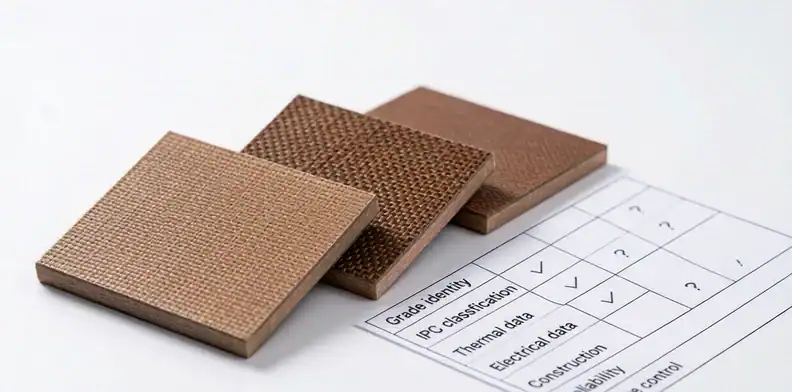
Isola 370HR should be compared with Tg170-class options through a requirement matrix, not a seven-brand numeric leaderboard. A shared nominal Tg or IPC-4101 slash sheet can put a grade on the shortlist, but it does not prove matching test methods, electrical behavior, available constructions, UL scope, CAF evidence, or customer approval.
Start by identifying the exact manufacturer and grade. For example, a buyer considering Shengyi can use the S1170G multilayer material comparison to frame questions, but the approval file still needs a current manufacturer document for the proposed grade. Record the construction and revision rather than accepting a family name. Then verify every retained property against the same definition and condition.
| Qualification field | What to compare | Why a label is insufficient |
|---|---|---|
| Grade identity | Exact laminate, prepreg, revision | Family names can contain variants |
| IPC classification | Applicable slash sheets | Shared coverage is only a screening clue |
| Thermal data | Tg method, Td definition, T260/T288 method | Similar headline numbers may use different tests |
| Electrical data | Dk/Df method, frequency, resin content | Mismatched values cannot support a loss ranking |
| Construction | Cores, prepregs, glass styles, copper | Availability changes the buildable stackup |
| Reliability and safety | CAF evidence, UL file/grade scope | Supplier claims may cover different conditions |
| Change control | Disclosure and customer approval | Technical similarity does not grant permission |
ITEQ candidates need variant control as well; the IT-170 variant selection guide shows why IT-170 is not a complete approval identity. Treat other candidate names the same way and publish no numeric equivalence without comparable primary evidence.
Is Isola 370HR Halogen-Free or Low-Loss?
The current Isola 370HR datasheet does not claim halogen-free status or publish a resin-curing chemistry label. It also should not be presented as a low-loss or high-speed laminate: the sheet lists a typical Df of 0.0250 at both 5 and 10 GHz by Bereskin stripline, materially above FR408HR under matched-frequency comparisons.
RoHS compliance and UL 94 V-0 answer different questions from halogen content. RoHS addresses specified restricted substances, while V-0 is a flammability classification. Neither statement proves a grade meets a customer’s halogen-free definition, so procurement should request a current grade-specific substance declaration and the applicable test or limit.
Loss language also needs a defined boundary. In this article, Isola 370HR is treated as a thermally capable standard-loss FR-4 based on its published Df and the matched-condition direction versus FR408HR; “standard-loss” is an engineering classification here, not wording quoted from Isola. Any candidate’s chemistry and loss still require current manufacturer evidence before comparison.
Keep environmental approval and signal-performance approval as separate gates. A material can satisfy one and miss the other.
When Should You Move from Isola 370HR to FR408HR?
Move from Isola 370HR to FR408HR when a construction-specific channel model or measurement shows that dielectric loss consumes too much of the insertion-loss budget. There is no defensible universal trigger at 5 Gbps or any other data rate because trace length, frequency content, topology, copper roughness, vias, connectors, and margin all affect the result.
The current manufacturer sheets support a clean directional comparison at 2 GHz. Both list typical Dk by Bereskin stripline: 4.04 for Isola 370HR and 3.68 for FR408HR. Both list typical Df under IPC-TM-650 2.5.5.9: 0.0210 for Isola 370HR and 0.0092 for FR408HR. At 5 GHz, both sheets list Bereskin-stripline Df, 0.0250 versus 0.0098, which confirms the lower-loss direction for FR408HR without turning the catalog gap into finished-channel loss.
Thermally, FR408HR’s sheet reports typical Tg 190°C by DSC and Td 360°C at 5% weight loss, compared with 180°C and 340°C for Isola 370HR under the corresponding methods. Those values support screening but still do not choose the stackup. Construction availability, pressed resin content, copper profile, impedance geometry, and fabricator qualification remain part of the decision.
Use the FR408HR hybrid-stackup guide when only selected signal layers need lower loss. A hybrid proposal should be modeled, fabricated, and approved as its own construction rather than assumed compatible from material names.
What Does “Isola 370HR or Equivalent” Permit?
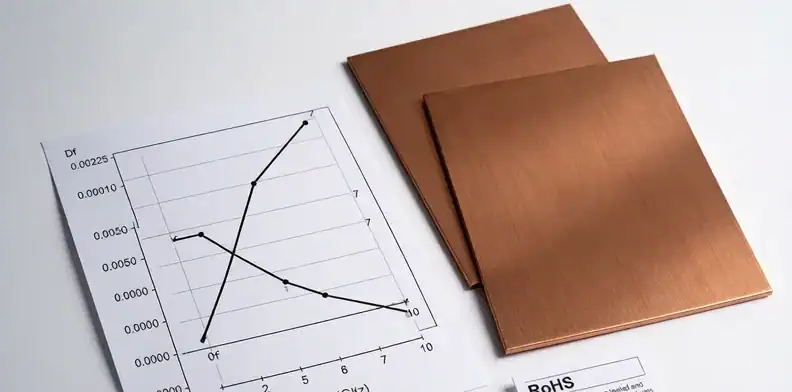
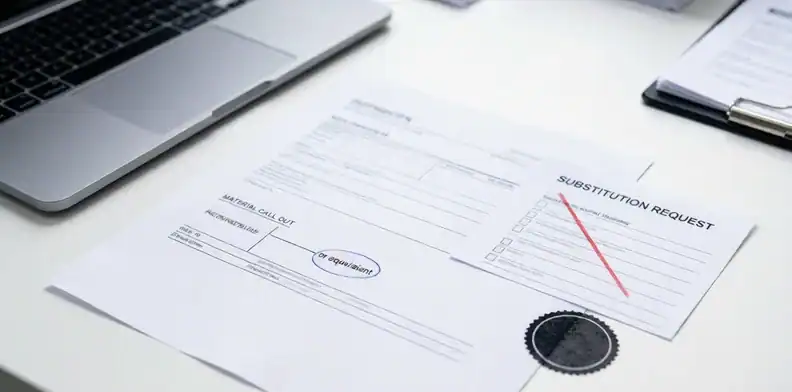
“Isola 370HR or equivalent” permits evaluation of another material; it does not grant an undocumented swap. The fabricator must follow the drawing, purchase order, customer specification, quality plan, and change-control terms, then obtain written approval when the authority or acceptance criteria are unclear.
Use a three-stage decision:
- Confirm permission. Identify who may approve a deviation and whether disclosure is required before quotation, tooling, or production.
- Screen the candidate. Compare exact grade, slash sheets, thermal methods, Dk/Df conditions, CAF evidence, UL scope, and buildable constructions.
- Close the approval. Record the proposed stackup, evidence package, differences, approver, and revision in a controlled record.
A PCB material selector can organize an early shortlist, but it cannot approve a substitution. Project limits still control. Distinguish “same class” from “same behavior.”
If a supplier offers NP-170, use the NP-170 material guide to frame follow-up questions, then check current manufacturer evidence. A blog or Tg label is not an approval record. Record what changed and who accepted it.
When Should You Reject a Proposed Substitute?
Reject or escalate a substitute when the specification forbids it, the authorized approver has not accepted it, or the supplier cannot close a requirement that matters to the design. A cheaper quote, local availability, or a shared Tg category does not override a missing electrical, thermal, safety, traceability, or contractual control.
Immediate escalation conditions include:
- “No substitution,” “exact material required,” or an approved-material-list restriction.
- No current grade-specific datasheet or unclear model variant.
- Dk/Df values with mismatched method, frequency, or conditioning.
- Missing construction availability for the approved stackup.
- Unconfirmed UL file, grade, thickness, or copper scope where required.
- No CAF or reliability evidence tied to the project’s acceptance plan.
- A customer-controlled program with no documented deviation path.
For a TU-768 proposal, the TU-768 Tg170 alternative guide can frame questions, but current TUC evidence and the project file decide. Check the exact construction and test context. Keep approval separate from the supplier’s category.
Apply the same discipline to Ventec. The VT-47 material guide provides orientation, while current manufacturer data carries the comparison. If a required field remains open, reject the substitution for release or request clarification.
How Should a Fabricator Qualify Isola 370HR?
A fabricator should qualify Isola 370HR at three levels: material identity, buildable construction, and project acceptance. The current datasheet anchors the grade, but incoming records, stackup data, process qualification, inspection, and change control connect that laminate identity to the shipped PCB.
The qualification file should contain the required Isola revision and exact core and prepreg constructions. Add the traceability records required by the purchase package, applicable UL scope, and relied-on CAF evidence. “Tg170 material” is not a substitute for those records.
For the board, review pressed dielectric thickness, resin content, glass style, copper profile, impedance geometry, via structure, and thermal profile. Use construction-specific design Dk and an agreed loss basis. Qualify assembly heat on the actual board rather than converting T288 into cycle count.
Change control closes the loop. The fabricator should disclose a proposed material or construction change before release when the contract requires it, preserve the approver and revision, and keep the approved stackup aligned with manufacturing documentation. If you want QueenEMS to assess that package, send the drawing, stackup, proposed material revision, interfaces, assembly profile, and approval rules through its multilayer PCB fabrication service for a contextual material and DFM review.
How Do You Specify Isola 370HR in an RFQ?
Specify Isola 370HR in an RFQ with an exact grade, a clear substitution rule, a controlled stackup, and a list of required evidence. The wording should tell the fabricator whether alternatives may be proposed, who approves them, and which electrical, thermal, safety, and traceability fields the quotation must address.
Use an RFQ checklist such as:
- Material callout: Isola 370HR laminate and prepreg, with the required datasheet or specification revision.
- Substitution language: exact material only, or alternatives disclosed for written approval before fabrication.
- Construction: layer count, finished thickness, copper weights, core/prepreg choices, resin content, glass styles, and impedance table.
- Electrical basis: target impedance, relevant frequency range, loss budget, design Dk source, copper profile, and any coupon requirement.
- Thermal basis: assembly profile, rework exposure, via reliability target, and project-specific validation.
- Compliance and records: applicable IPC slash sheets, UL scope, substance declarations, certificates, lot traceability, and customer flow-downs.
- Commercial scope: quantities, panel constraints, delivery locations, and quotation assumptions, without presuming stock or lead time.
For an allowed alternative, require a side-by-side deviation table that lists every difference and cites a current source. State that silence is not approval and that fabrication may begin only after the named authority accepts the proposal. This turns “or equivalent” from vague purchasing language into a reviewable release gate.
For a controlled quotation, send QueenEMS the fabrication package with the Gerbers or ODB++ data, drawing, stackup, material revision, impedance requirements, quantities, assembly profile, and substitution rule. The resulting quote can then state the exact construction, open deviations, and evidence needed for approval.
FAQ
Can I treat Isola 370HR as halogen-free?
No—do not treat it as halogen-free from the current Isola datasheet. The sheet states RoHS compliance and UL 94 V-0, but it does not make a halogen-free claim; request a current grade-specific declaration when the project has a halogen limit.
Can I replace Isola 370HR with another Tg170 material?
Yes, but only when the specification permits evaluation and the exact candidate passes the project’s technical and approval checks. A shared Tg label or IPC slash sheet is not enough to establish interchangeable constructions, Dk/Df, UL scope, CAF evidence, or customer acceptance.
Is Isola 370HR a low-loss laminate?
No, not under the design classification used here. Its sheet lists typical Df 0.0250 at 5 and 10 GHz by Bereskin stripline, while method-matched FR408HR values are lower; assess the actual channel before selecting an upgrade.
How many reflow cycles can Isola 370HR survive?
No fixed count is published in the current datasheet. T288 of 30 minutes is a standardized time-to-delamination test, not a linear cycle budget, so qualify the board construction, moisture history, assembly profile, and rework plan.
How do I know if the exact Isola grade is required?
Read the drawing, approved material list, purchase order, quality clauses, and deviation procedure. Treat “no substitution” or “exact material required” as controlled language, and obtain written approval when “or equivalent” leaves the authority or criteria unclear.
Sources
- Isola 370HR laminate and prepreg datasheet, Revision E
- Isola FR408HR laminate and prepreg datasheet, Revision F
- IPC-4101 base-material specification page
- UL Product iQ
- SAE AS9100D standard page
- FAA Advisory Circular AC 20-152A
- ISO 13485:2016 standard page
- Defense Federal Acquisition Regulation Supplement
- eCFR ITAR, 22 CFR Chapter I, Subchapter M
Written by the QueenEMS Engineering Team
Upload your files today · Free DFM check before production · Ship worldwide
Get your PCB prototypes in as fast as 24 hours. We handle FR4, Rogers, and Flex up to 60 layers — free prototypes for 2–4 layer boards, no minimum order.
Just upload your Gerber + BOM — we source every part, assemble, and inspect (AOI + X‑Ray) so you don't have to chase suppliers. Boards ship in as fast as 24 hours.