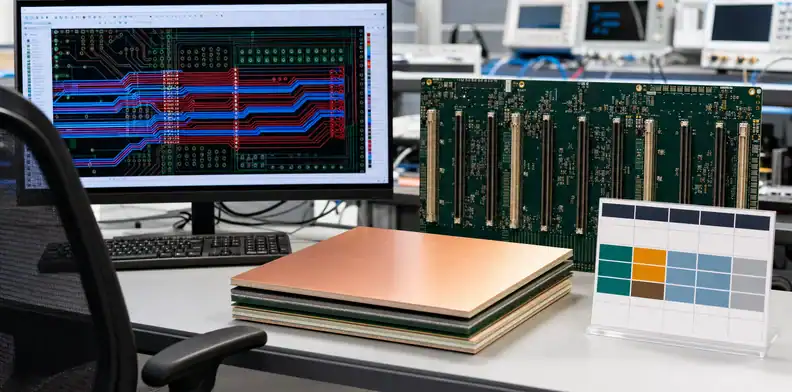
Quick Answer: ITEQ IT-968 PCB material is an ultra-low-loss FR-4.0 laminate and prepreg family for 100G/400G switch, backplane, wireless, radar, antenna, and high-speed multilayer boards. The current ITEQ IT-968 data lists Dk 3.66 @10GHz, Df 0.0050 @10GHz, and Tg 190°C by TMA, while IT-968G is the halogen-free variant with Dk 3.59 @10GHz, Df 0.0050 @10GHz, and Tg 175°C by TMA.
For the wider material-selection picture, including laminate properties, process constraints, and substitution risks, see our PCB materials guide.
Key takeaways
– Do not call IT-968 mid-loss; Df 0.0050 @10GHz puts it in the ultra-low-loss class.
– Do not write “IT-968” when the customer requires halogen-free material; specify IT-968G and ask for Br/Cl evidence.
– Treat IT-968, IT-968G, IT-968TC, IT-968BS, and IT-968SE as different choices, not interchangeable names.
– Use IT-988GSE or another lower-loss material when 112G PAM4/800G margin, long channels, or platform qualification requires it.
ITEQ IT-968 PCB material is best understood as a named high-speed laminate decision, not a generic “low-loss FR-4” note. A buyer may receive a drawing that says “IT-968 or equivalent,” while the SI engineer checks Megtron 6 loss, the compliance team asks for halogen-free status, and the fabricator tries to quote a buildable stackup.
That is the trap: one missing suffix can change compliance, Tg method, laminate family, and quote assumptions. This article decodes the IT-968 family so you can choose the right variant and use QueenEMS’ PCB material selector for Dk, Df, and Tg before a controlled stackup review.
Table of Contents
- What Is IT-968 in the Low-Loss Hierarchy?
- What Do the Datasheet Numbers Really Mean?
- Which IT-968 Variant Should You Specify?
- Is IT-968 Halogen-Free or Do You Need IT-968G?
- How Does IT-968 Compare With Megtron 6 and FR408HR?
- When Should You Move From IT-968 to IT-988GSE?
- Can IT-968 Support 56Gbps and 112G PAM4?
- Which 100G and 400G Applications Fit IT-968?
- How Do Fabricators Process IT-968 Day to Day?
- What Should “IT-968 or Equivalent” Permit?
What Is IT-968 in the Low-Loss Hierarchy?
ITEQ IT-968 PCB material sits in the ultra-low-loss 100G/400G laminate class, not in the mid-loss class. The current ITEQ product page describes IT-968 as a high-Tg, very-low-loss material for 100G/400G switch and wireless applications with Df 0.0050 @10GHz, which places it well below mid-loss materials around Df 0.008-0.014.
IT-968 is not the lowest-loss laminate in every stackup conversation. It is a practical middle of the high-speed ladder: lower loss than materials such as FR408HR or TU-872 SLK, but higher loss than premium grades such as Megtron 6 or IT-988GSE.
Why does this classification matter?
Classification affects quote scope and signal margin.
- “Mid-loss” language can make purchasing accept the wrong class.
- “100G/400G class” language helps the fabricator select buildable cores.
- “Or equivalent” language must define Dk, Df, Tg, copper, and compliance evidence.
Here is the part worth slowing down for: the material class is not a marketing label once it appears on a fab drawing. It becomes a controlled manufacturing requirement that affects stackup modeling, laminate availability, and production approval. Bottom line: treat IT-968 as an ultra-low-loss 100G/400G-class laminate, then prove whether that class fits your actual channel length and compliance requirement.
What Do the Datasheet Numbers Really Mean?
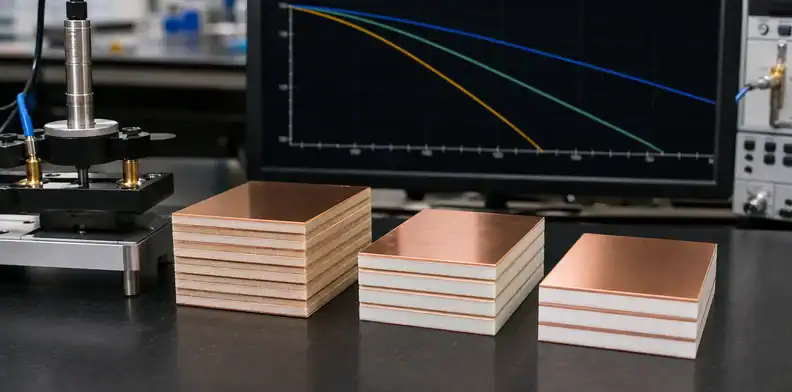
ITEQ IT-968 PCB material should be specified with method-bound values: the current ITEQ IT-968 data lists Dk 3.66 @10GHz, Df 0.0050 @10GHz, Tg 190°C by TMA, ANSI Type FR-4.0, and applicable IPC references including IPC-4101 /102 and IPC-4103 /240/540. Older IT-968BS/IT-968TC mirror data can show Tg 185°C by DSC, which means you must record the variant, revision, and test method before comparing numbers.
The same word “Tg” can mislead a buyer when DSC and TMA are mixed. A value from IT-968G should not be copied into a base IT-968 drawing.
Which numbers belong in the fab note?
Use the numbers that control production.
- Exact material suffix and datasheet revision.
- Dk and Df frequency, normally 10GHz for this comparison.
- Tg value and method, such as TMA or DSC.
- IPC slash-sheet basis where the supplier can document it.
- Copper foil profile used in the loss model.
So the safer wording is not “IT-968, Tg 185/190.” A safer wording is “ITEQ IT-968, current datasheet revision, Dk 3.66 @10GHz, Df 0.0050 @10GHz, Tg 190°C by TMA, or written engineering-approved equivalent.” Bottom line: never copy a Tg number without the test method and exact IT-968 variant.
| Field | Current IT-968 data | Why it matters |
|---|---|---|
| Dk | 3.66 @10GHz | Impedance and field-solver input |
| Df | 0.0050 @10GHz | Dielectric-loss screening |
| Tg | 190°C by TMA | Thermal comparison method |
| ANSI / IPC | FR-4.0, IPC references | Quote and compliance language |
The table shows why a material note is more than a brand name.
Which IT-968 Variant Should You Specify?
Choose the IT-968 variant from compliance, thermal method, loss target, and customer wording. ITEQ IT-968 PCB material is the base 100G/400G-class family member; IT-968G is the halogen-free option; IT-968TC is commonly treated as the higher-Tg thermal-cured branch; IT-968BS and IT-968SE need supplier confirmation before you publish exact differences in a controlled drawing.
Do not let the suffix disappear during quotation. In high-speed PCB sourcing, suffixes are engineering controls because they can change resin chemistry, halogen status, glass/copper assumptions, Tg value, and available constructions.
How should the family be read?
Read the family by suffix first, then by datasheet.
- IT-968: base high-Tg, lead-free, ultra-low-loss laminate and prepreg.
- IT-968G: halogen-free version with Br/Cl control requirement.
- IT-968TC: thermal-cured branch; confirm current datasheet and Tg method.
- IT-968BS: enhanced variant; keep the difference vendor-verified before use.
- IT-968SE: lower-loss enhanced option; confirm exact Dk/Df and glass/copper basis.
Watch the procurement handoff: shortening “IT-968G” to “IT-968” can break halogen-free compliance. Bottom line: write the exact suffix in the drawing, BOM note, quote request, and purchase order.
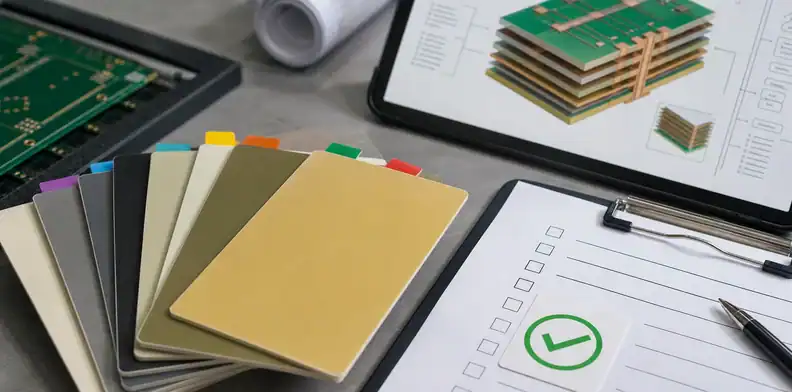
This is the minimum family map a buyer should carry into RFQ review: base IT-968 for standard 100G/400G, IT-968G for halogen-free, IT-968TC for thermal-cured requirements, and BS/SE only after supplier data is confirmed.
Is IT-968 Halogen-Free or Do You Need IT-968G?
No, base IT-968 should not be assumed halogen-free; specify IT-968G when the customer requires a halogen-free laminate. ITEQ identifies IT-968G as the halogen-free version and lists Br+Cl <=1500ppm, while the base IT-968 page does not carry the same halogen-free statement.
If a customer specification says all laminates must be halogen-free and purchasing buys base IT-968, the board can fail document review even if electrical performance is acceptable.
What should the compliance note say?
Use explicit compliance language instead of relying on memory.
- For halogen-free builds: “ITEQ IT-968G, halogen-free version, Br+Cl <=1500ppm, supplier evidence required.”
- For non-halogen-free-approved builds: “ITEQ IT-968 base version acceptable; halogen-free not required.”
- For uncertain customer drawings: ask a DFM question before quoting or tooling.
- For equivalent materials: require the same halogen-free limit and document evidence.
Now the practical move: when a supplier sees “IT-968” on a drawing and “halogen-free BOM” in a customer package, the supplier should flag the conflict before fabrication. QueenEMS can review that type of material conflict during a halogen-free PCB specification check or DFM review. Bottom line: if the word halogen-free appears anywhere in the customer requirement, write IT-968G, not base IT-968.
| Drawing wording | Compliance risk | Better wording |
|---|---|---|
| IT-968 | Ambiguous for halogen-free orders | IT-968 base version acceptable |
| IT-968, halogen-free | Conflicting wording | IT-968G halogen-free |
| IT-968 or equivalent | Supplier may choose wrong chemistry | IT-968G or approved halogen-free equivalent |
The wording column is what prevents a quote from becoming a compliance dispute.
How Does IT-968 Compare With Megtron 6 and FR408HR?
ITEQ IT-968 PCB material is usually a cost/performance candidate between higher-loss FR-4-based options and premium very-low-loss laminates. Its Df 0.0050 @10GHz is lower than FR408HR’s published Df 0.0092, but higher than many Megtron 6 family references around Df 0.002-0.004, which means IT-968 can be a strong 100G/400G candidate but not a silent Megtron 6 substitute.
For a 25Gbps short channel, IT-968 may provide enough dielectric-loss margin. For 56Gbps long backplane routing, Megtron 6 or another lower-loss material may carry more SI headroom.
Can it replace a premium material?
It can replace a premium material only after electrical and procurement approval.
- Compare method-matched Dk/Df values.
- Re-run loss and impedance models using actual copper profile.
- Check channel length, connector loss, via stubs, and equalization margin.
- Confirm customer qualification history.
- Reprice the complete board, not only the laminate sheet.
A hybrid strategy can be more realistic than a full swap: reserve a lower-loss laminate for the most critical differential-pair layers, then use IT-968 in layers where the loss budget allows it. QueenEMS’ Megtron 6 PCB material qualification page and FR408HR hybrid stackup article give useful boundary references for that comparison. Bottom line: use IT-968 to reduce cost only after the channel model and qualification plan show the margin.
Think of the ladder this way: Megtron 6-class materials protect long high-speed routes, IT-968 is the 100G/400G cost-performance candidate, and FR408HR often plays a thermal FR-4 or hybrid role. The stackup model still decides the answer.
When Should You Move From IT-968 to IT-988GSE?
Move from IT-968 to IT-988GSE when 112G PAM4, 800G switch routing, very long channels, or platform qualification needs materially lower loss than Df 0.0050 @10GHz. ITEQ’s IT-988GSE family is positioned for lower-Dk/lower-Df high-speed use, with public ITEQ launch data describing IT-988GSE values around Dk 3.28 and Df 0.0016 at 28GHz under stated resin-content conditions.
IT-968 can be right for many 100G and 400G boards, but 800G pushes the loss budget harder. That is when the “good enough” material may become the reason a channel fails after connectors, vias, copper roughness, and manufacturing variation are included.
What triggers the upgrade?
Use upgrade triggers, not brand preference.
- 112G PAM4 long reaches or tight insertion-loss mask.
- 800G switch or AI-server routing with limited equalization margin.
- Customer platform already specifies IT-988GSE or an equivalent tier.
- Low-Dk glass is required to reduce skew and dielectric loss.
- Qualification history blocks a lower-tier alternative.
Here is the clean procurement rule: do not jump to IT-988GSE just because it has better numbers, and do not stay with IT-968 just because it is easier to quote. Use the 800G stackup and channel budget as the decision record; the QueenEMS IT-988GSE processing article explains the higher-speed branch. Bottom line: keep IT-968 for 100G/400G when margin is proven; move up when 112G/800G loss margin says so.
| Use case | Starting material path | Decision test |
|---|---|---|
| 100G switch | IT-968 or IT-968G | Df 0.0050 margin and compliance |
| 400G switch | IT-968, IT-968G, or lower-loss hybrid | Channel length and connector/via budget |
| 800G switch | IT-988GSE class | 112G PAM4 insertion-loss budget |
This is a speed-boundary table, not a universal qualification approval.
Can IT-968 Support 56Gbps and 112G PAM4?
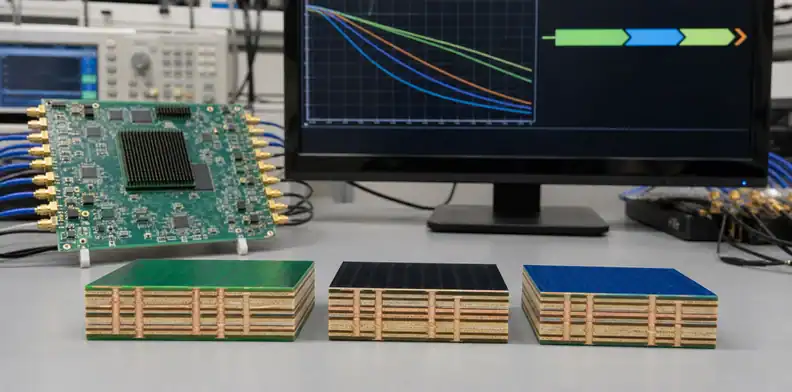
ITEQ IT-968 PCB material can support many 25Gbps and 56Gbps SerDes designs when the route length, copper roughness, via structure, connector loss, and equalization plan fit the channel budget. It should not be treated as a default 112G PAM4 answer because Df 0.0050 @10GHz may leave too little margin on long backplanes or dense switch fabrics.
The material number alone cannot answer the channel. A short 56Gbps route can pass on a laminate that would fail a long backplane with multiple connectors and via transitions.
What should SI teams check first?
Check the complete channel before approving the material.
- Route length and insertion-loss mask.
- Differential geometry and reference-plane continuity.
- Copper roughness and surface finish.
- Backdrill depth, via stubs, and connector model.
- Stackup Dk/Df by layer.
- Coupon and TDR or S-parameter report.
This is where a supplier quote should connect to engineering, not only purchasing. If the first quote only says “IT-968 material,” ask for the proposed stackup, copper, impedance model, and test coupon plan. Bottom line: IT-968 can be a 56Gbps candidate, but 112G PAM4 needs a measured channel decision.
The signal rate is only the start; the route length, vias, connectors, copper, and equalization plan set the real risk.
Which 100G and 400G Applications Fit IT-968?
ITEQ IT-968 PCB material fits 100G/400G switch boards, storage/server backplanes, telecom base-station cards, wireless infrastructure, radar, antenna, and other multilayer designs where Df 0.0050 @10GHz and FR-4.0-style processing meet the channel and reliability plan. IT-968G fits the same broad space when the project also requires halogen-free laminate evidence.
The best applications improve loss and thermal reliability without forcing a premium laminate tier. The weakest applications demand a named lower-loss material or a proven 800G path.
Where does it help buyers most?
It helps when you need a named, quote-ready, high-speed material.
- 100G/400G switch line cards and backplanes.
- Telecom base-station and wireless infrastructure PCBs.
- Storage and server boards with controlled high-speed layers.
- Radar and antenna support boards that need stable SI behavior.
- Hybrid stackups where only some layers need ultra-low-loss material.
For telecom projects, material selection should also align with RF routing, controlled impedance, thermal constraints, and inspection documents; QueenEMS’ 5G base-station PCB material selection article gives a broader application lens. Bottom line: choose IT-968 when it gives enough channel margin with a buildable and traceable stackup, not simply because the application says “400G.”
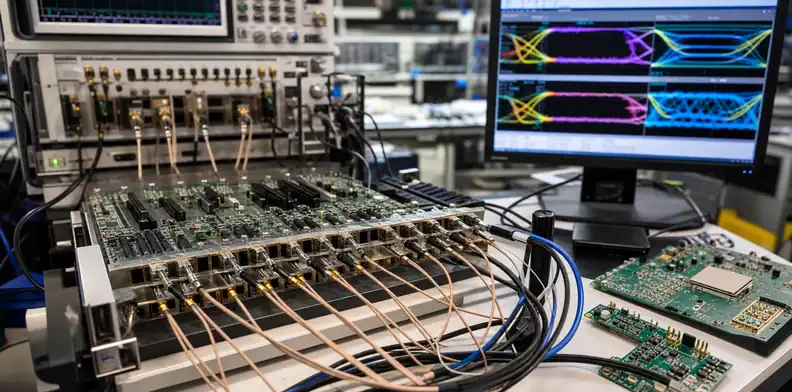
This application map should lead into a real stackup quote, not a generic material purchase.
How Do Fabricators Process IT-968 Day to Day?
Fabricators should process ITEQ IT-968 PCB material as a controlled high-speed FR-4.0 laminate, not as ordinary FR-4 and not as PTFE. ITEQ positions the material for standard multilayer PWBs with stable SI performance, but high-speed builds still need qualified drilling, desmear, lamination, copper-roughness, impedance, CAF, and lead-free assembly controls.
“FR-4 compatible” is a manufacturing advantage, not permission to reuse every default recipe. The fabricator still needs exact cores, prepregs, copper, drill parameters, and acceptance tests.
What should the factory check before tooling?
The DFM review should convert the material choice into build instructions.
- Confirm exact IT-968 variant and datasheet revision.
- Match core/prepreg availability to the stackup.
- Review copper foil profile used in loss modeling.
- Check drill aspect ratio, hole-wall reliability, and CAF risk.
- Confirm impedance coupon, TDR method, and report format.
- Align lead-free reflow exposure with the assembly plan.
Here is the manufacturing reality: many quote changes happen because the RFQ names a laminate but leaves copper, impedance, and coupon requirements undefined. QueenEMS can use a free PCB DFM check to flag these missing material controls before tooling. Bottom line: process IT-968 through a material-qualified fabrication route and lock the stackup before purchase order release.
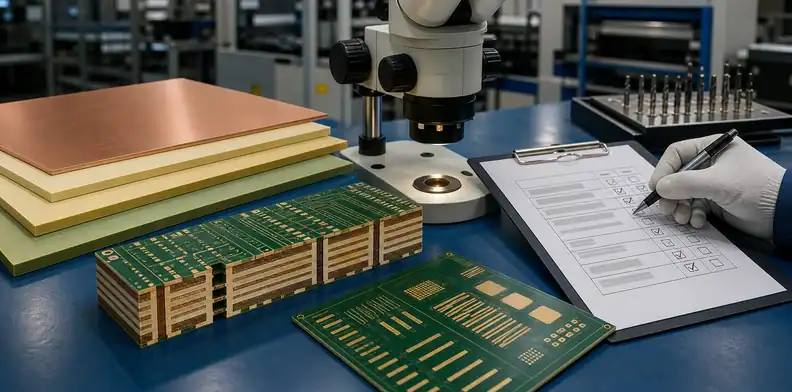
This is the difference between a material name and a production release: copper, lamination, drilling, and impedance evidence must all be tied to the stackup.
What Should “IT-968 or Equivalent” Permit?
“ITEQ IT-968 PCB material or equivalent” should permit only a disclosed, engineering-approved substitute with comparable Dk/Df, Tg method, copper option, IPC classification, halogen status, availability, and qualification evidence. It should not permit purchasing or the fabricator to swap in a cheaper low-loss laminate without SI and compliance approval.
The equivalent decision is risk control. A higher-Df substitute may change eye margin; a non-halogen-free substitute may fail compliance.
What should the RFQ ask for?
Ask for an equivalent matrix, not a verbal promise.
- Manufacturer, product code, and datasheet revision.
- Dk/Df at the same frequency and method where possible.
- Tg value and test method.
- Halogen-free status and Br/Cl evidence when required.
- IPC-4101 or IPC-4103 slash-sheet basis.
- Available thickness, prepreg, copper foil, and lead time.
- Qualification or requalification work needed before production.
If the equivalent affects the modeled channel, approval should come from engineering, not only purchasing. Use QueenEMS’ PCB material substitution approval process to document the decision. For a quote, send Gerber or ODB++, stackup, target impedance, exact IT-968 variant, halogen-free requirement, copper profile, and delivery destination through the QueenEMS contact page. Bottom line: write “or equivalent” only with measurable approval fields and a named owner.
| Equivalent field | Acceptable evidence | Reject when |
|---|---|---|
| Electrical | Method-matched Dk/Df comparison | Only nominal “low loss” wording |
| Compliance | Halogen-free certificate if required | IT-968 and IT-968G are mixed |
| Fabrication | Buildable stackup and copper option | Thickness or prepreg unavailable |
| Qualification | Engineering approval record | Purchasing-only substitution |
This matrix turns an open-ended material note into a controlled sourcing decision.
FAQ
Can I use base IT-968 for a halogen-free customer BOM?
No. Use IT-968G because ITEQ identifies it as the halogen-free version and lists Br+Cl control for that variant.
Can IT-968 replace Megtron 6 to reduce cost?
Sometimes, but only after SI review. IT-968 has Df 0.0050 @10GHz, while Megtron 6 references are typically lower loss, so long 56Gbps/112G channels may need the premium option.
How do I know whether IT-968 or IT-988GSE is better?
Use IT-968 when 100G/400G channel loss passes with Df 0.0050 @10GHz. Move to IT-988GSE-class material when 112G PAM4, 800G routing, or long backplane loss needs lower Df.
Can a fabricator choose an IT-968 equivalent without asking?
No. A fabricator should propose the exact substitute and wait for engineering approval because Dk, Df, Tg method, halogen-free status, copper, and IPC basis can change the board.
Sources
- ITEQ High Tg Very Low Loss product page
- ITEQ IT-968 current datasheet PDF
- Panasonic Megtron 6 family product page
- Isola FR408HR product page
- IPC standards catalog
Written by the QueenEMS Engineering Team
Upload your files today · Free DFM check before production · Ship worldwide
Get your PCB prototypes in as fast as 24 hours. We handle FR4, Rogers, and Flex up to 60 layers — free prototypes for 2–4 layer boards, no minimum order.
Just upload your Gerber + BOM — we source every part, assemble, and inspect (AOI + X‑Ray) so you don't have to chase suppliers. Boards ship in as fast as 24 hours.