
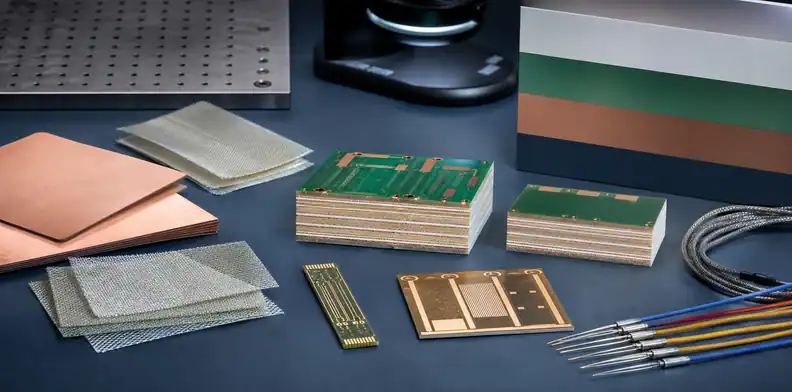
Quick Answer: IT-140 PCB material is identified in an ITEQ-branded REV 2.0-17 sheet as a conventional FR-4 laminate and prepreg, with typical values including a 140°C DSC Tg, 305°C Td, T260 of 15 minutes, and T288 of 2 minutes. Those figures are screening data from one reviewed sheet—not proof of current availability, a guaranteed construction, or a permitted number of reflow cycles—so release depends on the actual stackup, assembly profile, and controlled supplier evidence.
For a broader comparison of laminate families, electrical properties, processing limits, and sourcing choices, see our PCB materials guide.
Key takeaways
IT-140 PCB material can be a reasonable candidate for a conventional FR-4 build, but its 140°C Tg label cannot answer the question that matters: will the exact board survive fabrication, assembly, rework, and service with adequate margin? A BOM line that says only “IT-140 or equivalent” leaves the designer, buyer, and fabricator with different interpretations of that question.
The technical values available for this review come from an ITEQ-branded sheet marked REV 2.0-17, while the current public ITEQ product page did not expose IT-140 in the content retrieved on July 19, 2026. Confirm current availability, exact suffixes, qualified constructions, manufacturing sites, and change history before release.
Table of Contents
- What is IT-140 PCB material—and what is it not?
- What do IT-140 PCB material data points mean?
- Can Tg 140°C qualify a lead-free assembly profile?
- What does CAF resistance prove in a material review?
- Are S1141, NP-140, and KB-6160 equivalent?
- Where does IT-140 sit among ITEQ alternatives?
- Which boards are plausible candidates for IT-140?
- When should you evaluate a different laminate?
- How should “IT-140 or equivalent” be controlled?
- What belongs in the release and RFQ package?
What is IT-140 PCB material—and what is it not?
IT-140 is described in the reviewed ITEQ-branded REV 2.0-17 sheet as “Conventional FR-4 / High Reliability Laminate & Prepreg.” That identifies the product category and the manufacturer’s positioning, but it does not by itself establish current commercial status, a reliability class, or fitness for a particular PCB.
“High reliability” is not an acceptance criterion unless the project connects it to evidence such as thermal cycling, conductive anodic filament (CAF) testing, plated-through-hole reliability, or flammability recognition. The datasheet phrase is not a board-level result.
The grade name also needs precision. IT-140G is a separate product designation, not simply an environmental suffix that purchasing can apply to IT-140. An archived IT-140G sheet reports a different resin system description and materially different thermal and electrical values, so a request for halogen-free construction must trigger a separate material approval rather than an informal substitution.
Historical evidence is not current supply evidence; the NP-140 sourcing and qualification evidence shows the same document-control problem for a neighboring grade. Official ITEQ-domain records show that IT-140 documents existed, yet the current public product index reviewed here did not confirm orderability. Ask for the exact suffix, controlled technical data sheet (TDS), manufacturing site, certifications, and replacement history.
What do IT-140 PCB material data points mean?
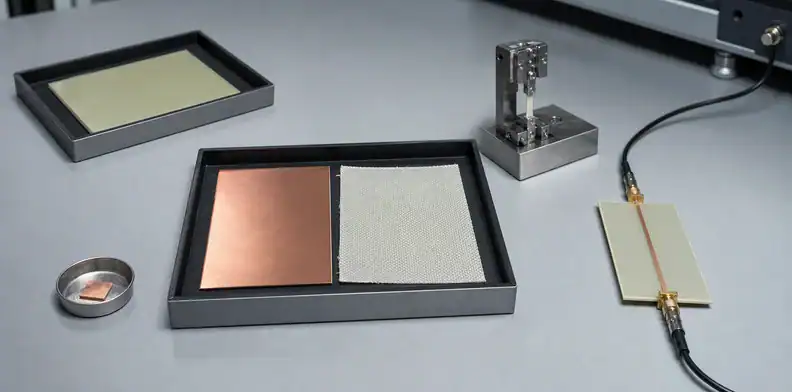
The REV 2.0-17 sheet provides useful screening values when each number stays attached to its method and condition. The values below are presented in the sheet’s “Typical Value” column; they should not be rewritten as guaranteed procurement limits.
| Property | Reviewed typical value | Method or condition | Decision use |
|---|---|---|---|
| Glass transition temperature (Tg) | 140°C | Differential scanning calorimetry (DSC); IPC-TM-650 2.4.25 | Indicates the reported glass-transition region, not assembly approval |
| Decomposition temperature (Td) | 305°C | IPC-TM-650 2.4.24.6 | Screens thermal-decomposition behavior under the stated method |
| T260 | 15 minutes | IPC-TM-650 2.4.24.1 | TMA time-to-delamination screening at 260°C |
| T288 | 2 minutes | IPC-TM-650 2.4.24.1 | TMA time-to-delamination screening at 288°C |
| Z-axis coefficient of thermal expansion (CTE), alpha-1 / alpha-2 | 55 / 290 ppm/°C | IPC-TM-650 2.4.24 | Separates expansion below and above the transition region |
| Z-axis expansion | 4.2% | 50–260°C | Helps frame through-thickness strain, with construction context still required |
The same sheet reports dielectric constant (Dk) and dissipation factor (Df) at 50% resin content under IPC-TM-650 2.5.5.13: 4.3/0.017 at 1 and 2 GHz, 4.1/0.018 at 5 GHz, and 4.0/0.018 at 10 GHz. These are reference values, not a construction-independent impedance model; glass style, cured resin content, copper profile, and test method affect the result.
Use the interactive PCB material selector to organize a shortlist, then request controlled data for the actual construction. A good engineering record distinguishes a typical datasheet value from a guaranteed specification, and a material screening value from the number used in a field solver.
Can Tg 140°C qualify a lead-free assembly profile?
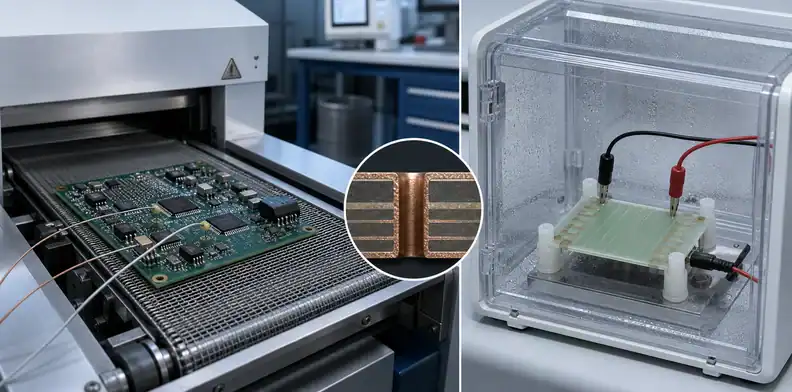
No. Tg describes a polymer transition under a defined test, while assembly qualification depends on the finished PCB’s complete thermal history. Peak temperature, time above liquidus, planned passes, rework, moisture, board thickness, copper distribution, and via structure all matter.
T288 is especially easy to misuse. IPC-TM-650 2.4.24.1 measures the time from the start of an isothermal hold until an irreversible thickness change is detected in a small, preconditioned specimen. The sheet’s typical T288 result of 2 minutes describes that laboratory sequence. It does not authorize or prohibit a particular number of production reflow passes, and T260’s 15 minutes is not allowable conveyor-oven dwell time.
The sheet also reports passing a 10-second thermal-stress test at 288°C for etched and unetched samples. This coupon result does not make every IT-140 multilayer build safe for every lead-free profile; plated holes, resin distribution, copper balance, moisture, and assembly history also affect the outcome.
For broader context on why Tg labels alone do not settle material selection, use the FR-4 Tg selection framework. For an IT-140 release, however, the required decision is narrower: compare the measured assembly and rework profile with the current material supplier’s guidance and board-level qualification evidence.
What does CAF resistance prove in a material review?
CAF resistance is relevant, but the qualitative phrase on the reviewed sheet is not a pass result. Conductive anodic filament growth is an electrochemical mechanism promoted by moisture, contamination, voltage bias, temperature, and conductor spacing.
The REV 2.0-17 sheet lists “excellent CAF resistance,” “good through hole reliability,” and “good thermal reliability.” It does not provide the reviewed test method, conditioning, voltage, spacing, duration, sample count, failure criterion, or comparison material behind those descriptions. Procurement should preserve them as manufacturer statements, not promote them into guaranteed board performance.
For a CAF-sensitive design, request evidence tied to the geometry and environment:
- test method and coupon construction;
- temperature, humidity, voltage bias, and exposure duration;
- conductor or hole-wall spacing and glass style;
- number of specimens and failure definition;
- results for the proposed manufacturing site and material construction;
- board cleanliness and process controls that remain the fabricator’s responsibility.
Through-hole reliability needs similar discipline. Z-axis CTE and TMA data screen risk, but hole geometry, copper thickness, drilling, desmear, plating, and thermal exposure determine board performance. Ask for board-level evidence against the actual via requirement.
Are S1141, NP-140, and KB-6160 equivalent?
Not on the evidence reviewed here. S1141, NP-140, IT-140, and KB-6160 may enter the same sourcing conversation, but similar FR-4 or Tg labels do not establish technical interchangeability. The available documents differ in age, construction, resin content, frequency, test method, and completeness.
| Material | Evidence available in this review | Qualification gap |
|---|---|---|
| IT-140 | ITEQ-branded REV 2.0-17 sheet with typical thermal and 50% RC electrical data | Current controlled ITEQ-hosted TDS, availability, suffix, site, and guarantees |
| S1141 | Official manufacturer endpoints identified, but the controlled sheet was not retrievable in this session | Current revision and method-matched values for the offered construction |
| NP-140 | Archived December 2007 manufacturer sheet | Current supply evidence and matched construction/method data |
| KB-6160 | Official 2022 electrical-property line-up by construction | Thermal data and a complete equivalence package for the offered build |
The Shengyi S1141 electrical-limits analysis explains why electrical numbers need construction context, but it does not replace a current supplier document.
An archived NP-140 sheet can inform historical interpretation, but it cannot establish current supply status. Ask the proposed supplier to return current controlled evidence.
The KB-6160 construction-specific review shows why listed electrical data varies by construction. Before judging equivalence, request the revision, core/prepreg construction, methods, frequency, resin content, copper profile, thermal data, site, and change controls from each supplier.
Where does IT-140 sit among ITEQ alternatives?
IT-140 should not be placed on a universal ladder based on model numbers alone. A sequence such as IT-140 to IT-158 to IT-170 to IT-180A may be convenient shorthand, but it does not prove that each step solves the same failed requirement, fits the same fabrication process, or carries a predictable cost premium.
Start with the design gap. For thermal margin, compare controlled Tg, Td, T260/T288, z-axis expansion, assembly guidance, and board evidence. For insertion loss, compare construction-specific electrical data under compatible methods. For compliance, verify the declaration and certification scope.
The IT-170 material-variant decision page illustrates why variants need separate approval; IT-170 is not an automatic replacement.
IT-180A is another thermal candidate, but do not infer IT-140’s curing chemistry from that comparison; REV 2.0-17 does not identify IT-140 as Dicy-cured.
IT-140G also remains outside a simple ladder: it is a separately documented grade with different reported properties and environmental positioning. The correct next material is the one that closes a documented requirement gap while remaining fabricable and source-controlled—not the next name in a catalog sequence.
Which boards are plausible candidates for IT-140?
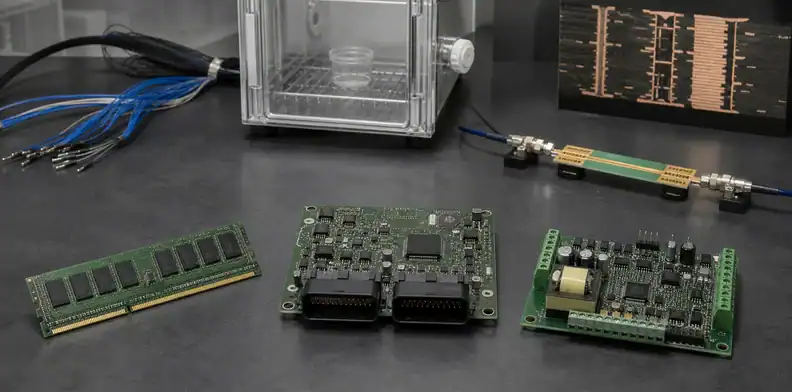
The manufacturer-branded REV 2.0-17 sheet lists automotive, PC/notebook, memory module, game player, and consumer categories. These are plausible screening contexts, not proof that IT-140 is approved for every board in those markets.
A conventional board may remain a candidate when its assembly profile, via structure, environment, loss budget, compliance needs, and sourcing controls fit the evidence. This may include computing, consumer, or general industrial designs, but an application label cannot replace qualification.
Automotive wording deserves care: cabin electronics, radar, under-hood ECUs, and traction-power assemblies have different environmental and qualification demands. “Automotive” in an application list does not establish AEC qualification, OEM approval, or location-specific suitability.
The memory-module listing has the same limitation. It does not prove market preference or fit for a fine-pitch layout; check spacing, bias, humidity, cleanliness, registration, flatness, and assembly history.
Keep the decision provisional until controlled documents and the assembly profile are available.
When should you evaluate a different laminate?
Evaluate another laminate when a documented requirement lacks margin—not when a rule of thumb reaches a certain layer count, operating temperature, or number of heat cycles. Fixed triggers ignore the interaction between resin system, glass construction, copper balance, board thickness, via geometry, moisture, assembly, and service conditions. The IT-180A versus Dicy FR-4 analysis frames one thermal candidate without making it an automatic upgrade.
Six evidence-based triggers are more useful:
- Assembly exposure: the measured reflow, selective-solder, repair, or rework profile is outside current supplier guidance or lacks board-level qualification.
- Via reliability: thermal-cycling or interconnect-stress evidence does not meet the project’s acceptance criteria for the proposed geometry.
- Electrical loss: method- and construction-correct Dk/Df data cannot support the loss, skew, or impedance budget.
- Environment: humidity, bias, temperature cycling, chemical exposure, or service life requires evidence the offered construction does not provide.
- Compliance: the exact build lacks required UL recognition, halogen status, customer approval, traceability, or regulatory documentation.
- Supply control: the supplier cannot confirm current grade identity, site, revision, change notification, or an approved alternate.
An upgrade is not automatically a higher-Tg laminate. The remedy could be a different resin system, lower-loss material, separate halogen-free grade, revised stackup, improved via design, tighter moisture control, or another assembly profile. That is why the failed requirement should be written before candidate materials are compared.
If you need a construction-level review, send the controlled datasheet, stackup, via geometry, impedance requirements, and assembly profile for a multilayer PCB fabrication assessment. The purpose is to identify missing evidence and fabrication constraints before the material is locked, not to approve a laminate from its Tg label alone.
How should “IT-140 or equivalent” be controlled?
“Or equivalent” should invite a documented alternate within the project’s approval process; it should not grant unrestricted substitution. The controlling meaning comes from the purchase order, fabrication drawing, approved-material list (AML), customer specification, and change-control terms.
A useful fabrication-note concept is:
Laminate: ITEQ IT-140 [exact laminate/prepreg suffix and controlled revision], or an alternate listed on the approved material list. No material substitution without written engineering approval. Supplier must identify manufacturer, grade, manufacturing site, TDS revision, construction, and qualification evidence before release.
Adapt that wording to contractual and regulatory requirements. If no current suffix or controlled revision is available, do not fill the gap with an assumption; record it as an open sourcing item and ask whether ITEQ has issued a replacement grade.
Engineering should define equivalence through matched requirements: thermal methods, z-axis expansion, electrical test conditions, resin and glass construction, copper profile, environmental status, UL recognition, CAF evidence where relevant, and board-level assembly/via qualification.
Procurement can then manage a primary and controlled alternates. The quote identifies the offered material and site, the order prohibits unapproved changes, and receiving records preserve traceability.
What belongs in the release and RFQ package?
A release package should make the decision reproducible. No controlled IT-140 fabrication instructions were reviewed here, so fixed press, desmear, storage, or board-bake settings would be inappropriate.
Include these inputs in the RFQ and approval record:
- exact manufacturer, laminate/prepreg grade and suffix, controlled TDS revision, and manufacturing site;
- approved alternates plus the written substitution-approval route;
- stackup, finished thickness, copper weights, glass styles, resin contents, copper profile, and impedance targets;
- applicable Tg, Td, T260/T288, z-axis expansion, Dk/Df, CAF, flammability, halogen, and customer-specific evidence, each with method and condition;
- via types, aspect ratios, minimum dielectric spacing, sequential lamination, and board-level reliability criteria;
- measured assembly profile, planned passes, selective soldering, repair/rework exposure, and moisture-handling requirements;
- test coupons, acceptance criteria, certificates, traceability, deviation control, and change-notification obligations.
Fabrication controls should come from current supplier guidance and the qualified board process. Document lamination, drilling, desmear, plating, registration, inspection, and testing for the released construction.
Before approval, reconcile every quote with the drawing and AML. Confirm whether the offered IT-140 identity is current, whether the proposed site and construction are recognized, and whether any alternate has been reviewed under comparable evidence. A technically acceptable laminate can still become a sourcing risk if the revision and change path are missing.
For a material-controlled quotation, send QueenEMS the BOM material note, controlled datasheet revision, stackup, annual and prototype quantities, assembly profile, compliance requirements, and substitution restrictions through the QueenEMS engineering contact. The resulting quotation can identify the offered construction and the open approval items without creating a new equivalence assumption.
FAQ
Is IT-140 currently available from ITEQ?
No current availability was verified in this review. Official ITEQ-domain historical records exist, but the current public product page retrieved on July 19, 2026 did not expose IT-140; ask for a current controlled TDS, exact suffix, manufacturing site, orderability, and replacement history.
Does T288 of 2 minutes mean two reflow passes?
No. T288 is a time-to-delamination result from an isothermal thermomechanical analysis method, while reflow survival depends on the finished board, actual profile, moisture state, planned passes, rework, and qualification evidence.
Is IT-140G a drop-in halogen-free version of IT-140?
No. The archived IT-140G sheet identifies a separate grade and reports a different property set, so it needs its own stackup, compliance, fabrication, and reliability approval.
Can a fabricator substitute S1141, NP-140, or KB-6160?
Only after the controlling documents permit it and engineering approves method- and construction-matched evidence. Similar FR-4 or Tg labels do not establish equivalence.
How do I know whether to select a higher-performance material?
Start with the failed or uncertain requirement: assembly margin, via reliability, electrical loss, operating environment, compliance, or supply control. Compare controlled candidate data against that requirement rather than using a fixed layer-count, temperature, or model-number rule.
Sources
- ITEQ, IT-140 Conventional FR-4 / High Reliability Laminate & Prepreg, REV 2.0-17. Manufacturer-branded archived sheet; cited without a public link because the reviewed copy is hosted by a PCB-manufacturing peer.
- ITEQ current product index, reviewed July 19, 2026; the retrieved public page did not expose IT-140, so current availability remains unverified.
- IPC Test Methods index, including the identification of IPC-TM-650 2.4.24.1 as the time-to-delamination TMA method.
- IPC-TM-650 2.4.24.1, Time to Delamination (TMA Method), for specimen preparation, isothermal hold, failure definition, and reporting context.
- UL plastics testing and certification, for the scope of UL 94 testing; this source does not verify a current IT-140 UL file or every construction.
- Kingboard KB-6160/KB-6060 electrical-property line-up, version 1.1, March 9, 2022; electrical construction data only.
Written by the QueenEMS Engineering Team
Upload your files today · Free DFM check before production · Ship worldwide
Get your PCB prototypes in as fast as 24 hours. We handle FR4, Rogers, and Flex up to 60 layers — free prototypes for 2–4 layer boards, no minimum order.
Just upload your Gerber + BOM — we source every part, assemble, and inspect (AOI + X‑Ray) so you don't have to chase suppliers. Boards ship in as fast as 24 hours.