

Quick Answer:
NP-170is not a complete current Nanya Plastics material code, so it should not be released as an unqualified fabrication callout. The current NPG-170N datasheet reports a Tg of 170 ± 5°C by DSC and a Td of 360°C at 5% weight loss, but a reliable PCB decision must also cover construction, expansion, moisture, electrical loss, assembly exposure, and change control.Key takeaways: – Confirm the complete grade before applying any property value. – Treat Tg as one screening input, not a reliability guarantee. – Compare alternatives only under compatible test conditions. – Release the stack-up, qualification evidence, and substitution rule together.
Official source: Read the Nanya NPG-170N technical datasheet (PDF). NP-170 is not a complete material callout. Verify the suffix and revision before applying NPG-170N values to a board specification.
NP-170 is best treated as a Tg170 search or procurement reference until the fabricator names the exact laminate and prepreg system. Nanya Plastics’ current catalogue uses complete codes such as NPG-170N and NPG-170D, and those suffixes matter because they distinguish formulations, properties, construction data, and processing guidance.
To compare laminate families, electrical behavior, fabrication limits, and sourcing trade-offs in one place, use the complete PCB materials guide.
That distinction becomes important on multilayer boards exposed to lead-free assembly, rework, high via strain, humidity, or long signal paths. This guide shows how to turn a vague high-Tg request into a material decision that engineering, purchasing, the fabricator, and the assembly provider can all verify.
Table of Contents
- What Does NP-170 Mean for a Tg170 PCB?
- Which NPG-170N Properties Need Method Context?
- How Does It Fit the Nanya Material Range?
- Why Doesn’t Tg Prove Thermal Reliability?
- How Should NP-170 Alternatives Be Compared?
- When Is Standard Tg170 No Longer Enough?
- Which Boards Are Plausible Fits?
- Which Process Controls Protect Reliability?
- How Should Identity and Substitutions Be Qualified?
- What Should the RFQ Include for a Useful Quote?
What Does NP-170 Mean for a Tg170 PCB?
NP-170 describes an intended temperature class more clearly than it identifies a production material. Research of Nanya Plastics’ current electronic-material catalogue found full high-Tg codes including NPG-170N, NPG-170D, and NPG-171, but not one current official grade whose complete name is simply NP-170.
Why is the missing suffix important?
A suffix connects the callout to one controlled datasheet, resin system, prepreg family, environmental declaration, and set of typical values. Without it, a buyer may believe the quotation includes one product while the fabricator has priced another high-Tg construction.
The ambiguity also makes comparisons unsafe. A Tg value from one grade, a dielectric value from another, and an availability claim from a third can easily become a convincing but nonexistent material profile.
| Wording in the file | What it proves | What remains open |
|---|---|---|
| NP-170 | Intent to consider a 170-class material | Exact grade, revision, and construction |
| NPG-170N | One current official Nanya grade | Core/prepreg pairing and board qualification |
| NPG-170D | A different current complete grade | Whether its feature set fits the design |
| NP-170 or equivalent | Permission to propose an alternate | Minimum properties and approval authority |
If the design is still selecting a temperature class, use a guide to FR-4 properties and Tg grades before fixing a brand code. If the grade is already approved, put the complete code, revision expectations, and substitution rule on the fabrication package.
Which NPG-170N Properties Need Method Context?
Every NPG-170N value should remain attached to its test method and sample context. The official datasheet describes its figures as nominal reference values and states that the main property table is based on 0.020-inch 1/1 samples tested by IPC-TM-650 methods.
What do the published thermal values say?
The sheet reports a glass-transition temperature (Tg) of 170 ± 5°C by differential scanning calorimetry (DSC). It reports a decomposition temperature (Td) of 360°C by thermogravimetric analysis (TGA) at 5% weight loss.
Those figures answer different questions. Tg marks a change in polymer behavior under one method, whereas Td marks a defined level of mass loss under another; neither number directly measures plated-through-hole fatigue after the board’s actual reflow and rework history.
Which electrical and physical values help screening?
| Property | NPG-170N typical value | Published context | Proper use |
|---|---|---|---|
| Tg | 170 ± 5°C | DSC | Temperature-class screening |
| Td | 360°C | TGA, 5% weight loss | Resin degradation margin |
| Dk | 4.1–4.3 | 1 GHz, C-24/23/50 | Early electrical estimate |
| Df | 0.009–0.012 | 1 GHz, C-24/23/50 | Early loss screening |
| Moisture absorption | 0.20–0.30% | D-24/23 | Moisture/process comparison |
| Z-axis CTE | 30–60 / 200–230 ppm/°C | Before / after Tg by TMA | Interconnect-strain screening |
Dielectric constant (Dk) and dissipation factor (Df) also vary with frequency, resin content, glass style, copper roughness, and test method. Use the datasheet to compare candidate families, then obtain construction-specific design values from the fabricator for field solving and loss analysis.

How Does It Fit the Nanya Material Range?
NPG-170N sits in the high-Tg part of Nanya Plastics’ current copper-clad-laminate range. That makes Nanya Plastics an upstream material supplier whose official documents can establish grade identity and typical laminate properties; it does not make every 170-class grade interchangeable.
What does the current sheet establish?
The datasheet describes NPG-170N as glass-cloth epoxy, flame-retardant copper-clad laminate. It identifies a halogen-, antimony-, and red-phosphorus-free formulation, UL 94 V-0 flammability, and IPC-4101E L127/128 references.
It also describes superior conductive anodic filament (CAF) resistance as a material feature. CAF is electrochemical growth along the glass-resin interface, but a supplier feature statement is not proof that every finished board will pass a particular voltage, humidity, spacing, contamination, or service-life requirement.
How should the range guide selection?
Start with the board’s constraints and use the supplier range to locate plausible constructions. A standard high-Tg grade may suit a conventional multilayer board, while a different high-Tg or lower-loss system may be needed when the design has severe thermal cycling, dense interconnects, or a demanding channel budget.
This prevents a catalogue ladder from becoming a false performance ranking. A higher grade number is useful only when its documented properties and available constructions close a real design or qualification gap.
Why Doesn’t Tg Prove Thermal Reliability?
Tg does not prove thermal reliability because the finished board fails through interacting material, geometry, process, and exposure mechanisms. A 170°C DSC result says where one polymer transition is observed; it does not state how many assembly excursions a particular plated hole will survive.
Which thermal measures answer different questions?
- Tg helps classify the resin’s transition behavior under the stated method.
- Td describes decomposition at a defined percentage of mass loss.
- Z-axis CTE describes expansion below and above Tg, which contributes to interconnect strain.
- Thermal-stress or T288 data describes a specific test condition, not an unlimited reflow allowance.
- Finished-board coupons test the actual material, layer build, holes, plating, and process together.
NPG-170N’s sheet reports at least 300 seconds in a 288°C solder-dip thermal-stress test as typical material data. That is useful evidence, but it should not be converted into a promised number of lead-free reflow or rework cycles because the heat transfer, board geometry, moisture state, and acceptance criteria differ.
Where does margin disappear?
Risk rises when a thick board combines high aspect-ratio holes, heavy copper, dense buried structures, multiple reflow passes, local rework, or aggressive thermal cycling. Above Tg, the published Z-axis expansion range is much higher than below Tg, so construction and exposure can matter as much as the nominal class.
The release decision should therefore connect the material sheet to the board’s assembly profile, interconnect coupon, microsection criteria, and service environment. Tg starts the discussion; the qualification plan closes it.
How Should NP-170 Alternatives Be Compared?
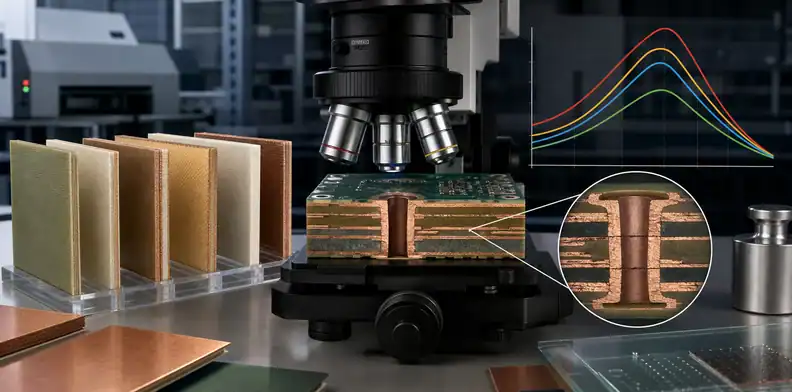
NP-170 alternatives should be compared by normalized requirements, not by copying unmatched headline values into one ranking table. Current official data for each exact grade should use compatible methods, conditioning, frequency, and construction wherever a numeric comparison is made.
What should the comparison normalize?
Review these categories in the same order for every candidate:
- exact laminate and prepreg grade, revision, and manufacturing site;
- Tg method, Td definition, T288 or thermal-stress method, and expansion data;
- Dk/Df frequency, test fixture, resin content, copper profile, and design-value source;
- environmental declaration, flammability recognition, and customer slash-sheet requirements;
- CAF evidence, moisture conditioning, spacing, voltage, and finished-board test plan;
- core/prepreg availability, lead time, change notification, and alternate approval.
The S1170G and S1000-2M material comparison illustrates why two high-Tg choices can serve different board priorities. The IT-170 variant selection guide similarly shows why a family name is not enough to release a stack-up.
What makes a comparison decision-ready?
| Question | NPG-170N starting point | Evidence needed from an alternate |
|---|---|---|
| Is the exact formulation approved? | Complete current grade and declarations | Matching grade-level documents |
| Is thermal margin credible? | Method-labeled Tg/Td and stress data | Compatible methods plus board exposure |
| Will the signal model be accurate? | Nominal and construction tables | Stack-up-specific design data |
| Is interconnect risk controlled? | Material CTE/CAF feature data | Coupons, plating, geometry, and test plan |
| Can production remain consistent? | Supplier construction guidance | Site, traceability, and change control |
Cost should be compared only after the candidates meet the same technical and documentation requirements. A cheaper quotation is not equivalent if it relies on a different construction, incomplete test package, or unapproved substitution.
When Is Standard Tg170 No Longer Enough?
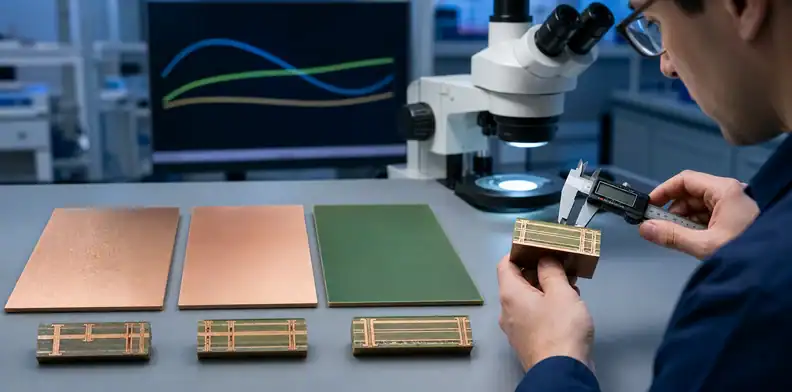
Standard Tg170 FR-4 is no longer enough when the board’s loss, interconnect, environment, or compliance requirements remain outside the qualified margin. Moving to another material tier should answer a documented failure mode rather than simply increase the Tg number.
Which triggers justify another material class?
A lower-loss system may be justified by a long high-speed channel, tight insertion-loss budget, or sensitivity to copper profile. A higher-reliability construction may be justified by severe thermal cycling, many assembly/rework excursions, dense HDI structures, or a high aspect-ratio via that cannot pass representative coupons.
High voltage, humidity, condensation, or small conductor spacing can also make CAF and insulation evidence central. In that case, the material statement must be combined with cleanliness, spacing, voltage, glass style, and finished-board testing.
Use the TU-768 Tg170 material guide to frame an alternative qualification path, or review the S1000-2M application discussion when power-layer and demanding multilayer requirements are involved. These are starting points for evidence gathering, not universal replacement instructions.
What keeps an upgrade proportionate?
Define the failing requirement, request one or more constructions that address it, and compare total qualification and production consequences. The right choice is the least complex approved stack-up that meets the electrical, thermal, mechanical, compliance, and supply-control requirements with adequate margin.
Which Boards Are Plausible Fits?
A documented Tg170 standard-loss FR-4 construction is a plausible fit for many multilayer computing, networking, industrial-control, gateway, power-management, and embedded boards. Application labels are only a first screen; the actual fit comes from the board’s channel length, via design, assembly exposure, environment, and qualification level.
What should be screened before selection?
For computing and networking hardware, examine the longest critical channel, data rate, connector budget, copper profile, and impedance tolerance. For industrial or power-control boards, add operating temperature, humidity, voltage, creepage and clearance, copper weight, expected service life, and thermal cycling.
Layer count alone does not determine the answer. A relatively high-layer board with short moderate-speed channels and proven vias may fit a standard Tg170 construction, while a lower-layer board with a long low-loss channel or severe voltage/humidity exposure may require a different system.
Which cases deserve an early escalation?
Escalate millimeter-wave or very long high-speed paths, high-voltage condensation exposure, safety-critical control, repeated thermal cycling, multiple planned rework events, and dense HDI or stacked microvia structures. These cases need application-specific evidence that the nominal Tg cannot provide.
The material can remain a candidate until the fabricator proposes a stack-up. It should become an approved release choice only after the electrical model, assembly profile, coupons, and compliance evidence are aligned.
Which Process Controls Protect Reliability?
Reliability is protected by controlling storage, lamination, drilling, plating, moisture, and assembly as one connected process. The supplier datasheet provides a starting window, while the fabricator must qualify the actual glass styles, resin contents, copper, panel design, equipment, and board geometry.
What does the NPG-170N guidance say?
The current sheet recommends a 1–3°C/min material heating rate from 70°C to 140°C, with 1.5–2.5°C/min preferred. It calls for at least 60 minutes above 170°C for cure and recommends cooling below 2.5°C/min above 100°C to reduce twist risk.
These values should be checked against the current revision and exact constructions used. Record prepreg identity, glass style, resin content, gel time, pressed thickness, copper foil, grain direction, storage conditions, and shelf life before the first production release.
Which controls connect material to the finished board?
Drilling parameters should reflect thickness, copper, glass style, stack height, tool condition, and required hole quality rather than an unsupported universal hit count. Desmear, electroless copper, plating, and thermal stress then determine whether the finished hole wall meets the drawing and coupon criteria.
Moisture management must continue through fabrication and assembly. Packaging, storage, floor exposure, bake decisions, reflow profiling, and rework limits should follow controlled procedures that suit the actual board and component package.
If the proposed grade, stack-up, or assembly profile has unresolved gaps, send the current datasheet and board package through a PCB DFM and material review. The assessment should identify the open construction, process, and evidence questions before they become quotation assumptions.
How Should Identity and Substitutions Be Qualified?
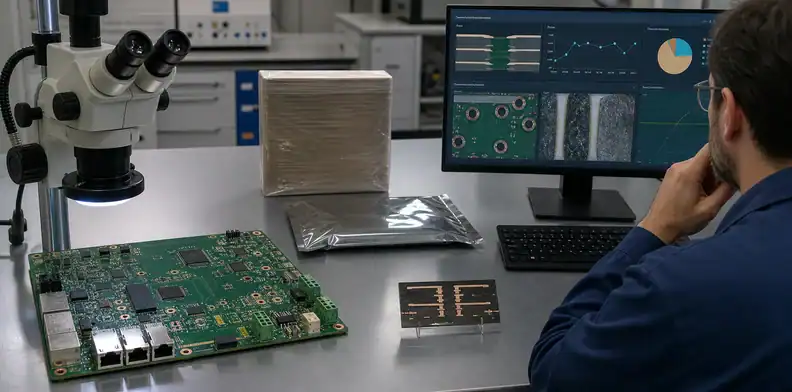
Material identity and substitutions should be qualified through documents, traceability, and an explicit approval path. A supplier brand, corporate relationship, or familiar Tg class does not prove that the exact grade, prepreg, construction, or fabrication site matches the approved build.
What evidence establishes identity?
The fabrication package should name the complete laminate and prepreg codes or define measurable minimum requirements. The quotation and stack-up should then state the proposed cores, prepregs, resin contents, glass styles, pressed thicknesses, copper foils, design Dk values, fabrication site, and source documents.
Incoming and production records should connect purchased material to the finished lot. Depending on product risk, that may include certificates, lot traceability, date codes, shelf-life status, impedance coupons, microsections, thermal-stress results, dimensional checks, and customer-required reports.
What makes an alternate controllable?
An approved-equivalent rule should define the properties that must match, the evidence package, the party authorized to approve, and the changes that trigger requalification. “Equivalent Tg170 FR-4” is too broad because two grades with similar Tg can differ in Td, expansion, loss, compliance, constructions, and process history.
The same control should cover a change in glass style, resin content, copper profile, pressed thickness, manufacturing site, or key process when that change can affect the qualified result. Purchasing can then evaluate availability and price without silently changing the technical baseline.
What Should the RFQ Include for a Useful Quote?
A useful RFQ gives every fabricator the same board data, material rule, assembly exposure, test plan, and commercial quantities. That makes quotations comparable and leaves fewer technical gaps to be priced as assumptions.
Which files and requirements should be sent?
Include:
- Gerber or ODB++ data, fabrication drawing, drill files, and IPC-356 netlist;
- exact laminate/prepreg callout or controlled approved-equivalent rule;
- layer stack, finished thickness, copper weights, and impedance requirements;
- via types, aspect ratios, tolerances, surface finish, and controlled dimensions;
- assembly reflow/rework profile and expected environmental exposure;
- flammability, halogen-free, customer, and regulatory requirements;
- coupon, inspection, report, traceability, and change-notice requirements;
- prototype and production quantities plus realistic forecast assumptions.
| Release gate | Pass condition | Decision owner |
|---|---|---|
| Material identity | Full grade, prepreg, and revision basis are clear | Engineering and purchasing |
| Stack-up | Constructions, copper, thickness, and impedance are approved | PCB engineer and fabricator |
| Thermal exposure | Reflow, rework, and service assumptions are documented | Assembly/process engineering |
| Qualification evidence | Risk-matched coupons and first-board records meet the plan | Product quality and design engineering |
| Material changes | Substitution authority and requalification triggers are stated | Design owner and procurement |
To request pricing from QueenEMS, provide the complete PCB fabrication package together with quantities and controlled requirements. Name the exact Nanya grade when it is fixed; when it is still open, state the performance limits and approval rule so the proposed construction can be evaluated before pricing is accepted.

FAQ
Can I put only NP-170 on a PCB drawing?
No. Use the complete current laminate and prepreg codes, or define measurable requirements and an alternate-approval process. The shorthand alone does not identify one controlled current Nanya Plastics datasheet.
What’s the difference between NP-170 and NPG-170N?
NP-170 is an ambiguous search or procurement reference, while NPG-170N is a complete current Nanya Plastics grade with a specific datasheet, formulation, typical properties, and prepreg guidance. Data from NPG-170N should not be assigned to an unidentified NP-170 callout.
Does a 170°C Tg guarantee lead-free reflow reliability?
No. Tg is one material transition value; finished-board reliability also depends on Td, expansion, moisture, via geometry, plating, lamination, reflow/rework history, and representative coupon evidence.
Is NPG-170N halogen-free?
Yes. The current Nanya Plastics datasheet describes NPG-170N as halogen-, antimony-, and red-phosphorus-free, but the exact declaration must still match the grade and revision being supplied.
How do I approve an alternative Tg170 material?
Define the exact properties, methods, construction data, compliance evidence, coupons, manufacturing site, traceability, and change-control rules that the alternate must meet. Approve the proposed stack-up only after those requirements are satisfied.
Sources
Written by the QueenEMS Engineering Team
Upload your files today · Free DFM check before production · Ship worldwide
Get your PCB prototypes in as fast as 24 hours. We handle FR4, Rogers, and Flex up to 60 layers — free prototypes for 2–4 layer boards, no minimum order.
Just upload your Gerber + BOM — we source every part, assemble, and inspect (AOI + X‑Ray) so you don't have to chase suppliers. Boards ship in as fast as 24 hours.