

Quick Answer: Hybrid PCB lamination should be approved only after the fabricator reviews CTE mismatch, resin flow, cure behavior, desmear response, warpage risk, and inspection evidence for the exact stackup. The buyer does not need the factory’s press recipe, but the RFQ must make the lamination risk visible before the build is priced and released.
Key takeaways
For a broader comparison of laminate families, electrical properties, processing limits, and sourcing choices, see our PCB materials guide.
- The main risk is not the word hybrid; it is the interface between dissimilar materials.
- CTE, resin flow, cure temperature, drill response, and chemical compatibility should be reviewed before the PO.
- Cross-section, microsection, and first-lot evidence make lamination assumptions traceable.
- A quote that ignores lamination evidence is not comparable to a quote that includes process control.
Hybrid PCB lamination becomes a purchasing issue when a board combines dissimilar dielectric materials to control RF loss, high-speed insertion loss, thermal behavior, or cost. The layout may look finished, but the manufacturability decision is still open until the stackup can be pressed, drilled, desmeared, plated, and inspected reliably.
This article is not a general delamination explanation. It is focused on the order-stage question: what should the buyer ask before a mixed-material PCB enters fabrication?
The safest approach is to turn lamination risk into a quote assumption. That means the supplier’s answer should name the materials, the interface risk, the evidence to be returned, and the conditions that would pause production.
Table of Contents
- Treat lamination as a mixed-material approval
- Check CTE mismatch before it becomes warpage
- Ask how resin flow and cure behavior are managed
- Separate drilling and desmear from ordinary FR4 processing
- Define evidence before the first lot ships
- Write the lamination boundary into the RFQ
- Decide what should stop production
- Make receiving inspection match the lamination risk
- Use RFQ wording that separates process choice from approval choice
Treat lamination as a mixed-material approval
A hybrid board should not move from quote to production just because the material names are available. The fabricator needs to approve the way those materials behave together under heat, pressure, drilling, chemical preparation, and reflow exposure.
The approval should be tied to the exact stackup, not a generic capability line. Changing the low-loss core, prepreg, copper foil, dielectric thickness, or layer order can change resin movement and dimensional behavior.
iNEMI’s hybrid PCB work highlights material compatibility and warpage as core manufacturing challenges. That matches the buying reality: the risk sits at the material interface, not only in the electrical design.
| Approval item | Why it belongs before PO release | Practical buyer action |
|---|---|---|
| Material pair | Different systems may move differently during heat cycles | Ask the supplier to confirm the exact pair, not only brands |
| Layer symmetry | Asymmetry can increase bow, twist, or registration concern | Review the stackup before treating cost as final |
| Evidence level | Some risks need first-lot proof | Decide whether proof is quote-stage or shipment-stage |
Approval rule: Release hybrid PCB lamination only when the exact mixed-material construction has been reviewed, not just the material brands.
Check CTE mismatch before it becomes warpage
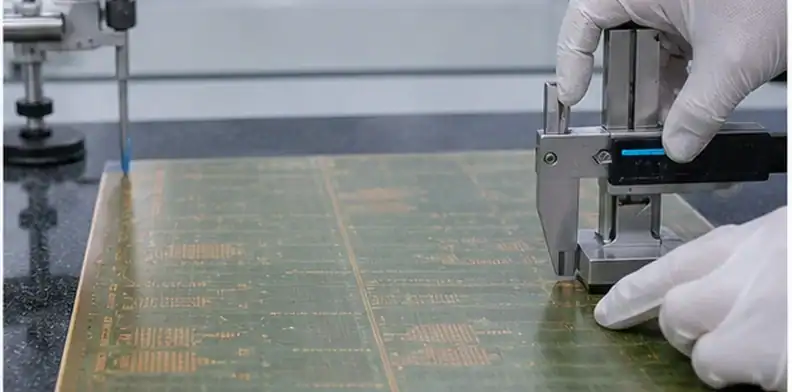
CTE mismatch is one of the first questions to raise because materials expand and contract differently through lamination and later thermal cycles. The result can be bow, twist, registration shift, via stress, or interlayer separation.
Altium’s reliability discussion points to CTE difference as a major factor in delamination risk. For a buyer, the useful action is to ask whether the supplier has reviewed X/Y/Z movement, board thickness, copper distribution, and symmetry for the proposed stackup.
| CTE-related item | Buyer risk | Question for supplier |
|---|---|---|
| Z-axis expansion | Via barrel stress and separation | How is through-hole reliability protected? |
| X/Y movement | Layer registration shift | Will CAM scaling be adjusted? |
| Asymmetric material placement | Bow and twist | Can the stackup be balanced? |
| Assembly thermal exposure | Post-reflow stress | Is the construction suitable for the planned reflow profile? |
For acceptance after fabrication, PCB bow twist spec and PCB microsection report requirements help define what evidence the buyer can actually review.
Warpage signal: If the construction is asymmetric or the CTE spread is large, treat flatness and cross-section evidence as part of the quote, not a later complaint.
Ask how resin flow and cure behavior are managed
Resin flow decides whether the layers bond fully and whether copper features, glass cloth, and material interfaces are properly filled. A mixed stackup can combine materials with different cure behavior, prepreg availability, and surface energy.
The buyer should avoid writing a process recipe, but the RFQ can ask the fabricator to confirm whether the chosen prepreg and lamination cycle are suitable for the material pairing. That keeps the supplier responsible for process control while making the assumption visible.
Useful supplier replies include a press-feasibility statement, a proposed alternative prepreg, a warning that the stackup needs balancing, or a request to change material placement. Those answers are valuable before CAM release and costly after production starts.
Resin rule: Do not approve a hybrid lamination quote unless the bonding path between unlike materials is part of the supplier’s assumption.
Separate drilling and desmear from ordinary FR4 processing
Hybrid PCB lamination does not end at the press. Mixed materials can change drill quality, smear behavior, hole-wall preparation, and plating consistency. PTFE-based layers, ceramic-filled materials, and high-speed thermosets may require different preparation from standard FR4.
The quote should state whether special drilling, plasma preparation, modified desmear, or additional inspection is included. A supplier may also suggest via structure changes if the released stackup creates unnecessary risk.
| Manufacturing step | What can go wrong | Evidence or control |
|---|---|---|
| Drilling | Rough hole wall or material smear | Drill parameter review |
| Desmear | Uneven preparation across materials | Process note or microsection |
| Plating | Barrel weakness at interfaces | Hole-wall copper evidence |
| Routing | Edge stress or exposed interfaces | Edge quality inspection |
This is where PCB incoming inspection becomes practical. Receiving should know which evidence belongs to the mixed-material risk before the boards arrive.
Drill call: Hybrid lamination approval should include the hole-wall preparation plan when plated holes cross dissimilar materials.

Define evidence before the first lot ships
The evidence package should match the risk level. A simple RF/digital hybrid may need stackup signoff and impedance data. A high-reliability radar, aerospace, or outdoor telecom board may justify cross-section review, microsection, thermal stress notes, or first-article approval.
Do not ask for every report by default. Evidence should be proportional to the consequence of failure. A prototype may need a smaller evidence set, while a production release should preserve enough data to make repeat orders comparable.
A practical evidence request can say: provide final stackup, controlled-impedance coupon report for critical nets, and cross-section image confirming dielectric and plating assumptions for the mixed-material construction.
Proof rule: Ask for evidence that proves the stackup was built as approved, not paperwork that merely repeats the quote.
Write the lamination boundary into the RFQ
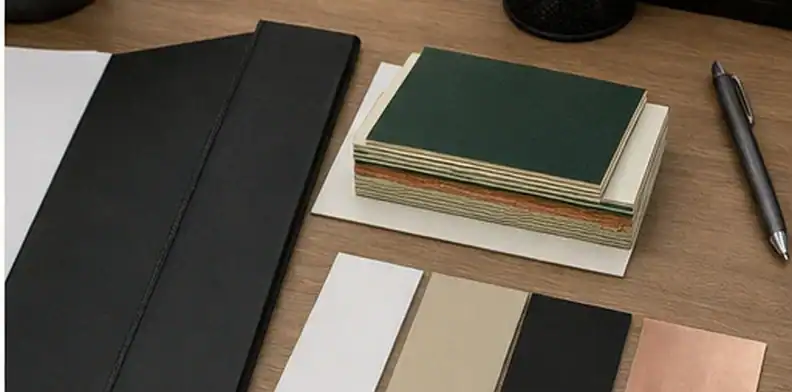
The RFQ should identify which lamination assumptions are fixed and which may be adjusted by CAM. Material family, RF layer assignment, finished thickness, controlled impedance, copper weight, and approval owner should be explicit.
The supplier may propose changes to improve yield or control impedance. The buyer should decide whether those changes are allowed without a revised quote, require engineering approval, or must stop the order until the stackup is re-released.
For related release control, connect the package to supplier stackup signoff and PCB quote changes after DFM. Both help prevent a lamination fix from becoming an undocumented product change.
Release boundary: The factory owns process control, but the buyer owns approval of material, stackup, and evidence changes that alter the released design.
Decide what should stop production
Hybrid lamination questions should have a stop rule. If the supplier finds an unsupported material pairing, a missing prepreg, a thickness conflict, a bow/twist concern, or an impedance adjustment outside the released tolerance, production should pause until the buyer responds.
A stop rule is not bureaucracy. It protects both sides from building a board that is technically different from the purchase order. Purchasing may want the fastest shipment, while engineering needs to know whether a process change affects RF loss, high-speed timing, assembly fit, or reliability evidence.
The RFQ can define three response levels. Minor manufacturability notes can be recorded by CAM. Material, thickness, or layer-order changes require engineering approval. Any change that affects qualification evidence or repeatability should trigger a revised quote or written deviation approval.
Hold rule: Hybrid PCB lamination should pause when the supplier’s process solution changes the released stackup, evidence level, or acceptance basis.
Make receiving inspection match the lamination risk
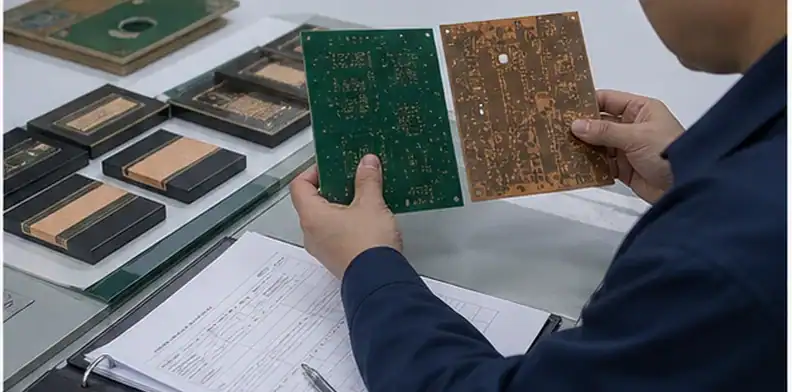
Receiving inspection should not treat a hybrid board exactly like a standard FR4 board when the order risk came from material interfaces. The incoming team needs to know which records to check and which physical signs may indicate a lamination problem.
For normal lots, the check may be document-based: approved stackup, test report, and packaging condition. For higher-risk builds, receiving may also review cross-section evidence, flatness, exposed edges, blisters, resin starvation signs, or hole-wall quality if microsection data is part of the release package.
The key is to decide this before shipment. If receiving discovers that evidence was never requested, the buyer has little leverage except delay, dispute, or rework. A clear incoming checklist lets the supplier know what must be returned with the boards.
Connect this step to PCB incoming inspection and keep the accepted evidence with the lot record. That way, a future field issue or reorder discussion can separate design risk from manufacturing execution.
| Receiving item | What it confirms | When to ask for more |
|---|---|---|
| Final stackup record | The lot matches the released construction | Supplier notes differ from the RFQ |
| Cross-section or microsection | Interfaces and plated holes look acceptable | The build is new or high risk |
| Supplier exception log | Changes were approved before release | The quote has undocumented deviations |
Receiving rule: Inspect the documents and physical signs that match the hybrid lamination risk named in the RFQ.
Use RFQ wording that separates process choice from approval choice
The RFQ should let the fabricator own the lamination process while keeping the buyer in control of product changes. This is a useful distinction. The buyer does not need to approve press temperature, pressure, or proprietary handling steps, but must approve changes that affect material, thickness, impedance, reliability evidence, or repeatability.
A practical request can say: please review the attached hybrid PCB lamination stackup for material compatibility, CTE mismatch, resin flow, desmear behavior, bow/twist risk, and required evidence. Confirm whether the stackup is manufacturable as drawn, or list any material, prepreg, thickness, drill, or inspection changes needed before release.
That wording invites a real engineering answer instead of a yes/no capability statement. It also gives purchasing a way to compare quotes. A supplier that includes cross-section review, impedance evidence, and clear exceptions is not quoting the same scope as a supplier that only returns a unit price.
For internal approval, copy the supplier’s exact answer into the purchase record. If the answer includes a substitution, tolerance relaxation, or extra evidence cost, engineering should accept it before the buyer releases the PO. That short discipline prevents lamination fixes from turning into undocumented product changes.
RFQ wording: Ask the fabricator to state whether the hybrid PCB lamination build is manufacturable as drawn and what evidence will prove it.
For production transfer, keep one short lamination handoff note with the approved stackup. The note should identify the fixed material set, any approved prepreg or thickness alternate, the evidence required before shipment, and the person or role that can approve a deviation. This prevents a second lot from being quoted as a normal FR4 build after the first lot required special review.
The handoff note also helps when production moves from prototype to a different factory line or a larger panel format. A new line may use different press loading, drill capacity, or panel compensation. The buyer does not need to manage those details, but should require the supplier to confirm that the accepted hybrid PCB lamination assumptions still apply.
FAQ
What causes hybrid PCB delamination?
The common causes are material incompatibility, CTE mismatch, poor resin flow, moisture, unsuitable surface preparation, or thermal stress after lamination. The exact cause depends on the material pair and process history.
Should I request a microsection for every hybrid PCB?
No. Request it when the stackup has high reliability risk, plated holes cross difficult material interfaces, or the first lot will become a production baseline. For low-risk prototypes, stackup signoff and impedance evidence may be enough.
Can a supplier change prepreg during CAM?
Only if the RFQ allows that change and the electrical/mechanical result is approved. Prepreg changes can affect dielectric thickness, impedance, lamination behavior, and final board thickness.
Is hybrid PCB lamination always slower than FR4?
Usually it needs more review, and sometimes extra lead time for material, press planning, or inspection. The quote should state whether the added time is material procurement, process review, testing, or production queue time.
Related QueenEMS articles
- Supplier stackup signoff
- PCB microsection report requirements
- PCB bow twist spec
Send QueenEMS the mixed-material lamination package
If your PCB project uses mixed Rogers, PTFE, high-speed thermoset, FR4, or high-Tg materials, send the stackup, material list, drill table, impedance requirements, assembly temperature exposure, and inspection expectations through the QueenEMS contact page.
QueenEMS can review the lamination boundary, supplier questions, cross-section needs, and quote assumptions so the build risk is clear before the order is released.
Sources
Written by the QueenEMS Engineering Team
Upload your files today · Free DFM check before production · Ship worldwide
Get your PCB prototypes in as fast as 24 hours. We handle FR4, Rogers, and Flex up to 60 layers — free prototypes for 2–4 layer boards, no minimum order.
Just upload your Gerber + BOM — we source every part, assemble, and inspect (AOI + X‑Ray) so you don't have to chase suppliers. Boards ship in as fast as 24 hours.