
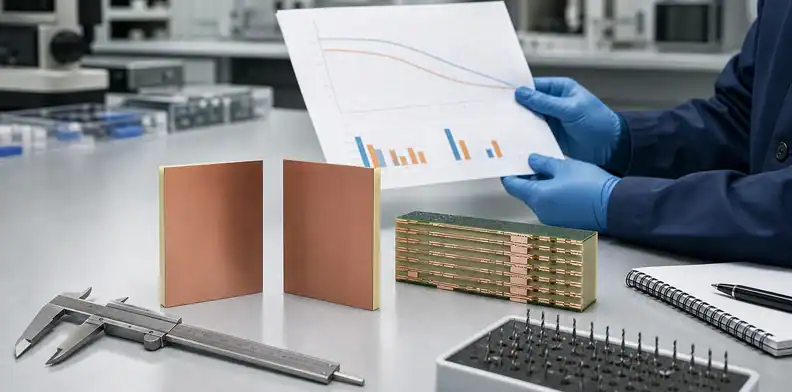
Quick Answer: Isola IS410 is a Tg 180°C, unfilled FR-4 laminate with Td 350°C, six 288°C solder-float passes, and IPC-4101 /21, /24, /26, /121, /124, and /129 coverage. It is not the halogen-free version of 370HR; choose it when small-hole drilling and its exact qualification family matter, and verify the approved material list before substitution.
Key takeaways: – IS410 is an unfilled, lead-free-assembly-compatible FR-4 system. – Its official data lists Tg 180°C, Td 350°C, T260 50 minutes, and T288 10 minutes. – RoHS compliance does not establish a halogen-free declaration. – An IPC slash sheet and the finished-board requirements decide whether an equivalent is acceptable.
Isola IS410 is a high-Tg FR-4 choice for projects that need defined thermal performance and practical drilling behavior, not a generic upgrade over every other high-reliability laminate. If a drawing says “IS410 or equivalent,” the risk is treating a trade name as a complete material specification; the safer route is to compare the applicable slash sheet, stack-up, finished-board qualification, and supply-chain approval before the quote is released. This Isola IS410 PCB material decision guide turns those checks into an RFQ-ready decision.
For the wider material-selection picture across performance, fabrication, and sourcing, refer to the full PCB materials guide.
Table of Contents
- What Is Isola IS410 and Is It Still Available?
- Which IS410 Datasheet Numbers Should You Use?
- How Does Unfilled IS410 Differ from Filled 370HR?
- Why Do IS410 Slash Sheets Matter on a Fab Drawing?
- Is Isola IS410 a Halogen-Free Laminate?
- When Should You Choose IS410 Instead of 370HR?
- Can IS410 Handle Reflow and Thermal Excursions?
- Which Applications Suit IS410 Without Over-Specifying It?
- What Should a Fabricator Check Before Processing IS410?
- What Does “IS410 or Equivalent” Actually Permit?
What Is Isola IS410 and Is It Still Available?
IS410 is a high-performance, lead-free-assembly-compatible FR-4 laminate and prepreg system with a 180°C DSC Tg. Isola lists it as a Legacy Material while also listing manufacture in Asia and Europe, which means the label should trigger a supply review rather than an assumption of end-of-life.
The product is offered as laminate from 2 to 125 mil (0.05 to 3.2 mm), with HTE Grade 3 and reverse-treat copper options in common weights. Prepreg is available in E-glass, square-weave, and mechanically spread-glass constructions. Those choices matter because an approved trade name alone does not lock the dielectric thickness, resin content, copper roughness, or glass weave that controls the finished stack-up.
What should your release package say?
Ask the fabricator to confirm the current material availability, laminate or prepreg form, copper foil, thickness, and approved production location. A legacy label does not replace a current purchase confirmation.
For a repeat program, record the manufacturer, product designation, TDS revision, approved production region, core and prepreg styles, and certificate requirements in the sourcing package. That gives purchasing a controlled baseline if availability changes without forcing engineering to interpret the word “legacy” during every quotation.
Which IS410 Datasheet Numbers Should You Use?
Use the official test-method-qualified values: Tg 180°C by DSC, Td 350°C at 5% weight loss, T260 50 minutes, and T288 10 minutes. These values describe the laminate test specimen, so they are material inputs—not a guarantee for a completed board under every assembly profile.
Glass transition temperature (Tg) is the point where the cured resin changes from a glassy state toward a softer response; decomposition temperature (Td) is measured at 5% mass loss. They answer different questions. Tg helps frame expansion behavior, while Td and time-to-delamination data help evaluate the material margin during high-temperature assembly and rework.
Which values influence the design?
- Dk is 3.90 at 1 GHz and 3.97 at 2 GHz in the listed stripline measurements.
- Df is 0.0189 at 1 GHz and 0.0200 at 2 GHz.
- Z-axis expansion from 50–260°C is 3.5%.
- Thermal conductivity is listed as 0.5 W/m·K.
- Moisture absorption is listed as 0.20% under the stated test method.
For a stack-up decision, pair the datasheet with the actual glass style, resin content, copper profile, impedance target, and reflow profile.
Do not lift a Dk value from one frequency and use it as an unqualified design value at another frequency. The published values use different methods across the frequency range, and the effective dielectric behavior of a finished transmission line also depends on resin percentage and weave. Ask the fabricator for the construction-specific model used in its field solver before freezing trace geometry.
How Does Unfilled IS410 Differ from Filled 370HR?
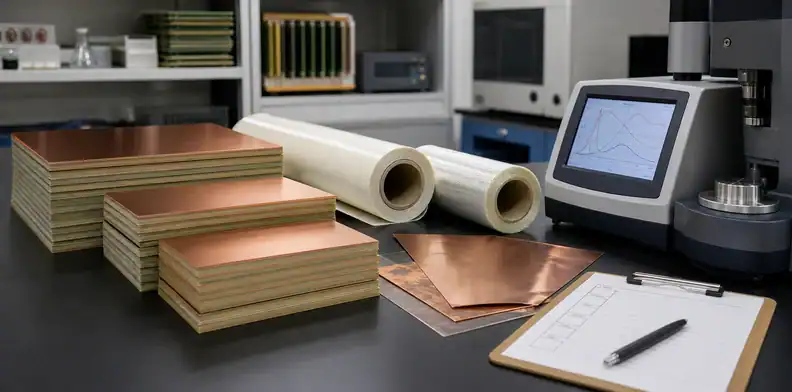
IS410 is unfilled, whereas 370HR uses an inorganic-filled resin system; neither description makes one a universal upgrade. The practical choice is a trade-off: Isola describes IS410 as optimized for small holes of 10 mil or less, while a filled system may be preferred where its dimensional-control characteristics have already been qualified.
“Unfilled” describes the resin formulation, not an empty or weak laminate. IS410 still uses woven E-glass reinforcement and is documented for conductive anodic filament (CAF) resistance. The manufacturing benefit is that the resin does not carry the same inorganic filler loading associated with abrasive tool contact, while the design team must still judge the published 3.5% total Z-axis expansion against via geometry and thermal exposure.
What changes on the factory floor?
Unfilled resin can be less abrasive to mechanical tooling, but drilling success still depends on panel construction, aspect ratio, drill parameters, and hole-wall verification. For HDI work, share the drill chart and cross-section requirement with your HDI PCB manufacturer before material is committed.
The datasheet wording “high aspect ratio holes of ≤10 mils” refers to the small finished or drilled feature range, not a blanket 10:1 aspect-ratio guarantee. Board thickness divided by drilled hole diameter still determines the actual aspect ratio. Require the fabricator to state its supported drill diameter, finished hole tolerance, plating requirement, and coupon inspection plan for the proposed thickness.
Why Do IS410 Slash Sheets Matter on a Fab Drawing?
IS410 is listed against IPC-4101 /21, /24, /26, /121, /124, and /129, so the slash-sheet callout can be more useful than a product name alone. Each slash sheet sets a defined material family and minimum performance framework; it does not make all laminates automatically interchangeable.
The current official product data lists six slash sheets—not seven. A reseller table or old qualification record may show a different set, but a fabrication drawing should be based on the manufacturer’s current declaration and the applicable revision of IPC-4101. Adding an unsupported slash sheet can narrow sourcing incorrectly or create a compliance mismatch at incoming inspection.
How should you write the callout?
State the applicable slash sheet, laminate/prepreg construction, copper foil, thickness, Tg method, and any qualification restriction. Use the FR-4 Tg selection guide to keep a general Tg callout from masking a different thermal or electrical need.
A practical drawing note separates mandatory and negotiable requirements. For example, make the IPC slash sheet, finished board class, flammability requirement, and customer-approved material list mandatory; then state whether the Isola trade name is required or whether an approved equivalent may be proposed. That format gives purchasing flexibility without silently changing the engineering basis.
Is Isola IS410 a Halogen-Free Laminate?
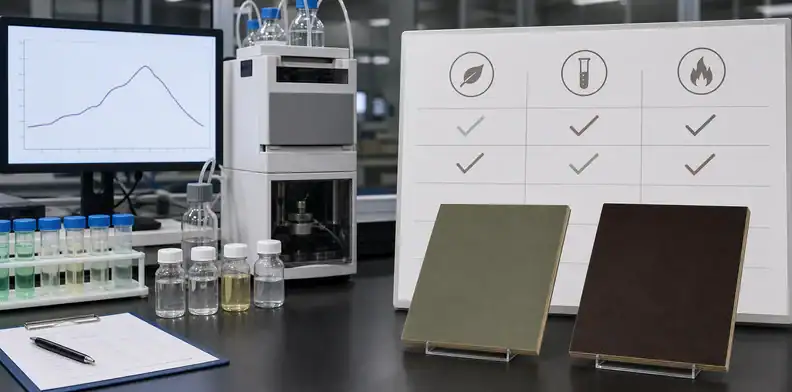
No. The IS410 datasheet states RoHS compliance and lead-free assembly compatibility, but it does not make a halogen-free declaration or provide the bromine-and-chlorine limit needed for that claim. Do not convert “RoHS compliant” into a halogen-free callout in a BOM or customer document.
RoHS restricts specified hazardous substances in electrical and electronic equipment, while a halogen-free laminate claim normally relies on separate chlorine and bromine limits and test evidence. The two concepts can overlap, but one does not prove the other. Likewise, “lead-free assembly compatible” describes suitability for higher-temperature solder processing; it is not a statement about the laminate’s flame-retardant chemistry.
What should you do for an environmental requirement?
Request the exact compliance evidence required by the customer and specify a product expressly documented for that purpose. This distinction prevents a late material change after the stack-up, samples, or compliance file are already approved.
If the customer requires IEC 61249-2-21 limits or another internal environmental specification, ask for a declaration or test report that names the exact laminate and prepreg. Do not rely on a distributor description, a generic family certificate, or an AI-generated comparison. The compliance file should connect the named material, manufacturing lot documentation, and customer requirement.
When Should You Choose IS410 Instead of 370HR?
Choose IS410 when its unfilled construction, small-feature drilling support, listed slash-sheet family, and current qualification match the design; choose 370HR when that material is the approved construction or its filled-resin behavior is required. Both are Tg-180-class FR-4 options, but a direct substitution needs electrical and reliability review.
The official numbers also prevent simplistic ranking. IS410 lists Td 350°C, T260 50 minutes, T288 10 minutes, and 3.5% Z-axis expansion from 50–260°C. A 370HR construction has a different filler system and published property set. The decision should weigh the actual via reliability, thermal cycling, drilling, impedance, and qualification needs rather than selecting whichever datasheet has the larger value in one row.
Which comparison is useful?
Compare the exact construction rather than a marketing hierarchy. The related Isola 370HR PCB material guide is useful background, while your fab should confirm impedance, CTE exposure, plated-through-hole reliability, and documentation requirements for the actual build.
Use IS410 as the stronger candidate when fine mechanical drilling and the /129 unfilled high-performance family are central to the release. Keep 370HR when the existing stack-up, reliability evidence, and approved-material record are tied to its filled construction. If neither constraint dominates, ask for two controlled stack-up proposals and compare manufacturability and qualification effort before approving the material.
Can IS410 Handle Reflow and Thermal Excursions?
Yes, within the declared material conditions: Isola lists IS410 as capable of six 288°C solder-float tests, with T260 of 50 minutes and T288 of 10 minutes. That supports lead-free assembly evaluation, but it does not remove the need to qualify a thick, high-copper, or reworked finished board.
A solder-float test is a standardized material or coupon exposure, not six guaranteed production reflow passes for every assembly. Reflow dwell time, moisture, copper distribution, board thickness, component thermal mass, selective soldering, and local hot-air rework create a different load. The six-pass statement is useful evidence of material capability, but the assembly profile remains the controlling process document.
What must be controlled?
Use a documented assembly profile and keep the board dry before thermal exposure. The material’s thermal data should be considered alongside laminate thickness, copper balance, vias, and the number of planned heat cycles.
For a demanding release, define the permitted peak temperature, time above liquidus, maximum reflow count, rework limit, and preconditioning method. Validate representative coupons or first articles for delamination and plated-through-hole integrity after the intended sequence. That turns the material data into a finished-board acceptance plan instead of an optimistic interpretation.
Which Applications Suit IS410 Without Over-Specifying It?
IS410 fits multilayer digital, industrial, medical, networking, and other boards whose documented requirements align with its high-Tg FR-4 data. It is not a low-loss or RF laminate merely because it has a published Dk and Df.
At 2 GHz, the listed Df is 0.0200, and at 5–10 GHz it is 0.0230 under the stated stripline method. Those values make the boundary clear: IS410 can support ordinary digital and control circuitry, but a long high-speed channel may require a lower-loss platform. Channel length, rise time, insertion-loss budget, copper profile, and glass weave should drive that decision.
When should you select another family?
If channel loss, frequency, or impedance tolerance drives the project, evaluate a purpose-built low-loss material instead. For ordinary multilayer construction, a multilayer PCB manufacturing review can test whether the stack-up and fabrication limits fit IS410 before purchasing material.
Medical or aerospace use also does not follow automatically from a material’s market list. The finished board, production site, quality system, customer drawing, traceability, and qualification plan control acceptance. Specify IS410 only when it appears on the relevant approved list or when the customer authorizes qualification; do not claim that the laminate alone confers a program certification.
What Should a Fabricator Check Before Processing IS410?
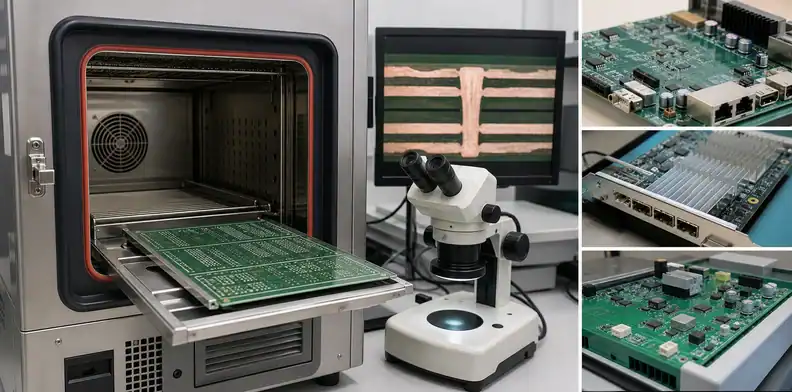
Confirm the approved construction before processing: core and prepreg style, copper type, thickness, layer count, drill requirements, and the customer’s thermal and electrical acceptance criteria. IS410 is FR-4 process compatible, but compatible does not mean every generic press cycle or drill recipe is appropriate.
Incoming inspection should confirm product identity, lot traceability, thickness, copper weight, storage condition, and any required certificate. Engineering should then release a construction-specific press cycle, drill program, desmear/plating plan, and coupon set. The aim is repeatability: the same trade name can be supplied in several glass styles and resin contents that do not behave identically in lamination or impedance modeling.
What belongs in the RFQ?
- Gerber and fabrication drawing
- Stack-up and impedance requirements
- Finished thickness, copper weights, and surface finish
- Assembly profile and material-documentation requirement
- Smallest drilled and finished holes, aspect ratio, and plating class
- Applicable IPC slash sheet and customer substitution authority
This information lets engineering identify whether the requested material is a fit before tooling starts.
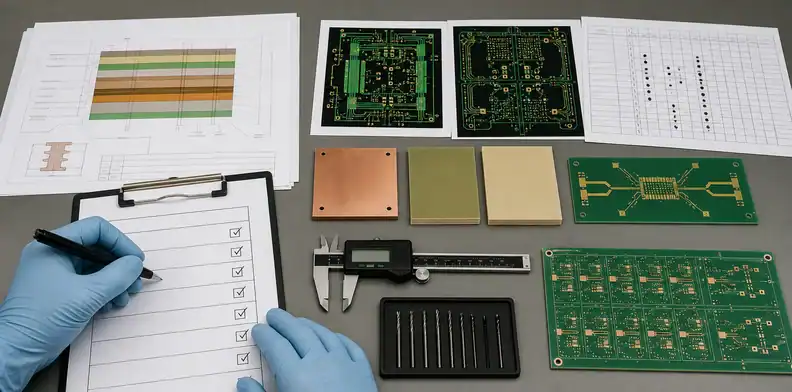
Before production, request a controlled stack-up showing actual core and prepreg part numbers and calculated dielectric thicknesses. If impedance is specified, include the target, tolerance, reference plane, copper profile assumption, and coupon method. These inputs reduce quotation ambiguity and make any later equivalent-material proposal auditable.
What Does “IS410 or Equivalent” Actually Permit?
“IS410 or equivalent” permits a candidate only after the required slash sheet, electrical behavior, thermal performance, construction, and approval status are matched. It is not permission to replace IS410 with any Tg-180 laminate, particularly where a customer has a qualified-material list or a controlled impedance model.
An equivalent should meet the mandatory slash sheet and finished-board requirements, but equality of Tg is not enough. Compare resin/filler construction, Td, T260/T288, Z-axis expansion, moisture absorption, Dk/Df by compatible methods, copper options, glass styles, UL recognition where required, and regional supply. Then assess what changes in the stack-up, process recipe, and validation plan.
How should you approve a substitute?
Require a side-by-side data review and written customer approval when the design is regulated, safety-related, or electrically sensitive. For commercial work, candidates such as the IT-180A comparison material may be considered only against the actual callout and completed-board needs.
Use a deviation request that identifies the proposed material, manufacturer data revision, matching slash sheet, changed properties, revised stack-up, and validation evidence. If the drawing names IS410 without “or equivalent,” treat substitution as prohibited until the design authority approves it. A clear approval trail protects both engineering intent and purchasing flexibility.
FAQ
Can I call IS410 the halogen-free version of 370HR?
No. IS410’s official documentation identifies RoHS and lead-free compatibility but does not declare it halogen-free; use the customer’s required halogen evidence and a specifically documented material.
Is IS410 an upgrade over 370HR?
No. They are different material constructions. Select against drilling, dimensional, thermal, electrical, and qualification requirements rather than a presumed hierarchy.
Can IS410 survive lead-free assembly?
Yes. The datasheet lists six 288°C solder-float passes, T260 of 50 minutes, and T288 of 10 minutes; qualify the finished board and its rework exposure separately.
How do I know whether an equivalent is acceptable?
Start with the slash sheet and actual construction, then compare Dk/Df, thermal data, stack-up, and customer approval requirements in writing.
Sources
- Isola IS410 technical data sheet, Revision C, official product documentation.
- IPC-4101, rigid and multilayer printed board base materials specification.
- Isola IS410 product page.
- IPC-4101 specification.
- IEC 61249-2-21 publication.
For a material review or quote, send QueenEMS your stack-up and compliance requirement so the material callout can be checked before fabrication.
Written by the QueenEMS Engineering Team
Upload your files today · Free DFM check before production · Ship worldwide
Get your PCB prototypes in as fast as 24 hours. We handle FR4, Rogers, and Flex up to 60 layers — free prototypes for 2–4 layer boards, no minimum order.
Just upload your Gerber + BOM — we source every part, assemble, and inspect (AOI + X‑Ray) so you don't have to chase suppliers. Boards ship in as fast as 24 hours.