
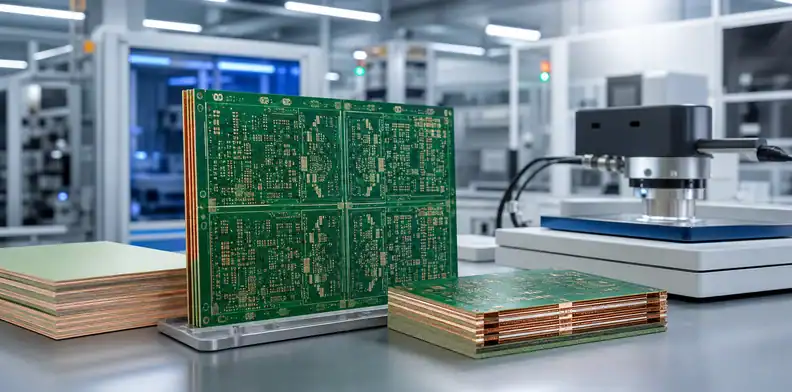
Quick Answer: TU-662 is a mid-Tg FR-4 laminate from Taiwan Union Technology Corporation (TUC). TUC publishes a DSC glass-transition temperature of 150°C, a decomposition temperature of 340°C, T288 above 10 minutes, and typical 1 GHz Dk/Df values of 4.3/0.014 at 50% resin content. It can fit cost-sensitive, conventional-speed boards when the actual construction meets the assembly, signal, compliance, and reliability requirements.
Key takeaways: – Use TU-662 as a standard-loss Tg150 candidate, not as a low-loss laminate. – Treat TU-662F as a separate halogen-free material with different electrical and thermal values. – Upgrade to TU-768 only when a documented thermal or channel-loss requirement needs more margin. – Release the exact laminate, prepreg, stack-up, and test plan rather than a family name alone.
TU-662 can be a sensible production choice when a board needs more thermal margin than entry-level FR-4 but does not benefit from a premium low-loss system. The decision becomes harder when a quotation mixes TU-662, TU-662F, and “equivalent Tg150” language without showing the finished construction.
To compare laminate families, electrical behavior, fabrication limits, and sourcing trade-offs in one place, use the complete PCB materials guide.
This guide turns the datasheet into a practical selection path. It explains the standard and halogen-free grades, the TUC product range, comparison limits, processing controls, and the information needed for a meaningful PCB quotation.
Table of Contents
- What Is TU-662 and Who Is It For?
- How Does TU-662F Differ from the Standard Grade?
- Where Does This Laminate Sit in the TUC Material Range?
- Which Electrical and Thermal Properties Matter Most?
- How Does TU-662 Compare with Other Tg150 Materials?
- When Should You Upgrade to TU-768?
- Which PCB Applications Are a Practical Fit?
- How Should a Fabricator Process This Laminate?
- When Does Halogen-Free Compliance Justify TU-662F?
- What Should a Production RFQ and Release Package Include?
What Is TU-662 and Who Is It For?
TU-662 is a laminate and prepreg system for lead-free FR-4 production. Its thermal class and familiar processing suit many controlled lead-free builds. It does not carry the cost or electrical performance of a high-speed laminate.
What problem does it solve?
The material sits between generic low-cost FR-4 and higher-temperature or lower-loss families. It can give conventional digital, control, power-management, consumer, and qualified automotive boards a practical balance of thermal performance, standard fabrication, and material cost.
That description is a screening position, not a universal application approval. A good candidate still needs:
- a controlled lead-free assembly profile;
- conventional channel lengths and a manageable loss budget;
- a core and prepreg construction available from the chosen fabricator;
- compatible flammability, environmental, and customer approvals;
- enough margin for the board’s layer count, via structure, and field conditions.
Start with the board requirement, then ask whether TU-662 meets it. Starting with the grade name encourages the team to defend a material before it has defined the problem.
The decision also crosses functions. Engineering defines impedance, thermal exposure, via geometry, and field conditions. Purchasing confirms availability, approved sites, lead time, and substitution terms. The fabricator turns those requirements into an available construction and process window. Keeping those roles visible prevents a commercial material choice from bypassing an engineering release.
How Does TU-662F Differ from the Standard Grade?
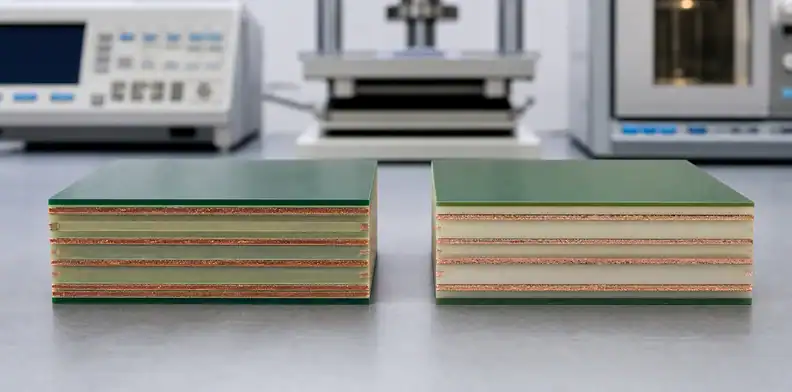
TU-662F is related to TU-662, but it is not a drop-in electrical substitute. TUC positions the F grade for halogen-free requirements and publishes different Tg, Td, T288, dielectric, and expansion values. Changing between the grades therefore affects both compliance and stack-up review.
Which published differences matter?
| Property | TU-662 | TU-662F | Why the difference matters |
|---|---|---|---|
| Tg, DSC | 150°C | 155°C | Thermal-class comparison |
| Td, TGA | 340°C | 345°C | Decomposition screening |
| T288 | >10 min | >20 min | Thermal-exposure screening |
| Dk at 1 GHz, RC 50% | 4.3 | 4.7 | Impedance and delay model |
| Df at 1 GHz, RC 50% | 0.014 | 0.018 | Channel-loss comparison |
| Z-axis CTE, 50-260°C | 3.2% | 2.8% | Via-reliability input |
Both grades are listed with UL 94V-0 performance and conventional FR-4 processing. The difference is not simply that one is “better.” TU-662F offers the designated halogen-free path and stronger published thermal-cycle figures. Its higher Dk and Df can still change an impedance-sensitive or loss-sensitive design.
Treat a change between the two as a controlled material substitution. Recalculate the stack-up where needed, review the exact compliance scope, and obtain current documentation for both laminate and prepreg.
Where Does This Laminate Sit in the TUC Material Range?
TU-662 occupies the cost-focused, mid-Tg, standard-loss part of the TUC range. TU-662F provides a halogen-free option in the same general production tier, while higher families address added thermal or electrical requirements.
How should you read the product ladder?
| Material tier | Main reason to consider it | Do not choose it only because |
|---|---|---|
| TU-662 | Tg150, standard-loss production | It is the lowest quoted material price |
| TU-662F | Halogen-free mid-Tg requirement | The suffix looks like an upgrade |
| TU-768 family | More thermal and electrical margin | Its Tg number is higher |
| TU-872 SLK family | Higher-speed, lower-loss channels | The interface has a high data rate |
The TU-768 Tg170 material guide provides more detail on the next thermal tier. A broader FR-4 Tg selection guide helps separate thermal class from signal-integrity needs.
Use the least complex material that passes the board’s requirements with documented margin. A premium material does not create value when its extra capability does not address a measured risk.
Which Electrical and Thermal Properties Matter Most?
The published values help you screen TU-662, but the production decision depends on how those values connect to the actual board. Resin content, glass style, copper roughness, pressed thickness, frequency, and test method can all change the impedance and loss behavior of a finished construction.
How do the thermal terms affect a PCB decision?
Glass-transition temperature (Tg) describes a change in polymer behavior; it is not a complete measure of assembly survival. Other inputs describe different parts of the risk. They include decomposition temperature (Td), time to delamination at 288°C (T288), z-axis expansion, moisture condition, and thermal-cycle count.
Use T288 and z-axis expansion when reviewing repeated lead-free reflow, repair exposure, and plated-through-hole reliability. Then connect those material inputs to the board thickness, copper distribution, via geometry, and qualification coupons.
How should you use Dk and Df?
Dielectric constant (Dk) affects impedance and propagation, while dissipation factor (Df) contributes to dielectric loss. Use the published 1 GHz values to compare material families, not as automatic field-solver values. Ask the fabricator for the construction-specific Dk behind the proposed stack-up and define the coupon or time-domain reflectometry (TDR) requirement for controlled-impedance builds.
This distinction keeps a useful datasheet from becoming a false guarantee about the finished board.
Keep three types of dielectric data separate in the design record. Catalog values help compare material families. Construction-specific design values support the field solver and impedance plan. Measured coupon values show what the chosen factory actually built. Labeling each value prevents a catalog Dk from being mistaken for measured production performance.
How Does TU-662 Compare with Other Tg150 Materials?
TU-662 competes with materials such as S1150G, IT-150DA, and NP-150, but a fair comparison needs more than an unlabeled Tg row. The suppliers may use different test methods, constructions, compliance packages, copper options, and regional supply paths.
Which comparison prevents a false economy?
Compare:
- Tg method, Td definition, T288 method, and z-axis expansion;
- Dk/Df frequency, resin content, test method, and glass style;
- CTI, UL recognition, slash sheets, and customer approvals;
- available cores, prepregs, copper types, and manufacturing sites;
- live material price, panel use, fabrication yield, freight, and qualification cost.
| Decision factor | TU-662 starting point | What must be normalized |
|---|---|---|
| Thermal class | Mid-Tg; published Td 340°C | Method and current supplier data |
| Electrical loss | Standard loss | Frequency, method, and construction |
| Halogen-free path | TU-662F available | Compliance scope and revalidation |
| Cost | Relevant to value builds | Finished-board cost and availability |
Keep savings examples transparent. Suppose laminate represents $1.00 of a board. If an approved option reduces that line by 12%, the gross material difference is $0.12 per board. At 120,000 boards, that is $14,400 before yield, panel utilization, freight, testing, and qualification. This is arithmetic, not a promised QueenEMS result or customer case.
Ask every fabricator to separate the material line, panel assumptions, testing, and qualification costs where possible. Then check whether the lower laminate price survives panel utilization, yield risk, regional freight, minimum order quantities, and new-source approval work.
When Should You Upgrade to TU-768?
Upgrade when the proposed TU-662 construction cannot meet a documented thermal, signal-integrity, reliability, or approval requirement with adequate margin. Do not change materials solely because TU-768 has a higher Tg.
Which signals justify the change?
- repeated lead-free cycles, rework, or repair reduce thermal margin;
- long high-speed channels exceed the insertion-loss budget;
- dense or demanding via structures increase z-axis reliability concern;
- the customer AVL or qualification basis names the higher grade;
- field temperature, lifetime, or environmental exposure exceeds the current evidence.
Stay with TU-662 when the interfaces are conventional, traces are short enough for the loss budget, reflow is controlled, and qualification passes with margin. Ask the fabricator to compare the actual constructions rather than generic datasheet rows.
The upgrade decision should end with evidence: a simulation, coupon result, assembly test, customer requirement, or approved supplier construction. Without that evidence, a more expensive material can add cost while leaving the real design risk unchanged.
Which PCB Applications Are a Practical Fit?
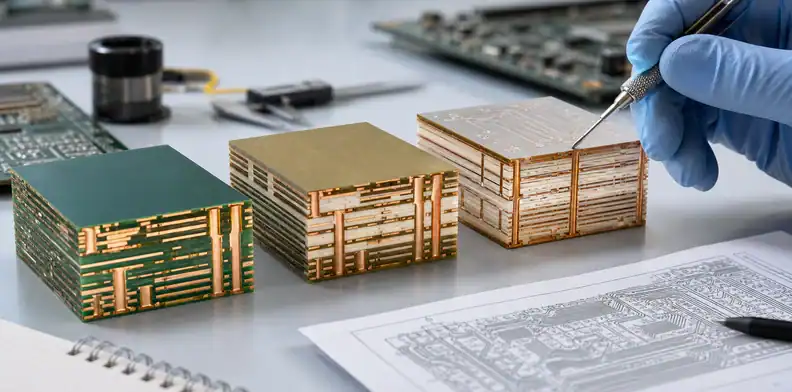
TU-662 can fit conventional-speed automotive and consumer products within the manufacturer’s stated application range. It may also suit industrial controls, routers, gateways, power-management boards, and other multilayer products. Their electrical, thermal, flammability, and approval requirements must match the proposed construction.
What does a good-fit board look like?
A stronger candidate has standard FR-4 processing, a controlled lead-free profile, moderate layer count, familiar impedance structures, and no aggressive low-loss requirement. Application names alone are not enough; a router with short ordinary channels and a router with long high-rate channels can require different material decisions.
Use deeper review for millimeter-wave RF, long PCIe-class channels, repeated thermal cycling, demanding HDI, high-voltage insulation systems, or safety-critical products. The PCB Material Selector can organize the frequency, environment, assembly, and compliance inputs before the stack-up is requested.
If you are choosing among TU-662, TU-662F, and TU-768, prepare the design inputs before selecting a grade. Send the interface, trace lengths, proposed stack-up, assembly profile, and compliance requirements through QueenEMS’ PCB DFM review for a construction-specific comparison.
How Should a Fabricator Process This Laminate?
TU-662 is intended for familiar FR-4 oxide, pressing, drilling, desmear, imaging, and lead-free assembly conditions. Familiar processing reduces disruption, but it does not make every Tg150 material or every construction interchangeable.
Which controls matter before lamination?
Verify that the specified TU-662 cores are paired with the intended TU-66P prepreg. Confirm glass style, resin content, copper foil, storage limits, shelf life, and the construction-specific press cycle. Mixing an approved core with the wrong prepreg can shift flow, thickness, impedance, and reliability.
Which records belong in production?
| Stage | Required control | Release evidence |
|---|---|---|
| Incoming material | Grade, lot, storage, and expiry | CoC and material labels |
| Lamination | Construction-specific press cycle | Press record and thickness results |
| Drilling/desmear | Hole quality and resin removal | Process record and microsection where required |
| Plating | Hole-wall copper and acceptance criteria | Microsection and thickness results |
| Electrical test | Continuity and controlled impedance | E-test and TDR records as specified |
Use the current supplier process guideline for the selected construction. A generic “standard FR-4 process” statement is not enough when the board has unusual thickness, copper, via, or impedance requirements.
When Does Halogen-Free Compliance Justify TU-662F?
Choose TU-662F when the procurement or product specification requires a halogen-free laminate and the finished stack-up can accommodate the grade’s electrical behavior. Do not select it merely because its published thermal figures look stronger.
Which evidence should purchasing collect?
A material name ending in “F” is not enough for a regulated supply chain. Define the restricted-substance scope and request:
- the current supplier declaration and applicable RoHS/REACH documents;
- UL file and flammability designation;
- IPC-4101 slash-sheet designation where required;
- laminate and prepreg lot traceability;
- approved manufacturing sites and substitution controls;
- a deviation process for any material change.
Engineering must use TU-662F construction values rather than copying the standard TU-662 model. The QueenEMS halogen-free PCB specification guide explains how compliance definitions, documentation, and availability affect the quote.
The decision is complete only when compliance, impedance, fabrication capability, and supply are all addressed. That makes TU-662F a requirement-driven choice rather than a suffix-driven purchase.
What Should a Production RFQ and Release Package Include?
A useful RFQ makes every fabricator quote the same board, material, stack-up, test coverage, and substitution rules. Without that control, a lower price may represent a different construction or a weaker qualification package.
What should you send for quotation?
Include the exact grade or approved-equivalent rule, plus the Gerber or ODB++ data and layer stack. Add finished thickness, copper weights, impedance, surface finish, via structure, assembly profile, quantities, compliance scope, and required tests. State whether the material is fixed or the supplier may propose a controlled alternate.
For volume work, also identify the approved manufacturing region, forecast horizon, lot-traceability expectation, change-notification period, and evidence required for a deviation. For prototypes, state which controls may be provisional and which must already match the intended production build. This prevents a successful prototype from qualifying a construction that cannot be repeated at volume.
What closes the production release?
| Release item | Pass condition | Typical owner |
|---|---|---|
| Material identity | Laminate and prepreg are named | Engineering and purchasing |
| Stack-up | Thickness and impedance are approved | PCB engineer and fabricator |
| Assembly exposure | Reflow and repair cycles are defined | Process engineering |
| Validation | First article and required coupons pass | Quality team |
| Change control | Notice and alternate approval are defined | Engineering and supply chain |
For a PCB quotation, send QueenEMS the Gerber files and production requirements. Include the stack-up, quantities, impedance table, material choice, surface finish, and required tests. If the material is still open, the same package can support an engineer comparison of qualified TUC options before pricing.
FAQ
Can I use TU-662 for lead-free PCB assembly?
Yes. TUC describes TU-662 as lead-free-process compatible and publishes a Td of 340°C with T288 above 10 minutes. The finished board still needs a qualified reflow profile, moisture controls, and construction-specific evidence.
What’s the main difference between TU-662 and TU-662F?
TU-662F is the designated halogen-free option, and its published thermal and dielectric values differ from standard TU-662. Treat a change between them as a controlled material substitution rather than a suffix change.
How do I know whether TU-662 is fast enough?
Check the channel-loss and impedance budget rather than using Tg as a speed rating. Long or high-data-rate channels may need a lower-loss grade even when the material has enough thermal margin.
Can I replace S1150G or IT-150DA with TU-662?
Only after a method-matched engineering, compliance, fabrication, and supply comparison. Normalize thermal data, Dk/Df, CTI, UL recognition, available constructions, customer approvals, and change controls before updating the AVL.
What’s the best way to quote a production board?
Provide the same controlled package to every fabricator: board data, exact material rule, stack-up, copper, impedance, surface finish, quantities, assembly exposure, and tests. This makes the returned prices technically comparable.
Sources
Written by the QueenEMS Engineering Team
Upload your files today · Free DFM check before production · Ship worldwide
Get your PCB prototypes in as fast as 24 hours. We handle FR4, Rogers, and Flex up to 60 layers — free prototypes for 2–4 layer boards, no minimum order.
Just upload your Gerber + BOM — we source every part, assemble, and inspect (AOI + X‑Ray) so you don't have to chase suppliers. Boards ship in as fast as 24 hours.