
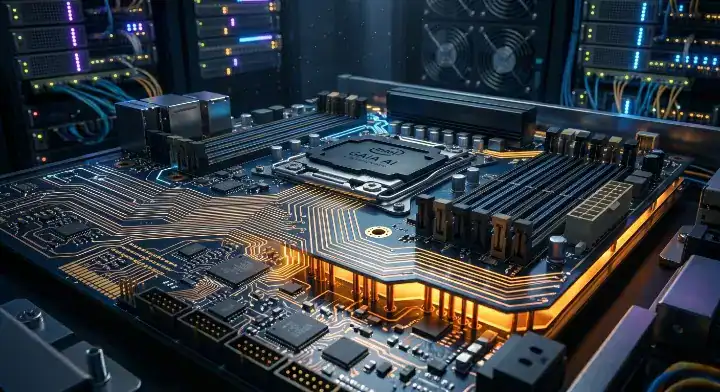
FR408HR is Isola’s high-reliability, high-performance FR-4 laminate with a Df of 0.0092 and a high Tg of 190°C (DSC). While it is no longer the primary signal-carrying material for modern 56G+ architectures, it plays an indispensable role as the cost-optimizing base layer for power, ground, and low-speed control routing in almost every modern AI server and high-speed switch hybrid stackup.
“Why would I use FR408HR instead of Megtron 8 on all layers of an AI server board?” This guide answers that exact question. We will explore FR408HR’s true technical capabilities, its critical function as a hybrid stackup foundation, and the exact engineering boundaries where you must upgrade to mid-loss or ultra-low-loss materials.
Table of Contents
- What Is FR408HR and Why Does Isola Call It “High-Performance FR-4”?
- What Electrical and Thermal Properties Define FR408HR in Rev G?
- Where Does FR408HR Sit in Isola’s Five-Tier Material Pyramid?
- Why Is FR408HR the Hidden Hero of Every AI Server Hybrid Stackup?
- When Should You Upgrade from FR408HR to I-Tera MT40?
- How Does FR408HR Compare to 370HR, I-Speed, and Standard FR-4?
- How Much Does FR408HR Save in a Hybrid Stackup vs All-Premium Builds?
- How Do Fabricators Process FR408HR Alongside Tachyon and Megtron?
- When Is FR408HR Not Enough and What Are the Halogen-Free Alternatives?
- How Will FR408HR’s Role Evolve as PCIe Gen6 and 224G Drive Material Upgrades?
- Frequently Asked Questions
1. What Is FR408HR and Why Does Isola Call It “High-Performance FR-4”?
FR408HR is not your commodity low-end FR-4. It is a proprietary, high-performance epoxy resin system engineered specifically for multi-layer printed circuit boards that demand superior thermal reliability and better signal integrity than standard FR-4 can provide.
The “HR” stands for High Reliability. By delivering a 30% improvement in Z-axis expansion and a 25% wider bandwidth capability compared to standard competitive products in its class, FR408HR prevents plated through-hole (PTH) failures during multiple severe lead-free reflow cycles. This mechanical robustness makes it the default foundational material for boards exceeding 16 layers.
Bottom line: FR408HR is the structural backbone of high-layer-count PCB manufacturing, providing exceptional thermal stability and base-level electrical performance without the steep premium of advanced RF laminates.
2. What Electrical and Thermal Properties Define FR408HR in Rev G?
To understand how FR408HR performs, engineers must consult the most current material specifications. Per Isola’s official FR408HR product page, the laminate delivers a nominal Dk of 3.68 and Df of 0.0092 at 10 GHz.
Furthermore, the official FR408HR datasheet (Rev G, January 2026) documents a robust Tg of 190°C (DSC) and 230°C (DMA), with a Td of 360°C and a pre-Tg Z-axis CTE of approximately 42 ppm/°C. For precise impedance modeling, Isola’s official FR408HR Dk/Df Tables PDF (Rev G Jan 2026) provides the exact values mapped to specific glass styles and resin contents. From a compliance perspective, FR408HR is classified under IPC-4101 slash sheets /98, /99, /101, and /126.
| Parameter | Value | Condition |
|---|---|---|
| Dk | 3.68 (nominal, 55% RC 2×2116) | @ 10 GHz (Bereskin Stripline) |
| Df | 0.0092 (nominal) | @ 10 GHz |
| Dk range | 3.30-3.82 | Varies by glass style / RC% |
| Df range | 0.0083-0.0095 | Varies by glass style / RC% |
| Tg (DSC) | 190°C | |
| Tg (DMA) | 230°C | |
| Tg (TMA) | — | |
| Td | 360°C | 5% wt loss |
| T260 | > 60 min | |
| T288 | > 60 min | |
| CTE Z (pre-Tg) | ~42 ppm/°C | 30% improvement vs std FR-4 |
| CTE X/Y | ~14-16 ppm/°C | |
| Z-axis expansion | ~2.5% | 50-260°C |
| Thermal conductivity | ~0.40 W/mK | |
| Moisture absorption | ~0.10% | |
| UL 94 | V-0 | |
| MOT | 130°C | |
| IPC | IPC-4101 /98 /99 /101 /126 | |
| UL File | E41625 | |
| Glass | Spread weave (Standard across all, Rev G) | E-glass |
| Copper | RTF (Standard); HVLP optional | |
| Lead-free reflow | 6× @ 260°C + 6× @ 288°C | Solder float |
| Via filling | YES | |
| Sequential lamination | YES | |
| CAF resistant | YES | |
| AOI compatible | YES | Laser fluorescing + UV blocking |
Bottom line: The Rev G update standardizing spread weave glass across the entire FR408HR portfolio significantly mitigates the fiber weave effect, making it exceptionally stable for sub-10Gbps routing and robust power delivery.
3. Where Does FR408HR Sit in Isola’s Five-Tier Material Pyramid?

Here is how we think about Isola’s portfolio in practice: FR408HR covers approximately 40% of the total layer count on a typical high-speed board because power planes, ground planes, and low-speed routing make up 40% of the layers even on a 28-layer AI server design. I-Tera MT40 covers the next 25% — PCIe Gen4/5, DDR5, and secondary signal layers. Tachyon 100G takes 20% — the critical 56G-112G PAM4 SerDes layers. TerraGreen 400G2 or EM-892K2 substitutes when halogen-free is mandated. Astra MT77 takes the remaining 5-10% on boards with RF/mmWave content. The common mistake is designing a board entirely from the most expensive material in the stack. The correct approach is treating each layer as a cost-performance decision: signal layers get the material their frequency demands; everything else gets FR408HR.
| Tier | Product | Df @ 10 GHz | Typical Role | Pricing vs FR-4 |
|---|---|---|---|---|
| Tier 5 (Base) | FR408HR | 0.0092 | Power/ground/low-speed signal/outer layers | 1.5-2× |
| Tier 4 | I-Tera MT40 | 0.0031 | PCIe Gen4/5, DDR5, 25G-56G | 2-3× |
| Tier 3 | Tachyon 100G | 0.0021 | 56G-112G PAM4 SerDes | 3-5× |
| Tier 2 | TerraGreen 400G2 | 0.0015 | 100G+ halogen-free | 4-6× |
| Tier 1 | Astra MT77 | 0.0017 | RF/mmWave 28-110 GHz | 4-6× |
Bottom line: FR408HR is not just “fancy FR-4”; it is the fundamental structural layer that economically supports Isola’s ultra-low-loss materials in complex printed circuit boards.
4. Why Is FR408HR the Hidden Hero of Every AI Server Hybrid Stackup?
In advanced computing hardware, placing premium ultra-low-loss dielectrics on every single layer is an egregious waste of engineering budget. High-speed differential signals require advanced laminates, but power planes, ground planes, and low-speed control traces do not.
When utilizing Tachyon 100G ultra-low-loss specifications for 100Gbps designs on the critical SerDes layers, FR408HR acts as the perfect structural companion for the non-critical layers. Because a power plane does not carry high-frequency AC signals, the dielectric loss (Df 0.0092 vs Df 0.0021) has zero measurable impact on power integrity.
This philosophy extends across the industry. When hardware architects build boards using the Panasonic Megtron 8 R-5795 manufacturing guide for AI servers for 112G signal lanes, they rarely use Megtron 8 for power and ground. Instead, they specify a tier-equivalent mid-loss material. In Isola’s ecosystem, FR408HR is the direct equivalent to Panasonic’s Megtron 4 (R-5725) in this hybrid core role.
You will often see this exact material class strategy deployed when analyzing the NVIDIA Blackwell platform BOM and CCL allocation, where M4-grade cores form the internal power delivery network beneath the ultra-low-loss M8 signal layers.
| Dimension | FR408HR (Isola) | Megtron 4 R-5725 (Panasonic) |
|---|---|---|
| Dk @ 10 GHz | 3.68 | ~3.8 |
| Df @ 10 GHz | 0.0092 | ~0.005 |
| Tg (DSC) | 190°C | 200°C |
| Role | Isola hybrid stackup power/ground layer | Panasonic hybrid stackup power/ground layer |
| NVIDIA BOM | Used in GB200 core layers (if Isola signal layers are chosen) | Used in GB200 core layers (if Megtron 8 signal layers are chosen) |
Bottom line: In the power and ground layers of a hybrid stackup, using Megtron 8 or Tachyon 100G provides zero electrical benefit over FR408HR while inflating board costs substantially.
5. When Should You Upgrade from FR408HR to I-Tera MT40?
A customer brought us a 16-layer switch management board originally specified entirely in FR408HR. The board carried eight 10G Ethernet channels routed across 12 inches and four PCIe Gen4 x16 slots with 8-inch traces. We ran channel loss simulations and found FR408HR delivered 1.05 dB/inch at 8 GHz (PCIe Gen4 Nyquist) — on the 8-inch Gen4 traces, total loss was 8.4 dB. The PCIe Gen4 spec allows roughly 16 dB of total channel loss including connectors, which gave approximately 5 dB of margin. The 10G channels at 12 inches measured 8.2 dB — also within budget. The customer asked whether upgrading to I-Tera MT40 would help. Our simulation showed I-Tera MT40 would reduce Gen4 channel loss to 5.2 dB and 10G loss to 5.8 dB — more margin, but not functionally different. Material cost on I-Tera MT40 would have been 65% higher. We recommended keeping FR408HR for this board and reserving I-Tera MT40 for the customer’s next-generation design moving to PCIe Gen5. The customer saved approximately $38 per board across a 1,500-unit production run.
To simplify this decision for your own layouts, consult the boundary matrix below:
| Signal Type | Is FR408HR Enough? | Engineering Reason |
|---|---|---|
| < 1 Gbps I2C / SPI / JTAG | ✅ Yes | Vastly exceeds requirements. |
| 1-5 Gbps SGMII / LVDS | ✅ Yes | Easily closes the channel budget. |
| 10G Ethernet | ✅ Yes | Sufficient for trace lengths < 15 inches. |
| PCIe Gen3 (8 Gbps) | ✅ Yes | Sufficient margin. |
| PCIe Gen4 (16 Gbps NRZ) | ⚠️ Marginal | Works for short links; > 12 inches requires I-Tera MT40. |
| PCIe Gen5 (32 Gbps NRZ) | ❌ No | Insertion loss is too high; upgrade to I-Tera MT40. |
| 25G NRZ Ethernet | ❌ No | Upgrade to I-Tera MT40. |
| DDR5 memory bus | ✅ Yes | Acceptable for extremely short routing lengths (< 2 inches). |
| Power plane (any) | ✅ Yes | Df does not impact DC power delivery. |
| Ground plane (any) | ✅ Yes | Df does not impact ground reference performance. |
Bottom line: PCIe Gen4 and 10G Ethernet represent the absolute maximum bandwidth boundaries where FR408HR is reliable for routing. Transitioning to PCIe Gen5 or 25G requires an upgrade to mid-loss laminates for those specific signal layers.
6. How Does FR408HR Compare to 370HR, I-Speed, and Standard FR-4?

Understanding standard FR-4 material properties and Tg grades helps frame exactly why FR408HR is designated as a “high-performance” baseline rather than a commodity substrate.
| Material | Dk | Df @ 10 GHz | Tg (DSC) | Key Characteristics |
|---|---|---|---|---|
| FR408HR | 3.68 | 0.0092 | 190°C | Highest Tg in class; exceptional thermal reliability. |
| 370HR | 3.92 | 0.025 | 180°C | Lower cost standard FR-4 upgrade; much higher Df. |
| I-Speed | 3.63 | 0.0080 | 200°C | Slightly lower Df but carries a higher price premium. |
| I-Speed CAF | 3.63 | 0.0080 | 200°C | Enhanced CAF-resistant version of I-Speed. |
| FR408HRIS | ~3.50 | ~0.0080 | 190°C | FR408HR resin paired with low-Dk spread glass. |
FR408HR’s Df of 0.0092 is substantially better than Isola 370HR (Df 0.025), granting engineers roughly twice the signal trace length budget before attenuation becomes critical. While I-Speed offers marginally better insertion loss, FR408HR remains the more prevalent, cost-optimized choice for power and ground planes in hybrid stacks.
Bottom line: If your sub-10Gbps design is failing thermal stress tests on 370HR or requires tighter impedance control, FR408HR is the immediate, logical step up.
7. How Much Does FR408HR Save in a Hybrid Stackup vs All-Premium Builds?
FR408HR is the material we process in the highest absolute volume in our facility — not because boards are built entirely from FR408HR, but because every hybrid stackup using Tachyon 100G, Megtron 8, or EM-892K2 on signal layers uses FR408HR on the power, ground, and low-speed routing layers. On a recent 24-layer AI server board, we used Megtron 8 on 10 signal layers, I-Tera MT40 on 6 secondary signal layers, and FR408HR on 8 power and ground layers including four 4-oz copper planes. If the customer had used Megtron 8 across all 24 layers, material cost would have been approximately $1,850 per panel. The hybrid with FR408HR on non-critical layers brought material cost to approximately $1,240 per panel — a 33% savings with zero measurable impact on signal integrity, power integrity, or thermal reliability. FR408HR laminated cleanly alongside both Megtron 8 and I-Tera MT40 in the same press cycle at 200°C for 90 minutes. The key is matching the prepreg: FR408HR prepreg between FR408HR core layers, and Megtron 8 or I-Tera MT40 prepreg between their respective core layers.
Establishing correct PCB stackup design principles for multilayer boards is mathematically crucial for hardware profitability.
Even when environmental compliance dictates the use of an EM-892K2 halogen-free M8 laminate for AI server builds on the critical nets, combining it with FR408HR (or an equivalent halogen-free baseline) on power layers drastically suppresses the BOM explosion.
Cost Profile Example (22-Layer Server Board):
- All Megtron 8 Build: Baseline 100% material cost.
- Standard Hybrid: 14 layers M8 signal + 8 layers FR408HR power/ground yields roughly 30-35% savings.
- Aggressive 3-Tier Hybrid: 8 layers M8 + 6 layers I-Tera MT40 + 8 layers FR408HR yields roughly 40-45% savings.
Bottom line: Leveraging FR408HR in a hybrid stackup routinely reduces overall bare-board material costs by 30% to 45% without compromising the high-speed channels.
8. How Do Fabricators Process FR408HR Alongside Tachyon and Megtron?

Manufacturing engineers appreciate FR408HR because it presents virtually zero learning curve. Among Isola’s entire high-speed portfolio, it processes the most like standard FR-4.
When executing multilayer PCB fabrication for high-layer-count designs, we utilize standard high-Tg FR-4 lamination press cycles for FR408HR. It desmears perfectly using standard alkaline permanganate chemistry without requiring plasma processing. Furthermore, unlike PTFE or ultra-low-loss materials that require 15% to 25% reductions in drill chiploads to prevent resin smearing, FR408HR accepts standard drilling parameters, saving valuable machine time.
Because it has excellent thermal robustness and supports via filling, fabricating an HDI PCB with sequential lamination and via filling using FR408HR is highly reliable. It easily withstands the 6x lead-free reflow testing at 260°C and 288°C required for complex, multi-lamination structures.
Bottom line: If a PCB factory can successfully build standard FR-4 boards, they can build FR408HR boards. Its forgiving processing window makes hybrid manufacturing seamless.
9. When Is FR408HR Not Enough and What Are the Halogen-Free Alternatives?
FR408HR has two primary limitations: high-frequency attenuation and environmental compliance.
First, its Df of 0.0092 physically disqualifies it from acting as the signal layer for any protocol running above 16 Gbps (like PCIe Gen5 or 25G Ethernet). Second, FR408HR contains halogens as part of its V-0 flame retardant package. If your corporate directives mandate strict adherence to halogen-free PCB specification and manufacturing rules, you cannot use FR408HR anywhere in the stackup.
In those instances, designers must pivot to halogen-free baseline materials (such as Isola TerraGreen or standard HF FR-4) for the power/ground planes to maintain hybrid cost efficiencies.
Bottom line: Do not use FR408HR for signal routing above PCIe Gen4 speeds, and do not specify it on green-initiative projects requiring halogen-free certification.
10. How Will FR408HR’s Role Evolve as PCIe Gen6 and 224G Drive Material Upgrades?
As data centers rapidly shift toward PCIe Gen6 (64 GT/s PAM4) and 224G switch architectures, the critical signal layers are migrating strictly to Tier 1 and Tier 2 materials like Megtron 8, Megtron 9, and Astra MT77.
However, this high-frequency evolution does not obsolete FR408HR. A 32-layer 800G switch still requires massive, thermally stable copper planes to distribute 1000W+ of DC power to the ASICs. The physical physics of DC power delivery and low-frequency logic do not change when SerDes speeds double. Therefore, FR408HR will continue to cement its position as the preferred, high-reliability foundational layer anchoring the bottom half of the world’s most advanced computing stackups.
Bottom line: Even as signaling speeds push into the 224G domain, FR408HR will remain the industry standard for power, ground, and mechanical support layers in complex hybrid architectures.
11. Frequently Asked Questions
Why use FR408HR instead of Megtron 8 on all layers? Power and ground planes do not carry high-speed differential signals, so Megtron 8’s Df advantage over FR408HR has no measurable impact on those layers. Using FR408HR on power, ground, and low-speed routing layers saves 30-35 percent on total material cost versus an all-Megtron-8 build. In NVIDIA GB200 and GB300 boards, the M4-grade core layers serve exactly this function.
Is FR408HR good enough for PCIe Gen5? No. PCIe Gen5 at 32 GT/s NRZ has Nyquist at 16 GHz. FR408HR measures approximately 1.1 dB per inch at that frequency, which on traces exceeding 6-8 inches pushes close to the channel loss budget. Upgrade to I-Tera MT40 for PCIe Gen5 signal layers. FR408HR remains appropriate for power and ground layers on the same board.
Does FR408HR process the same as standard FR-4? Essentially yes. FR408HR uses standard high-Tg FR-4 lamination cycles, standard permanganate desmear, and standard drilling parameters with no chipload reduction needed. It is the closest to conventional FR-4 processing of any Isola high-speed material. The only notable difference from commodity FR-4 is the spread weave glass standard across all constructions since Rev G.
How much does FR408HR save in a hybrid stackup? On a 22-layer AI server board, replacing 8 power and ground layers from Megtron 8 to FR408HR saves approximately 30-35 percent on total material cost. A more aggressive three-material hybrid using Megtron 8 on critical SerDes layers, I-Tera MT40 on secondary signal layers, and FR408HR on power and ground can save 40-45 percent versus an all-Megtron-8 build.
Is FR408HR halogen-free? No. FR408HR is not halogen-free. For halogen-free alternatives at the same reliability tier, consider Isola’s TerraGreen 400G family or EMC’s EM-892K2. For halogen-free power and ground layers specifically, standard halogen-free high-Tg FR-4 materials from multiple vendors are available at comparable cost to FR408HR.
Conclusion
Isola FR408HR is rarely the star of a high-speed design presentation, yet it is arguably the most vital cost-saving component in modern PCB fabrication. By understanding its role as a high-reliability structural base rather than a legacy FR-4, hardware architects can drastically reduce the cost of 24+ layer AI servers and 800G switches without sacrificing an ounce of performance. By deploying it intelligently on power, ground, and sub-10G layers beneath premium ultra-low-loss laminates, you achieve the perfect balance of budget and signal integrity. If you need assistance configuring a robust, cost-optimized hybrid stackup for your next project, contact us today to review your layer count and material allocation.
Written by the QueenEMS Engineering Team
Upload your files today · Free DFM check before production · Ship worldwide
Get your PCB prototypes in as fast as 24 hours. We handle FR4, Rogers, and Flex up to 60 layers — free prototypes for 2–4 layer boards, no minimum order.
Just upload your Gerber + BOM — we source every part, assemble, and inspect (AOI + X‑Ray) so you don't have to chase suppliers. Boards ship in as fast as 24 hours.