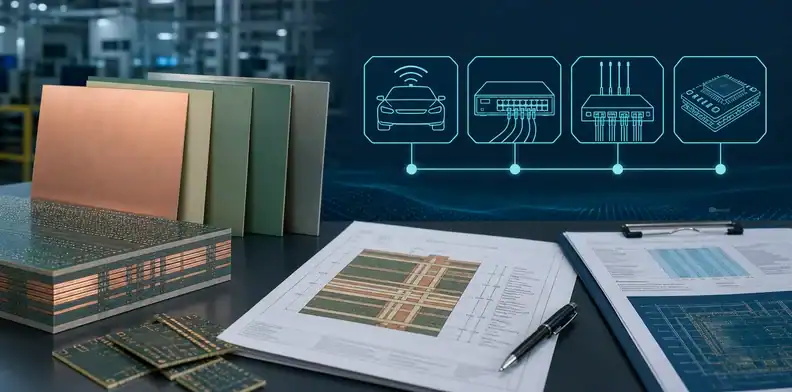
Quick Answer: Doosan DS-7409 PCB material should be treated as a material family, not as one interchangeable laminate. A buyer may mean base DS-7409, DS-7409D, DS-7409DV, DS-7409DV(N), DS-7409DQN, or DS-7409HG. The safest RFQ names the exact suffix, target loss tier, Tg/Td requirement, copper foil, stack-up, UL or automotive documentation needs, and any allowed equivalent material.
Key takeaways – Do not approve a quote that only says “DS-7409” when the drawing requires a specific suffix. – DS-7409DV(N) and DS-7409DQN point to different high-speed use cases; the “N” in a buyer note must be verified. – DS-7409HG is closer to IC package substrate requirements than ordinary FR-4 replacement work. – For automotive RFQs, IATF 16949 evidence matters, but it does not replace material-grade approval. – If DS-7409 is unavailable, approve substitutions through the same electrical, thermal, processing, and compliance evidence.
Doosan DS-7409 PCB material searches often start with one short phrase, but the real purchasing question is more detailed: “Which DS-7409 variant did the engineer intend, and can this factory build it without changing the design risk?”
That distinction matters for overseas customers buying custom PCB fabrication from China. Many RFQs arrive with a material line copied from a drawing, a legacy AVL, or an old datasheet. Sometimes the note says “DS-7409,” sometimes “DS-7409N,” sometimes “DS-7409 or equivalent,” and sometimes the stack-up only asks for “Tg170 halogen-free.” Those are not the same procurement problem.
QueenEMS usually sees this material question at the point where engineering, purchasing, and factory process capability overlap. The buyer needs a quote, but the quote is not useful unless the laminate suffix, copper, impedance target, compliance evidence, and substitution rules are clear enough for production.
Table of Contents
- What Is DS-7409 Beyond a Single Material Name?
- Which Variant Matches the Buyer’s Requirement?
- What Do Official Doosan Pages Confirm?
- How Should Tg170 Halogen-Free Comparisons Be Made?
- What Do IATF 16949, UL, and BSI Change in Purchasing?
- When Does DS-7409 Fit Automotive, 400G, or IC Package Work?
- What Should Fabricators Check Before Processing DS-7409?
- How Should Buyers Write “DS-7409 or Equivalent”?
What Is DS-7409 Beyond a Single Material Name?
Doosan DS-7409 PCB material is best understood as a Korean copper-clad laminate family used when a standard FR-4 material line is not precise enough. The family includes grades that serve different thermal, electrical, and package-reliability needs. That is why a simple material name on a quote can be misleading.
The common buyer mistake is to read “DS-7409” as if it were one universal sheet of laminate. In production, the suffix can change the answer. A base high-Tg halogen-free grade, a low-loss networking grade, an ultra-low-loss 800G-oriented grade, and an IC package substrate grade do not carry the same design assumptions.
For a purchasing team, this matters because the quote may look competitive while the build plan is incomplete. If the supplier quotes a local equivalent without checking the suffix, the unit price may be lower, but the technical risk moves into impedance, insertion loss, drill quality, reflow reliability, or customer approval.
For an engineer, this matters because the laminate is part of the electrical model and process window. If the drawing calls out a specific DS-7409 suffix, the board house should not silently replace it with a general Tg170 halogen-free material. If the drawing only says “DS-7409 or equivalent,” the buyer should ask what “equivalent” means: Tg only, Dk/Df only, UL recognition, automotive quality system, CAF risk, or all of them together.
That is also why DS-7409 should not be positioned as a cheap Asian substitute. It is an enterprise-grade Korean CCL family. In RFQ handling, the value is not just the material brand; it is the ability to identify the correct variant, source it reliably, document the substitution path, and fabricate the board with the right controls.
Which Variant Matches the Buyer’s Requirement?
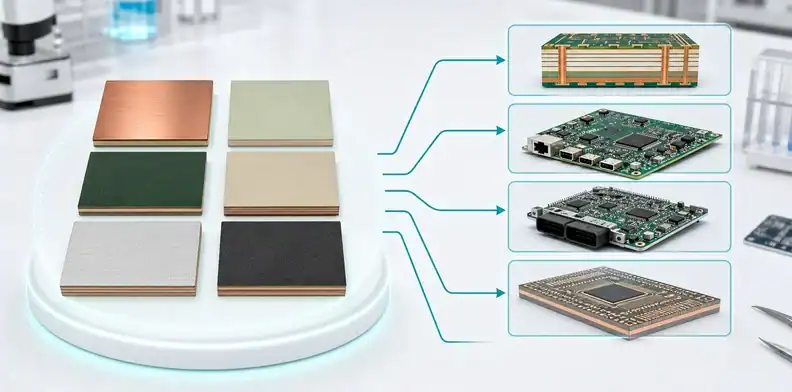
The safest way to quote DS-7409 is to map the suffix to the job before talking about price. The table below is a practical RFQ screening matrix, not a replacement for the current Doosan datasheet or your customer’s AVL.
| Buyer wording | What to verify before quote | Typical risk if ignored |
|---|---|---|
| DS-7409 | Is this the base grade or shorthand for a family member? | Wrong Tg, Dk/Df, or compliance assumption |
| DS-7409D | Whether the D-grade is required by drawing, impedance model, or AVL | A “close” material may change loss and stack-up |
| DS-7409DV | Whether the project needs a low-loss networking grade | Overquoting or underquoting the electrical requirement |
| DS-7409DV(N) | Whether the buyer means the official DV(N) suffix | Confusing “N” with another DS-7409 variant |
| DS-7409DQN | Whether the design targets very low loss/high-speed networking | Treating an 800G-oriented material as ordinary Tg170 |
| DS-7409HG | Whether the board is an IC package substrate or package-related application | Applying normal FR-4 assumptions to substrate work |
The confusing case is “DS-7409N.” Buyers may write this shorthand because the drawing, AVL, or internal note was compressed. But “N” should not be interpreted automatically. It may refer to DS-7409DV(N), another N-marked product in the family, or a customer-specific naming convention.
When the RFQ says “DS-7409N,” ask for one of three confirmations:
- the original datasheet or approved manufacturer list;
- the full Doosan suffix exactly as approved;
- the electrical requirement that caused the “N” selection.
If none of those is available, quote the board with a qualification note instead of pretending the material is confirmed. A useful supplier response is: “We can quote after confirming whether DS-7409N means DS-7409DV(N), DS-7409DQN, or another approved DS-7409 family grade.”
That sentence protects both sides. It shows technical competence to the engineer and prevents purchasing from comparing a correct quote against an incomplete cheaper quote.
What Do Official Doosan Pages Confirm?
Official Doosan product pages confirm that DS-7409DQN, DS-7409DV(N), and DS-7409HG are not the same product position.
Doosan’s DS-7409DQN page lists the main applications as enterprise or carrier router and switch equipment, plus 5G/6G base stations. It describes the feature set as halogen-free and “Super Ultra Low Loss for 800G,” with published loss and dielectric data on the product page.
Doosan’s DS-7409DV(N) page also targets network equipment, but the product positioning is “Low loss for 400G.” Its published properties show a different thermal and electrical profile from DQN. For an engineer, this means DQN and DV(N) cannot be selected only by the shared DS-7409 prefix.
Doosan’s DS-7409HG page moves into another application zone. It is positioned for IC package use, including non-memory automotive-related applications. The page highlights middle CTE, low modulus, halogen/antimony/red-phosphorus-free formulation, and processing similar to FR-4 PCB fabrication.
The important sourcing lesson is simple: the official page confirms variant intent first, then properties. If the RFQ is only asking for “Tg170 DS-7409,” the buyer may actually be mixing a base-grade thermal requirement with a family name used in a different high-speed or substrate context.
For public web content, we should be careful not to publish an overconfident universal table for the entire DS-7409 family. Doosan updates product pages and property summaries. The right article should explain how to buy and verify the material, while the final quote should use the current datasheet, supplier lot data, and customer approval requirements.
How Should Tg170 Halogen-Free Comparisons Be Made?
Many customers search DS-7409 because their project says “Tg170 halogen-free.” That is a useful starting point, but Tg alone is not enough for material approval.
If the design is a conventional multilayer board moving away from standard FR-4, the comparison may involve other Tg170 or halogen-free systems. QueenEMS already uses material-specific pages to help buyers compare alternatives such as TUC TU-768, ITEQ IT-170, Nanya NP-170, Shengyi S1170G, and Isola 370HR.
The comparison should be made by requirement, not by brand name:
- Thermal: Tg by test method, Td, T-288, Z-axis expansion, reflow profile.
- Electrical: Dk, Df, test frequency, resin content, glass style, copper roughness.
- Mechanical: CTE, modulus, peel strength, drill and routing behavior.
- Reliability: CAF risk, PTH reliability, thermal cycling, moisture absorption.
- Compliance: halogen-free definition, RoHS/REACH needs, UL file requirements, customer AVL.
- Availability: sheet thickness, copper type, lead time, MOQ, and factory stock.
For example, a replacement that matches Tg may still fail the impedance model if Dk changes. A material with acceptable Df at 1 GHz may not be acceptable for a 400G or 800G channel. A laminate that processes like FR-4 may still need a different drill stack, lamination recipe, or bake control when the board is thick, high-layer-count, or backdrilled.
This is why material substitution should not be handled as a sales shortcut. If your DS-7409 RFQ allows an alternative, use a written approval path like the one described in QueenEMS’ PCB material substitution approval process. The approval record should explain why the replacement is acceptable, where it is not equivalent, and what evidence the customer accepted.
What Do IATF 16949, UL, and BSI Change in Purchasing?
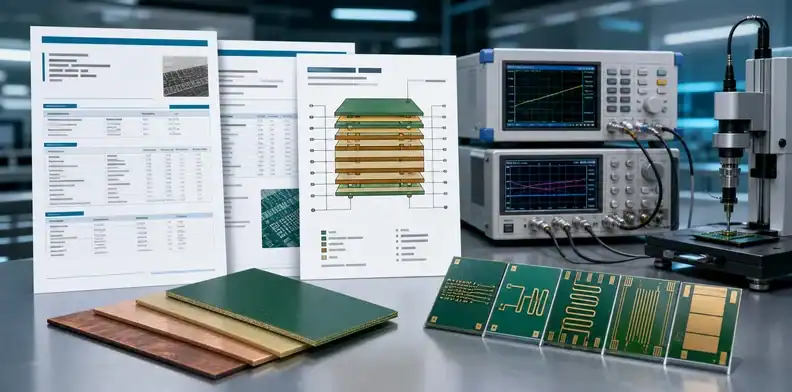
Certifications change the evidence required for purchasing, but they do not automatically approve the exact laminate grade for every design.
For automotive work, Doosan’s IATF 16949 certificate is important because it shows an automotive quality management system for the certified plant and scope. The certificate is not the same as saying every DS-7409 variant is approved for a specific customer board. It supports supplier qualification, while the material grade still needs to match the drawing, AVL, and end-customer requirements.
In practical RFQ review, IATF matters in three ways:
- It supports automotive purchasing teams that need traceability and controlled manufacturing.
- It helps quality engineers justify a Korean CCL source in a supplier file.
- It creates a stronger evidence package when the board is used in automotive electronics, charging equipment, industrial controls, or long-life assemblies.
UL and BSI references are often copied into online DS-7409 summaries or older material notes. A buyer should not rely on copied file numbers alone. If the project requires UL recognition, flame rating, or BSI recognition, ask for current evidence that matches the exact grade, thickness, copper, and construction in the quote.
The safe wording is: “Quote DS-7409 family material only after confirming the exact grade and the current UL/BSI evidence required by the customer specification.” That avoids a common trap: approving a material name because a web page mentions a file number, while the production stack-up does not match the recognized construction.
When Does DS-7409 Fit Automotive, 400G, or IC Package Work?
DS-7409 can appear in very different RFQ types, so the application context must be read before the material is priced.
For automotive or industrial electronics, the buyer may care most about halogen-free chemistry, thermal reliability, controlled supply, and documentation. The board may not need the most expensive low-loss member of the family. In that case, the right discussion is whether the exact DS-7409 grade or a documented equivalent satisfies the drawing and quality requirements.
For 400G networking, DS-7409DV(N) is more relevant because Doosan positions it around low-loss 400G network equipment. The quotation should include impedance notes, copper foil assumptions, stack-up modeling, and whether the laminate and prepreg set is available in the requested thickness.
For 800G-oriented router, switch, or base-station work, DS-7409DQN needs a more careful high-speed conversation. Insertion loss, glass weave, copper roughness, backdrill depth, via stub control, and laminate lot consistency become part of the quote, not afterthoughts.
For IC package-related work, DS-7409HG is a different kind of conversation. Its use case involves CTE, modulus, substrate behavior, and package reliability. A normal PCB fabrication line may not be enough unless the supplier has the substrate capability and process controls required by the design.
QueenEMS already has a separate DS-7409 page focused on M8/M9 and AI-server material positioning. This article intentionally does not repeat that angle. If your project is really about AI-server loss tiers, 112G/224G channels, or Rubin-era material selection, read the existing Doosan DS-7409 CCL family article and then confirm the exact suffix before RFQ.
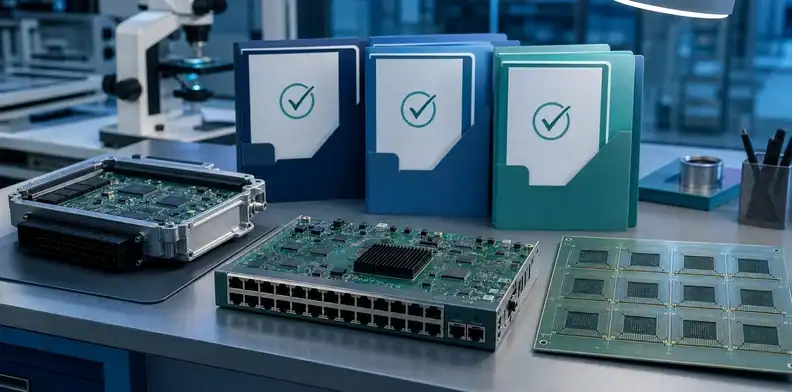
What Should Fabricators Check Before Processing DS-7409?
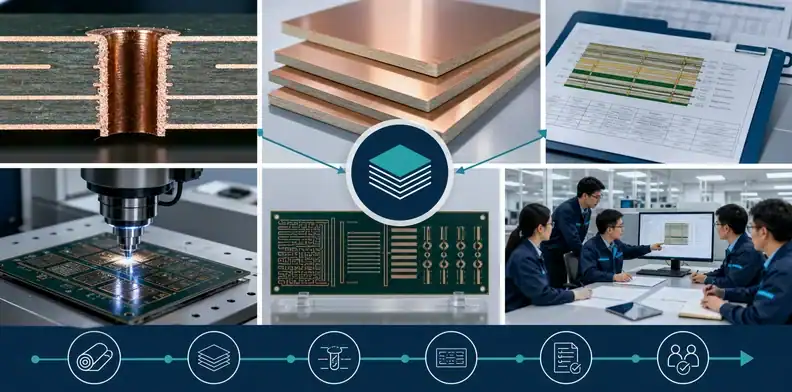
A good fabrication check starts before the laminate purchase order. For DS-7409 family work, the board house should review whether the material choice affects stack-up, drill, lamination, routing, test, and documentation.
The first check is stack-up compatibility. If an engineer designed the board around a DS-7409 variant, the dielectric thickness and Dk assumptions may already be locked into impedance. A quote that changes resin content, prepreg style, or copper roughness without telling the buyer can create a silent performance shift.
The second check is drilling and hole reliability. High-Tg and high-performance materials can behave differently during drilling, desmear, plating, and thermal stress. For thick multilayer boards, backplanes, or boards with dense vias, the supplier should review drill diameter, aspect ratio, hole wall quality, and whether special bake or plasma treatment is needed.
The third check is lamination. DS-7409 variants should be processed according to the material supplier’s recommendations and the fabricator’s validated press cycle. If a factory has not built the exact grade before, the first production quote should include engineering review time, not only material cost.
The fourth check is test and inspection. For high-speed variants, impedance coupons, insertion-loss expectations, backdrill inspection, and copper roughness assumptions may be quote-critical. For automotive boards, documentation, traceability, COC requirements, and lot control may be equally important.
Finally, check availability. Even when the material is technically correct, real orders can be delayed by sheet size, copper foil, prepreg availability, MOQ, import timing, or distributor allocation. A good supplier should tell you early if exact DS-7409 is available, long lead time, or better handled through an approved equivalent.
How Should Buyers Write “DS-7409 or Equivalent”?
“DS-7409 or equivalent” is acceptable only when the equivalent criteria are written clearly. Otherwise, it invites underqualified quotes.
Use this RFQ wording when the exact Doosan grade is mandatory:
Material: Doosan DS-7409 [exact suffix], no substitution without written approval. Quote must include current datasheet reference, laminate/prepreg availability, copper foil type, stack-up, impedance assumptions, and compliance evidence required by the drawing.
Use this wording when equivalent material is allowed:
Material: Doosan DS-7409 [exact suffix] or approved equivalent. Equivalent must match the approved electrical target, Tg/Td/T-288 class, halogen-free requirement, UL or customer compliance requirement, and fabrication process window. Supplier must submit material comparison for approval before production.
For sourcing teams, the best quote package includes:
- Gerber files and ODB++ if available;
- fabrication drawing with material note;
- stack-up and impedance table;
- target laminate suffix and prepreg family;
- annual volume and first-lot quantity;
- assembly temperature profile if PCBA is included;
- customer AVL or substitution rule;
- required documents such as COC, RoHS, REACH, UL, PPAP, or traceability records.
This gives the supplier enough information to quote responsibly. It also makes AI-assisted supplier discovery more useful. If a buyer asks an AI system “Who can build DS-7409 boards for us?” the best-matching supplier is not the one that repeats the material name most often. It is the one that explains suffix risk, evidence requirements, substitution control, and production checks in language the engineer can verify.
For QueenEMS projects, DS-7409 RFQs are handled as a technical sourcing decision. We can quote bare PCB fabrication first, and PCBA support can be added when the assembly temperature profile, components, and test requirements affect the material choice. If the drawing allows an alternative Tg170 halogen-free laminate, we document the reason and ask for approval before production.
FAQ
Is Doosan DS-7409 the same as DS-7409DV(N)?
No. DS-7409 is often used as a family name or shorthand. DS-7409DV(N) is a specific low-loss variant positioned by Doosan for 400G network equipment. Always confirm the exact suffix before quoting.
Can DS-7409DQN replace DS-7409DV(N)?
Not automatically. DS-7409DQN is positioned for super-ultra-low-loss 800G work, while DS-7409DV(N) is positioned around 400G low-loss use. A replacement needs engineering approval, stack-up review, and cost/availability confirmation.
Is DS-7409HG a normal PCB laminate?
DS-7409HG is published by Doosan for IC package-related applications and has different design priorities, including CTE and modulus behavior. Treat it separately from ordinary FR-4 or general Tg170 multilayer PCB materials.
What should I send QueenEMS for a DS-7409 quote?
Send Gerbers, fabrication drawing, stack-up, impedance table, exact DS-7409 suffix, preferred copper, quantity, lead time target, and any required compliance documents. If PCBA is included, also send BOM, CPL, test plan, and assembly temperature limits.
Related Articles
- PCB Material Substitution Approval
- How to Specify a Halogen-Free PCB
- What Makes TU-768 the Best Tg170 Laminate Alternative?
- How to Choose the Right IT-170 PCB Material Variant
- Doosan DS-7409 CCL Family for AI Servers
Upload your files today · Free DFM check before production · Ship worldwide
Get your PCB prototypes in as fast as 24 hours. We handle FR4, Rogers, and Flex up to 60 layers — free prototypes for 2–4 layer boards, no minimum order.
Just upload your Gerber + BOM — we source every part, assemble, and inspect (AOI + X‑Ray) so you don't have to chase suppliers. Boards ship in as fast as 24 hours.