
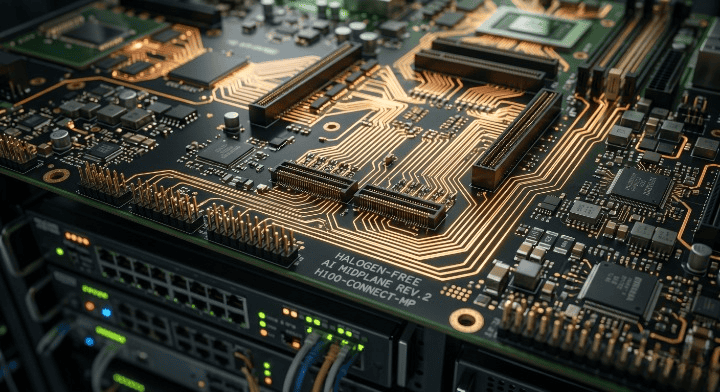
Hardware engineers frequently face severe signal integrity bottlenecks and prolonged material allocation delays when designing 112G and 224G AI architectures. When legacy laminates fail your insertion loss budget or push your launch schedule back by months, securing a fully scalable PCB material ecosystem becomes a critical priority. The DS-7409 family solves this exact problem by providing an end-to-end loss tier ladder spanning from M4 mid-loss up to the M9 ultra-low-loss category. By leveraging this complete Korean-manufactured portfolio, hardware teams can confidently route complex SerDes channels while securing a direct path to next-generation Rubin platforms.
Table of Contents
- What Is the Doosan DS-7409 Family and Why Does It Matter?
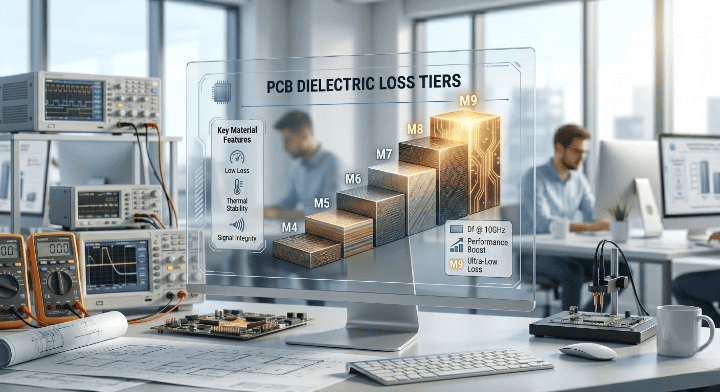
- How Does the DS-7409 Loss Tier Ladder Work, from M4 to M9?
- What Electrical Specs Define DS-7409DV(N), DJN+, and M9Q?
- How Do Thermal and Mechanical Specs Drive DS-7409 Reliability?
- Why Did Doosan Win NVIDIA M9 Qualification Before Others?
- How Does DS-7409DJN+ Compare to Megtron 8 and EM-892K2?
- Where Does DS-7409 Fit in NVIDIA Rubin and 800G Switch BOMs?
- How Does DS-7409DQN Address 800G and Halogen-Free Demands?
- How Do Fabricators Process the DS-7409 Family in Production?
- How Do You Source DS-7409 and View the Roadmap to M10?
What Is the Doosan DS-7409 Family and Why Does It Matter?
The Doosan DS-7409 series is an entire high-speed copper-clad laminate family, not a single product, scaling from base FR-4 up to the M9-grade DYQ variant with a Df of ≤0.0007. Engineers often misunderstand this naming convention, assuming any material carrying this prefix delivers identical high-frequency performance. Specifying this laminate series gives procurement teams access to a massive Korean manufacturing ecosystem tied directly to top-tier semiconductor advancement.
Clarifying the HG Series Confusion
Many designers mistakenly attempt to specify the DS-7409HG series for their standard motherboard designs. The HG variants are exclusively designed as IC package substrates for line and space rules below 30 micrometers.
Here is the truth: mixing up the PCB CCL variants with the HG substrate variants will instantly derail your quoting process.
- DS-7409HG(LE) targets NAND Flash and Memory IC packages.
- DS-7409HG(KN) targets 5G Antenna-in-Package (AiP) modules.
- D, DV, DJN, and DQN suffixes target standard PCB fabrication.
- HG variants cannot be used for server backplanes or switch cards.
Key Takeaway: The Doosan portfolio is split strictly between IC substrates and standard printed circuit board laminates. Bottom line: If you are building a server motherboard or line card, you must completely ignore the HG series and focus purely on the D, DV, and DJN/DQN extensions.
| Category | Suffix Examples | Primary Application |
|---|---|---|
| PCB CCL | D, DV, DV(N), DJN+, DQN | AI Servers, Switch Line Cards |
| IC Substrate | HG, HG(LE), HG(KN) | NAND Flash, 5G AiP Modules |
How Does the DS-7409 Loss Tier Ladder Work, from M4 to M9?
The DS-7409 portfolio operates on a rigid naming ladder where specific suffixes dictate the dielectric loss, ranging from the M4-class DS-7409D (Df ~0.005) up to the M9-class DYQ/DCQ variants. Hardware teams must explicitly state the full part number on their fabrication notes because mixing them up will instantly crash your 112G channel margins. This scalable approach allows designers to qualify a single resin chemistry baseline and easily step up performance as data rates increase across different board layers.
Navigating the Design Choices
Choosing the right variant requires matching your specific SerDes speed to the exact material suffix. You can seamlessly mix lower-tier variants for power delivery and premium variants for high-speed routing within the same hybrid stackup.
What does this mean for you? You only pay for extreme ultra-low-loss performance on the exact layers that absolutely require it.
- Use base DS-7409 for sub-10 Gbps general computing.
- Use DS-7409DV(N) for 25-56 Gbps networking routes.
- Use DS-7409DJN+ for 56-112 Gbps PAM4 AI server layers.
- Use DS-7409DQN or M9Q for 112-224 Gbps critical channels.
Key Takeaway: The suffix entirely defines the M-grade classification and raw signal integrity capability of the board. Bottom line: The suffix determines the tier, so you must select based on exact Df requirements rather than assuming all DS-7409 materials are identical.
| Variant Suffix | M-Grade Tier | Df @ 10 GHz | Target Speed |
|---|---|---|---|
| D / D(X) | M4 – M5 | ~0.005 | < 25 Gbps |
| DV(N) | M7 | 0.0025 | 56 Gbps |
| DJN+ | M8 | ~0.0013 | 112 Gbps |
| DYQ / DCQ | M9 | ≤0.0007 | 224 Gbps |
What Electrical Specs Define DS-7409DV(N), DJN+, and M9Q?
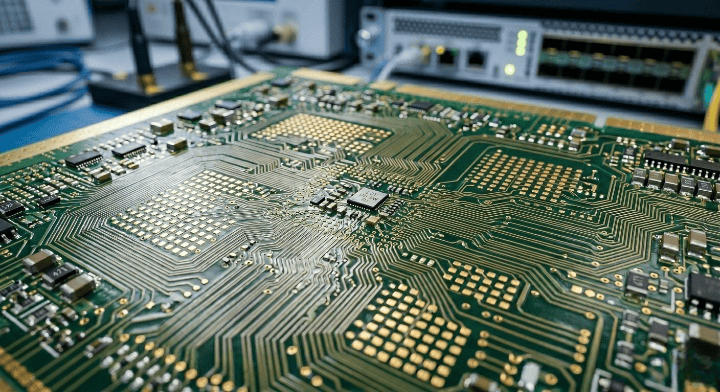
The electrical characteristics of this series are anchored by highly stable dielectric parameters, with the M8-grade DS-7409DJN+ delivering a Dk of approximately 3.0 and Df of 0.0013 at 10 GHz. As a representative M7-grade product in the DS-7409 family, DS-7409DV(N) delivers Dk 3.28 and Df 0.0025 at 10 GHz per Doosan’s published characterization data. Pushing to the absolute limit, the DYQ M9Q variant drops the dissipation factor below 0.0007.
Validating Performance Metrics
Doosan validates these extreme low-loss numbers using precise cavity resonator and stripline testing methodologies. DS-7409 variants are characterized per IPC-TM-650 2.5.5.5 stripline method, with the DV(N) and DJN+ grades conforming to IPC-4101E slash sheet specifications for high-speed laminates.
Consider this fact: third-party testing validates that these laminates maintain flat impedance curves even at 28 GHz frequencies.
- Dk stability holds tightly across varying humidity conditions.
- Smooth HVLP3 copper foil minimizes skin effect resistance.
- Spread glass styles drastically reduce fiber weave skew.
- Moisture absorption remains firmly below 0.06 percent.
Key Takeaway: Rigorous electrical testing proves these materials support the tightest signal integrity margins in modern data centers. Bottom line: Strict electrical validation ensures these laminates deliver the exact signal integrity margin required for complex AI hardware routing.
| Electrical Spec | DV(N) [M7] | DJN+ [M8] | M9Q [M9] |
|---|---|---|---|
| Dk @ 10 GHz | 3.28 | ~3.0 | ~3.0 |
| Df @ 10 GHz | 0.0025 | ~0.0013 | ≤0.0007 |
| Copper Foil | RTF / VLP | HVLP3 | HVLP4 / HVLP5 |
| Test Method | Stripline | Stripline | SPDR / Stripline |
How Do Thermal and Mechanical Specs Drive DS-7409 Reliability?
Thermal resilience across the DS-7409 family is exceptional, with premium variants like DJN+ and M9Q boasting a Glass Transition Temperature (Tg) exceeding 220°C. Maintaining dimensional stability during sequential lamination requires understanding how to match laminate materials to signal speed requirements without compromising via reliability. The decomposition temperature (Td) consistently measures above 400°C, providing a massive thermal safety window for high-layer-count assemblies.
Handling Massive Lamination Cycles
Thick 30-layer server motherboards undergo multiple extreme heat cycles during fabrication. Doosan engineered the Z-axis CTE (Coefficient of Thermal Expansion) to remain strictly controlled, preventing internal copper barrel cracking.
Let’s look at the numbers: a stable Z-axis expansion safeguards the microvias passing through delicate PPO resin layers.
- Tg (DMA): consistently 220°C to 225°C for high-end variants.
- Td (TGA): >400°C across the ultra-low-loss ladder.
- Peel strength: exceeds 3.0 lb/in even with ultra-smooth copper.
- Z-axis CTE: tightly constrained to prevent via fracturing.
Key Takeaway: High Tg and excellent dimensional stability protect complex HDI structures from catastrophic thermal stress. Bottom line: The mechanical foundation of this material series guarantees flawless via integrity through multiple intense lamination press bakes.
| Mechanical Parameter | Value Range | Test Condition |
|---|---|---|
| Tg (DMA) | 220°C – 225°C | IPC-TM-650 2.4.24.4 |
| Td (TGA) | > 400°C | 5% Weight Loss |
| Z-axis CTE (< Tg) | 40 – 45 ppm/°C | TMA |
| Peel Strength | > 3.0 lb/in | As Received (HVLP) |
Why Did Doosan Win NVIDIA M9 Qualification Before Others?
Doosan secured its M9 incumbent status by perfectly timing its PPO and Q-glass resin development alongside Samsung’s dominant HBM ecosystem, achieving a Df of ≤0.0007. DigiTimes reported in August 2025 that Asian CCL firms—Doosan among them—have secured M9-grade certifications for next-generation NVIDIA AI server platforms. This victory positions Doosan as the primary, mass-producing material supplier for the upcoming Rubin architecture.
The Ecosystem Advantage
Winning this tier was not a matter of luck; it required deep synergy within the Korean semiconductor matrix. The M9 CCL specification for NVIDIA Rubin platform demands extreme precision that Doosan refined over five years of dedicated PPO chemistry research.
Here is the truth: being deeply embedded with the world’s leading HBM memory supplier creates massive material qualification leverage.
- Over 5 years of proprietary PPO resin development.
- Deep integration with Samsung’s hardware supply chain.
- Early mastery of Q-glass cloth impregnation.
- Vietnam facilities offering rapid capacity scaling.
Key Takeaway: Doosan combined superior low-loss chemistry with strategic semiconductor partnerships to dominate the M9 landscape. Bottom line: Doosan’s M9 victory is a calculated result of superior resin chemistry combined with a massive Korean semiconductor ecosystem advantage.
| M9 Success Factor | Doosan Capability | Industry Impact |
|---|---|---|
| Resin Chemistry | Advanced PPO + Q-glass | Df drops below 0.0007 |
| Ecosystem Tie | Samsung HBM Partnership | Accelerated qualification |
| Capacity | Scalable Vietnam Factory | Faster ramp than Japan fabs |
| Status | Qualified Incumbent | Safe bet for OEM designs |
How Does DS-7409DJN+ Compare to Megtron 8 and EM-892K2?
In the M8 category, DS-7409DJN+ delivers a Df of approximately 0.0013, making it a fully qualified second source that directly challenges the Panasonic Megtron 8 manufacturing details. While the Japanese incumbent offers a slightly lower Df of 0.0010-0.0012, Doosan provides significantly faster lead times for fabricators. It operates in the exact same performance bracket as the EMC EM-892K2 halogen-free M8 laminate, giving procurement teams immense flexibility.
Evaluating the Alternatives
When evaluating an 800G switch or GB200 build, hardware architects often weigh these M8 materials against ultra-premium options like the Isola Tachyon 100G ultra-low-loss laminate. The Doosan variant frequently wins when factoring in ecosystem continuity.
What does this mean for you? You can safely substitute DJN+ on standard signal and power layers to drastically cut costs.
- Megtron 8: Highest SI margin, longest lead times.
- DS-7409DJN+: Strong Korean ecosystem, M9 forward-compatibility.
- EM-892K2: Halogen-free compliance, excellent pricing.
- SH G7: Lowest cost option for domestic AI designs.
Key Takeaway: The DJN+ laminate matches the industry’s elite materials in practical performance while offering unique supply chain benefits. Bottom line: DS-7409DJN+ is a highly capable GB200 alternative that balances near-flagship electricals with superior supply chain availability.
| Material Brand | M8 Product | Df @ 10 GHz | Core Market Advantage |
|---|---|---|---|
| Doosan | DS-7409DJN+ | ~0.0013 | Samsung ecosystem, M9 roadmap |
| Panasonic | Megtron 8 | 0.0010-0.0012 | Industry SI benchmark |
| EMC | EM-892K2 | 0.0011-0.0013 | Halogen-free, fast Taiwan supply |
| Shengyi | SH G7 | 0.0014 | Extreme cost efficiency |
Where Does DS-7409 Fit in NVIDIA Rubin and 800G Switch BOMs?
The DS-7409 family dominates modern AI platforms, with the DYQ M9Q variants serving as the incumbent core for the upcoming Rubin Midplane and Rubin Ultra orthogonal backplanes. When analyzing a complete GB200 and GB300 BOM breakdown, you will find the DJN+ variant utilized extensively across standard build-up layers as a trusted multi-source option. This versatility allows hardware teams to standardize on one manufacturer across multiple accelerator generations.
Real-World Hybrid Implementation
One of our recent AI server projects used DS-7409DJN+ on a 26-layer compute board approximating the structure NVIDIA uses for GB200-class boards. The customer originally specified Megtron 8 across all eighteen build-up layers, but Megtron 8 allocation came back at 11 weeks. We proposed DS-7409DJN+ on twelve of the eighteen build-up signal layers and kept Megtron 8 on the six most critical 112 Gbps PAM4 NVLink-class layers.
The hybrid stackup measured 0.56 dB/inch insertion loss at 28 GHz on the DJN+ layers versus 0.50 dB/inch on the Megtron 8 layers—a 12% margin difference well within the customer’s 14 dB channel budget across 19 inches of trace. DJN+ allocation came in at 5 weeks through our authorized Doosan distributor. Material cost on the DJN+ layers ran approximately 22% lower than equivalent Megtron 8; the board passed system bring-up with no SI escalations. The substitution shipped four weeks earlier than a pure Megtron 8 build would have allowed, which matched a customer milestone for their AI cluster ramp.
Key Takeaway: Strategic layer substitution with DJN+ slashes fabrication time and costs without failing channel loss budgets. Bottom line: Targeted layer substitution using this laminate family saves massive budget and lead time while keeping strict insertion loss targets intact.
| NVIDIA Platform | Target Board | Required Doosan Material |
|---|---|---|
| H200 SXM | Compute Board | DS-7409DV(N) / DJN+ |
| GB200 Bianca | Build-up Layers | DS-7409DJN+ (M8) |
| Rubin VR200 | Midplane | DS-7409DYQ M9Q (M9) |
| Rubin Ultra | Orthogonal Backplane | DS-7409DCQ M9Q (M9) |
How Does DS-7409DQN Address 800G and Halogen-Free Demands?
DS-7409DQN is Doosan’s newest 2026 release specifically targeting the intense demands of 800G infrastructure and halogen-free mandates. Per Doosan’s official DS-7409DQN product page, the laminate achieves a transmission loss of -0.87 dB per inch at 26.5 GHz when paired with HVLP3 copper foil, positioned specifically for 800G networking infrastructure. It perfectly addresses the stringent eco-friendly regulations required by European telecom operators without sacrificing raw bandwidth.
Bridging the Gap to M9
This specific DQN variant operates on the exact edge between the M8+ and M9 categories. It directly competes with other halogen-free giants in the market while holding the prestige of Doosan’s M9-capable manufacturing precision.
Consider this fact: eliminating halogens historically ruined signal integrity, but Doosan’s DQN formulation completely bypasses this legacy penalty.
- Officially classified as “Super Ultra Low Loss” for 800G.
- Achieves -0.87 dB/inch loss at 26.5 GHz.
- Fully halogen-free for global RoHS and REACH compliance.
- Perfect for enterprise routers and 5G/6G macro cell stations.
Key Takeaway: The DQN variant provides engineers with an elite halogen-free option that rivals top-tier competitors in the demanding switch market. Bottom line: DS-7409DQN is Doosan’s dedicated answer to EM-892K2, delivering exceptional 800G performance with a clean, halogen-free chemistry profile.
| DQN Characteristic | Specification | Engineering Benefit |
|---|---|---|
| Target Speed | 800G / 1.6T | Supports next-gen network switches |
| Loss @ 26.5 GHz | -0.87 dB/inch | Preserves tight channel margins |
| Copper Pairing | HVLP3 | Minimizes skin effect degradation |
| Eco-Compliance | Halogen-Free | Meets strict EU telecom mandates |
How Do Fabricators Process the DS-7409 Family in Production?
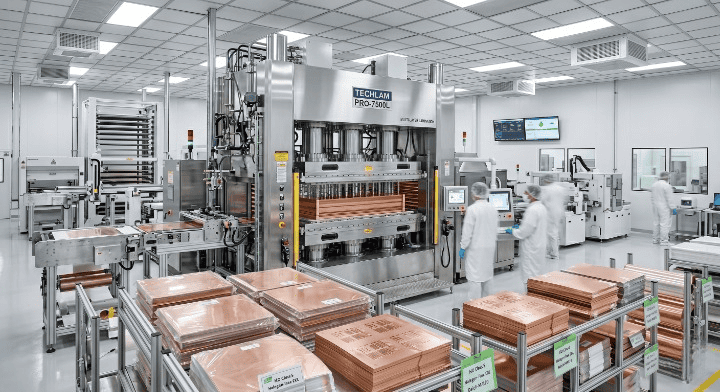
Fabricating this laminate series requires precise control over lamination parameters, typically utilizing a standard 200°C press cycle for 90 minutes. Executing flawless HDI PCB fabrication with sequential lamination demands strict adherence to Doosan’s matched-family prepreg recommendations. The resin system behaves predictably under standard desmear processes, making it highly fabrication-friendly for experienced high-speed board houses.
Shop Floor Engineering Experience
A recent 22-layer build for an AI server customer used a mixed DS-7409 stackup: DS-7409DJN+ for the four NVLink-class SerDes signal layers and DS-7409DV(N) for eight intermediate-speed routing layers, with standard high-Tg FR-4 on the outer power planes. The challenge was not the material chemistry but the prepreg matching. Doosan’s documentation strongly recommends using matched-family prepreg with each core variant—DJN+ prepreg paired with DJN+ core, DV(N) prepreg with DV(N) core—and mixing DJN+ core with DV(N) prepreg in the same lamination cycle measurably degraded the impedance accuracy on our first-article coupons.
We rebuilt the stackup with strict family-matched plies and the second batch held differential impedance to within ±3% across all signal layers. Lamination ran at 200°C for 90 minutes on a standard FR-4 press recipe. The DJN+ layers required HVLP3 copper foil; DV(N) layers accepted standard reverse-treated copper. First-pass yield landed at 93% across 50 panels, limited by registration drift on the second-level sub-laminations.
Key Takeaway: Correct prepreg pairing prevents impedance shifts and guarantees high yields on complex hybrid stackups. Bottom line: Strict prepreg family matching is the non-negotiable secret to achieving high first-pass yields when pressing multiple variations of this material.
| Process Step | Standard Requirement | Shop Floor Note |
|---|---|---|
| Lamination Cycle | 90 minutes @ 200°C | Similar to standard high-Tg FR-4 |
| Prepreg Matching | Strictly matched per suffix | Crucial for ±3% impedance control |
| Copper Foil Prep | HVLP3 for DJN+/DQN | Prevents bonding degradation |
| Desmear | Standard permanganate | Compatible, predictable etch rate |
How Do You Source DS-7409 and View the Roadmap to M10?
Standard factory inventory for the DS-7409 series ranges from 4 to 8 weeks, massively outperforming the 6 to 12-week allocation delays common with Japanese competitors. Procuring this material directly from Doosan’s Korean and Vietnamese manufacturing facilities provides North American assemblers with a highly reliable safety valve. Beyond immediate availability, Doosan’s confirmed roadmap ensures that design teams investing in this ecosystem today are perfectly positioned for tomorrow’s hardware.
The Future of Ultra-Low Loss
The strongest forward-looking signal about DS-7409 sits in NVIDIA’s Rubin supplier list. As of late 2025 and into 2026, DS-7409DYQ and DCQ M9Q variants are the M9-grade material in active production for Rubin Midplane and Rubin Ultra orthogonal backplane builds. No other CCL supplier currently holds qualified mass-production status at M9—Panasonic and EMC remain in M9 development and M10 testing phases.
For board designers, the implication is that the qualification work, drilling parameters, and supply chain relationships built around DS-7409 today carry directly into M9-class production builds tomorrow. Doosan’s Vietnam production facility adds capacity flexibility that Japanese and Taiwanese competitors cannot easily match. For ODM partners and PCB fabricators evaluating multi-year material strategy, DS-7409 represents one of the few CCL families with end-to-end coverage from M4 mid-loss applications through M9 ultra-low-loss AI server boards.
Key Takeaway: Partnering with Doosan secures immediate material availability while locking in your supply chain for upcoming M10 platforms. Bottom line: Doosan is not just a secondary option; it is the current M9 incumbent offering the most secure, long-term supply chain roadmap for future AI platforms.
| Supply Metric | Doosan DS-7409 | Japanese Competitors |
|---|---|---|
| Typical Lead Time | 4 – 8 Weeks | 6 – 12 Weeks (Restricted) |
| Factory Locations | Korea, Vietnam | Japan, Limited SE Asia |
| Current AI Status | M9 Incumbent (Mass Prod) | M8 Incumbent, M9 Testing |
| Roadmap | M10 Testing Confirmed | M10 Testing Confirmed |
Our engineering team specializes in transforming advanced Korean laminates into zero-defect AI hardware. Whether you need to navigate severe supply chain allocations or qualify a complex multi-tier stackup, we deliver the precision necessary for 112G and 224G success. Let us help you eliminate signal integrity risks while cutting your fabrication lead times in half. Reach out and contact us today to discuss your next high-layer-count server project. At QueenEMS, we believe that world-class computing should never be held hostage by material shortages.
FAQ
Is DS-7409 a single product or a product family? DS-7409 is a product family that spans the full M4-to-M9 loss tier ladder. The base DS-7409 is a high-Tg FR-4 grade. The D, DV, DV(N), DJN+, DQN, and DYQ/DCQ M9Q suffixes each represent measurably lower dielectric loss for progressively higher data rate applications. The DS-7409HG series is separate—it covers IC package substrates, not PCB CCL.
Can DS-7409DJN+ replace Megtron 8 in NVIDIA GB200 boards? Partially yes. DS-7409DJN+ is already qualified at NVIDIA for selected GB200 build-up layers. It delivers Df at approximately 0.0013 at 10 GHz versus Megtron 8 at 0.0010-0.0012—within roughly 15% on dB/inch insertion loss at 28 GHz. For the most critical NVLink 5.0 SerDes layers, some ODMs default to Megtron 8 for SI margin, but power, ground, and most signal layers accept DJN+ as a second source.
Why did Doosan win NVIDIA M9 qualification before Panasonic? Three factors. Doosan invested early in PPO resin chemistry suitable for Q-glass at the M9 loss target. Samsung’s HBM dominance pulled Doosan-qualified materials through the broader NVIDIA AI supply chain. And Doosan’s Vietnam production capacity allowed faster scale-up than the Japan-anchored Panasonic facilities. The DS-7409DYQ M9Q product achieves Df below 0.0007 in mass production for Rubin Midplane builds.
How does DS-7409DQN compare to Megtron 8 and EM-892K2 for 800G designs? DS-7409DQN is a 2026 addition positioned at M8-plus or M9-edge with halogen-free chemistry. Doosan specifies a transmission loss of -0.87 dB per inch at 26.5 GHz with HVLP3 copper. It competes directly with EM-892K2 on halogen-free 800G applications and with Megtron 8 on raw performance, with Doosan’s M9 incumbent status as the long-term roadmap advantage.
What’s the difference between DS-7409 PCB CCL and DS-7409HG IC substrate? DS-7409HG variants are IC package substrate materials designed for line and space rules below 30 micrometers, used in NAND Flash memory packages and 5G antenna-in-package applications. The DS-7409D, DV, DJN, DQN, and M9Q variants are PCB copper-clad laminates for motherboards, backplanes, switch line cards, and AI server boards. The two product lines are not interchangeable.
Written by the QueenEMS Engineering Team
Upload your files today · Free DFM check before production · Ship worldwide
Get your PCB prototypes in as fast as 24 hours. We handle FR4, Rogers, and Flex up to 60 layers — free prototypes for 2–4 layer boards, no minimum order.
Just upload your Gerber + BOM — we source every part, assemble, and inspect (AOI + X‑Ray) so you don't have to chase suppliers. Boards ship in as fast as 24 hours.