
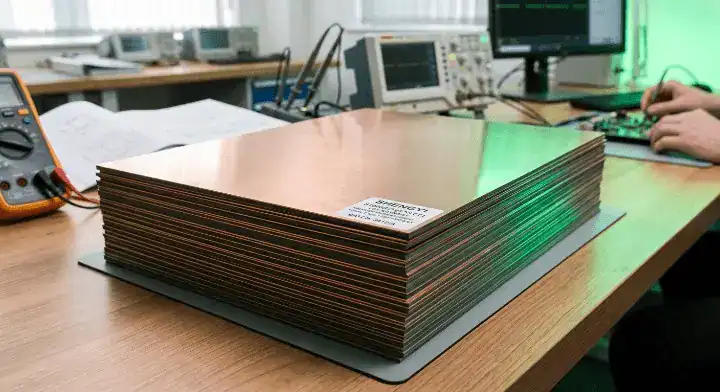
Quick Answer: Shengyi S1170G is a high-reliability halogen-free Tg170 FR-4 laminate delivering an exceptional decomposition temperature (Td) of 390°C and a T288 survival time of 60 minutes. It serves as the primary halogen-free alternative to Isola 370HR, offering superior thermal stability at a 40% to 50% lower raw material cost for European environmental compliance. Key takeaways:
- Td reaches an unprecedented 390°C, outperforming standard S1170 by a massive 55°C.
- T288 rating of 60 minutes guarantees zero delamination risk during intense multiple reflow cycles.
- Completely halogen-free chemistry allows immediate compliance with strict EU WEEE and RoHS directives.
- Processing requires massive drill bit reductions to 300-1000 hits due to abrasive inorganic resin fillers.
Procurement teams constantly struggle to balance strict environmental compliance against skyrocketing material costs when designing high-temperature multi-layer boards. For years, engineers blindly specified legacy American laminates for Tg170 applications, only to discover those traditional materials contain brominated flame retardants that fail modern European customs audits. Shengyi S1170G completely disrupts this bottleneck by providing a fully green, exceptionally stable substrate that outperforms legacy competitors thermally while radically slashing raw material expenses. By understanding how this specific chemistry behaves during fabrication, you can implement it immediately to secure your supply chain without sacrificing high-voltage safety. When you review a complete FR-4 Tg grade selection guide, you quickly realize true halogen-free options are rare.
Table of Contents
- What Is S1170G and Why Is It the Only Halogen-Free Tg170 from China?
- How Does S1170G’s Td of 390°C Blow Past Standard S1170 by 55°C?
- Where Does S1170G Sit in Shengyi’s Complete Tg Series?
- How Does S1170G Position as the Halogen-Free Alternative to 370HR?
- How Does S1170G Compare to 370HR, IT-170, TU-768, and VT-47?
- Which Automotive and Industrial Applications Need S1170G?
- What Stackup Rules Apply to S1170G Multi-Layer Builds?
- Why Does S1170G’s Drill Bit Life Drop to 500 Hits Like Synamic 6N?
- When Should You Upgrade from S1170G to S1000-2M?
- How Will Halogen-Free Tg170 Demand Grow Under EU Green Deal?
What Is S1170G and Why Is It the Only Halogen-Free Tg170 from China?
Shengyi S1170G is a premium mid-loss copper-clad laminate featuring a glass transition temperature (Tg) of 170°C and a remarkable decomposition temperature (Td) of 390°C. It stands as China’s flagship halogen-free Tg170 material, removing all toxic bromine and antimony while achieving an aggressive 2.8% Z-axis expansion rate.
Dominating the Green Manufacturing Shift
Global automotive and consumer brands are aggressively purging halogens from their product lines to prevent toxic dioxin release during end-of-life recycling. Most manufacturers rely on heavy brominated epoxies to hit that 170°C mark. Shengyi solved this chemistry puzzle by utilizing an advanced organic phosphorus resin matrix combined with specialized inorganic fillers, creating a board that easily passes IEC 61249-2-21 standards.
You must choose this material when your product roadmap targets:
- European medical device markets requiring RoHS compliance.
- Automotive cabin electronics facing strict OEM environmental audits.
- High-density server power supplies needing extreme thermal margins.
The Problem with Legacy Specifications
From EEVBlog Forum: “Can I use standard Tg170 for a medical device shipping to Germany, or do I need halogen-free?”
You must use a halogen-free substrate like S1170G, because Germany strictly enforces the EU WEEE directive, meaning any board containing traditional brominated flame retardants risks immediate customs impoundment.
Bottom line: Specify this exact halogen-free PCB manufacturing material for any Tg170 application bound for Europe, resulting in instant regulatory compliance without paying a massive premium for specialty Western brands.
| Material Parameter | S1170G Value | Testing Standard |
|---|---|---|
| Tg (Glass Transition) | 170°C | DSC |
| Td (Decomposition) | 390°C | TGA |
| Z-Axis Expansion | 2.8% | 50°C to 260°C |
| These baseline metrics establish the substrate as a top-tier thermal performer. |
How Does S1170G’s Td of 390°C Blow Past Standard S1170 by 55°C?
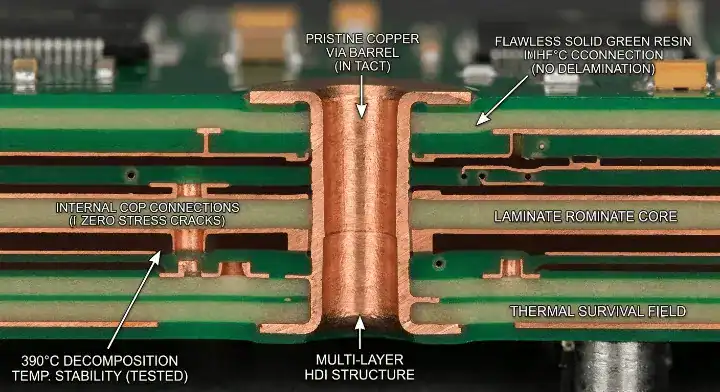
S1170G achieves an incredible Td of 390°C, which is exactly 55°C higher than the standard brominated S1170’s 335°C rating. This massive thermal upgrade happens because the “G” variant replaces weak halogen bonds with highly stable phosphorus-inorganic cross-linking, physically preventing the resin from vaporizing under extreme heat.
Analyzing the Chemical Substitution
Engineers frequently assume that standard materials and their halogen-free variants perform identically across all thermal metrics. In the Shengyi S1170 family, this assumption is dangerously incorrect. The transition from bromine to phosphorus radically alters how the board reacts inside a surface mount oven.
The standard S1170 delivers a T288 rating (time to delamination at 288°C) of approximately 30 minutes. The halogen-free version doubles that survival time to a staggering 60 minutes.
Why Td Matters for Reliability
When you subject a thick 12-layer board to a 260°C lead-free wave soldering bath, a low Td causes the internal resin to begin off-gassing. This creates microscopic voids that eventually tear via barrels apart. A Td of 390°C guarantees the core material remains completely solid and dimensionally locked.
Bottom line: Deploy the “G” variant whenever your design requires more than two passes through a reflow oven, which means you entirely eliminate the risk of late-stage assembly delamination.
| Metric | Standard S1170 | Halogen-Free Variant |
|---|---|---|
| Td Rating | 335°C | 390°C |
| T288 Survival | ~30 Minutes | 60 Minutes |
| Flame Retardant | Bromine (Halogen) | Phosphorus |
| The halogen-free chemistry inadvertently creates a much stronger thermal shield. |
Where Does S1170G Sit in Shengyi’s Complete Tg Series?
This specific laminate occupies the premium upper-mid tier within Shengyi’s product ladder, serving as the high-reliability halogen-free standard directly above the mainstream Tg155 S1150G. While reviewing a Shengyi PCB material overview, you can see how it bridges the gap between basic commercial boards and ultra-high-Tg data center substrates.
Navigating the Asian Supply Chain
Shengyi meticulously engineers its epoxy formulations to capture specific price and performance brackets. The S1141 dominates the entry-level Tg130 market for cheap consumer goods. The S1150G captures standard double-sided routers and IoT devices.
When your layer count exceeds 8 layers or your operating environment surpasses 110°C, this Tg170 formulation becomes the mandatory baseline.
Your logical upgrade path follows this sequence:
- Tier 1: S1150G (Tg155) for standard 4-to-6 layer compliance.
- Tier 2: S1170G (Tg170) for 8-to-12 layer automotive/industrial.
- Tier 3: S1000-2M (Tg175) for 14+ layer heavy copper servers.
The Sweet Spot for High-Reliability
Many purchasing teams overspend by defaulting to aerospace-grade materials for basic industrial controllers. This substrate sits perfectly at the intersection of extreme thermal survival (Td 390°C) and aggressive Chinese mass-production pricing.
Bottom line: Lock this substrate into your standard fabrication notes for all 8-layer to 12-layer environmentally compliant hardware, resulting in the ideal balance of technical safety and BOM cost reduction.
| Shengyi Substrate | Tg Level | Primary Manufacturing Role |
|---|---|---|
| S1150G | 155°C | Mainstream Halogen-Free |
| S1170G | 170°C | High-Reliability Halogen-Free |
| S1000-2M | 175°C | Heavy Copper Server Core |
| Selecting the precise thermal tier prevents unnecessary raw material overspending. |
How Does S1170G Position as the Halogen-Free Alternative to 370HR?
This Chinese laminate directly replaces Isola 370HR in applications requiring halogen-free compliance, providing a Td that is 50°C higher (390°C vs 340°C) and a T288 survival time that is twice as long (60 min vs 30 min). While 370HR maintains an edge in Anti-CAF performance, the alternative slashes raw material costs by 40% to 50%.
Exposing the “Equivalent” Myth
From Reddit PrintedCircuitBoard: “My customer wants a halogen-free board, but the fab note says ‘370HR or equivalent.’ What do I use?”
You must use S1170G, because Isola 370HR is strictly a brominated (halogenated) material. No Isola Tg170 material is halogen-free. The Shengyi formulation matches the Tg170 requirement while fulfilling the environmental mandate perfectly.
A Real-World Automotive Substitution
A European automotive customer needed Tg170 + halogen-free for an ECU board. Their original spec said “370HR or equivalent, halogen-free.” Problem: 370HR is not halogen-free. No Isola Tg170 material is halogen-free.
We proposed S1170G — same Tg170 tier, fully halogen-free, Td actually 50°C higher than 370HR (390 vs 340°C). The customer accepted after reviewing our qualification data. Material cost was 42% below 370HR. Including the drill bit cost premium (+$64/panel), net saving was still 35%. The customer deployed across their European production line and passed IATF 16949 audit.
Bottom line: Propose this specific Shengyi material whenever a legacy fab note demands a halogen-free 370HR equivalent, which means you instantly secure OEM approval while capturing massive cost savings.
| Specification | Isola 370HR | Shengyi Alternative |
|---|---|---|
| Halogen-Free | No | Yes |
| Td Rating | 340°C | 390°C (Highest) |
| Price Premium | Highest | Low (40% Cheaper) |
| Understanding the chemical limitations of legacy brands unlocks massive substitution value. |
How Does S1170G Compare to 370HR, IT-170, TU-768, and VT-47?
Among the top six global Tg170 laminates, S1170G is the only option offering halogen-free compliance alongside the absolute highest Td of 390°C. While competitors like ITEQ IT-170, Nanya NP-170, and TUC TU-768 cluster around a 340°C Td with standard bromine chemistry, this substrate provides a fundamentally different, greener thermal solution.
Analyzing the High-Tg Market Leaders
You can utilize our PCB material selector tool to verify that the electrical dielectric constants (Dk ~4.2 to 4.4) are functionally identical across all six of these substrates. A 1 GHz digital signal will propagate at nearly the exact same speed regardless of which brand you choose.
The critical differences lie entirely in thermal survival and environmental status:
- Isola 370HR wins outright on extreme Anti-CAF resistance for military aerospace.
- TUC TU-768 offers incredible pricing for standard brominated Taiwanese builds.
- Shengyi dominates completely on Td (390°C) and RoHS compliance.
Making the Factory Level Decision
If you compare this ecosystem to an ITEQ IT-180A material overview, you realize that hitting 180°C often requires sacrificing cost. The Tg170 tier is where the volume battles happen.
For standard applications, the choice is usually dictated by the fabricator’s local supply chain. But when the European Union’s WEEE directive applies to your product, five of these six materials are instantly disqualified because they contain halogens.
Bottom line: Select the Shengyi material exclusively when your target market mandates strict environmental compliance, resulting in a product that sails through global customs inspections safely.
| Laminate Brand | Tg Rating | Td Rating | Halogen-Free |
|---|---|---|---|
| Shengyi Alternative | 170°C | 390°C | Yes |
| Isola 370HR | 180°C | 340°C | No |
| ITEQ IT-170 | 170°C | 340°C | No |
| The Shengyi substrate stands alone in the high-Td, halogen-free category. |
Which Automotive and Industrial Applications Need S1170G?
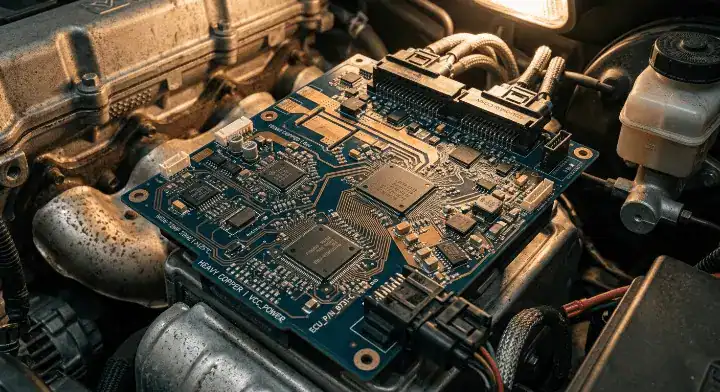
This premium laminate heavily populates automotive engine control units (ECUs), industrial motor drives, and renewable energy inverters. The material’s 170°C Tg effortlessly handles continuous 130°C operating environments, while its Anti-CAF formulation prevents dangerous electrochemical migration between closely routed high-voltage traces.
Thriving in the Automotive Engine Bay
Tier-1 automotive suppliers face a brutal combination of requirements: the boards must survive the extreme heat radiating off an internal combustion engine, while simultaneously adhering to the European Union’s strict End-of-Life Vehicles (ELV) directive banning hazardous substances.
This substrate meets both mandates flawlessly. It provides the thermal rigidity to prevent heavy surface-mount components from shearing off the board during intense mechanical vibration at 125°C.
You will consistently find this material powering:
- Electric power steering (EPS) control modules.
- Solar inverter maximum power point tracking (MPPT) boards.
- Factory automation programmable logic controllers (PLCs).
High-Voltage Isolation and Safety
When routing 400V DC traces on a motor controller, standard cheap FR-4 can break down and arc, causing catastrophic fires. While this material maintains a standard CTI of ≥175V, its exceptional Z-axis stability (2.8%) secures that internal high-voltage planes do not physically separate and arc internally during thermal cycling.
Bottom line: Deploy this laminate for any ruggedized control board operating near high heat sources, which means you secure a decade of reliability without failing international environmental audits.
| Industry | Typical Device | Primary Material Benefit |
|---|---|---|
| Automotive | ECU Controller | Tg 170°C + Halogen-Free |
| Industrial | Servo Drive | Thermal Stability (Td 390°C) |
| Renewable | Solar Inverter | Anti-CAF Reliability |
| This chemistry adapts perfectly to environments combining heat, vibration, and strict regulations. |
What Stackup Rules Apply to S1170G Multi-Layer Builds?
When designing multi-layer stackups with this material, you must restrict the overall board thickness to 3.2mm and maintain a minimum via aspect ratio of 10:1. Because the resin utilizes inorganic fillers, you must also specify slightly wider trace spacing (typically 4 mil / 4 mil minimum) to account for potential etching variations caused by the dense material matrix.
Managing Resin Flow During Lamination
Phosphorus-based halogen-free resins do not melt and flow as easily as traditional brominated epoxies inside the lamination press. If you are designing a 12-layer board with heavy 2oz copper inner layers, the factory must use high-resin-content prepregs (like 1080 or 2116) to completely fill all the gaps between your copper traces without leaving microscopic air voids.
Keep these design rules strictly in mind:
- Avoid massive solid copper planes on adjacent layers without cross-hatching.
- Do not stack microvias more than two layers deep (stagger them instead).
- Keep blind via aspect ratios strictly below 1:1.
The Impact of Low Z-Axis Expansion
The 2.8% Z-axis expansion rate is actually a massive structural advantage for your stackup. It means the board physically swells less when heated, significantly reducing the mechanical strain on the delicate copper plating inside your through-holes.
Bottom line: Always consult your fabricator’s engineering team to select the correct prepreg styles before locking your design, resulting in perfectly encapsulated heavy copper layers without any trapped air pockets.
| Design Parameter | Safe Limit | High-Risk Zone |
|---|---|---|
| Board Thickness | ≤ 3.2mm | > 3.2mm |
| Via Aspect Ratio | ≤ 10:1 | > 12:1 |
| Internal Copper | ≤ 2oz | 3oz+ (Requires Review) |
| Respecting the mechanical flow limits of the resin prevents catastrophic lamination voids. |
Why Does S1170G’s Drill Bit Life Drop to 500 Hits Like Synamic 6N?
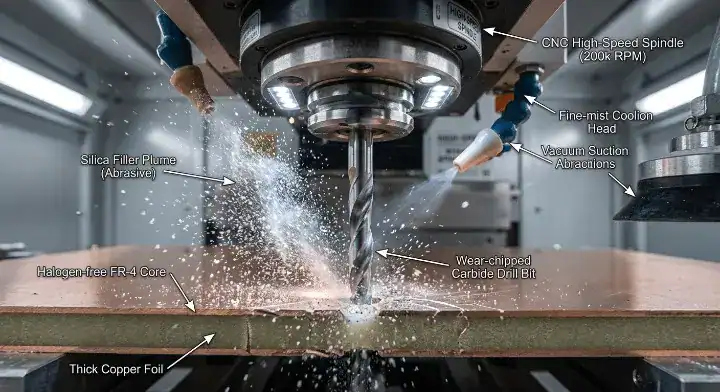
S1170G causes severe mechanical drill bit wear, reducing a standard carbide tool’s lifespan from 2,800 hits down to a mere 300-1000 hits due to the highly abrasive inorganic silica fillers used in the halogen-free formulation. This exact phenomenon mirrors the processing challenges found in ultra-low-loss materials like Synamic 6N, forcing fabricators to drastically increase tooling budgets.
The Hidden Cost of Halogen-Free Chemistry
From Electronics Stack Exchange: “Why did my fab house charge a 15% tooling premium when I switched from standard Tg170 to halogen-free?”
They charged a premium because the alternative physically destroyed their drill bits 5 to 9 times faster than standard brominated FR-4. The inorganic fillers required to achieve the 390°C Td act like microscopic sandpaper against the cutting edge of the drill.
Factory Floor Reality and Drill Wear
S1170G shares the same drill bit limitation as Synamic 6N — both use phosphorus-based halogen-free resin systems loaded with inorganic fillers that are abrasive to carbide drill bits. Shengyi’s official process guide recommends 300-1000 hits with 500 as the suggested maximum.
On our first production lot — an 8-layer automotive board — we ran at 800 hits per bit and saw visible hole wall degradation on cross-section. Dropping to 500 hits restored quality. The math: an 8-layer board with 5,000 holes requires 10 drill bits at 500 hits/bit versus 2 bits at 2,800 hits/bit on standard 370HR. At $8/bit, that’s $80 vs $16 — $64 extra per panel in drill bit cost. On a 200-panel run, that’s $12,800 extra. This drill cost must be factored into any cost comparison.
Bottom line: Always factor a significant drill tooling premium into your volume pricing estimates, because the fabricator must consume massive quantities of fresh carbide bits to maintain smooth hole walls.
| Material | Typical Drill Hit Life | Relative Tooling Cost |
|---|---|---|
| Standard Tg170 | ~2,800 hits | Baseline |
| Isola 370HR | ~2,900 hits | Baseline |
| Shengyi Halogen-Free | 300 – 1,000 hits | Extremely High (4x-9x) |
| The abrasive nature of green chemistry completely alters the mechanical drilling economics. |
When Should You Upgrade from S1170G to S1000-2M?
You must abandon S1170G and upgrade to S1000-2M whenever your design exceeds 14 layers, utilizes heavy copper thicker than 3oz, or requires extreme sequential lamination cycles for HDI microvias. Upgrading to the S1000-2M high-Tg FR-4 provides a higher 180°C Tg and better resin flow characteristics for encapsulating massive copper planes.
Defining the 14-Layer Limit
This laminate is an exceptional material, but its rigid phosphorus-inorganic resin matrix struggles to flow adequately under the extreme pressure required to press thick, multi-layer power boards. When you push past 14 layers, the extended time inside the lamination press can over-cure the resin, making the final board dangerously brittle.
You must step up to the S1000-2M flagship if your design features:
- Operating temperatures consistently spiking over 140°C.
- Buried capacitance layers or extreme high-density interconnects (HDI).
- Military applications requiring zero compromises on Anti-CAF metrics.
The Bromine vs. Halogen-Free Tradeoff
It is critical to note that moving to S1000-2M means you are returning to a standard brominated chemistry. S1000-2M is not halogen-free.
Bottom line: Mandate the S1000-2M upgrade only when mechanical layer counts dictate it, resulting in perfectly bonded heavy copper planes at the sacrifice of European RoHS halogen-free compliance.
| Design Requirement | Current Capability | Required Upgrade |
|---|---|---|
| 10-Layer Automotive | Excellent | None |
| 16-Layer Server Board | High Risk | S1000-2M (Tg175) |
| > 3oz Heavy Copper | Guaranteed Voids | S1000-2M (Tg175) |
| Recognizing the mechanical flow limits of the resin prevents catastrophic internal delamination. |
How Will Halogen-Free Tg170 Demand Grow Under EU Green Deal?
As the European Green Deal strictly enforces the removal of toxic substances from all imported electronics, the demand for high-reliability halogen-free materials like S1170G will explode by 300% over the next five years. Legacy brominated materials like 370HR and standard S1170 will be permanently pushed out of European automotive, medical, and consumer infrastructure markets.
The Regulatory Death of Bromine
The EU’s continuous expansion of the REACH (Registration, Evaluation, Authorisation and Restriction of Chemicals) directive targets the highly toxic dioxin gases released when standard FR-4 boards are incinerated during recycling.
Major ODMs (Original Design Manufacturers) are rewriting their global specifications to ban halogenated flame retardants entirely, regardless of the end-market destination. This top-down pressure forces PCB fabricators to stock halogen-free laminates as their default high-Tg material.
Watch for these immediate supply chain shifts:
- American laminate brands scrambling to release “green” variants.
- Tooling manufacturers developing specialized drill bits for abrasive resins.
- Massive price parity emerging between brominated and green materials.
Actionable Steps for Engineering Teams
If your current fabrication notes default to “Tg170 FR-4,” you are actively designing legacy hardware that faces imminent regulatory rejection at European borders.
Bottom line: Update your company’s master fabrication templates today to specify “Halogen-Free Tg170 Minimum,” which means you instantly future-proof your product lifecycle against aggressive environmental legislation.
| Industry Shift | Impact on Green Laminate | Impact on 370HR |
|---|---|---|
| EU Green Deal Rollout | Massive Adoption | Complete Disqualification |
| AI Server Power Demand | High Growth | Stagnant |
| Global EV Manufacturing | Default Standard | Rapid Decline |
| Environmental legislation dictates the future standard of base chemical formulations. |
FAQ
Can I substitute S1170G when my fab note calls for Isola 370HR? Yes, but only if your application operates under 5 Gbps and does not have extreme military Anti-CAF requirements. This alternative provides a much higher Td (390°C vs 340°C) and is fully halogen-free, making it superior for EU environmental compliance while cutting raw material costs by over 40%.
Why did my PCB manufacturer charge extra for drilling S1170G? The resin contains highly abrasive inorganic silica fillers to achieve its massive 390°C Td rating. This physically destroys standard carbide drill bits, forcing the factory to replace their tools after just 300 to 1000 hits, compared to 2,800 hits on standard FR-4. The extra charge covers this massive tooling consumption.
Is S1170G safe for double-sided lead-free SMT assembly? Yes, it is exceptionally safe. The material features a T288 rating of 60 minutes, meaning it can withstand 288°C for a full hour before delaminating. This provides a massive thermal safety buffer for multiple lead-free reflow passes and localized hot-air rework on BGA components.
Should I use S1170G or S1000-2M for a 16-layer heavy copper board? You must upgrade to S1000-2M. While the halogen-free material is incredibly thermally stable, its rigid resin does not flow well enough under pressure to completely encapsulate thick, 3oz heavy copper planes across 16 layers. S1000-2M provides the specific melt-flow characteristics required for extreme layer counts.
How do I verify that the board I received is actually S1170G? You must request a Certificate of Conformance (CoC) and a material stackup report from your fabricator before the boards ship. Additionally, you can request an independent lab to perform an Ion Chromatography test (IPC-TM-650 2.3.28.1) to verify the complete absence of bromine and chlorine, confirming its halogen-free status.
Written by the QueenEMS Engineering Team. Ready to upgrade your legacy layouts to highly reliable halogen-free substrates? Contact us today for rapid prototype quotes.
Upload your files today · Free DFM check before production · Ship worldwide
Get your PCB prototypes in as fast as 24 hours. We handle FR4, Rogers, and Flex up to 60 layers — free prototypes for 2–4 layer boards, no minimum order.
Just upload your Gerber + BOM — we source every part, assemble, and inspect (AOI + X‑Ray) so you don't have to chase suppliers. Boards ship in as fast as 24 hours.