
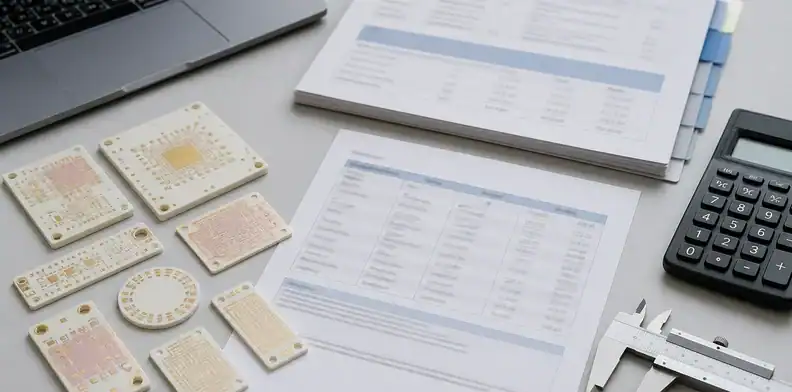
Ceramic PCB MOQ lead time cost questions usually appear when a prototype has moved beyond a simple engineering sample but is not yet ready for production pricing. The buyer wants a small quantity, fast delivery, and a controlled budget. The supplier wants enough information to choose the material route, prepare tooling or process setup, hold yield, and avoid rework.
Use the ceramic materials and fabrication overview to describe the route being quoted before comparing quantity and schedule options.
The hard part is that ceramic PCB cost does not scale like a standard FR-4 prototype. Alumina, AlN, DBC, AMB, DPC, thick-film, thin-film, and LTCC routes have different setup work, panel use, inspection needs, and yield risks. A request for “10 pcs fast” may be easy in one route and inefficient in another.
Quick Answer: Ceramic PCB MOQ, lead time, and cost depend on material route, ceramic thickness, copper or metallization process, line/space, holes or cavities, finish, inspection documents, assembly scope, and whether the order is a prototype, pilot lot, or repeat small batch. Small buyers should ask for minimum charge, panel use, NRE/setup cost, lead-time drivers, and what changes between first article and repeat order.
For a detailed ceramic PCB cost breakdown or lead-time reduction, use the dedicated articles. Here, compare how a minimum purchase quantity, minimum charge and reusable setup affect a small order of the same specification.
Table of Contents
- What does MOQ mean for ceramic PCB orders?
- Why do small ceramic PCB orders feel expensive?
- Which details drive lead time before production starts?
- How do material and process routes change cost?
- When does assembly change the MOQ and schedule?
- How should buyers compare prototype, pilot, and repeat orders?
- What quote questions prevent surprise charges?
- How can small-batch buyers reduce cost without weakening the design?
- What files should you send for a realistic quote?
What does MOQ mean for ceramic PCB orders?
MOQ usually states a minimum order quantity. A quotation can also impose a minimum panel purchase, material purchase or lot charge. Keep these fields separate: a minimum charge can apply even when the supplier accepts the requested piece count.
For a simple FR-4 prototype, a small piece count may be easy to price because the factory runs many similar jobs. Ceramic PCB work is more route-specific. The supplier may need a ceramic sheet, metallization setup, DBC or AMB substrate process, plating preparation, laser or mechanical processing, special inspection, or a fixture. Those fixed steps do not disappear when the quantity is small.
MOQ also changes by deliverable. A bare ceramic substrate may have one minimum. A finished ceramic circuit may have another. A ceramic PCB assembly with components, soldering, wire bonding, or test may add sourcing and process minimums. A quote that does not state scope can make the MOQ look lower than it really is.
| MOQ phrase | What the buyer should ask |
|---|---|
| Minimum pieces | Are these individual boards, coupons, or panel positions? |
| Minimum charge | What setup, process, or inspection work is included? |
| Minimum panel | How many usable boards fit on the panel or ceramic sheet? |
| Material minimum | Is a special ceramic, copper, or finish batch required? |
| Assembly minimum | Does the number include component sourcing, stencil, fixtures, or test? |
The general PCB MOQ article is useful background, but ceramic sourcing needs an extra layer: the route and ceramic process must be named before MOQ is meaningful.
Why do small ceramic PCB orders feel expensive?
Small ceramic PCB orders feel expensive because setup work, material preparation, engineering review, inspection, and yield risk are spread across fewer boards. The unit price can look high even when the supplier is not adding a large margin.
The fixed work often includes file review, material selection, stackup confirmation, tooling or fixture preparation, panel planning, metallization or copper process setup, finish control, dimensional inspection, packaging, and export documentation. If assembly is included, stencil, component sourcing, programming, test setup, and process validation can add more fixed cost.
NRE is part of this picture. The QueenEMS article on NRE and PCB setup/tooling costs explains the general concept. In ceramic PCB projects, NRE may appear as engineering setup, tooling, fixture, mask, or process preparation depending on the route.
Small-batch buyers should separate unit price from total project cost. A quote with a low unit price but high hidden setup may not be cheaper. A quote with a higher unit price and clear repeat-order pricing may be better for an engineering team that expects revisions.
Compare the Same Specification at Two Quantities
This illustrative calculation uses assumed amounts, not market prices or a QueenEMS quotation. Assume a first-order setup charge S = $300, variable fabrication cost v = $20 per accepted board, and a fabrication minimum charge M = $600 excluding setup. All boards use the same approved construction. Shipping, tax, assembly, rejected parts and revisions are excluded.
Under those assumptions, first-order cost is S + max(M, v × Q), where Q is the number of accepted boards purchased. A repeat-order calculation can omit S only if the quotation confirms the setup is reusable and no repeat charge applies.
| Accepted quantity Q | First-order total | Average per purchased board | Repeat total if setup is reusable |
|---|---|---|---|
| 10 | 300 + max(600, 200) = $900 | $90 | $600 |
| 30 | 300 + max(600, 600) = $900 | $30 | $600 |
| 50 | 300 + max(600, 1000) = $1,300 | $26 | $1,000 |
The lower unit average does not make 50 boards the cheaper order: it requires $400 more cash than 30 in this example. If only 10 boards are usable before a design revision, extra pieces may have no value. Ask whether the minimum covers delivered good boards, panel starts or a material purchase, and whether unused material belongs to the buyer.
Which details drive lead time before production starts?
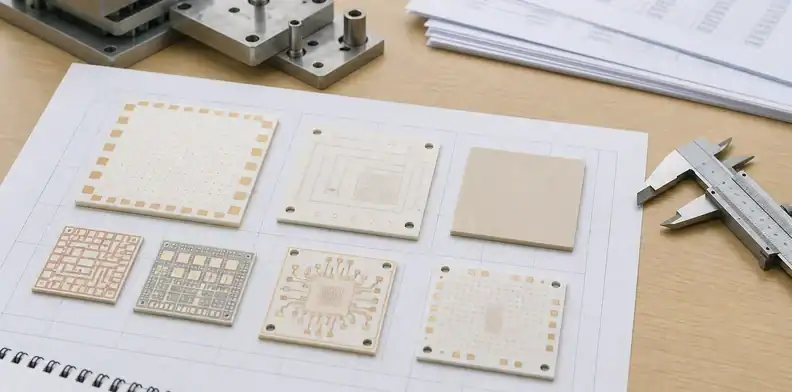
Ask the supplier to state the lead-time trigger in the quotation: for example, technical approval, payment, material arrival or a combination. Separate fabrication time from the earlier material and approval work; do not assume every supplier starts the clock at the first email or at technical release alone.
The most common pre-production delays are incomplete files, unclear material route, missing finish notes, aggressive line/space or cavity features, unclear copper thickness, unapproved substitutions, customer compliance forms, and late component data. Time-zone differences can make these delays worse for US, Canada, EU, and Israel teams when questions are answered only once per day.
| Lead-time driver | Why it delays small batches |
|---|---|
| Material route not fixed | Supplier cannot choose alumina, AlN, DPC, DBC, AMB, LTCC, or film route |
| Drawing mismatch | Gerber, stackup, and PDF notes do not agree |
| Special finish | Supplier needs confirmation of soldering, wire bonding, or die attach need |
| Tight geometry | Engineering review may be required before release |
| Assembly scope | BOM, components, stencil, process, and test must be planned |
| Documentation need | RoHS/REACH, inspection reports, or customer forms add review time |
The first-order instructions for preparing a ceramic PCB prototype order covers file preparation in more detail. For this page, the main point is schedule control: unresolved decisions are lead-time items.
How do material and process routes change cost?
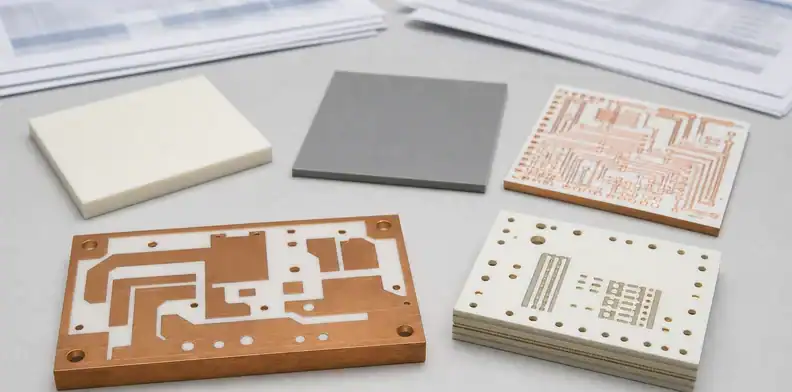
Material and process route change ceramic PCB cost because each route has different material price, setup work, panel efficiency, copper or metallization method, inspection method, and yield risk. Alumina, AlN, DPC, DBC, AMB, LTCC, thick-film, and thin-film builds should not be priced as if they were one process.
The buyer should ask the supplier to identify the route used in the quote. A low price can hide a route change that affects thermal performance, dielectric behavior, copper thickness, line/space, or qualification. The QueenEMS article on ceramic PCB thickness, copper, and trace/space capability is a useful follow-up when comparing route-specific capability.
| Route decision | Cost and schedule implication |
|---|---|
| Alumina vs AlN | Material and thermal-performance trade-off |
| DPC vs DBC/AMB | Fine pattern vs power substrate construction |
| Thick film vs thin film | Metallization precision and process preparation difference |
| Standard finish vs special finish | Soldering, wire bonding, or die attach documentation changes |
| Prototype route vs production route | First sample may not be the cheapest repeat-order route |
When does assembly change the MOQ and schedule?
Assembly changes MOQ and schedule when the supplier must source components, prepare stencil or fixtures, define soldering or die-attach process, inspect placement, program test, or manage consigned materials. A bare ceramic PCB quote does not automatically predict ceramic PCB assembly cost.
Small-batch assembly can be affected by component reel minimums, distributor lead time, NCNR parts, manual handling, special solder profile, wire bonding, thermal interface materials, and test fixture needs. Even when the ceramic substrate quantity is small, component sourcing can create a larger purchasing lot.
For consigned builds, the buyer should state whether components are supplied loose, taped, labeled, moisture-controlled, or already approved by receiving. Missing component labels or extra substitutions can slow the schedule more than the ceramic board itself.
The QueenEMS article on prototype vs production ceramic PCB supplier selection explains why supplier type matters. Prototype assembly support and production substrate supply are related, but not identical, buying problems.
How should buyers compare prototype, pilot, and repeat orders?
Request quantity breaks against the same controlled specification when the goal is to compare MOQ and price. List any changed process, inspection scope or setup separately. A prototype and a production build may legitimately differ, but the price difference then cannot be attributed to quantity alone.
The first prototype may carry setup cost, extra DFM review, and conservative inspection. A pilot lot may need fixture improvement, packaging definition, compliance documents, and test records. A repeat small batch should use the approved route and a stable revision, but it may still require material reservation or forecast support if the ceramic or finish is special.
| Order stage | Main buyer question |
|---|---|
| Prototype | Can the design be built and tested without hiding route risk? |
| Pilot lot | Can the process, documentation, and inspection repeat? |
| Repeat small batch | Can cost and lead time stabilize without redesign? |
The PCB prototype vs production switch article gives a broader PCB decision framework. Ceramic PCB buyers should add route stability and material availability to that decision.
What quote questions prevent surprise charges?
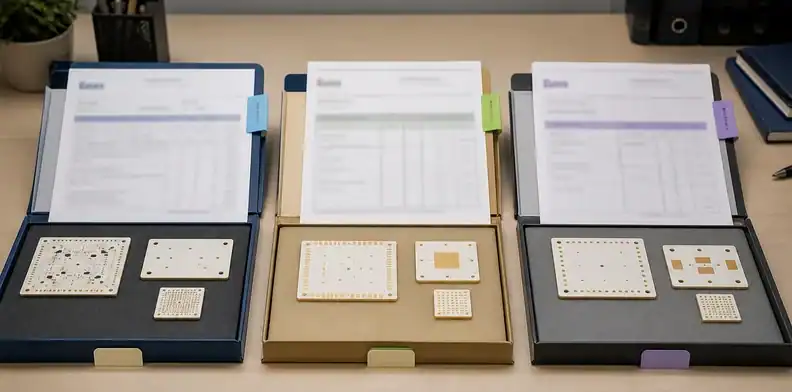
The best quote questions expose what is included, what is excluded, and what triggers a re-quote. Small-batch ceramic buyers should ask these questions before approving the PO, especially when the design uses AlN, DBC, AMB, DPC, cavities, tight flatness, special finish, or assembly.
Ask whether the quote includes engineering review, tooling, fixtures, mask or setup, inspection report, material certificate if needed, RoHS/REACH declaration, packaging, shipping preparation, assembly setup, component sourcing, programming, test, and repeat-order price basis. Also ask what changes the price: material substitution, copper thickness, panel quantity, finish, lead-time acceleration, drawing revision, or added documentation.
How can small-batch buyers reduce cost without weakening the design?
Small-batch buyers can reduce cost by simplifying avoidable complexity while protecting the requirements that matter. The goal is not to make the ceramic PCB cheap at any cost; it is to remove expensive ambiguity, noncritical tolerances, and process conflicts.
Practical cost-control moves include accepting supplier-standard ceramic thickness when it does not affect the product, avoiding unnecessary special finish, separating prototype-only experiments from production intent, relaxing noncritical dimensions, reducing panel waste, freezing the BOM earlier, and approving equivalent components only through a controlled AVL.
The QueenEMS article on reducing PCB panel costs is useful because panel efficiency can affect ceramic cost too. Ceramic panelization is not the same as FR-4 panelization, but the buyer still needs to understand how usable area, breakage risk, and inspection affect price.
Do not reduce cost by removing the evidence that protects the project. For power, RF, medical, optical, or high-temperature builds, inspection reports, material notes, and DFM records may be more valuable than a small unit-price reduction.
What files should you send for a realistic quote?
For the small-batch comparison, attach the fabrication and assembly data relevant to the quoted deliverable. Add the required usable quantities, minimum-charge questions and expected repeat releases; these determine how setup and purchasing minimums affect the order.
Also state what is flexible. If alumina is acceptable instead of AlN, say so. If the finish is fixed for wire bonding, say so. If the first order is only a fit-and-function prototype, identify which features are allowed to be prototype-only. If the next order may be a pilot lot, ask for repeat-order assumptions now.
Useful RFQ wording:
Please quote prototype and repeat small-batch options for this ceramic PCB, including minimum charge, MOQ basis, material route, setup or NRE, lead-time trigger, DFM exceptions, inspection documents, assembly scope if included, and re-quote conditions for revision or material changes.
Check supplier responsibilities using the ceramic supplier qualification checks. Bring the completed small-batch quotation requirements to that discussion.
Send QueenEMS a ceramic PCB small-batch RFQ package
For an order-specific comparison, request quantities and delivery milestones from QueenEMS. Attach the released fabrication data, material and finish requirements, inspection scope and assembly package where relevant. State the usable quantity needed at each stage and ask which charges recur on later releases.
FAQ
What is the MOQ for ceramic PCB?
There is no universal ceramic PCB MOQ. Ask for the minimum accepted-board quantity and separately identify panel, material and assembly minimums or minimum charges for the quoted construction.
Why is my ceramic PCB prototype expensive?
The first prototype spreads setup, material preparation, engineering review, inspection, and yield risk across a small quantity. The repeat order may price differently after the route and revision are stable.
Can I get ceramic PCB faster by paying expedite fees?
Sometimes, but only after the technical release is clear. Missing drawings, unclear material route, special finish, component shortages, and unapproved DFM exceptions can block the schedule even with expedite budget.
Should I ask for prototype and production pricing together?
Yes. Ask for prototype, pilot, and repeat small-batch assumptions separately so the supplier can show which costs are one-time, which are quantity-driven, and which depend on revision stability.
What is the best way to reduce ceramic PCB cost?
Reduce ambiguity and noncritical complexity first. Keep the material, finish, tolerances, inspection, and documentation that the product actually needs.
Written by the QueenEMS Engineering Team
Upload your files today · Free DFM check before production · Ship worldwide
Get your PCB prototypes in as fast as 24 hours. We handle FR4, Rogers, and Flex up to 60 layers — free prototypes for 2–4 layer boards, no minimum order.
Just upload your Gerber + BOM — we source every part, assemble, and inspect (AOI + X‑Ray) so you don't have to chase suppliers. Boards ship in as fast as 24 hours.