
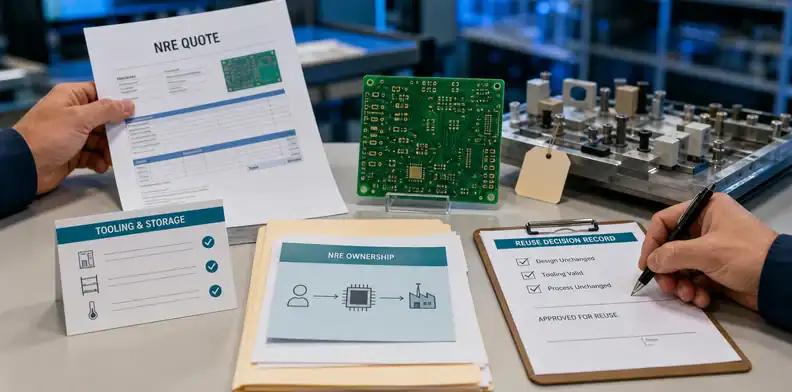
Quick Answer: PCB NRE ownership should be clarified before the first order is released, not after the buyer asks for a reorder or supplier transfer. The useful RFQ question is whether paid setup, tooling, panel data, test fixtures, programming files, or engineering records can be reused, modified, transferred, or only applied inside the original supplier’s process.
Key takeaways
- Treat PCB NRE ownership as a release decision, not a loose purchasing phrase.
- Name the approval owner before the supplier spends money, reserves capacity, modifies files, or starts production.
- Keep evidence, quote assumptions, and repeat-order conditions in the same record so supplier answers stay comparable.
- Use a topic-specific RFQ note instead of relying on memory from email threads.
A PCB buyer may understand NRE as a one-time cost and still misunderstand what was actually purchased. The invoice may say tooling, engineering, fixture, stencil, programming, panel setup, or test setup, but those words do not automatically mean the buyer owns a portable asset.
This matters most when an order moves from prototype to repeat production. Purchasing wants the second quote to be cheaper, engineering wants the same build conditions, and the supplier may treat the paid work as internal setup rather than buyer-owned property.
The right answer is not to argue about the word NRE after the fact. It is to define ownership, reuse rights, change limits, and evidence before the first PO or before a reorder assumes the old charge can disappear.
Separate paid setup from buyer-owned assets
A paid NRE line does not automatically give the buyer transferable tooling or data ownership.
Ask the supplier what the charge creates: an internal CAM setup, a fixture, a stencil, a test program, panel tooling, engineering review time, or documented production data.
Use the existing QueenEMS article on PCB NRE cost basics for the cost definition, then add an ownership line to the RFQ.
A buyer-owned item should have a name, storage rule, reuse condition, and transfer answer. Internal setup can still be valuable, but it may not travel with the project.
At this stage, the engineering reviewer should look for product-changing effects while purchasing checks whether the supplier’s answer changes the commercial baseline. Keeping those reviews together prevents a technical approval from becoming a hidden price or schedule change.
The record for this first decision should capture the starting assumption and the reason it matters. That prevents the project from moving forward on a comfortable phrase that different people interpret differently.
Decide what can be reused on the next order
Reuse should be tied to the same revision, process, supplier site, and acceptance requirement.
A repeat order is safer when the buyer knows which setup records carry forward. CAM outputs, panel arrays, fixture settings, impedance coupons, stencil files, and test programs may depend on the exact revision.
Connect the NRE record to repeat PCB order revision control so the next PO does not reuse old tooling against a changed board.
The supplier’s answer should say whether reuse is automatic, requires review, requires revalidation, or is not available after a design change.
The supplier’s reply should be judged by execution clarity. A useful reply names the file, asset, BOM line, date, quantity, approval owner, or evidence record affected; a vague assurance is not enough for release.
For the second decision, keep the supplier’s proposed wording close to the buyer’s approval wording. Small differences in scope language are often where later reorder disputes, missing evidence, or quote changes begin.
| Decision point | Buyer-side question | Supplier answer to request |
|---|---|---|
| Scope | What exactly is included in PCB NRE ownership? | Name the covered files, assets, process, quantity, date, evidence, or service boundary. |
| Approval | Who can approve a change? | State whether engineering, purchasing, quality, or supplier standard process controls the answer. |
| Commercial impact | What changes price, lead time, liability, or inventory? | Identify deposits, NCNR terms, cancellation rules, expedite cost, or quote validity limits. |
| Release condition | What must be true before work proceeds? | Give a proceed, hold, revise, requote, or shipment-release condition. |
This table is not meant to replace engineering review. It gives purchasing, engineering, quality, and management the same language for deciding whether the supplier may proceed, hold, revise, or requote.
Price NRE against the evidence it returns
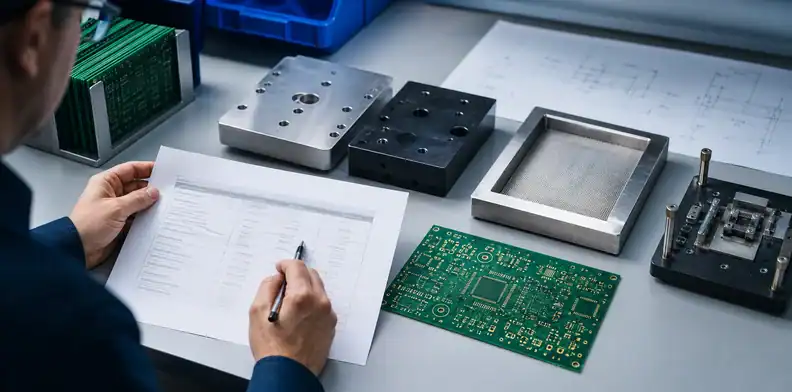
An NRE line is easier to accept when the buyer knows what proof or reusable work it creates.
A quote may include engineering setup without returning a separate file. Another quote may include fixture build, validation, fixture storage, and later reuse. These are not equal even if both are labeled NRE.
When comparing suppliers, ask for the output: CAM note, stencil file, test fixture ID, programming revision, impedance setup, or retained production record.
The PCB quote exclusions review helps identify whether NRE includes storage, repair, retest, fixture modification, or only first-build preparation.
For a near-order buyer, the practical question is whether the remaining uncertainty can be closed before money is committed. If the answer affects only planning, the project may continue; if it affects the manufactured or assembled result, the release record needs a firmer approval.
The third decision should name the evidence that will prove the supplier followed the accepted rule. Without evidence, the buyer may have only a promise, and that promise is hard to use during receiving, failure review, or a repeat order.
Control changes before reusing tooling
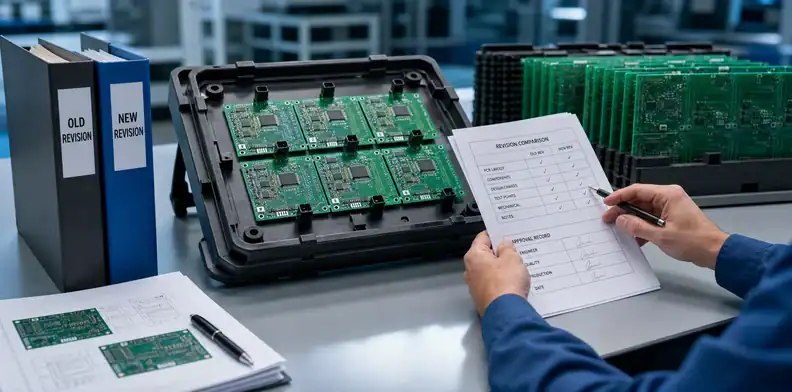
Tooling reuse is only useful when the design change does not invalidate the tool or setup assumption.
A small BOM change may not affect bare-board tooling, but it can affect assembly fixture, test programming, stencil aperture, or inspection setup. A board outline change may invalidate panel tooling even if the electrical design looks similar.
Engineering should approve whether the old setup remains acceptable. Purchasing should record whether the supplier keeps the NRE benefit or charges again for modification.
A practical reorder note says which items may be reused and which must be reviewed after revision change, material substitution, panel change, finish change, or test-method change.
Quality and receiving teams also need the decision in a form they can use later. When a shipment, test report, kit, or repeat release arrives, they should not have to interpret a long email thread to decide whether the supplier followed the accepted rule.
The fourth decision should state the hold point. A hold point is not a punishment; it tells the factory exactly which operation must wait and which low-risk preparation may continue.
A useful review note normally has four fields: accepted baseline, supplier action allowed, buyer approval still required, and the event that reopens the quote. That compact format is easier for a supplier to follow than a long email thread.
Clarify transfer rights before changing suppliers
Supplier transfer is where vague NRE language becomes expensive.
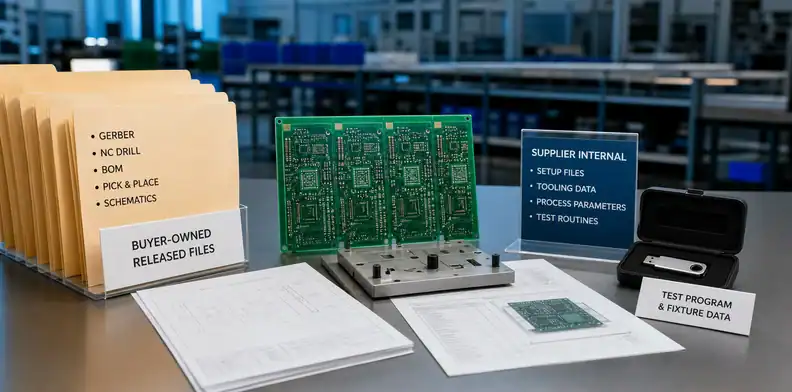
Some assets are physically transferable; others are process knowledge, software setup, or supplier-owned fixtures built for that factory. The buyer should not assume that paying NRE means another factory can use the same item.
Use PCB fabrication quote files to separate released design data from supplier-created work. The buyer always needs clean released files even when supplier setup is not transferable.
If transfer matters, the RFQ should say whether fixture CAD, test program, stencil data, panel tooling data, or validation records must be returned and in what format.
The strongest supplier comparison uses the same assumption set for every quote. That means the buyer should not compare one answer that includes review, evidence, storage, or sourcing liability with another answer that leaves those items outside the price.
The fifth decision should connect technical acceptance with commercial exposure. If the buyer accepts a different source, asset, process, release date, or supplier boundary, the price and liability record should change with it.
Put NRE ownership into the PO record
The PO should preserve the accepted ownership and reuse rule, not only the price.
A useful PO line can say that the NRE covers first setup only, or that a named fixture will be stored for repeat production under the same revision. Either answer is better than silence.
The PCB purchase order review step should confirm whether the supplier acknowledgement repeats the ownership rule accurately.
QueenEMS can review PCB or PCBA quote packages where NRE, setup, fixture, stencil, tooling, or test-program ownership affects repeat orders. Send the quotation, active files, expected reorder path, and supplier wording; we can help turn the NRE line into a clear reuse and approval record.
The release instruction should name the next irreversible step. Depending on the project, that step may be CAM approval, material purchase, fixture fabrication, component prebuy, SMT setup, shipment release, or inventory allocation.
The sixth decision should be written as handoff language. A buyer who was not present in the engineering discussion should still understand what the supplier may do, what remains conditional, and what would require another quote.
The final handoff should fit into a purchase order note, supplier acknowledgement, internal sourcing record, or production-release checklist. Long background explanations can stay in the engineering file; the supplier instruction should be short, controlled, and tied to the active quote.
Practical order-stage examples
Prototype buyers often accept an NRE line to keep the first build moving, then discover that the repeat price did not drop because the charge was for engineering time rather than reusable tooling.
A PCBA project can look like a bare PCB repeat order until the test fixture or stencil needs modification after a component substitution. That is why the ownership note should name both PCB and assembly-side assets.
Management may approve NRE for schedule reasons. The decision record should still say whether the cost buys only the first build or protects future reorders.
Role-specific review also matters for PCB NRE ownership. Engineering should look for any change to released design intent, assembly behavior, test result, material choice, or acceptance criteria. Purchasing should look for changed price basis, quote validity, MOQ, deposit, cancellation exposure, storage rule, or delivery promise.
A founder or general manager usually needs a shorter view: what risk is being reduced, what money is being committed, what date is being protected, and what would make the decision wrong. That view should come from the same record, not from a separate management summary that loses technical detail.
Quality and receiving need a practical evidence path. The article’s decision should say whether photos, certificates, test reports, shipment labels, lot records, fixture records, or supplier acknowledgements are needed before shipment, at receiving, or only for archive.
Useful RFQ wording can be simple: “Please confirm the scope, owner, approval condition, and release evidence for PCB NRE ownership. Identify any assumption that changes price, lead time, sourcing liability, test evidence, shipment release, or repeat-order reuse before production starts.”
For an engineer, the main question is whether the supplier’s proposed action changes fit, function, reliability, firmware, test, compliance, or acceptance evidence. For purchasing, the main question is whether the proposed action changes price, lead time, cancellation exposure, quote comparison, or repeat-order liability. For management, the main question is whether the business benefit justifies the remaining technical and commercial risk.
Good supplier communication keeps those three views connected. It does not make every issue dramatic, but it does prevent silent changes from becoming surprises after boards are built, components are bought, or a shipment arrives.
How to judge the supplier reply
A strong reply about PCB NRE ownership should include the supplier’s exact assumption, the affected file or commercial term, the operation that can proceed, and the operation that must wait for buyer approval. The reply should not only say “confirmed” or “standard process” when the topic changes the product, sourcing exposure, test evidence, delivery promise, or repeat-order baseline.
The buyer should also look for missing negatives. If a supplier says an item is included, ask what is not included: storage, transfer, retest, revalidation, fixture repair, engineering change, expedite handling, evidence report, or later release. These exclusions are often more useful than a broad positive answer because they define the real boundary of the quote.
A supplier answer becomes quote-ready when it can be copied into the RFQ, PO note, ECO disposition, or production-release checklist without changing meaning. That means the wording should avoid private shorthand and should name the date, revision, quantity range, approval owner, and evidence requirement when those details affect the decision.
If two suppliers answer differently, do not force them into the same price table too early. First normalize the scope. One supplier may be giving engineering review and retained evidence; the other may be quoting only the build. Once the scope is normalized, the buyer can decide whether the more expensive offer is actually safer, or whether the lower-cost offer is acceptable with a tighter buyer-side record.
For repeat business, keep the accepted answer with the order file rather than in a personal inbox. The person placing the next order may not be the person who negotiated the first one, and the supplier contact may also change. A short record protects both sides because it shows what was paid for, what was approved, and what must be rechecked when the project changes.
FAQ
Does paying PCB NRE mean I own the tooling?
No. It only means the supplier charged for non-recurring work unless the quote or PO states ownership, storage, reuse, or transfer rights.
Can NRE be reused after a PCB revision change?
Sometimes. Reuse depends on whether the change affects the tool, setup, fixture, panel, stencil, test program, or acceptance record.
Should I ask for NRE to be waived on repeat orders?
Yes, but only after confirming the same revision, same supplier process, same evidence requirement, and same reusable setup are still valid.
What should QueenEMS review in an NRE quote?
Send the NRE line, active files, expected repeat plan, supplier ownership wording, and any fixture or test requirement so the quote can be reviewed for hidden reuse assumptions.
Sources
- QueenEMS NRE cost article – existing QueenEMS owner for general PCB NRE cost meaning.
- CIRCUITS ASSEMBLY board buying article – industry article discussing tooling and testing charges from the buyer side.
Send QueenEMS a quote-ready package
If your PCB or PCBA project has needs related to PCB NRE ownership, send QueenEMS the quotation with NRE lines, active revision, repeat-order expectation, fixture or stencil notes, test-program requirements, and supplier ownership wording. We can provide all-around support by giving back reuse-rights review, setup ownership boundary, reorder-risk notes, and quote-ready wording for the PO, so the project can move toward quotation, DFM/CAM review, sourcing, production release, or shipment evidence with fewer hidden assumptions.
Written by the QueenEMS Engineering Team
Upload your files today · Free DFM check before production · Ship worldwide
Get your PCB prototypes in as fast as 24 hours. We handle FR4, Rogers, and Flex up to 60 layers — free prototypes for 2–4 layer boards, no minimum order.
Just upload your Gerber + BOM — we source every part, assemble, and inspect (AOI + X‑Ray) so you don't have to chase suppliers. Boards ship in as fast as 24 hours.