Quick Answer: Move a ceramic PCB from prototype to production by checking whether the approved construction, manufacturing process and inspection evidence can be repeated at the intended site and quantity. The same supplier may handle both stages. Change supplier or process only when the existing route cannot meet the next build’s requirements, and assess the effect of that change before release.
Review the ceramic construction options before deciding whether a production transfer also changes the substrate process.
Key takeaways
- A good ceramic PCB prototype proves a design direction; it does not automatically approve the supplier for production.
- The switch point appears when quantity, reliability evidence, customer approval, or repeat-lot control becomes more valuable than speed.
- Record ceramic grade, metallization, copper thickness, flatness and assembly exposure because a change can affect the validated construction.
- Define who provides fabrication, assembly, test records and change approval for the next build.
Ceramic PCB buyers often reach the same awkward moment after a first successful sample. The board turns on, the heat path looks acceptable, and purchasing wants to know whether the same supplier can build the next lot. That question is not only about price or quantity. It is about whether the first build was a controlled route or a useful experiment.
For overseas buyers, the risk is sharper. A fast prototype may have been quoted through email, sample-stock material, manual inspection, or a limited process window. A production order may need material traceability, documented inspection, stable copper thickness, controlled surface finish, assembly records, and shipment evidence. The supplier that helped you learn quickly may not be the supplier that should own a customer qualification lot.
Use supplier selection by project type to check application fit and the ceramic manufacturer comparison to research possible suppliers. This article addresses the transfer record: what stays approved, what changes, and what evidence the next lot needs.
Table of Contents
- What changes when a ceramic PCB prototype becomes a production order?
- Which prototype success signals are not enough for production?
- When Does the Prototype Route Need Production Qualification?
- What production evidence should be frozen before the next RFQ?
- How should AlN, DBC, AMB, and LTCC projects handle the handoff?
- What files belong in the ceramic PCB production transfer package?
- How do purchasing, engineering, and quality approve the switch?
- What warning signs mean the prototype route should not scale?
What changes when a ceramic PCB prototype becomes a production order?
A ceramic PCB prototype is mainly a learning build. A production order is a controlled release. The same drawing may be used for both, but the buyer should expect different evidence, assumptions, and approval gates.
A prototype may test material options, thermal paths, component fit or assembly methods. Document open questions and any accepted exceptions before building. The required inspection follows the purpose and risk of the test; prototype status alone does not justify omitting safety-critical or customer-required checks.
Production is different. The buyer needs to know which material grade is approved, which copper process is locked, which surface finish is allowed, how holes and outlines will be inspected, and what happens if the supplier proposes a substitution. Ceramic substrates can crack, warp, delaminate, or shift thermally when the material route changes. That makes the handoff record more than paperwork.
Once the transfer requirements are defined, review QueenEMS ceramic production capabilities for the fabrication scope. The decision here is whether the next lot can repeat the approved construction and provide the required records.
Which prototype success signals are not enough for production?
A working ceramic PCB sample is encouraging, but it is not enough for production approval. It proves that one build worked under one set of assumptions. It does not prove that the next lot will use the same material grade, copper route, inspection method, or assembly exposure.
The most common false signal is visual success. A ceramic board can look clean and still have unverified copper adhesion, flatness risk, thermal path uncertainty, or unclear lot records. Another false signal is electrical pass on a few units. That may confirm continuity or basic function, but it does not confirm long-term reliability, isolation margin, or repeatability.
A quick quotation may exclude first-article inspection, material declarations, packaging development or fixtures. Check the exclusions against the intended build. An omission needs an explicit disposition whether the order is a prototype or production; it is not evidence that the supplier lacks capability by itself.
| Prototype signal | What it proves | What it does not prove |
|---|---|---|
| Board powers on | Basic design path may work | Material and process route are production-controlled |
| One small lot passes visual review | No visible defect was found by the stated inspection | Repeat lots will hold flatness, copper, and finish |
| Supplier quotes quickly | Communication is responsive | Production evidence and capacity are included |
| Thermal test looks promising | Heat path may be close | Lot material and interface assumptions are frozen |
| Assembly succeeds once | Reflow or attachment can work | Ceramic stress limits are approved for repeat builds |
For first builds, use the QueenEMS article on ordering your first ceramic PCB prototype to avoid missing file and drawing inputs. For the production switch, ask what was controlled in the sample and what must be added before the next order.
When Does the Prototype Route Need Production Qualification?
Switch supplier type when the next order needs a different operating model, not just a higher quantity. A prototype-friendly supplier may be the right partner for fast DFM feedback, small batches, and file cleanup. A production supplier must also support frozen specifications, lot records, customer evidence, and repeatability.
Review production readiness when the design enters customer qualification, repeat demand increases, a material or process changes, assembly exposes a new failure mode, or receiving requires more controlled records. A change from one ceramic grade or route to another is relevant because it changes the construction, not because every named material is inherently production-only.
This does not always mean replacing the prototype supplier. Sometimes the right move is to ask the same supplier for a production release package, production quantity ladder, and evidence scope. Other times the prototype partner helps bridge to a specialist substrate producer or a larger production route. The practical question is whether the supplier can support the next risk level.
| Switch trigger | Keep prototype route when… | Move toward production route when… |
|---|---|---|
| Quantity increases | The build is still engineering-only | Repeat orders need frozen route and records |
| Customer qualification starts | The customer only needs samples | The customer requires evidence and traceability |
| Material route changes | Alumina sample remains a learning board | AlN, DBC, AMB, or LTCC must be qualified |
| Assembly risk appears | Manual review is enough | Reflow, attach, or thermal cycling must repeat |
| Receiving requirements grow | Informal packing is acceptable | Labels, CoC, inspection, and shipment records matter |
The existing QueenEMS article on PCB prototype vs production order switch signals covers the broader PCB transition. This page applies that logic to ceramic-specific material and substrate risks.
What production evidence should be frozen before the next RFQ?
Before a ceramic PCB moves into production, the buyer should freeze the evidence that defines an acceptable repeat lot. This includes material, process, geometry, finish, inspection, assembly exposure, packaging, and change-control assumptions.
Start with separate material and process records. Name the ceramic family and grade, then specify DBC, AMB, DPC, film metallization or the co-fired system as appropriate. Keep thermal, dielectric, dimensional and mechanical requirements tied to their test conditions. If the next quote proposes a different construction, assess it as a change rather than comparing price as though it were identical.
Then freeze the process record. A production supplier should know the metallization or copper-bonding route, copper thickness target, surface finish, hole or slot rules, outline tolerance, and inspection method. If assembly is included, add soldering profile limits, fixture needs, component attach method, cleaning restrictions, and packing requirements.
| Evidence field | Production-ready question |
|---|---|
| Material route | Which ceramic family and grade were approved? |
| Copper/process route | Which metallization, DPC, DBC, AMB, thick-film, or thin-film route is locked? |
| Drawing control | Which Gerber/ODB++, drawing, stackup, and revision define the build? |
| Inspection record | Which dimensional, visual, electrical, isolation, flatness, or material records are required? |
| Assembly exposure | Which soldering, bonding, cleaning, or thermal process may stress the ceramic? |
| Change control | Who approves material, finish, supplier, or process substitution? |
Check the scope and edition of any referenced fabrication or soldered-assembly standard before applying it. A generic IPC class label does not establish acceptance of every metallized ceramic construction. For customer programs using AIAG PPAP, the submission supports the agreed production requirements; it does not replace the part-specific test and acceptance plan.
How should AlN, DBC, AMB, and LTCC projects handle the handoff?
The handoff evidence should follow the failure modes and changes in the actual application. A high-voltage alumina part can require extensive validation, while an AlN dimensional sample may have a limited test purpose. Do not infer the rigor of the transfer from the material name alone.
For AlN, the handoff should lock the thermal intent. Specify the AlN grade, ceramic thickness, surface finish, copper route, flatness expectation, heat-sink interface, and assembly temperature exposure. A buyer should not allow a production supplier to replace the material or metallization route without engineering approval.
For DBC and AMB, the handoff should focus on copper bonding, isolation, warpage, and reliability records. DBC and AMB are often selected for power modules, so the supplier must understand copper thickness, ceramic type, isolation test expectations, surface finish, and whether the part will face thermal cycling or customer qualification. The QueenEMS article on AMB ceramic PCB vs DBC can carry the route-selection background; this article only defines when that route must be production-controlled.
For LTCC, control the tape and conductor system, layer structure, fired shrinkage, via design and dimensional or RF acceptance. For thin-film RF, control the substrate, deposited/plated conductor stack, line geometry, finish and relevant RF test structure. Fired-shrinkage controls do not automatically apply to a circuit patterned on an already-fired thin-film substrate.
What files belong in the ceramic PCB production transfer package?
A ceramic PCB production transfer package should tell the next supplier exactly what was approved, what may change, and what must stop the order for engineering review. It should be stronger than a prototype ZIP because it becomes the record for repeated builds.
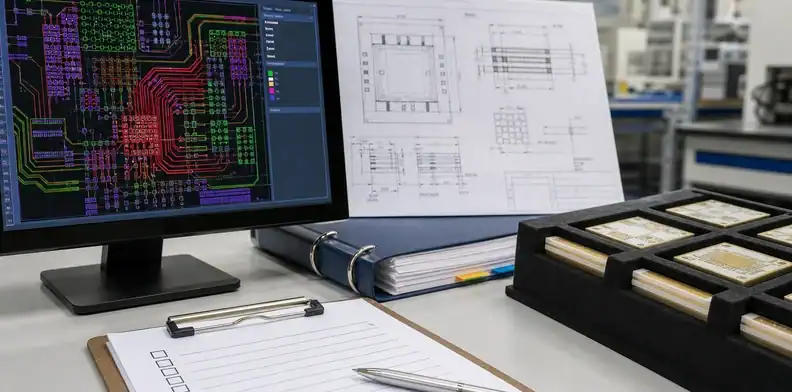
At minimum, include the released Gerber or ODB++ data, fabrication drawing, substrate drawing or stackup note, material selection, copper thickness, surface finish, outline and hole tolerances, inspection requirements, assembly drawing if PCBA is included, and the accepted prototype or qualification result. If the prototype supplier used assumptions that are not in the drawing, move them into the release package before production quoting.
| File or record | Why it belongs in the handoff |
|---|---|
| Released Gerber, ODB++, or manufacturing data | Defines the controlled circuit geometry |
| Fabrication and substrate drawing | Defines material, thickness, finish, tolerances, and notes |
| Prototype build record | Shows which route was already tested |
| DFM/CAM disposition | Captures approved supplier questions and engineering answers |
| Inspection or test report | Defines evidence that must repeat |
| Assembly package | Adds BOM, CPL, drawing, reflow, attach, cleaning, and test needs |
| Change-control note | States what substitution needs written approval |
The broader QueenEMS PCB production release package article is useful when the buyer needs a general release checklist. For ceramic work, add the material and process route because those items can change performance even when the layout file is unchanged.
How do purchasing, engineering, and quality approve the switch?
The supplier switch should not be owned by purchasing alone. Engineering should approve the material and process route, purchasing should control the quote and commercial assumptions, and quality should define the evidence needed at receiving or customer release.
Engineering owns the technical risk. That includes material substitution, copper thickness, dielectric or thermal requirements, hole quality, flatness, surface finish, soldering exposure, and reliability limits. If the prototype worked because of a special process assumption, engineering must decide whether that assumption becomes part of the production drawing.
Purchasing owns the supplier and quote record. The production RFQ should separate unit price, tooling or fixture charges, inspection costs, sample or first-article requirements, packaging, shipment terms, validity period, and requote triggers. A supplier response that hides inspection or tooling assumptions inside the unit price is hard to compare.
Compare MOQ and lead time against the actual prototype-to-volume plan. Separate engineering setup, tooling or fixture work, material procurement, qualification builds and repeat-lot fabrication on the schedule. Identify which tasks must finish before the next starts and which existing tools or test fixtures can be reused. A prototype delivery date does not establish the production schedule.
For the cost transition, request the one-time charges and recurring unit cost at the intended order quantities, with the inspection scope and yield assumption stated. Identify who bears scrap and rework costs and what happens if qualification requires another build. Use actual quotations and accepted-lot evidence; do not assume that higher volume guarantees a particular yield improvement or saving.
Quality should define required receiving and customer evidence with the responsible engineers. AEC-Q200 addresses the applicable passive component. A bare ceramic substrate needs a separately defined qualification scope. Identify the actual automotive, medical or aerospace requirement and the object it covers before requesting the report.
Record What Changes Between Builds
This is an illustrative transfer review, not a reported QueenEMS project. Assume the approved prototype used supplier site A and the production quote proposes site B, a different ceramic grade or a new inspection method. The correct outcome is an assessment request; none of these changes can be declared qualified merely because the artwork is unchanged.
| Proposed change | Evidence to compare | Release decision to record |
|---|---|---|
| Different manufacturing site | Processes, equipment coverage, traceability and representative sample results | Existing evidence applicable, additional validation required, or change rejected; name the responsible approver |
| Different ceramic grade or copper build | Conditioned material data, geometry, attachment and affected thermal/electrical requirements | Which prior tests remain applicable and which must be repeated |
| New inspection or test method | Measured characteristic, resolution, calibration, sampling and acceptance criteria | Whether the new method can detect the defects controlled by the old plan |
Leave the disposition open until evidence is reviewed. Record the old and proposed construction revisions, the reviewer’s basis, the required test report and the final approval. The number of signatures follows the organization’s release process; it is not a universal three-person rule.
What warning signs mean the prototype route should not scale?
The prototype route should not scale when the supplier cannot explain how the production lot will repeat the sample. A low price, friendly email response, or good-looking sample is not enough if the supplier cannot control material, process, inspection, and change rules.
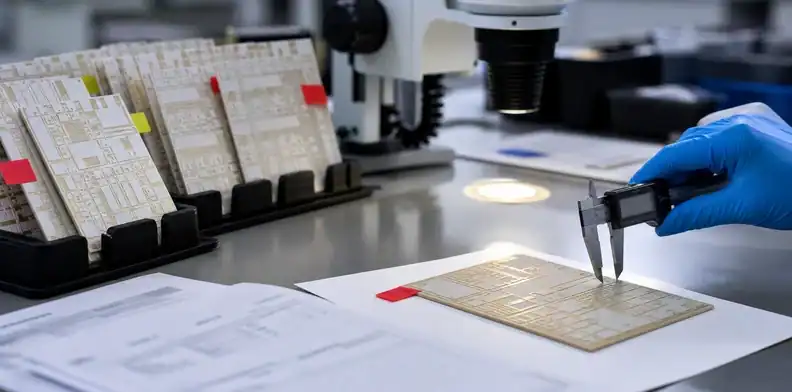
Strong warning signs include missing material grade, no named process route, no drawing revision on the quote, vague inspection language, unclear surface finish, no answer about assembly exposure, or a refusal to state what changes at higher quantity. Another warning sign is a supplier that treats ceramic PCB exactly like FR-4, especially for AlN, DBC, AMB, LTCC, or thin-film projects.
For overseas buyers, communication risk also matters. A supplier may technically support the route but still be hard to use if English DFM notes, time-zone response, quotation revision control, and document return are weak. Those items affect schedule and receiving quality, not only convenience.
| Warning sign | Why it matters | Buyer response |
|---|---|---|
| No material grade or route on quote | Supplier may substitute silently | Request revised quote before PO |
| No inspection evidence listed | Receiving has no release basis | Define records before next lot |
| Prototype and production quote look identical | Production evidence may be missing | Ask for production assumptions |
| Supplier avoids thermal or assembly questions | Ceramic stress risk is unmanaged | Pause or limit to learning build |
| No change-control owner | Future lots may drift | Require written approval rule |
FAQ
Can I use the same supplier for ceramic PCB prototype and production?
Yes, if the supplier can document the production route, not just build a sample. Ask for material, process, inspection, packaging, and change-control evidence before increasing quantity.
When should I switch from a ceramic PCB prototype supplier to a production supplier?
Switch when repeatability, customer approval, qualification evidence, or volume scheduling becomes more important than fast learning. The trigger is evidence need, not only order quantity.
Is a successful AlN ceramic PCB prototype enough for production?
No. An AlN prototype must be tied to material grade, thermal intent, copper process, flatness, finish, and assembly exposure before it becomes production evidence.
What makes DBC or AMB production transfer different?
DBC and AMB transfer needs copper bonding or brazing evidence, ceramic family, isolation expectations, surface finish, warpage control, and reliability assumptions. A sample photo is not enough.
What should overseas buyers verify before scaling a ceramic PCB order?
Verify English DFM response, quote revision, material route, drawing revision, inspection evidence, packaging, shipment documents, and who approves substitutions.
Sources
- IPC-6012 rigid printed board qualification and performance standard
- IPC J-STD-001 soldered electrical and electronic assemblies standard
Send QueenEMS a ceramic PCB transfer package
Request a production-transfer review with the prototype results, released construction, intended order volume and proposed process changes. Include any prototype-only concessions. The next quotation should identify which requirements remain unchanged and which changes need another engineering approval.
Written by the QueenEMS Engineering Team
Upload your files today · Free DFM check before production · Ship worldwide
Get your PCB prototypes in as fast as 24 hours. We handle FR4, Rogers, and Flex up to 60 layers — free prototypes for 2–4 layer boards, no minimum order.
Just upload your Gerber + BOM — we source every part, assemble, and inspect (AOI + X‑Ray) so you don't have to chase suppliers. Boards ship in as fast as 24 hours.