
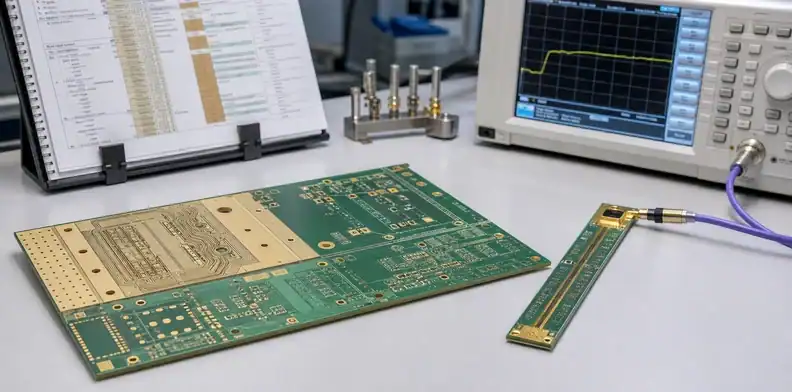
Quick Answer: A hybrid PCB impedance coupon should prove the controlled structure that matters on the board, not just show a passing trace on a generic panel strip. The buyer should approve the stackup, coupon geometry, test method, layer mapping, and release limit before production so TDR evidence can support receiving and repeat orders.
Key takeaways
- A coupon is useful only when it represents the same layer pair, dielectric group, copper condition, and routing class as the controlled circuit.
- TDR evidence should be tied to the released stackup and coupon drawing, then saved with the PO or first-lot quality file.
- Mixed PTFE, hydrocarbon ceramic, and FR4 constructions need sharper coupon boundaries than ordinary FR4 boards.
- The safest RFQ asks the supplier to state what is represented, what is not represented, and which change would trigger a new impedance review.
The impedance question usually appears late, when layout is finished and purchasing wants a quote that can survive production. A supplier may answer “controlled impedance included,” but that phrase does not say whether the test coupon represents the actual hybrid layer pair, whether the trace was tested by TDR, or whether the board feature that matters is inside the measured coupon family.
This article is not a repeat of the general PCB impedance test report requirements page. That page explains report fields for ordinary controlled-impedance work. This page focuses on the buyer decision for a mixed-material board, where a low-loss core, FR4 support layers, thin bondply, resin content, copper roughness, and RF launch geometry can make one coupon result weaker than it looks.
The practical goal is simple: give engineering, purchasing, and quality a quote-ready way to ask for impedance proof before the order is released, then keep that proof with the finished boards.
Table of Contents
- Decide what the coupon must represent
- Connect coupon design to the released stackup
- State the TDR method and acceptance window
- Separate board features from panel coupons
- Review traceability before shipment
- Compare supplier replies without guessing
- Write the impedance proof into the RFQ
- Keep the result useful for the next order
Decide what the coupon must represent
The first buyer decision is not whether an impedance coupon exists. It is which circuit feature the coupon is supposed to represent. In a hybrid PCB, the answer may be a stripline inside a low-loss core, a microstrip over a Rogers or similar RF dielectric, a high-speed trace that transitions into FR4, or a controlled launch near an edge connector.
Ask engineering to name the controlled structure before the quote is released. A useful request says “50 ohm single-ended microstrip on L1 referenced to L2,” “90 ohm differential stripline on L3/L4,” or another specific construction. A bare statement such as “impedance controlled board” leaves too much room for the supplier to test the easiest representative structure instead of the one that carries risk.
The coupon should also match the copper condition that affects the circuit. Finished copper, plated copper, etch compensation, solder mask over microstrip, and surface finish can change the practical result. Purchasing does not need to solve field theory, but it does need to ask whether the test coupon reflects the built condition that engineering approved.
| Buyer question | Why it matters | Quote evidence |
|---|---|---|
| Which layer pair is represented? | Hybrid boards may contain several dielectric systems | Coupon drawing or impedance table |
| Which copper condition is represented? | Plating and etch change final width and height | Final CAM note or controlled trace table |
| Is solder mask included in the model? | Top-layer microstrip may shift after coating | Supplier impedance model note |
| Is the coupon on the production panel? | Separate coupons may not share the same local process | Panel drawing or traveler reference |
Representation rule: Treat an impedance coupon as release evidence only after the represented structure is named in the quote package.
Connect coupon design to the released stackup
The coupon is only as strong as the stackup it points to. For a hybrid board, the stackup should state laminate family, core and bondply thickness, copper weights, plating allowance, resin or bond system, layer order, and any controlled impedance layer pairs. If the coupon is designed before the supplier finalizes press thickness, the result can prove an outdated construction.
Use the supplier stackup signoff record as the anchor. The impedance coupon table should reference the same revision, not a sales quote sketch or early DFM estimate. That prevents a common receiving problem: the test report passes, but the buyer cannot tell whether the reported coupon belongs to the final approved construction.
The supplier should also flag where a field change breaks the coupon assumption. A material substitution, a new copper foil type, a different prepreg or bondply thickness, a routing-width adjustment, or a panelization change may require a fresh model or coupon review. Engineering owns that acceptance, while purchasing records whether the change was quoted.
Stackup call: The coupon, impedance table, and signed stackup should share one revision path before the board is released.
State the TDR method and acceptance window
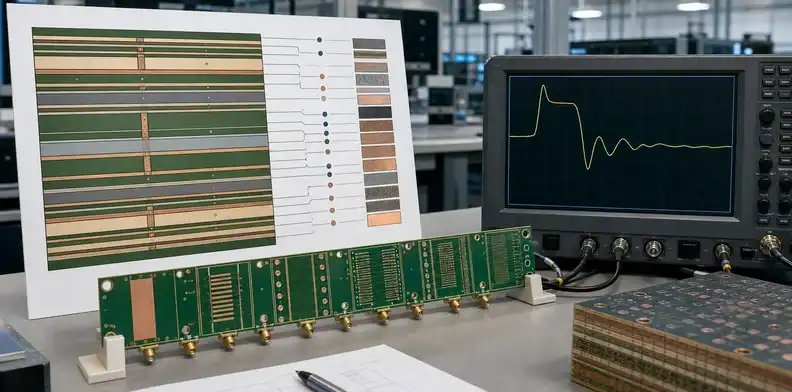
TDR evidence is useful when the method, target, and acceptance window are visible. A report that lists only “pass” may satisfy a shipping form, but it does not help a buyer compare quotes or defend a field issue. Ask for target impedance, allowed tolerance, tested coupon ID, layer or net class, test equipment or method reference, measured result, date, and disposition.
Do not invent a tolerance if the design owner has not approved one. Some commercial work uses a common plus or minus 10 percent tolerance, while tighter RF or high-speed applications may need a narrower window. The quote should state the window that will control shipment. If the buyer only says “controlled impedance,” two suppliers can quote different test limits and both sound compliant.
| Report field | Weak answer | Better answer |
|---|---|---|
| Target | Controlled | 50 ohm SE or 100 ohm differential by layer pair |
| Tolerance | Standard | Customer-approved range or supplier-stated limit |
| Coupon ID | Panel coupon | Coupon number tied to panel or traveler |
| Method | Tested | TDR method and equipment family or procedure |
| Result | Pass | Measured result with disposition |
Test rule: A coupon result should be quotable as target, tolerance, method, coupon identity, and measured value.
For RF and high-speed products, the buyer should also decide whether the report must include only coupon traces or whether the supplier should flag mismatched board features. A clear note such as “coupon represents straight transmission line only; launch geometry remains engineering-owned” prevents the report from being used beyond its scope.
Separate board features from panel coupons
A coupon does not automatically prove every impedance-sensitive feature on the board. It normally proves a representative transmission-line structure under controlled geometry. It may not prove an RF launch, a connector transition, a via stub, a cavity area, a local ground cut, a dense BGA escape, or a bend in a constrained zone.
That distinction matters in hybrid designs because the functional feature may sit near a material boundary or mechanical edge. The panel coupon can look clean while the real circuit is affected by local routing, copper pour, plating, mask, connector launch geometry, or a dielectric transition. Engineering should decide which features need simulation, layout review, special coupon, or first article measurement.
When the board includes RF launch geometry, connect this article with the related RF edge launch PCB thickness and stackup release records only when they apply. The buyer should not ask the coupon to prove a feature it was not designed to represent.
Boundary check. Use coupon evidence for representative lines, and use separate engineering evidence for local RF or high-speed features that the coupon does not copy.
Review traceability before shipment
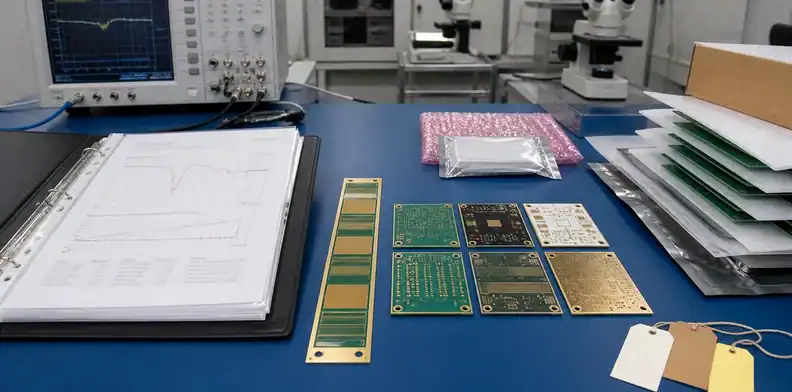
Traceability turns a coupon result into a receiving record. The test file should identify the order, part number, revision, lot, panel or coupon number, layer pair, result, and shipment relation. Without that path, quality may receive a report that looks professional but cannot be tied to the boards on the dock.
For a first supplier order, ask whether the coupon data will be shipped with the finished boards, sent before shipment, or retained by the factory unless requested. The answer affects receiving inspection. A startup or hardware team may not need a large quality system, but it does need a folder that connects the PO, approved stackup, test report, and any accepted deviation.
For larger or repeat orders, keep the result with PCB quality documents before shipment. A later reorder should not depend on memory that “the first batch worked.” It should reuse the approved construction and know which evidence level was accepted.
Record signal: A passing coupon is not complete until the buyer can connect it to the shipped lot and released revision.
Compare supplier replies without guessing
Two quotes can both say “impedance controlled” while covering different work. One may include modeling, panel coupons, TDR report, and engineer review. Another may include only CAM compensation and final electrical continuity. The lower price may be valid for a low-risk prototype, but it is not the same scope.
Ask each supplier to answer the same four items: what structure is represented, what method is used, what tolerance controls shipment, and what evidence is delivered. That converts a vague price comparison into a manufacturing decision. The buyer can then decide whether the risk supports a lighter package, a first article hold, or a fuller report.
| Supplier reply | Buyer interpretation | Next step |
|---|---|---|
| “Controlled impedance included” | Scope is not yet defined | Request coupon and report details |
| “TDR report by layer pair” | Better for receiving record | Check whether coupon represents the feature |
| “Simulation only” | May be enough before fabrication | Ask whether shipment proof is included |
| “No coupon possible” | Design or panel issue may exist | Ask for alternative evidence or design change |
Quote signal: The best reply is not always the longest reply; it is the one that states represented structure, method, tolerance, and deliverable evidence.
Write the impedance proof into the RFQ
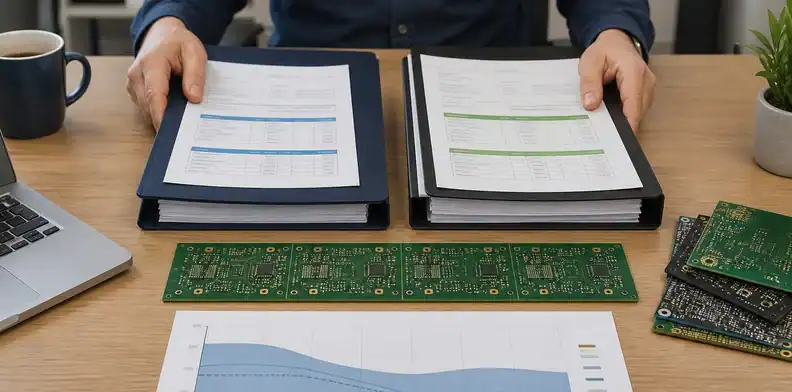
The RFQ should name the controlled structures, attach the released stackup, request the coupon or test report format, and state the approval rule for changes. It should also say whether the quote must include TDR evidence before shipment or whether the buyer will accept supplier-held records for a low-risk build.
A practical RFQ sentence can be short: “Please quote controlled impedance with representative production-panel coupon and TDR report for the listed layer pairs; state target, tolerance, coupon identity, method, and any stackup or material change that requires buyer approval.” That wording gives the supplier room to propose a manufacturable approach without hiding the evidence scope.
Connect the impedance request with processed Gerber approval after CAM review. If the supplier adjusts trace width to meet the target, the buyer needs to know whether that change is in the processed data and whether engineering accepts it.
RFQ call: Put the coupon evidence and change rule in the quote request, not in a late email after boards are already in process.
Keep the result useful for the next order
The first useful coupon result should become a controlled baseline. Save the final stackup, coupon report, CAM disposition, material records, and any accepted exception with the PO. On the next order, purchasing can ask whether the supplier will build the same construction, same material set, same coupon scope, and same release evidence.
This matters when demand grows. A prototype run can pass with extra attention, while a production lot may move to a different panel size, press load, copper source, or test process. The reorder record should define which changes are allowed silently and which require engineering review.
Before releasing repeat quantity, ask one direct question: “Will this order use the same approved impedance structure and coupon evidence as the previous accepted lot?” A supplier answer of “yes” should be tied to revision and lot history. A “no” should reopen the stackup and test decision.
Release point. Repeat orders should reuse the approved impedance evidence path or deliberately approve the change before production starts.
Sources
FAQ
Is an impedance coupon required for every hybrid PCB?
No. A coupon is most useful when the board has a controlled transmission-line requirement, a customer flow-down, or a risk that cannot be checked by visual inspection. A simple mechanical adapter may not need it, while an RF or high-speed product usually should define the evidence.
Can a TDR coupon prove an RF launch?
Usually no. A TDR coupon can prove a representative line, but a launch also depends on connector geometry, ground transition, edge plating, via fields, and local layout. Treat launch proof as a separate engineering or first-article question.
Should purchasing compare quotes by impedance price alone?
No. Compare the represented structure, method, tolerance, and delivered report. A cheaper quote may be acceptable only if the buyer is consciously accepting a lighter evidence package.
What should be saved for a repeat order?
Save the approved stackup, impedance table, coupon report, CAM change notes, and shipment relation. The reorder should ask whether those items remain unchanged.
If your PCB or PCBA project has a hybrid stackup, RF path, controlled impedance requirement, or shipment evidence question, send QueenEMS the released stackup, impedance table, Gerber or ODB++ data, and any required test format through the contact page. QueenEMS can review whether the quote package gives you a usable impedance evidence path before the supplier starts irreversible fabrication work.
Written by the QueenEMS Engineering Team
Upload your files today · Free DFM check before production · Ship worldwide
Get your PCB prototypes in as fast as 24 hours. We handle FR4, Rogers, and Flex up to 60 layers — free prototypes for 2–4 layer boards, no minimum order.
Just upload your Gerber + BOM — we source every part, assemble, and inspect (AOI + X‑Ray) so you don't have to chase suppliers. Boards ship in as fast as 24 hours.