
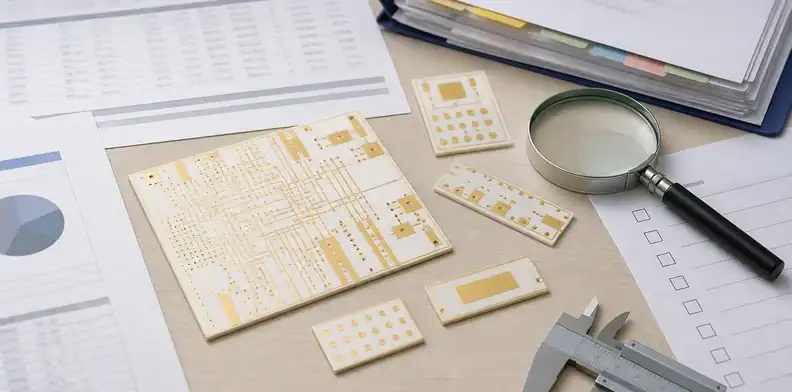
A ceramic base alone cannot establish RoHS or REACH compliance for the delivered product. The assessment must cover the supplied substrate, metallization, finish and any components or assembly materials. Keep shipping packaging in a separate scope: its material obligations cannot be inferred from an electronic-board declaration.
If a declaration uses unfamiliar process names, consult the ceramic PCB construction guide to identify which parts and materials need documentation.
That is where buyer confusion starts. A supplier may say the ceramic substrate is compliant, while the buyer actually needs a compliant finished article for an EU product file. Another supplier may provide a generic RoHS statement without naming the finish, solder process, or REACH SVHC screening basis. For medical, power, LED, RF, and industrial electronics, that gap can delay customer approval even when the board works electrically.
Quick Answer: Match declarations to the supplied ceramic PCB or assembly revision. RoHS substance limits apply to homogeneous materials in equipment within scope; REACH article obligations use their own definitions and thresholds. Check the material and finish, supplied BOM and assembly materials, applicable exemptions, dated Candidate List basis and other relevant REACH restrictions. Review packaging separately.
This article does not replace legal advice or product compliance ownership. It gives overseas buyers a practical RFQ and documentation checklist for ceramic PCB sourcing.
Table of Contents
- What does RoHS mean for ceramic PCB buyers?
- What does REACH mean for ceramic PCB buyers?
- Which ceramic PCB materials usually need the closest review?
- Can a bare ceramic substrate statement cover an assembled product?
- What compliance documents should buyers request?
- How should buyers handle exemptions, customer formats, and updates?
- How do ceramic PCB applications change the compliance package?
- What should you send before asking for a compliance quote?
What does RoHS mean for ceramic PCB buyers?
RoHS restricts certain hazardous substances in electrical and electronic equipment placed on the EU market. For a ceramic PCB buyer, the practical issue is whether the finished board or assembly contains restricted substances above the allowed limits, or whether an exemption is being used.
The European Commission states that RoHS currently restricts ten substances, including lead, cadmium, mercury, hexavalent chromium, PBB, PBDE, and four phthalates. It also states that products with an electrical or electronic component generally need to comply unless specifically excluded. That is why a ceramic PCB cannot be cleared only by saying “the ceramic is clean.”
For ceramic boards used in equipment within RoHS scope, collect evidence for the ceramic, metallization, finish, solder or die attach, component materials, wire bonds and marking materials that remain in the product. A lead-free assembly statement does not establish compliance with every restricted substance. RoHS limits apply to each homogeneous material, rather than the average composition of the whole board.
For example, weighing a small solder joint together with a large ceramic plate could dilute its apparent lead concentration. That calculation does not demonstrate the solder material meets a RoHS limit. Ask which material the reported concentration describes and whether an applicable exemption is being used.
| RoHS review item | Why it matters in ceramic PCB sourcing |
|---|---|
| Ceramic body | Usually not the only material in the finished article |
| Copper and metallization | Check substances remaining in the supplied metallization |
| Surface finish | Nickel, gold, silver, and other finishes need declared basis |
| Solder or die attach | Can introduce lead or other restricted substances |
| Components | Package terminals and internal materials need BOM-level support |
| Exemptions | Some products rely on specific RoHS exemptions that may expire or change |
A useful RoHS statement names the product scope and the version or basis of the declaration. A weak statement only says “RoHS OK” without naming the part number, finish, assembly state, date, or responsible supplier.
What does REACH mean for ceramic PCB buyers?
REACH is broader than RoHS because it covers chemical substance registration, restriction, authorization, and communication duties in the EU. For ceramic PCB buyers, the most common sourcing issue is whether any Candidate List substance of very high concern is present above the reporting threshold in an article and whether downstream communication is required.
Use the ECHA Candidate List current at the declaration date, and record that list date. Ask whether the statement covers Candidate List communication only or also the relevant REACH restrictions for the supplied product and use. An SVHC-content statement documents one part of the review; other applicable REACH duties still need to be checked.
A REACH statement needs a defined assessment scope. Identify the articles in the supplied object using the REACH definition; do not automatically call every deposited finish, adhesive or solder layer a separate article. ECHA explains that the Candidate List threshold applies to each constituent article within a complex object, rather than being diluted over the complete assembly. Document the assessment boundary when material is added during assembly.
For the Article 33 communication duty, a Candidate List substance above 0.1% weight by weight in an article triggers information needed for safe use, including the substance name. This communication duty has no annual-tonnage threshold. ECHA describes the supply-chain communication obligation; separate notification and SCIP requirements have their own conditions and responsible parties.
| REACH question | Useful supplier answer |
|---|---|
| Which article is covered? | Bare substrate, finished PCB, assembly, packaging, or all supplied items |
| Which list was checked? | Current ECHA Candidate List and any customer-required restricted list |
| Any SVHC above threshold? | Clear yes/no statement, substance name if present, and safe-use information |
| Who owns component data? | Supplier, buyer, distributor, or component manufacturer named |
| Update trigger | New Candidate List update, material change, finish change, or BOM change |
For EU-bound products, buyers should keep the supplier declaration with the drawing, BOM, finish, and revision it covers. A declaration separated from the revision record becomes hard to defend later.
Which ceramic PCB materials usually need the closest review?
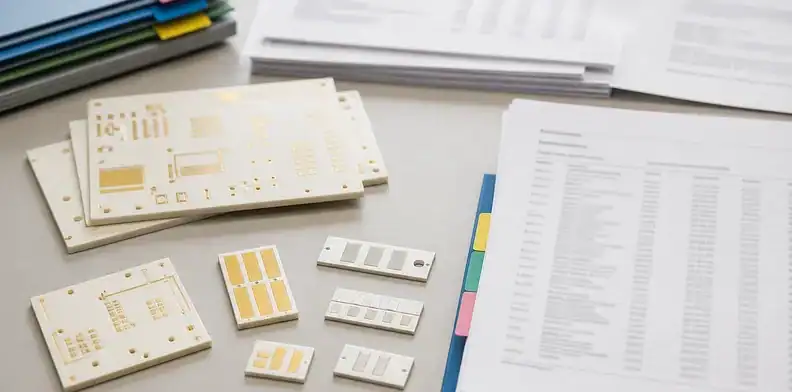
Review each material in the supplied construction using available composition and supplier evidence. Pay attention to metallization and thick-film formulations, finishes, solder or braze alloys, adhesives, inks and supplied components; do not assign a ceramic grade a low-risk status from its name alone.
For DBC or AMB, identify the ceramic grade, copper and any bonding material included in the purchased substrate. For film circuits, include the fired or deposited conductor system. Treat packaging declarations separately from the electronic construction; the EU packaging rules and any applicable REACH obligations need their own review.
The same applies to application-specific ceramic builds. An LED ceramic PCB may use high-reflectivity finishes or silicone materials. A power module substrate may involve die attach and heavy copper. An RF ceramic module may use gold finishes and package materials. A medical device project may have customer-specific material declarations beyond RoHS and REACH.
The ceramic PCB manufacturer hub gives the broader service context. For compliance, the important point is narrower: list every material that ships to the buyer, not only the ceramic substrate.
Can a bare ceramic substrate statement cover an assembled product?
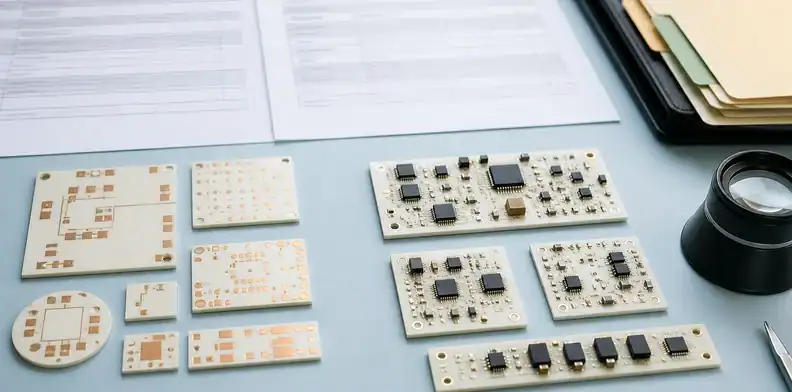
A bare-substrate declaration supports the supplied substrate scope. It cannot by itself cover subsequently added components, solder, die attach, wire bonding, adhesives or labels. Shipping packaging also needs a separately identified declaration scope when requested.
This distinction matters when a buyer purchases ceramic PCB plus assembly or supplies consigned components. The substrate supplier can declare what it provides. The assembly partner can declare solder process and assembly materials. Component manufacturers or distributors may need to support the BOM. The buyer usually still owns the final product compliance file.
| Supply scope | Compliance evidence usually needed |
|---|---|
| Bare ceramic substrate | Material and finish declaration for the supplied substrate |
| Finished ceramic PCB | Substrate, metallization, finish, and marking declaration |
| Ceramic PCB assembly | Bare board declaration plus solder, component, and assembly material data |
| Consigned component build | Buyer-provided component data plus assembler process declaration |
| EU product shipment | Product-level file aligned to the market and customer requirement |
The QueenEMS article on ceramic PCB for medical and implantable devices is a good example of why scope matters. Medical projects often need stricter documentation than a simple industrial prototype, even when both use ceramic substrates.
What compliance documents should buyers request?
Buyers should request documents that connect the compliance statement to the exact ceramic PCB revision. Generic certificates are weak unless they are tied to part number, drawing revision, material route, finish, assembly state, and date.
A practical compliance package can include a supplier RoHS declaration, supplier REACH/SVHC declaration, finish statement, lead-free process statement if assembly is included, BOM compliance records for components, material safety documents where relevant, customer-format declarations, and any exemption record. For EU-bound products, ask whether SCIP-related data is needed from the supply chain when SVHC obligations apply.
The supplier does not always need to send lab test reports for every order. Testing can be useful for risk review or customer demands, but documentation often starts with controlled material declarations. The buyer should decide when a lab report is required based on product risk, customer requirement, market, and supplier history.
| Document | Buyer use |
|---|---|
| RoHS declaration | Shows restricted-substance statement for the supplied article |
| REACH/SVHC declaration | Shows Candidate List screening basis and any reportable substance |
| Finish declaration | Links compliance to ENIG, silver, nickel/gold, or other surfaces |
| Assembly material statement | Covers solder, flux, adhesive, underfill, or die attach when included |
| BOM compliance file | Supports component terminals and package materials |
| Exemption record | Shows why a restricted substance is allowed when applicable |
Keep documents with the purchasing record. A compliance email without the drawing revision, date, and supplier identity is easy to lose and hard to use during customer review.
Review a Declaration Before Accepting It
The following is an illustrative document review, not a customer case or a model legal declaration. Suppose an email states only “our ceramic boards are RoHS and REACH compliant.” It does not identify the purchased revision, finish, assembly state or date of the substance-list check. The next step is to request the missing scope, not to infer a failed chemical test.
| Field to resolve | What makes the reply reviewable |
|---|---|
| Part and supplied scope | Part number, drawing revision, bare board or assembled product, and supplied versus consigned BOM items |
| RoHS basis | Applicable substance restrictions, evidence for homogeneous materials, and any precise exemption relied upon |
| REACH basis | Candidate List date, identified article boundaries, any substance requiring communication and the coverage of relevant restrictions |
| Changes and responsibility | Named issuing supplier, issue date and trigger for review after material, finish, BOM or legal-list changes |
A dated, part-specific reply closes identification gaps; it does not automatically validate the supporting evidence. If a component was consigned or a finish changed after the declaration, obtain the missing manufacturer data or an updated assessment before treating the assembly file as complete.
How should buyers handle exemptions, customer formats, and updates?
Buyers should handle exemptions, customer formats, and updates as change-controlled items. RoHS exemptions can be specific, time-sensitive, and application-dependent. REACH Candidate List updates can create new communication duties after an older declaration was issued.
If an exemption is used, record its exact entry, application and equipment category, and check the current legal status for the relevant market-placement date. Expiry and a timely renewal application can affect that status; a customer accepting the paperwork does not itself create a legal exemption. Use the Commission’s RoHS implementation information to locate the current exemption documents.
Customers may request material-declaration formats such as IPC-1752, full material disclosure or IMDS, as well as their own restricted-substance lists. CMRT and EMRT address responsible-minerals sourcing and serve a different purpose; they do not establish RoHS or REACH compliance. Agree the required formats before quote release.
The QueenEMS article on halogen-free PCB cost and manufacturing rules is related because customer environmental requirements often travel together. Halogen-free is not the same as RoHS or REACH, but buyers often ask for all three in one supplier package.
How do ceramic PCB applications change the compliance package?
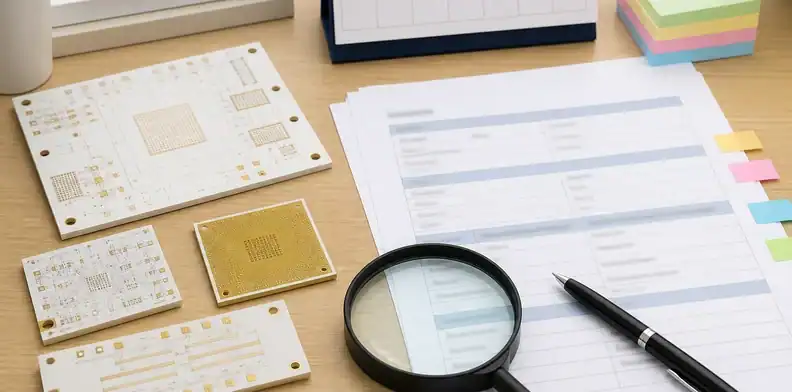
Ceramic PCB applications change the compliance package because the supplied article and customer risk are different. A bare AlN heat spreader, an LED ceramic PCB, an RF module, a power substrate, and a medical electronics assembly do not need identical evidence.
For LED and UV-C products, review solderable finish, LED package data, reflectivity-related materials, adhesives, lens or silicone materials if supplied, and customer market requirements. For power modules, review DBC or AMB substrate declarations, die attach, solder, copper construction, and any high-temperature process material. For RF modules, review gold finish, package materials, and controlled material substitutions. For medical electronics, align the compliance package with the device maker’s quality and regulatory file.
The top ceramic PCB manufacturers in China article helps buyers understand the material supplier landscape, while ceramic supplier qualification checks gives supplier screening questions. Compliance belongs in that screening, especially for overseas buyers who need English declarations and customer-ready records.
What should you send before asking for a compliance quote?
Send enough information for the supplier to define the compliance scope before quoting. A useful request includes the ceramic material, process route, finish, assembly scope, component BOM, target market, customer declaration format, required standards or restricted substance lists, expected shipment destination, and whether the product is prototype, pilot, or production.
The RFQ should also state whether the buyer needs a declaration only, material disclosure, lab testing, exemption support, or customer form completion. Each option changes the supplier’s work. For small-batch buyers, asking early prevents an unpleasant surprise after the boards are already built.
Useful RFQ wording:
Please confirm RoHS and REACH declaration support for the supplied ceramic PCB scope, including substrate material, metallization, finish, solder or assembly materials if included, BOM components if supplied by you, current REACH Candidate List basis, and any exemption used.
Send QueenEMS a ceramic PCB compliance review package
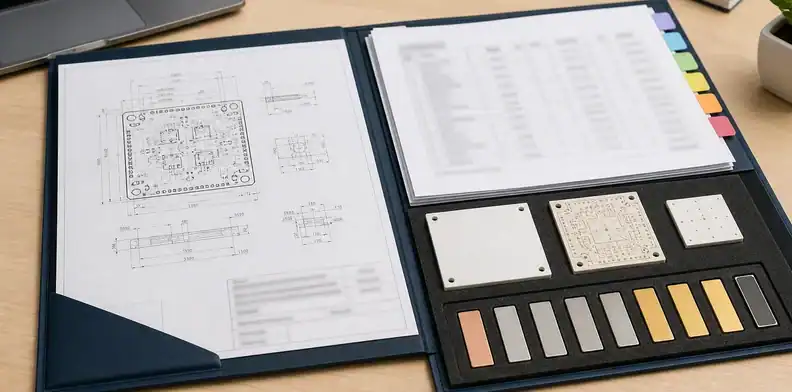
Discuss the required compliance documents with QueenEMS. Supply the finished construction, BOM, target market, customer declaration form and any claimed exemption. Identify consigned components and other items outside the supplier’s scope so the document request reaches the responsible party.
FAQ
Is ceramic PCB automatically RoHS compliant?
No. For a board used in equipment within RoHS scope, evidence must address the homogeneous materials in the supplied construction. Components and assembly materials require coverage when included. Shipping packaging is a separate scope.
Is ceramic PCB automatically REACH compliant?
No. Check the article scope, Candidate List date and any communication duty, together with the REACH restrictions relevant to the product and use. Candidate List screening alone is not proof of every REACH obligation.
Does RoHS apply to prototypes?
RoHS obligations depend on market placement and product scope, not only prototype status. Even for engineering prototypes, many customers request RoHS documentation before approving a supplier.
Do I need lab testing for every ceramic PCB order?
Not always. Many projects start with controlled supplier declarations, but lab testing may be required by customer policy, high-risk materials, missing supplier evidence, or regulated end markets.
What is the biggest compliance mistake with ceramic PCB sourcing?
The biggest mistake is accepting a bare-substrate declaration as proof for a finished assembled product. Match the declaration to the exact supplied scope and revision.
Sources
- European Commission, Restriction of Hazardous Substances in Electrical and Electronic Equipment
- ECHA, Candidate List of substances of very high concern
Written by the QueenEMS Engineering Team
Upload your files today · Free DFM check before production · Ship worldwide
Get your PCB prototypes in as fast as 24 hours. We handle FR4, Rogers, and Flex up to 60 layers — free prototypes for 2–4 layer boards, no minimum order.
Just upload your Gerber + BOM — we source every part, assemble, and inspect (AOI + X‑Ray) so you don't have to chase suppliers. Boards ship in as fast as 24 hours.