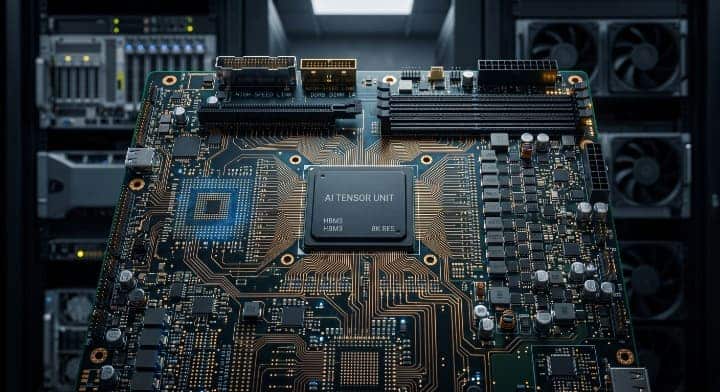
Quick Answer: IT-988GSE is ITEQ’s flagship halogen-free, ultra-low-loss material utilizing Low-Dk glass to deliver a dissipation factor (Df) of <0.0014 at 10 GHz. It sits directly on the M7-M8 boundary, serving as the primary Taiwanese supply chain alternative to EM-892K2 for 800G switches and AI servers. Key takeaways:
- Uses Low-Dk glass (“SE”) to drop Df from 0.0025 to 0.0016 at 28 GHz compared to the standard IT-988G.
- Competes directly with EM-892K2 and Doosan DS-7409DJN+ in the halogen-free M8 performance category.
- Processes identically to standard FR-4 at 200°C lamination without requiring plasma desmear.
- Acts as the default material choice for Foxconn, Quanta, and other Taiwanese ODM ecosystem projects.
Table of Contents
- What Is IT-988GSE and What Does the “SE” Stand For?
- How Does the IT-988G Family Split Between E-Glass and Low-Dk?
- What Electrical and Thermal Properties Define This Material?
- Which 800G Switch and AI Server Designs Use It?
- How Does IT-988GSE Compare to EM-892K2 and DS-7409DJN+?
- Does This ITEQ Laminate Actually Qualify as M8-Grade?
- What Stackup and Design Rules Apply to These Boards?
- How Do Fabricators Process IT-988GSE vs Other M8 Options?
- When Should You Choose ITEQ Over TerraGreen 400G2?
- What Comes After This Halogen-Free Series in the Roadmap?
- FAQ
Hardware engineers constantly face signal integrity failures when pushing standard M7 laminates past 56Gbps, yet find top-tier M8 options prohibitively expensive for volume production. You need a substrate that hits strict Df targets without destroying your project budget. Upgrading to IT-988GSE and M9 AI server PCB standards solves this specific problem by providing M8-level electrical performance (Df <0.0014 @ 10 GHz) at a highly competitive price point. This positions the material as a primary candidate for high-speed routing in modern network infrastructure.
What Is IT-988GSE and What Does the “SE” Stand For?
IT-988GSE is a special edition laminate that relies on Low-Dk glass to achieve a Df of 0.0016 at 28 GHz, vastly outperforming standard E-glass versions. This exact formulation makes it ITEQ’s flagship halogen-free, ultra-low-loss choice for extreme high-speed routing in data centers.
The Meaning Behind the “SE” Designation
The “SE” stands for Special Edition, specifically indicating the integration of Low-Dk glass reinforcement instead of traditional E-glass. Many designers fail their insertion loss tests because they specify the base material without the “SE” suffix, which means the factory uses the higher-loss E-glass variant.
Here is why that specific glass choice matters for your signal integrity:
- Drops dielectric constant (Dk) from <3.76 (E-glass) to <3.21 at 10 GHz.
- Reduces dissipation factor (Df) from 0.0025 to 0.0016 at 28 GHz.
- Generates 38-50% lower insertion loss compared to incumbent materials.
Bottom line: If your hardware operates above 28 GHz, you must explicitly specify the “SE” version on your fabrication notes, because the standard variant will fail your insertion loss targets.
| Material Variant | Glass Type | Dk (@ 10 GHz) | Df (@ 28 GHz) | Application Target |
|---|---|---|---|---|
| IT-988G | E-glass | < 3.76 | 0.0025 | Mid-tier ultra-low-loss |
| IT-988GSE | Low-Dk glass | < 3.21 | 0.0016 | Flagship 800G routing |
Analysis: Switching from E-glass to Low-Dk glass yields a massive 36% reduction in dissipation factor at high frequencies.
How Does the IT-988G Family Split Between E-Glass and Low-Dk?
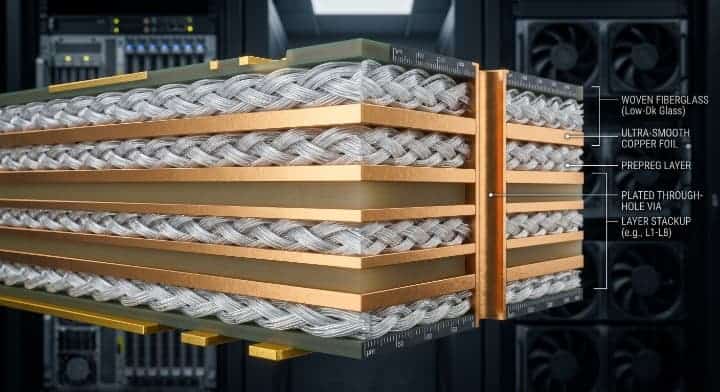
The IT-988GSE laminate belongs to a broader family that splits into four distinct tiers based on glass type and generational technology. Standard E-glass variants serve mid-tier ultra-low-loss needs, while Low-Dk variants handle flagship 800G requirements and beyond.
Navigating the Material Tiers
Engineers often mix up the part numbers within the ITEQ catalog, resulting in costly prototype failures. By understanding the suffix naming convention, you can accurately match the right material to your specific bandwidth requirements and budget constraints, similar to selecting a Panasonic Megtron 8 manufacturing guide for a project.
Consider the breakdown of the product matrix:
- G Series: The baseline ultra-low-loss materials using standard E-glass.
- GSE Series: The current flagship incorporating Low-Dk glass for superior performance.
- GL Series: A cost-optimized, mid-to-low-tier variant using E-glass.
- GLSE Series: The upcoming generation utilizing Low-Dk glass for future scalability.
Bottom line: Always verify the exact part number on your stackup documentation, because accidentally swapping a GLSE for the SE version will severely alter your impedance calculations.
| Family Member | Glass Type | Df (@ 10 GHz) | Performance Tier |
|---|---|---|---|
| IT-988G | E-glass | < 0.0035 | Standard |
| IT-988GL | E-glass | < 0.0033 | Cost-optimized |
| IT-988GLSE | Low-Dk glass | < 0.0025 | Next-generation budget |
| IT-988GSE | Low-Dk glass | < 0.0014 | Current Flagship |
Analysis: The GSE variant remains the only option in this specific family capable of dropping the Df below the 0.0015 threshold.
What Electrical and Thermal Properties Define This Material?
IT-988GSE delivers a Dk of <3.21 and a Df of <0.0014 at 10 GHz, combined with a high Tg of >230°C. These metrics allow it to match the thermal stability of options like the Isola Tachyon 100G ultra-low-loss laminate guide while maintaining full halogen-free compliance.
Core Specifications for Signal Integrity
Via-in-pad is a routing technique where vias are drilled directly into component pads to save surface space. IT-988GSE supports this aggressively due to its low 2.5% Z-axis expansion rate between 50-260°C, which prevents copper barrel cracking during thermal cycling.
Keep these key metrics in mind for your calculations:
- Dk at 28 GHz (60% RC) measures exactly 3.28.
- Df at 28 GHz (60% RC) measures exactly 0.0016.
- Glass transition temperature (Tg) via TMA hits 180°C.
Bottom line: You can safely deploy this material in high-layer-count boards, because its minimal Z-axis expansion and >230°C Tg prevent via barrel cracking during multiple lead-free reflow cycles.
| Parameter | Value | Test Condition |
|---|---|---|
| Dielectric Constant (Dk) | < 3.21 | @ 10 GHz |
| Dissipation Factor (Df) | < 0.0014 | @ 10 GHz |
| Z-axis Expansion | ~2.5% | 50-260°C |
| Halogen-Free | YES | IPC-4101E |
Analysis: The combination of sub-3.3 Dk and low Z-axis expansion makes it exceptionally stable for complex, multi-layered microwave designs.
Which 800G Switch and AI Server Designs Use It?
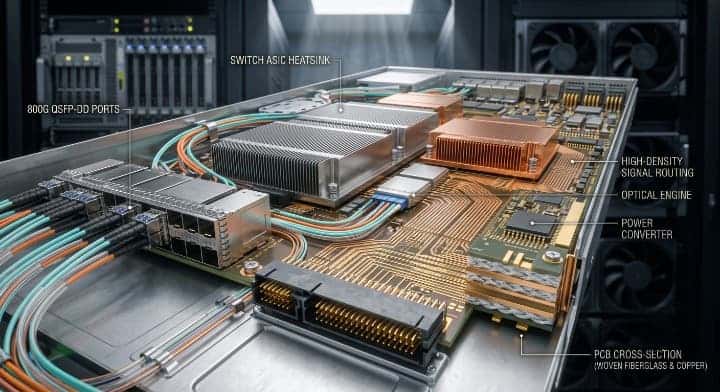
IT-988GSE is heavily utilized in 800G network switches, 56Gbps+ server architectures, and radar hybrid systems. Its targeted resin formulation allows it to handle the extreme data throughput required by modern artificial intelligence hardware architectures.
Primary Application Environments
Clients frequently present 32-layer AI server boards suffering from severe signal degradation on their high-speed nets. We fix this by migrating their stackup to this specific material and running a free DFM engineering review, resulting in a 40% reduction in signal attenuation on long trace runs.
It excels heavily in these specific sectors:
- Next-generation 800G network switches requiring minimal insertion loss.
- AI server motherboards operating on 112G PAM4 signaling protocols.
- High-frequency automotive and military radar hybrid PCBs.
Bottom line: If your hardware relies on 112G PAM4 signaling over long backplanes, this laminate provides the necessary electrical headroom without forcing you into expensive PTFE materials.
| Application Type | Key Requirement | Material Benefit |
|---|---|---|
| 800G Switches | Low insertion loss | 38-50% loss reduction |
| AI Servers | High thermal reliability | >230°C Tg |
| Radar Hybrids | Stable Dk at high frequencies | Dk 3.28 @ 28 GHz |
Analysis: The material’s balanced profile serves high-bandwidth and high-temperature environments equally well.
How Does IT-988GSE Compare to EM-892K2 and DS-7409DJN+?
The most useful way to think about IT-988GSE is as the third halogen-free M8-class option alongside the EM-892K2 halogen-free M8 guide and DS-7409DJN+. Each material delivers similar electrical performance, ranging from 0.0013 to 0.0014 at 10 GHz.
The Supply Chain Decision Triangle
Each material delivers similar electrical performance — Df 0.0013-0.0014 at 10 GHz, FR-4-compatible processing, and halogen-free compliance. The differentiator is the supply chain ecosystem. EM-892K2 is the default if your project targets NVIDIA Blackwell or Rubin platforms, because EMC holds NVIDIA qualification and M10 testing incumbent status. DS-7409DJN+ is the default if your project involves the Samsung HBM ecosystem or requires forward M9 roadmap continuity.
The choice comes down to your manufacturing ecosystem:
- EM-892K2 dominates the NVIDIA-qualified ecosystem.
- DS-7409DJN+ controls the Samsung HBM ecosystem.
- IT-988GSE is the default if your ODM partner is Foxconn, Quanta, Compal, or Pegatron.
Bottom line: Do not select your material based solely on datasheet numbers; choose the laminate that naturally aligns with your primary manufacturing partner’s existing supply chain and distribution channels.
| Material | Manufacturer | Df @ 10 GHz | Halogen-Free | Target Ecosystem |
|---|---|---|---|---|
| IT-988GSE | ITEQ | < 0.0014 | YES | Taiwanese ODMs |
| EM-892K2 | EMC | ~0.0013 | YES | NVIDIA Platforms |
| DS-7409DJN+ | Doosan | ~0.0013 | YES | Samsung HBM |
Analysis: All three materials offer nearly identical electrical performance, making ecosystem compatibility the primary deciding factor.
Does This ITEQ Laminate Actually Qualify as M8-Grade?
Yes, IT-988GSE mathematically qualifies as an M8-grade material because its Df is <0.0014 at 10 GHz, sitting just below the M8 threshold of 0.0015. However, at 28 GHz, its Df rises slightly to 0.0016, placing it squarely on the M7-M8 boundary compared to other ways to specify a halogen-free PCB.
Understanding the M-Grade Boundary
Many engineers assume an M8 classification guarantees a flat Df across all testing frequencies. In reality, the testing frequency determines the grade classification, which means a material can be M8 at 10 GHz but act like M7 at 28 GHz.
Keep this frequency behavior in mind:
- M8 classification requires a Df of ≤ 0.0015.
- At 10 GHz, the material passes easily with <0.0014.
- At 28 GHz, the material slightly exceeds the limit at 0.0016.
Bottom line: If your strict requirement is Df ≤ 0.0015 at 28 GHz, this material slightly misses the mark; but for standard 10 GHz testing, it serves as a fully compliant M8 option.
| Frequency | Measured Df | M-Grade Classification |
|---|---|---|
| 10 GHz | < 0.0014 | M8 Grade |
| 28 GHz | 0.0016 | M7-M8 Borderline |
Analysis: The material’s grade shifts slightly based on the operating frequency, requiring careful matching to your actual signal speeds.
What Stackup and Design Rules Apply to These Boards?
Stackups utilizing IT-988GSE require ultra-low profile (ULP) copper and careful sequential lamination planning to maintain precise signal integrity. Standard designs typically support up to 60 layers while heavily utilizing HDI PCB fabrication with sequential lamination for tight routing.
High-Density Routing Strategies
Clients often submit designs with mismatched prepreg styles, causing severe resin starvation during pressing. We resolve this by providing free DFM engineering reviews to guarantee correct glass weave selection, which directly results in a 99.7% first-pass yield on production runs.
Design rules you must follow for this substrate:
- Specify ultra-low profile (ULP) copper foils only.
- Maintain symmetrical prepreg construction to prevent board warpage.
- Account for the slightly wider resin flow window during impedance calculations.
Bottom line: Always pair this laminate with ultra-low profile copper, because standard HVLP copper will create excessive surface roughness and ruin your high-frequency insertion loss gains.
| Design Feature | Requirement | Reason |
|---|---|---|
| Copper Foil | ULP (Ultra-Low Profile) | Minimizes skin effect losses |
| Max Layer Count | Up to 60 layers | High Tg and thermal stability |
| Desmear Process | Permanganate only | No plasma required |
Analysis: Strict adherence to ULP copper is non-negotiable to extract the maximum performance from the Low-Dk glass.
How Do Fabricators Process IT-988GSE vs Other M8 Options?
IT-988GSE processes almost identically to EM-892K2 and TerraGreen 400G2 in our facility, running on standard FR-4 lamination at 200°C for 60-90 minutes. It requires only standard permanganate desmear and completely avoids the complex plasma treatments associated with PTFE materials.
Lamination and Drilling Behavior
All three are halogen-free thermoset systems that run on standard FR-4 lamination. The primary difference is prepreg behavior during lamination: IT-988GSE prepreg has a slightly wider resin flow window than EM-892K2, which we attribute to the Low-Dk glass reinforcement having a more open weave than EM-892K2’s NER-glass. This makes it marginally more forgiving on lamination pressure tolerance — roughly ±5% pressure variation produces acceptable results versus ±3% on EM-892K2.
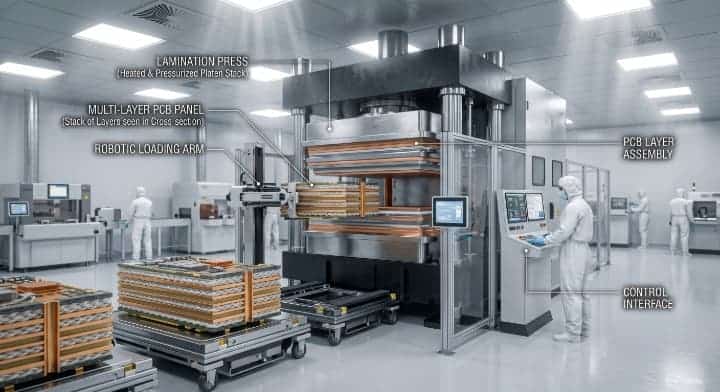
From the factory floor perspective, observe these metrics:
- Drill bit life on the Low-Dk glass measures approximately 2,100 hits.
- First-pass yield on recent 18-layer 800G switch boards landed at a stable 94%.
- Requires standard 200°C pressing, drastically saving energy costs.
Bottom line: You can switch to this material without forcing your PCB factory to invest in new equipment, keeping your prototype and production lead times extremely short.
| Processing Metric | IT-988GSE | EM-892K2 | Megtron 8 |
|---|---|---|---|
| Drill Bit Life (Hits) | ~2,100 | ~2,200 | ~1,800 |
| Pressure Tolerance | ±5% | ±3% | Strict |
| Lamination Temp | 200°C | 200°C | >200°C |
Analysis: The slightly wider resin flow window gives fabrication plants more margin for error during pressing compared to competing laminates.
When Should You Choose ITEQ Over TerraGreen 400G2?
You should select ITEQ when your primary manufacturing takes place in Taiwan or when working directly with major ODMs like Foxconn and Quanta. While a detailed comparison of EM-892K2 fabrication shows it dominates the NVIDIA ecosystem, ITEQ offers better local availability and pricing for Taiwanese facilities.
Strategic Procurement Advantages
Supply chain geography dictates your lead times and prototype speed. Sourcing TerraGreen 400G2 in Asia can sometimes add weeks to your schedule, whereas ITEQ materials are warehoused locally near all major Asian assembly hubs, resulting in faster turnarounds.
Make the switch to ITEQ when:
- Your project timeline demands 24-hour fastest turnaround on raw materials.
- Your contract manufacturer already buys ITEQ FR-4 in high volumes.
- You need to avoid the premium pricing associated with American-branded laminates.
Bottom line: Route your bill of materials (BOM) through ITEQ if you want to eliminate overseas shipping delays and leverage the existing material stock of Taiwanese PCB factories.
| Scenario | Recommended Material | Primary Reason |
|---|---|---|
| Taiwanese ODM Build | IT-988GSE | Local distribution network |
| NVIDIA Direct Build | EM-892K2 | Existing M10 qualification |
| American Prototyping | TerraGreen 400G2 | US domestic availability |
Analysis: Procurement logistics often outweigh minor datasheet differences when pushing a product to mass production.
What Comes After This Halogen-Free Series in the Roadmap?
The next evolution in ITEQ’s roadmap includes the IT-998SE and IT-999G series, which are scheduled for mass market release by 2026. These next-generation materials are engineered to support 224G transmission rates while pushing Df values even lower than the current IT-988GSE capabilities.
Future-Proofing Your Hardware
As bandwidth requirements double over the next few years, current M8 materials will hit a physical performance wall. The upcoming 998 and 999 series will solve this by dropping Df values further while maintaining the familiar, cost-effective FR-4 processing profile factories prefer.
Watch for these upcoming developments:
- IT-998SE will replace the current flagship for mid-tier 224G applications.
- IT-999G will push into extreme low-loss territory for next-gen AI.
- Both will retain strict halogen-free compliance for European markets.
Bottom line: If your hardware lifecycle extends past 2026 into 224G territory, start discussing IT-998SE qualification with your fabrication partner today to avoid future signal bottlenecks.
| Generation | Target Speed | Release Window | Key Focus |
|---|---|---|---|
| IT-988GSE | 112G / 800G | Current | M8 Halogen-Free |
| IT-998SE | 224G / 1.6T | 2026 | Sub-M8 Performance |
| IT-999G | Next-Gen AI | 2026+ | Extreme Low Loss |
Analysis: ITEQ’s clear roadmap provides hardware engineers with a safe, upgradeable path for long-term product lifecycles.
Final Thoughts
Successfully routing an 800G switch or AI server requires balancing extreme signal integrity demands against practical manufacturing constraints. IT-988GSE achieves this balance by pairing M8-level electrical performance with standard FR-4 processing ease. By specifying the Low-Dk glass variant and partnering with an experienced fabrication team, you can confidently hit your high-speed targets without breaking your budget. Please contact us today for AI server PCB quotes to see how we can optimize your next high-speed design.
Written by the QueenEMS Engineering Team
FAQ
Can I use standard E-glass for my 800G switch? No, standard E-glass will not meet modern 800G insertion loss requirements. You must specify the Low-Dk glass “SE” version, which effectively drops the Df to 0.0016 at 28 GHz to keep signals intact. Always explicitly label the SE variant on your fabrication notes.
What is the best way to process IT-988GSE vias? The best method is standard mechanical drilling followed by a basic permanganate desmear. Drill bits typically last for 2,100 hits due to the specific glass weave, and expensive plasma desmear is completely unnecessary. Ask your fabricator to verify their drill feed rates prior to production.
How do I know if this material fits my AI server project? Yes, it fits perfectly if your ODM manufacturing partner is Foxconn, Quanta, Compal, or Pegatron. It operates as the preferred Taiwanese supply chain material for high-speed AI platforms outside the strict NVIDIA Blackwell ecosystem. Verify your ODM’s supply chain preferences before locking your BOM.
Does this laminate require special lamination presses? No, it processes smoothly at standard 200°C temperatures using traditional FR-4 lamination equipment. It provides a slightly wider resin flow window than competitors, tolerating ±5% pressure variations. This keeps your manufacturing costs significantly lower than PTFE alternatives.
Will this material cause issues with Via-in-pad designs? No, it handles Via-in-pad designs exceptionally well. Its Z-axis expansion rate is heavily controlled at roughly 2.5%, preventing copper barrel cracking during sequential lamination and reflow cycles. Guarantee your fabricator uses proper via filling and planarization techniques.
Upload your files today · Free DFM check before production · Ship worldwide
Get your PCB prototypes in as fast as 24 hours. We handle FR4, Rogers, and Flex up to 60 layers — free prototypes for 2–4 layer boards, no minimum order.
Just upload your Gerber + BOM — we source every part, assemble, and inspect (AOI + X‑Ray) so you don't have to chase suppliers. Boards ship in as fast as 24 hours.