

Quick Answer: Hybrid PCB first article inspection should prove that the supplier built the released mixed-material construction, met the critical mechanical and electrical characteristics, closed all approved deviations, and created a repeatable baseline for production. The buyer should define the report package before the PO so the first lot is not reduced to one attractive sample and a generic certificate.
Key takeaways
- First article approval is a controlled decision against the drawing, stackup, and inspection plan—not a visual opinion.
- Hybrid evidence should cover material identity, final stackup, holes, registration, thickness, impedance or RF needs, finish, electrical test, and traceability as applicable.
- The report must separate measured results, supplier statements, and open deviations.
- Production release should state what remains fixed and which changes require a new or partial first article review.
A working prototype does not automatically prove that a hybrid PCB is ready for repeat production. The board may function while material identity, final dielectric thickness, hole-wall preparation, layer registration, or coupon evidence remains undocumented. Those gaps often surface only when a second supplier, a larger lot, or a customer audit asks what was actually approved.
The purpose of hybrid PCB first article inspection is to convert the first build into an evidence-backed production baseline. Engineering checks design intent. Quality checks measured conformance. Purchasing checks that the quoted evidence and change rules are included. Management gets a clearer answer to the question, “Can we release the next quantity without reopening hidden technical assumptions?”
This page is specific to a bare mixed-material PCB and its handoff to assembly. It does not repeat the general first article inspection versus AOI page or the full PCBA component-verification process.
The practical output is a signed release record that purchasing can attach to the PO, quality can use at receiving, and engineering can reopen when a controlled input changes.
Table of Contents
- Define the first article approval boundary
- Freeze the files and characteristics to be inspected
- Build an evidence package for the hybrid risks
- Separate conformance from functional validation
- Close deviations before approving production
- Create a repeatable production baseline
- Write the first article request into the RFQ
Define the first article approval boundary
The first decision is what the approval covers. It may cover bare PCB fabrication only, the assembled PCBA, or both in sequence. For a hybrid board, bare-board approval usually needs to occur before expensive components are committed, yet some RF or functional characteristics can only be verified after connector installation or assembly.
Write the boundary in one sentence: “Approve the first fabricated lot against the listed stackup and characteristics before volume PCB release,” or “Approve bare-board conformance first, then approve assembled RF performance before the remaining quantity is built.” This keeps a PCB report from being mistaken for a complete product qualification.
Identify the approval owner. Engineering owns functional and design-impact decisions. Quality owns conformance and disposition. Purchasing owns PO scope and commercial release. The supplier provides evidence and stops at the defined hold point. One person may fill more than one role in a small company, but the decisions should still be visible.
| Approval boundary | What it proves | What remains open |
|---|---|---|
| Bare PCB first article | Fabricated board matches released characteristics | Component placement and product function |
| PCBA first article | Assembly and component setup match released data | Long-term product qualification unless included |
| RF launch validation | Connector-to-board transition meets agreed test | Other PCB characteristics not measured by RF test |
| Production baseline approval | Controlled files, evidence, and deviations are closed | Future changes and lot-to-lot process monitoring |
Boundary rule: State exactly which release decision the first article supports and which later validations are outside that approval.
Freeze the files and characteristics to be inspected
A report is only meaningful when it identifies the product definition used to make the sample. Freeze the fabrication data, stackup drawing, drill/rout data, material callouts, impedance table, surface finish, board outline, finished thickness, acceptance specification, and any customer-specific notes before the first article is measured.
Create a characteristic list that points to the governing source. Some items come from the drawing, others from the material specification, connector drawing, impedance table, or customer requirement. The list should state the characteristic, nominal or requirement, permitted range or disposition rule, method, sampling, and report output.
Do not ask the supplier to “check everything” without priority. Mark the features that justify first-article attention: mixed-material interfaces, critical via groups, thin dielectrics, RF launches, connector edges, cavities, controlled thickness, fine registration, and any characteristic changed since prototype.
Use supplier stackup signoff to lock the construction and processed Gerber approval to lock accepted CAM output. The first article report should reference both when they control the built board.
File check: Do not begin first-article measurement until the report template and production traveler point to the same released revisions.
Build an evidence package for the hybrid risks
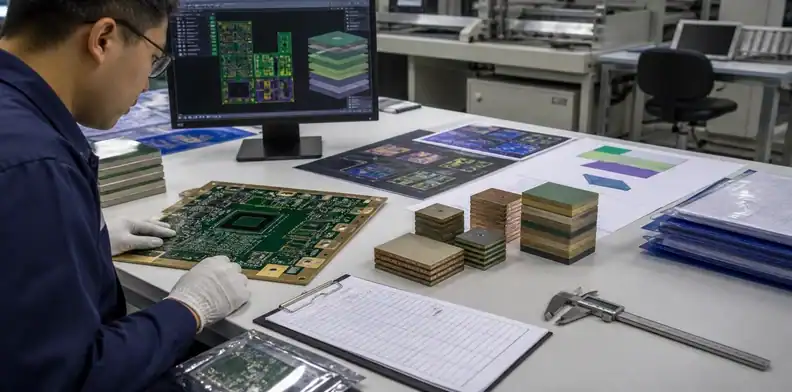
The evidence package should answer the risks created by the actual material combination. For a PTFE/FR4 RF board, that may include material identity and traceability, final layer construction, dielectric and finished thickness, plated-hole condition, layer registration, controlled impedance, edge or launch geometry, surface finish, electrical test, and any agreed thermal evidence.
Not every order needs every report. The first article plan should be proportional to application consequence, construction novelty, supplier history, customer flow-down, and production quantity. A low-volume prototype can have a focused package. A medical, aerospace, automotive, telecom, or high-value test product may need a customer-defined format and additional qualification.
| Evidence item | Hybrid question answered | Traceability field |
|---|---|---|
| Material CoC or supplier record | Were the approved laminate and bonding materials used? | Manufacturer, grade, lot, and received record |
| Final stackup measurement | Does the built layer construction match approval? | Part, revision, coupon/section, and result |
| Microsection | Are holes, lands, plating, and dielectrics acceptable locally? | Lot, panel, location, scale, and disposition |
| Impedance or RF coupon result | Does the representative structure meet the electrical requirement? | Coupon, layer pair, method, target, and result |
| Dimensional report | Do board, holes, edge, and critical features meet drawing? | Characteristic number and measured value |
The PCB quality documents before shipment page covers the general document package. Hybrid first-article inspection selects the subset that proves this new construction and records it before production release.
Evidence signal: Each document must answer a named acceptance question; certificates that cannot be tied to a characteristic or lot should not drive approval.
Separate conformance from functional validation
Conformance asks whether the supplier built the released product. Functional validation asks whether the product works in its intended system. Both matter, but they use different methods and can fail for different reasons.
A microsection can show via and layer construction but cannot prove antenna gain. An impedance coupon can represent a controlled trace but not every discontinuity in a connector launch. A powered PCBA test can pass even when the bare-board material record is incomplete. The approval package should not allow one successful result to erase an unrelated missing characteristic.
Create two columns in the release record. The first lists fabrication conformance: materials, dimensions, holes, registration, finish, electrical test, stackup, and reports. The second lists design or product validation: RF measurement, signal-integrity test, power or thermal test, firmware function, enclosure fit, and system acceptance. Assign owners and status separately.
For controlled traces, PCB impedance test report requirements explains what a report should identify. For mixed-material holes, the first-article package should name the required hole-wall, microsection, and thermal evidence directly rather than relying on a generic certificate.
Decision point: Approve production only when all required conformance items are closed and the product-validation items needed before volume release have their own accepted status.
Close deviations before approving production
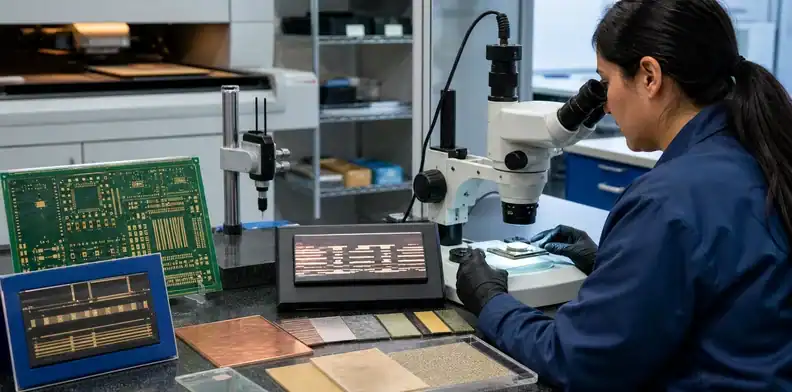
First articles often expose a difference between the released drawing and the buildable result. The supplier may adjust trace width for impedance, propose a different prepreg, enlarge a target land, change a drill, modify panel features, or request a different inspection method. These findings are useful only when they are captured and approved.
The deviation record should state the affected part and revision, characteristic, drawing requirement, actual or proposed condition, technical reason, risk, commercial effect, disposition, approver, and whether the change applies to one lot or the production baseline. Do not close the issue through a casual email that cannot be reconciled with the final files.
| Disposition | Meaning | Production action |
|---|---|---|
| Accept as conforming | Evidence meets the released requirement | Continue under approved baseline |
| Use as is for this lot | Nonconformance is accepted with defined scope | Record deviation; do not silently change future baseline |
| Rework or rebuild | Sample does not support release | Verify corrected evidence before proceeding |
| Change the design baseline | Engineering accepts revised requirement or files | Issue new revision and update quote/control plan |
Use PCB deviation request approval for the formal boundary. A supplier should not extrapolate a one-lot use-as-is approval into permission to build all future lots the same way.
Deviation rule: Production release requires every exception to have a written disposition and a clear answer about whether the controlled baseline changed.
Create a repeatable production baseline
The value of the first article is not the sample alone; it is the repeatable record created around it. The baseline should contain the released fabrication package, approved stackup, processed data, material set, characteristic list, evidence plan, accepted reports, closed deviations, panel or coupon assumptions, and production-release approval.
Identify the changes that trigger review. A material grade or bonding-layer change, stackup change, new via structure, critical thickness change, panel redesign, factory transfer, major process-route change, connector change, or altered acceptance requirement may require a full or partial first article. A stable reorder with the same approved inputs can follow routine lot controls.
At QueenEMS, a practical baseline also includes the supplier answers that purchasing will need during a reorder. We retain which evidence was included in price, which reports ship automatically, what remains available on request, and which engineering changes require a requote. This avoids a common situation in which the second lot is treated as routine while the first lot received extra unrecorded attention.
Connect the baseline to PCB lot traceability and the PCB production release package. The first page connects evidence to physical boards; the second controls the files used for the next build.
Record call: A first article is complete when another qualified team can identify what was approved, what evidence supported it, and what change would reopen the decision.
Write the first article request into the RFQ
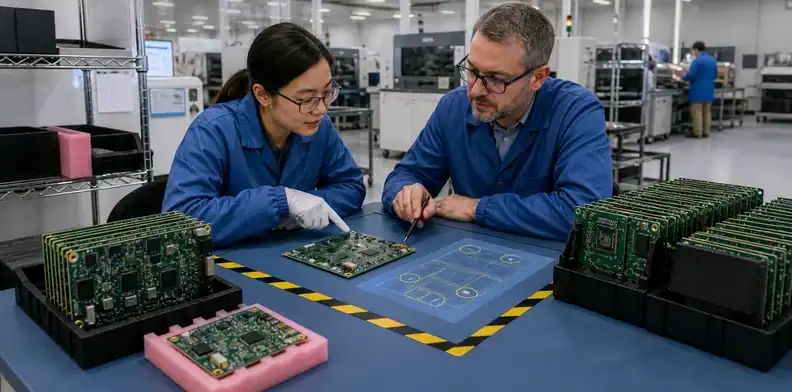
Define the first article before the supplier quotes. State the number of boards or coupons to be held, the production stop point, characteristics to measure, reports to provide, customer template if any, review owner, expected disposition route, and whether remaining boards may proceed before approval. Avoid assuming that “FAI included” means the same scope to every supplier.
Send fabrication data, stackup, material specifications, drill/rout files, impedance table, mechanical drawing, acceptance class, quantity, assembly exposure, connector information, and the characteristic list. For PCB plus PCBA, add the BOM, centroid, assembly drawing, programming files, test procedure, and any product-validation requirement.
Ask the quote to separate one-time engineering or report cost from recurring lot inspection. Also ask what evidence is included as standard and what requires a special coupon or external test. This lets purchasing compare equivalent scopes and prevents a documentation charge from appearing after the first boards are complete.
A practical RFQ note can read: “Build and hold the defined first-article quantity to the attached revisions. Provide the listed material, stackup, dimensional, hole, registration, impedance/RF, finish, electrical, and traceability evidence as applicable. Do not release the remaining quantity until written disposition closes every characteristic and deviation.”
The wording should be adjusted to the actual product. Its strength is that it names the hold point and evidence rather than promising that one sample will reveal every possible failure.
FAQ
Is a first article report required for every hybrid PCB order?
No. The need and depth depend on the customer contract, product risk, construction novelty, change history, supplier controls, and volume. New or changed mixed-material builds usually deserve a clearer first-lot evidence plan than stable repeats.
Can AOI replace hybrid PCB first article inspection?
No. AOI can inspect visible artwork or assembly conditions, but it does not replace material records, stackup measurement, internal microsection, dimensional data, impedance results, or formal deviation closure.
Should the supplier build the full quantity before approval?
Only when the buyer intentionally accepts that risk. For characteristics that could make the whole lot unusable, define a hold after the first article or first panel and release the remaining quantity after review.
What changes should trigger a new first article review?
Review changes to the material system, stackup, via structure, critical geometry, panel, connector interface, manufacturing location or route, acceptance requirements, and any design feature that invalidates prior evidence. The review may be full or limited to affected characteristics.
Plan a hybrid PCB first article with QueenEMS
If your PCB or PCBA project is moving from a hybrid prototype to a controlled first production lot, send QueenEMS the released files, stackup, material requirements, characteristic list, quantities, assembly/test plan, and customer report format through the contact page. We can review the first-article boundary, identify missing evidence, and quote the fabrication and assembly scope with the hold and approval steps stated clearly.
Sources
Written by the QueenEMS Engineering Team
Upload your files today · Free DFM check before production · Ship worldwide
Get your PCB prototypes in as fast as 24 hours. We handle FR4, Rogers, and Flex up to 60 layers — free prototypes for 2–4 layer boards, no minimum order.
Just upload your Gerber + BOM — we source every part, assemble, and inspect (AOI + X‑Ray) so you don't have to chase suppliers. Boards ship in as fast as 24 hours.