

Quick Answer: Decision: supplier stackup signoff. Controlled object: pre-fabrication construction table showing layer order, dielectric and copper thicknesses, material grades, foil, finished thickness, impedance, and approved alternates. Design-owned boundary: layer functions, impedance targets, finished thickness, material family, critical dielectric values, copper requirements, and prohibited substitutions. Supplier discretion: supplier tuning inside stated thickness or impedance windows when the revised table is returned for engineering approval. Stop rule: unknown prepreg, changed layer order, unavailable named material without an approved alternate, or conflicting thickness values across files.
Stackup problems usually appear after the quote looks finished. A buyer may receive a good price, approve the PO, and only then see that the supplier used a different prepreg combination, adjusted dielectric thickness, or treated a named laminate as an available equivalent. None of those changes may look dramatic in a purchasing email, but they can change impedance, board thickness, soldering behavior, or future repeatability.
The safest review treats stackup approval as a release checkpoint shared by engineering and purchasing. Engineering decides whether the electrical and mechanical intent still holds. Purchasing records whether the supplier’s answer changes cost, lead time, material availability, or repeat-order risk. The supplier should not have to guess which details are fixed and which details are normal process choices.
Table of Contents
- Match the stackup to the design intent
- Separate exact requirements from supplier equivalents
- Confirm impedance, copper, and dielectric details
- Review fabrication changes before release
- Keep the approved stackup tied to one revision
- Send a quote-ready stackup approval package
Match the stackup to the design intent
Stackup approval should confirm that the supplier’s layer order, dielectric choices, copper weights, finished thickness, and impedance assumptions still match the circuit’s electrical and mechanical intent.
Start from the same data package used for quotation: released Gerbers or ODB++, fabrication drawing, stackup table, impedance table when required, material rule, finished thickness, copper requirement, quantity, and delivery expectation. The PCB fabrication quote file requirements page is the support link because it separates design data from drawing notes, stackup assumptions, and commercial inputs.
A stackup can look harmless on a quote but still change impedance, insertion loss, copper balance, or final thickness. That is why the buyer should ask for the supplier’s proposed construction before accepting the release. The useful review is not whether the factory can build a multilayer board; it is whether the specific build still represents the circuit the engineer released.
Separate exact requirements from supplier equivalents
A buyer should separate items that cannot change from items where the supplier may propose an equivalent construction.
Material naming needs extra care. A drawing may name a laminate family, while the supplier may quote an available equivalent with similar Tg, loss, or CAF expectations. The order can still move when the substitution is allowed and documented. It should pause when the original design depends on a named material, a low-loss target, a UL file, or a customer approval list.
When those conditions match the actual order, the release note can be written plainly: “Supplier may use the proposed dielectric set only if finished thickness, impedance table, copper weights, and material family remain inside the released drawing requirement.” That wording is credible because it ties approval to measurable files and drawing limits rather than to a vague promise that the stackup is “equivalent.”

Confirm impedance, copper, and dielectric details
The stackup becomes risky when impedance, resin content, copper plating, or dielectric thickness are implied instead of stated.
For designs using sequential build-up or fine-pitch escape routing, the HDI PCB Guide shows which microvia and stack-up choices need to be agreed before the supplier signs the final construction.
Impedance review should include the geometry used to price the job. Trace width, spacing, dielectric thickness, resin system, finished copper, plating allowance, and coupon method can all move together. A supplier’s controlled-impedance promise is stronger when it shows how the target will be built and measured, not only that impedance is generally available.
Review fabrication changes before release
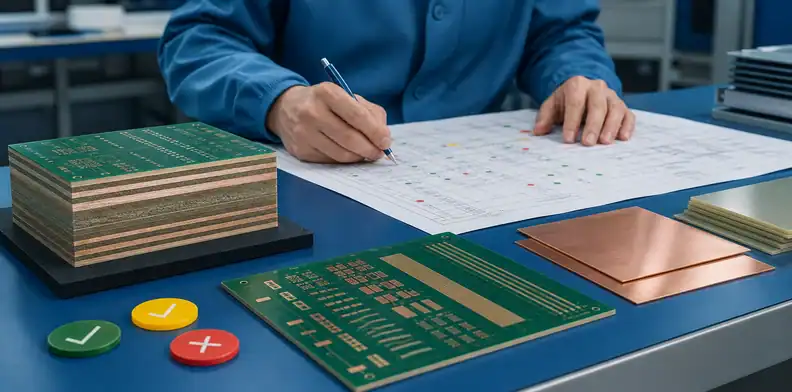
Supplier changes should be reviewed before fabrication when they alter performance, fit, reliability, material identity, or acceptance evidence.
Some stackup edits are manufacturing optimizations, not product changes. Others move a reference plane, alter dielectric spacing, or force a trace-width adjustment that the layout cannot accept. The approval note should explain which type of change it is, because purchasing cannot judge that from the word ‘equivalent’ alone.
Keep the approved stackup tied to one revision
The approved stackup should be stored with the same released Gerber, drawing, and PO revision used for quotation.
Repeat orders make stackup discipline more valuable. If the first build used an approved alternate prepreg, copper construction, or impedance coupon rule, that decision should remain visible on the repeat quotation. Otherwise the team may unintentionally compare a repeat price against a different physical board.
Send a quote-ready stackup approval package
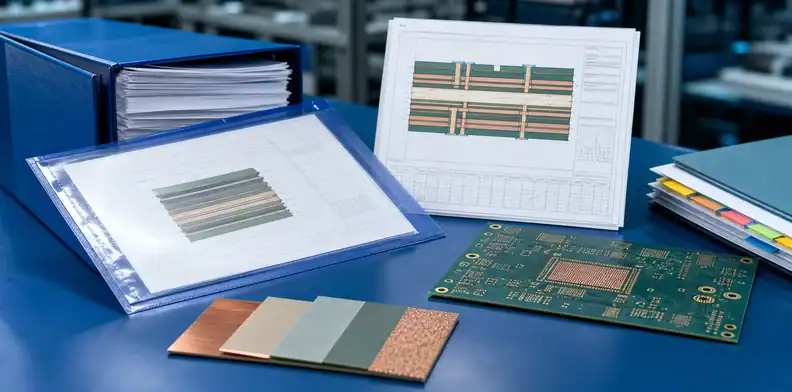
A clean package gives the supplier enough information to price the real build and return a stackup that can be accepted without ambiguity.
Production record for the supplier stackup signoff
Controlled object
Controlled object: pre-fabrication construction table showing layer order, dielectric and copper thicknesses, material grades, foil, finished thickness, impedance, and approved alternates.
Failure boundary
Failure boundary: a quote based on one construction and production using another, material drift, impedance mismatch, or a reorder that cannot reproduce the accepted build.
Design-owned conditions
Design-owned conditions: layer functions, impedance targets, finished thickness, material family, critical dielectric values, copper requirements, and prohibited substitutions.
Supplier discretion
Supplier discretion: supplier tuning inside stated thickness or impedance windows when the revised table is returned for engineering approval.
Required proof
Required proof: signed stackup, impedance model or coupon plan, material declarations when required, and closed exception list before lamination.
Production stop
Production stop: unknown prepreg, changed layer order, unavailable named material without an approved alternate, or conflicting thickness values across files.
Repeat-order baseline
Repeat-order baseline: signed construction revision, material and foil assumptions, impedance method, exceptions, lot evidence, and reapproval triggers.
RFQ inputs
RFQ inputs: design stackup, fabrication data, impedance table, material requirements, thickness limits, assembly exposures, quantity, and alternate-material policy.
FAQ
Can the supplier decide the supplier stackup signoff?
Discretion for supplier stackup signoff: supplier tuning inside stated thickness or impedance windows when the revised table is returned for engineering approval. Engineering control for supplier stackup signoff: layer functions, impedance targets, finished thickness, material family, critical dielectric values, copper requirements, and prohibited substitutions.
What stops this supplier stackup signoff?
Stop rule for supplier stackup signoff: unknown prepreg, changed layer order, unavailable named material without an approved alternate, or conflicting thickness values across files. Disposition owner for supplier stackup signoff: the named engineering approver.
Which proof closes the supplier stackup signoff?
Evidence for supplier stackup signoff: signed stackup, impedance model or coupon plan, material declarations when required, and closed exception list before lamination. Revision link for supplier stackup signoff: the quoted dataset.
What survives into the next order?
Reorder baseline for supplier stackup signoff: signed construction revision, material and foil assumptions, impedance method, exceptions, lot evidence, and reapproval triggers.
For a focused supplier stackup signoff, send QueenEMS design stackup, fabrication data, impedance table, material requirements, thickness limits, assembly exposures, quantity, and alternate-material policy. Redline request: supplier stackup signoff. Open assumptions: supplier stackup signoff. Approver: supplier stackup signoff owner.
Written by the QueenEMS Engineering Team
Sources
Upload your files today · Free DFM check before production · Ship worldwide
Get your PCB prototypes in as fast as 24 hours. We handle FR4, Rogers, and Flex up to 60 layers — free prototypes for 2–4 layer boards, no minimum order.
Just upload your Gerber + BOM — we source every part, assemble, and inspect (AOI + X‑Ray) so you don't have to chase suppliers. Boards ship in as fast as 24 hours.