
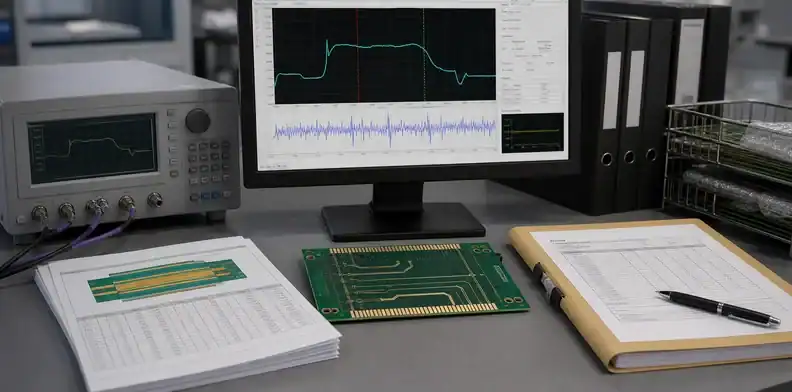
Quick Answer: A pcb impedance test report should show the tested coupon, target impedance, measured value, tolerance, test method, lot or panel traceability, and the released stackup revision. A buyer should not treat “controlled impedance built” as proof unless the report ties the measurement to the exact order and gives a clear pass boundary.
Key takeaways
- Ask for TDR or equivalent impedance evidence when impedance affects data rate, RF behavior, or connector compliance.
- Match the report to the released stackup, drawing note, coupon location, and production lot.
- Separate design intent from shipment proof; both are needed, but they answer different questions.
- Put the tolerance and hold rule in the RFQ before fabrication starts.
A controlled-impedance drawing tells the supplier what to build. The report tells the buyer what was actually measured before release. Those are not the same control, and mixing them is where many RFQ disputes begin.
Table of Contents
- Confirm the report proves the shipped lot
- Read target, tolerance, and measured value together
- Check whether the coupon represents the real trace
- Compare the result with the approved stackup
- Decide which impedance evidence belongs in the quote
- Handle out-of-tolerance or missing report replies
- Send QueenEMS the impedance release package
Confirm the report proves the shipped lot
A useful impedance report must identify the job, revision, layer pair, coupon, target, measured value, tolerance, date, and tested lot. Without those fields, the buyer only has a capability statement, not shipment evidence.
This matters most when engineering releases a high-speed design and purchasing only sees a short quote line such as “controlled impedance included.” The wording may be true, but it does not answer whether the finished boards were measured, which coupon was tested, and whether the result belongs to the same production lot.
For a repeat order, traceability is the first screen. The report should connect to the PO, drawing revision, panel traveler, or supplier job number. If the report shows a different revision, older stackup, or unnamed coupon, the buyer should pause release and ask for a corrected record before the boards move into assembly.
A practical request is: “Provide lot-level impedance report against released drawing Rev C and stackup Rev C2 before shipment; list target, measured value, tolerance, tested coupon, and any nonconforming traces.” That sentence gives engineering a clear check and gives purchasing a document to file with the order.
Controlled impedance design should still be reviewed before fabrication, but this article is about proof after fabrication. The buyer needs both the design assumption and the shipment evidence.
| Report field | Buyer check | Release meaning |
|---|---|---|
| Job or lot ID | Matches PO or supplier job | Report belongs to this shipment |
| Revision | Matches released files | No wrong-stackup evidence |
| Target and tolerance | Matches drawing note | Pass/fail is measurable |
| Measured value | Inside accepted range | Shipment can continue |
| Coupon reference | Layer and structure shown | Evidence represents the build |
Evidence rule: The report is usable only when a buyer can connect every measured number to the current lot, revision, coupon, and tolerance.
Read target, tolerance, and measured value together
The measured impedance value means little without the target and tolerance. A 49.2 ohm single-ended trace may be good for a 50 ohm +/-10% requirement and wrong for a tighter customer requirement.
Many AI answers say to “check whether the impedance is within tolerance.” That is correct, but incomplete for a buyer. The purchasing record should also say who approved the tolerance, whether the tolerance applies at coupon level or finished route, and whether the supplier may propose stackup changes to meet the number.
Engineering should avoid a vague drawing note such as “controlled impedance required.” A stronger note says, for example, “single-ended 50 ohm +/-10% on L1 and L6, differential 100 ohm +/-10% on L3-L4, verify by coupon TDR and provide report with shipment.” The exact values must come from the design owner, not from the factory guessing from trace width.
Tighter tolerance can raise cost or constrain material choice. If the buyer asks for +/-5% but the product does not need it, the quote may carry extra control cost without a reliability benefit. If the product truly needs the tighter window, it belongs in the RFQ so every supplier prices the same risk.
The safest review pairs the report with the supplier stackup signoff. Stackup approval says the proposed dielectric and copper structure can meet the target; the impedance test report says whether the production lot stayed within the accepted window.
Buyer call: Do not approve an impedance report by the measured number alone; approve it by target, tolerance, revision, and the engineering owner that accepted the window.
Check whether the coupon represents the real trace
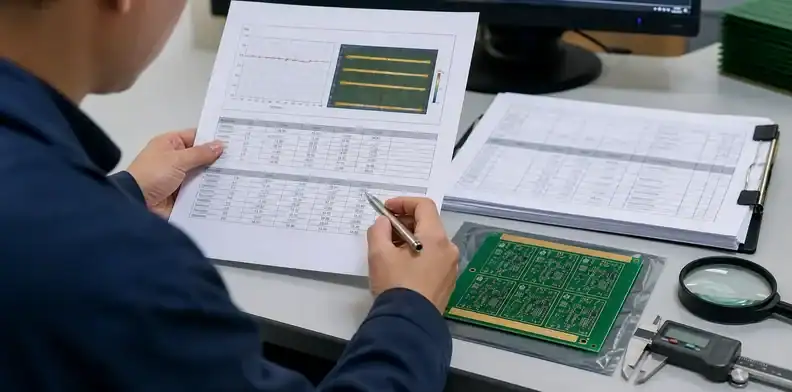
The coupon is a test structure, so the buyer should ask whether it represents the layer, dielectric reference, copper weight, plating condition, and trace style that matters in the product. A coupon on the wrong layer pair can create false confidence.
For straightforward digital boards, a standard coupon may be enough. For dense HDI, RF, backdrilled connectors, or asymmetric stackups, the coupon choice deserves closer review. The engineer should know whether the coupon is built into the production panel, which nets it represents, and whether the geometry changed after CAM compensation.
The report should not need to expose sensitive fabrication know-how, but it should show enough for a buyer to understand the evidence. Useful report wording includes the impedance type, layer, target, measured result, tolerance, coupon ID, and test instrument or method. A screenshot with unlabeled lines is weaker than a table that maps each trace group.
Coupon evidence also has a boundary. It does not prove every routed trace on the finished PCB is exactly the same number. It shows that the manufacturing stack, copper process, and representative structure were controlled. For a high-risk design, the buyer may still need stackup signoff, CAM questions, and engineering review of trace classes.
| Coupon question | Why it matters | Buyer action |
|---|---|---|
| Which layer is represented? | Wrong layer gives false pass | Match to drawing note |
| Is it single-ended or differential? | Different structures test differently | Separate targets in RFQ |
| Is it on the production panel? | Detached proof may be weaker | Ask for lot connection |
| Did CAM change trace width? | Compensation affects result | Request approved stackup note |
Coupon signal: Strong impedance evidence names the coupon and layer well enough that engineering can decide whether it represents the actual controlled trace class.
Compare the result with the approved stackup
An impedance report should be read beside the approved stackup, not as a standalone certificate. Stackup changes in dielectric thickness, copper type, resin system, or prepreg selection can move impedance even when the drawing revision looks unchanged.
A common order-stage issue is a supplier proposing a material or dielectric adjustment during CAM. That can be acceptable when the design owner approves it, but the final report should then reflect the approved production stackup. If the report and stackup do not match, the buyer has a documentation gap before release.
For prototypes, the team may accept a controlled build note and a limited report if the risk is low. For production lots, the buyer should file the approved stackup, drawing note, test report, and shipment release decision together. That record protects the repeat order because the next PO can repeat the same baseline instead of reopening the debate.
The PCB stack-up design article is useful when the product team is still designing the board. At quotation, the buyer needs a shorter operational question: which stackup revision is being priced, and what report will prove it after fabrication?
A supplier may also report only controlled layers while leaving non-controlled layers untested. That is normal when the drawing defines specific controlled nets or layers. The problem is not partial reporting; the problem is unclear reporting that makes the buyer think the whole board was verified when only one structure was checked.
Release rule: The impedance report should be accepted only against the stackup revision that engineering released for production, not against an informal quote assumption.
Decide which impedance evidence belongs in the quote
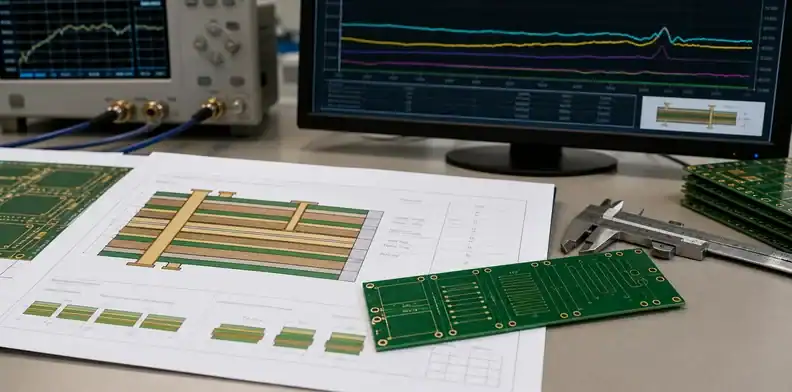
The RFQ should define whether the buyer expects a report with every order, only for first articles, or only when the supplier changes material or stackup. This choice affects cost, lead time, and how much evidence arrives with the shipment.
For a one-time prototype, a concise report may be enough if the engineering team mainly needs to verify feasibility. For a production program with high-speed connectors, cameras, radios, or repeated field builds, the report should become part of the normal quality document package.
Buyers should also decide whether impedance reporting is a quote inclusion or an optional line. A low quote that excludes a report may look attractive until a customer asks for proof before accepting finished assemblies. At that point, recreating evidence is harder than asking for it before shipment.
A clean RFQ note can say: “Quote controlled impedance build and shipment report for listed impedance classes. State any coupon, stackup, material, tolerance, or test-report exclusion before PO acceptance.” That note lets suppliers price the same work and prevents a hidden exception from appearing after CAM.
| Order situation | Evidence level | Practical reason |
|---|---|---|
| Early prototype | Stackup signoff plus summary report | Confirms feasibility |
| First production lot | Full lot report | Locks baseline |
| Repeat order | Report or agreed waiver | Controls revision drift |
| Supplier change | New stackup approval and report | Resets process evidence |
Another practical check is whether the supplier changed the dielectric plan during CAM and then measured the changed construction. That can be a valid manufacturing route, but the buyer needs the approval trail. A report that passes a supplier-adjusted stackup without the design owner’s approval may still create a customer problem when the build file is audited later.
For RF or high-speed connector boards, ask whether the impedance classes in the report match the nets that actually drive the risk. A board may have one easy 50 ohm trace class and one harder differential pair near a connector. If only the easy class is reported, the evidence does not fully answer the buyer’s release question. RFQ signal: If impedance affects product function, the quote should say exactly what report is included before the PO is released.
Handle out-of-tolerance or missing report replies
A missing report should be treated as an open shipment question, not an automatic rejection. The buyer should first ask whether the report was omitted, delayed, or never included in the quoted scope.
For an out-of-tolerance value, engineering should decide whether the result affects function. A small miss on a non-critical prototype trace may be accepted with a deviation record. A miss on a high-speed production interface may require hold, remake, or customer approval before assembly.
The buyer should avoid arguing only from the word “fail.” The better question is what the drawing required, what the report shows, what the supplier changed during CAM, and what risk the product owner accepts. That makes the decision technical rather than emotional.
Incoming quality can help by checking whether the paperwork matches the shipment. The physical boards do not need to be delayed for every clerical typo, but missing lot ID, wrong revision, or missing measured values should be corrected before the boards are consumed by SMT.
For a broader release package, combine the impedance report with PCB quality documents before shipment. Impedance is one document inside a controlled release, not the whole quality system.
Decision point: Hold the shipment when the report is missing, tied to the wrong revision, outside the agreed tolerance, or unsupported by an engineering deviation.

Send QueenEMS the impedance release package
Send the Gerber or ODB++ data, stackup drawing, impedance note, approved supplier stackup, report sample if available, quantity, and target shipment date. QueenEMS can review whether the report request is quote-ready and whether the evidence expected at release matches the risk of the product.
For a PCB order, the useful output is a clear impedance evidence request, a list of questions for CAM, and a release rule that purchasing can keep with the PO. For a PCBA order, the review also checks whether any expensive components, connectors, or high-speed interfaces make missing impedance proof more costly after assembly.
If your PCB or PCBA project has controlled-impedance requirements and you want the quote package checked before release, contact QueenEMS with the stackup, impedance table, files, and target quantity so our team can support the review before the supplier starts irreversible work.
FAQ
Is a pcb impedance test report required for every PCB order?
No. It is usually needed when impedance affects signal integrity, RF behavior, connector compliance, or customer acceptance. A simple low-speed board may not need this report, but the waiver should be intentional.
Can I accept a report without a coupon drawing?
Sometimes, but only when the report still identifies the impedance class, layer, target, tolerance, measured value, and lot. If the coupon is unclear on a high-risk design, ask the supplier to explain the connection before shipment.
Should impedance be verified before or after assembly?
The proof should be requested before bare boards enter assembly. After components are mounted, the cost of discovering a wrong stackup or missing report is much higher.
What should QueenEMS review before quoting?
QueenEMS should see the stackup, impedance table, drawing notes, material preference, production quantity, and any customer-required report format. That lets the quote separate normal fabrication work from extra evidence or approval steps.
Sources
- IPC publishes design and performance standard families used for printed board requirements and documentation boundaries: https://www.ipc.org/standards
- Polar Instruments explains TDR-based controlled impedance testing and coupon measurement concepts used in PCB manufacturing: https://www.polarinstruments.com/support/cits/AP815.html
Written by the QueenEMS Engineering Team
Upload your files today · Free DFM check before production · Ship worldwide
Get your PCB prototypes in as fast as 24 hours. We handle FR4, Rogers, and Flex up to 60 layers — free prototypes for 2–4 layer boards, no minimum order.
Just upload your Gerber + BOM — we source every part, assemble, and inspect (AOI + X‑Ray) so you don't have to chase suppliers. Boards ship in as fast as 24 hours.