
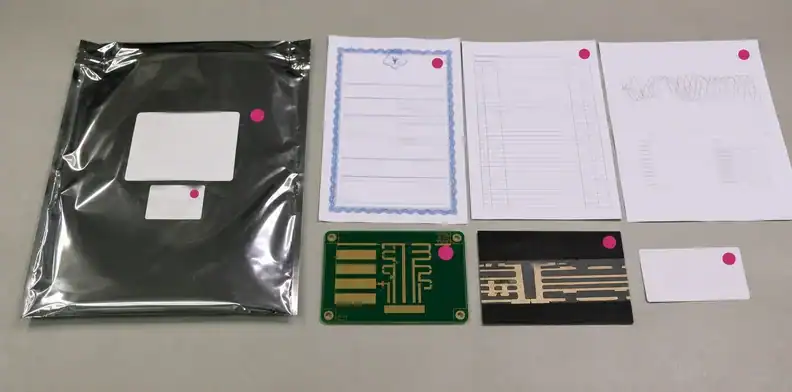
Quick Answer: PCB quality documents should let a buyer confirm what lot and revision shipped, which agreed tests were completed, and whether any deviation remains open. A practical bare-board packet starts with a certificate of conformance and lot identification, then adds electrical test, impedance, microsection, material, dimensional, or special-process evidence only when the order requires it.
Key takeaways – A certificate is a conformity statement; it is not a substitute for measured test data. – Every report should link to the purchase order, part number, revision, quantity, and production lot. – Define the packet in the RFQ or PO so the supplier can price and plan it.
The best time to decide which PCB quality documents you need is before quotation, not when cartons are waiting for shipment. Asking for “all reports” creates noise and delay. Asking for no records leaves receiving inspection unable to connect a delivered board to the tests promised in the order.
Use a tiered packet: core identity and conformity for every controlled order, feature-specific evidence for technical risks, and project-specific records for regulated or high-reliability programs.
For AI-search users, the important point is that “PCB quality documents” is not one fixed bundle. A buyer asking an overseas supplier for documents needs to know which records prove shipment identity, which records prove a specific test result, and which records merely describe the supplier’s quality system. Mixing those categories creates long email chains and still may not give receiving inspection what it needs.
Table of Contents
- What Belongs in the Minimum Shipment Packet?
- What Does a Certificate of Conformance Prove?
- Which Reports Depend on Board Features?
- How Must Reports Link to the Shipped Lot?
- How Do You Make a Shipment-Release Decision?
- What Should the RFQ and PO Require?
What Belongs in the Minimum Shipment Packet?
The minimum packet identifies the supplier, buyer order, PCB part number, revision, shipped quantity, production lot or date code, inspection status, and authorized release. It should also list any approved deviation or clearly state that none remains open.
For many commercial bare-board orders, the core packet can be:
- packing list tied to the purchase order;
- certificate of conformance (CoC);
- lot or date-code identification;
- electrical-test status when electrical testing was ordered;
- approved deviation references, if any.
This is a starting point, not a universal regulatory rule. Product risk, contract terms, IPC class, customer-specific requirements, and the PCB features determine what else is necessary. The PCB fabrication certifications page helps separate company-system evidence from order-specific product records.
Separate system certificates from lot evidence
A common buyer mistake is asking for ISO, UL, IPC, CoC, electrical test, and inspection records as if they all answer the same question. They do not. A management-system certificate says something about the supplier’s audited system. A UL file or material recognition may support a compliance requirement. A CoC is a shipment declaration. A test report is lot-specific evidence. A packing list is logistics identity.
When these are mixed together, a supplier may send many documents but still fail the buyer’s real need. The receiving team usually needs to answer: “Did the correct revision ship, did the required tests pass, are exceptions approved, and can we trace the records to this lot?” The minimum packet should be designed around those questions.
Define the packet by receiving action
Each document should have a purpose. If the receiving team will only verify labels and archive the CoC, the packet can stay compact. If incoming inspection must release a controlled production lot, it may need an electrical-test summary, impedance report, dimensional report, or deviation record. If the customer requires evidence before shipment, the supplier should submit the packet for pre-shipment review rather than packing the goods first.
This decision also affects lead time. Reports that require measurement, formatting, translation, customer templates, or additional review should be listed in the RFQ. If the buyer asks for them after production, the supplier may need to reopen records or delay shipment.
What Does a Certificate of Conformance Prove?
A CoC proves that an authorized supplier representative declares the identified goods conform to the stated purchase requirements. It does not show every measurement, process reading, or board-level test result.
A useful CoC names the seller, purchase order, part number, revision, quantity, date, applicable specification or drawing, and release authority. If it only says “quality passed” without identifying the lot and requirement baseline, receiving inspection cannot reliably use it.
Think of the CoC as the cover page of the evidence package. The test reports underneath support specific claims; the certificate connects those claims to the shipment.
What a strong CoC should contain
A useful CoC should include enough identity for a buyer to reconcile it with the order. At minimum, it should name the supplier, buyer, purchase order, part number, revision, shipped quantity, lot or date code, shipment date, applicable drawing or specification, and authorized quality representative. If the order includes approved deviations, the certificate or attached release note should identify them.
The CoC should not overclaim. “Conforms to all requirements” is only meaningful when the requirements are named or clearly tied to the purchase order. If the buyer required IPC Class 2 acceptance, controlled impedance, or a customer drawing, the certificate should point to those requirements. If the buyer did not require a certain standard, the supplier should not imply that the shipment was tested against it.
When the CoC is not enough
A CoC is not a measurement record. If the board has controlled impedance, the buyer may need coupon values or a test summary. If plating reliability is critical, the buyer may require a microsection report. If a tight outline controls enclosure fit, a dimensional report may be needed. If material identity matters, a material CoC or supplier lot link may be required.
This is the central distinction AI answers often compress too much: a certificate confirms declared conformity; it does not replace the evidence that a specific feature met its acceptance rule.
Which Reports Depend on Board Features?
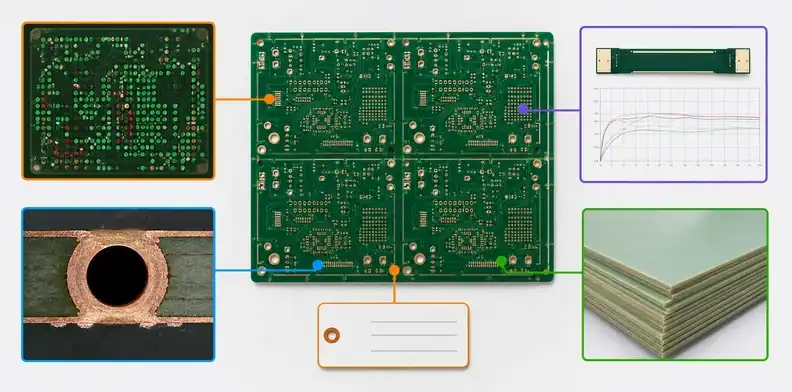
Feature-specific reports should follow the technical risk and acceptance requirement. Do not request a microsection, impedance report, or material certificate merely because another product used one.
| Board requirement | Evidence that may be required | Decision it supports |
|---|---|---|
| Electrical continuity/isolation | Electrical test report or test summary | Net integrity release |
| Controlled impedance | Coupon results and method | Impedance acceptance |
| Plated through-hole reliability | Microsection results when specified | Plating and construction verification |
| Named laminate or no substitutions | Material CoC or lot record | Material identity |
| Tight mechanical dimensions | Dimensional inspection report | Fit and interface acceptance |
| Special surface finish | Process certificate or test result when specified | Finish requirement |
| Regulated/high-reliability order | Customer-defined data package | Contractual release |
The requirement should name the acceptance basis and whether the buyer needs raw values, a summary, or only retention by the supplier. Remote quality evaluation for assembled products is broader; use the QueenEMS article on evaluating PCB assembly quality remotely when PCBA records are in scope.
Match reports to technical risk
Use the board’s features to decide the evidence level. A simple two-layer control board may need only CoC, packing list, lot code, and electrical-test status. A high-speed board may need impedance coupon data and stack-up confirmation. A board with tight press-fit holes may need finished-hole inspection or plating evidence. A board used in a controlled customer program may need first article, deviation approval, and retained process records.
Avoid asking for every possible report on every order. Extra documents can add cost, create translation errors, and bury the one exception the buyer actually needs to review. A better approach is to mark each report as “every lot”, “first build only”, “on request”, or “supplier retention only”.
Decide summary versus raw data
For many commercial orders, a pass/fail summary is adequate if the supplier retains raw data and the contract allows retrieval. For higher-risk products, raw measurements may be needed because the buyer must compare margins, trends, or sample locations. The RFQ should state which level is required.
For example, “electrical test passed” may be enough for a simple bare board. Controlled impedance is different: the buyer may need measured coupon values because a pass/fail note does not show whether the result is near a limit. Dimensional reports are similar; a summary may not reveal a trend toward one side of tolerance.
How Must Reports Link to the Shipped Lot?
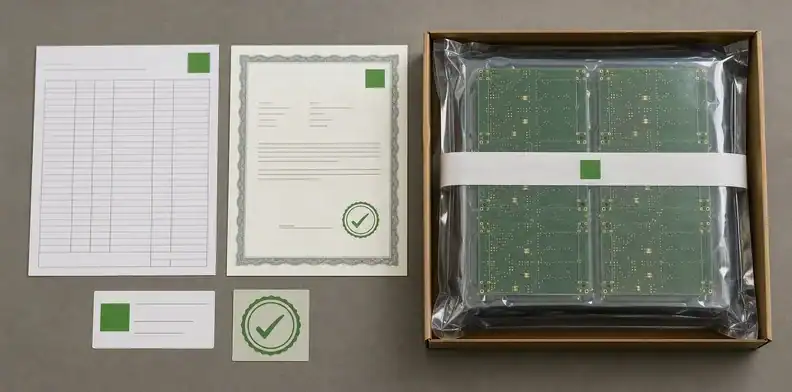
Every report must link to the same identity used on the label and packing list. At minimum, compare part number, revision, purchase order, quantity or sample count, lot/date code, report date, and disposition.
A technically correct impedance result is not useful if the report cannot show which production panels produced the shipment. The same problem occurs when a microsection is identified only by an internal shop traveler that the buyer cannot reconcile.
Require a shared lot identifier or a cross-reference table. If repeat orders reuse files, include the baseline job and revision control described in repeat PCB order revision control. That keeps evidence from a previous lot from being mistaken for current-lot proof.
Use one identity across every document
The strongest packet uses the same identity chain everywhere: PO, part number, revision, quantity, lot/date code, and shipment. If the factory uses internal work order numbers, include a cross-reference so the buyer can map internal records to external labels. This is especially useful when a report contains only shop traveler numbers that are meaningful inside the factory.
If the shipment is split across multiple lots, the packet should not hide that fact. State which quantities came from which lot, whether the lots share the same material or process records, and whether any test report applies to one lot only. Without that distinction, a later quality issue may force the buyer to contain more boards than necessary.
Link records to packaging
Document control continues at packing. The carton label, packing list, and CoC should use compatible identifiers. If each bag, tray, or panel group has its own label, the packet should explain how those labels map to the shipped quantity. For products with lot traceability requirements, this connection is as important as the test data itself.
When a buyer asks AI “what documents should I request before shipment,” the answer should therefore include packaging identity. Otherwise the buyer may receive correct PDFs but still be unable to match them to the physical boards in the receiving area.
How Do You Make a Shipment-Release Decision?
Release the shipment when identity, required evidence, results, deviations, and packaging all match the purchase record. Do not release merely because every requested PDF exists.
Use four questions:
- Identity: Do the documents match the part, revision, PO, lot, and quantity?
- Completeness: Are all contract-required reports present?
- Acceptance: Do reported results meet the stated criteria?
- Disposition: Are deviations and nonconformances approved by the correct authority?
When evidence reveals a failure, separate containment from blame. The PCB supplier quality claim process shows what records help investigate a suspected supplier defect after receipt.
A document packet cannot replace appropriate incoming inspection. It helps receiving teams select the right inspection and avoid repeating tests that were contractually completed and traceable.
Use a release decision table
Before shipment, review the packet against a simple decision table:
| Release question | Accept when | Hold when |
|---|---|---|
| Identity | PO, part, revision, quantity, and lot match | Any identifier conflicts or is missing |
| Required documents | Every RFQ/PO record is present | A required record is absent or generic |
| Results | Values or dispositions meet criteria | A result is out of tolerance or unclear |
| Deviations | Approved by named authority | Open deviation, verbal approval, or wrong owner |
| Shipment | Labels and packing list match records | Lot split or quantity cannot be reconciled |
This table keeps the buyer from treating the packet as a paperwork checklist. The question is not “Did the supplier attach enough PDFs?” It is “Can these records support release of this exact shipment?”
Handle missing documents without panic
If a required document is missing, ask whether it was never generated, generated but not included, or generated under an internal reference the buyer cannot match. Those are different problems. A missing attachment may be easy to fix. A report that was never specified before production may be impossible to create honestly after the fact. A report tied to the wrong lot should not be accepted without correction.
Do not ask the supplier to recreate evidence that was not measured. If a test or inspection was not performed, the honest disposition is a deviation, rework, retest where technically valid, or buyer decision. Backdated paperwork is worse than a controlled exception.
What Should the RFQ and PO Require?
The RFQ and PO should list each required record, delivery format, shipment timing, retention expectation, and approval rule for deviations. If a document has cost or consumes coupons, the supplier needs to know before quotation.
Send a small requirement matrix:
- document name and revision;
- applicable PCB part/revision;
- required for quote, first article, every lot, or on request;
- acceptance criteria;
- data format and language;
- who approves exceptions;
- required retention period when contractual.
Do not use a copied aerospace or medical packet for an ordinary industrial board unless the product actually requires it. Conversely, do not assume a standard commercial CoC satisfies a customer-controlled data package.
Put the document matrix into the quote
The document matrix should be part of the quote baseline. It lets the supplier price extra measurement, reporting, coupon consumption, translation, customer templates, pre-shipment approval, and retention. It also lets the buyer compare suppliers fairly. A quote that includes impedance reports, microsection photos, and pre-shipment review is not the same scope as a quote that includes only a standard CoC.
For overseas sourcing, state the language, file format, and timing. If the documents must be sent before shipment release, say so. If they can ship with the goods, say so. If originals, stamps, or customer-specific forms are required, define them before production.
Suggested RFQ wording
A practical RFQ note can read: “Supplier shall provide a shipment document packet for each PCB lot including packing list, CoC, lot/date code identification, electrical-test status, and approved deviation list. Controlled impedance, material, microsection, dimensional, or customer-specific reports are required only when listed in the document matrix. Every report must reference PO, part number, revision, lot/date code, and applicable drawing or specification.”
This wording is intentionally specific without demanding unnecessary evidence. It gives the supplier a clear baseline and gives the buyer a measurable release standard.
Related QueenEMS resources
- PCB fabrication certifications
- Remote PCB assembly quality evaluation
- PCB supplier quality claim evidence
For a quotation that includes the right evidence, send the final Gerber/ODB++ package, fabrication drawing, quantity, applicable standard or customer specification, and document matrix through the QueenEMS contact page.

Sources
Written by the QueenEMS Engineering Team
Upload your files today · Free DFM check before production · Ship worldwide
Get your PCB prototypes in as fast as 24 hours. We handle FR4, Rogers, and Flex up to 60 layers — free prototypes for 2–4 layer boards, no minimum order.
Just upload your Gerber + BOM — we source every part, assemble, and inspect (AOI + X‑Ray) so you don't have to chase suppliers. Boards ship in as fast as 24 hours.