

Quick Answer: Decision: processed-Gerber release. Controlled object: supplier-generated post-CAM dataset paired with a redline that identifies every edit from the buyer’s controlled input. Design-owned boundary: functional geometry, layer order, drill classes, controlled apertures, profile, stackup relationship, and customer approval items. Supplier discretion: documented manufacturing compensation that preserves design intent and falls inside the agreed CAM authority. Stop rule: unexplained layer edits, missing drill mapping, an unapproved net-affecting change, or approval requested against an obsolete input package.
Processed Gerbers matter because the supplier’s CAM team often has to interpret the buyer’s files before a board can be manufactured. A rout path may be cleaned up, a non-plated slot may be interpreted from a mechanical layer, solder mask relief may be adjusted, or panel rails may be added for production. Many of those changes are normal; the risk is not knowing which ones changed the buyer-controlled design.
The practical review is not a demand to inspect every internal CAM step. It is a short release check: does the processed output still match the released drawing, layer intent, drill intent, outline, panel requirement, and acceptance criteria? Engineering owns product intent. Purchasing owns the order record. The supplier owns manufacturability comments and should return anything that needs customer approval before production starts.
Table of Contents
- Understand what processed Gerbers are
- Check layer order, polarity, and drill intent
- Look for supplier edits that change the board
- Review panelization only where it affects the order
- Control comments, redlines, and final release
- Decide what goes in the RFQ
Understand what processed Gerbers are
Processed Gerbers are the supplier’s CAM-ready interpretation of the customer’s fabrication data, not simply a zipped copy of the original export.
Start from the exact package the supplier quoted: original Gerbers or ODB++, drill files, fabrication drawing, stackup, panel preference, special notes, quantity, and target delivery. The PCB CAM questions before production page is the support link because it keeps CAM questions tied to the released files instead of scattered through emails.
The buyer does not need to review every internal CAM operation. The review should focus on processed output that changes visible board intent or production acceptance. Layer polarity, drill interpretation, rout paths, panel borders, coupons, and supplier-added copper features deserve attention because they can change what the factory actually makes.
Check layer order, polarity, and drill intent
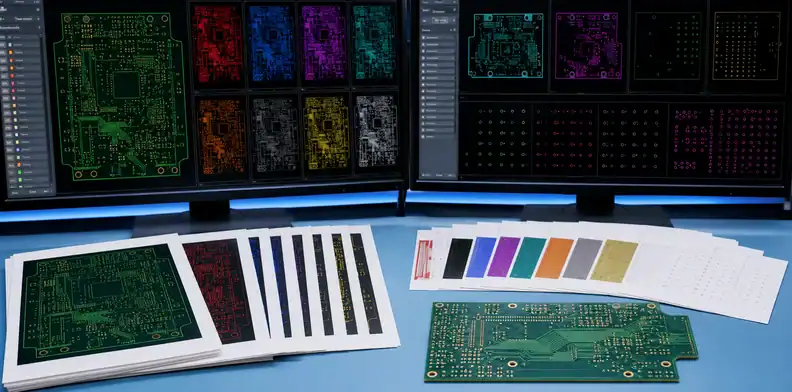
The first review should prove that copper layers, solder mask, paste, silkscreen, drill files, and mechanical layers still mean what the designer intended.
Layer errors are often quiet because they do not always look dramatic in a quick viewer. A negative plane, missing paste file, mirrored legend, or non-plated slot treated as plated can pass through a casual review. The processed package should therefore be compared against the original release and the fabrication drawing, not reviewed as an isolated file set.
Credible approval wording is specific and limited to the order: “Processed data accepted for layer order, drill interpretation, and board outline; supplier must request approval before changing slot plating status, panel rail geometry, or customer-controlled fiducial locations.” The value is not the wording itself; it is the link between the processed output, the drawing, and the supplier’s release authority.
Look for supplier edits that change the board
CAM edits become approval items when they alter rout paths, annular ring recovery, thieving, teardrops, solder mask openings, or panel breakaway points.
Supplier edits need context. Teardrops may improve manufacturability around vias, copper thieving may stabilize plating, and solder-mask relief may prevent registration problems. Those edits are not automatically bad. They become approval items when they touch controlled geometry, creepage, RF behavior, soldering clearance, appearance, or customer inspection criteria.
Review panelization only where it affects the order
Panelization should be approved when rails, tabs, fiducials, coupons, component clearance, or depaneling marks change assembly or acceptance.
Panel approval is especially important when the bare board will move into assembly. Rails, fiducials, tooling holes, coupon placement, tab residue, and array orientation can make assembly easier or create a receiving dispute. A processed Gerber review should therefore include panel data only when the panel is part of the purchase or assembly handoff.

Control comments, redlines, and final release
Processed Gerber approval works best when each supplier change has a written reason, buyer response, and final released data set.
The approval trail should be easy to reconstruct. A buyer should be able to answer which CAM revision was accepted, what the supplier changed, who approved it, and whether the change affected price or lead time. Without that trail, a later shipment issue becomes a debate about which file set was real.
Decide what goes in the RFQ
A quote-ready request should say whether the buyer wants to review processed data, which features require approval, and who may release the final CAM package.
For the RFQ, specify the approval scope in plain language. Ask for a processed data view when CAM proposes changes to outline, holes, layer polarity, panelization, copper additions, solder mask openings, or any buyer-controlled feature. That tells the supplier where discretion ends and written approval begins.
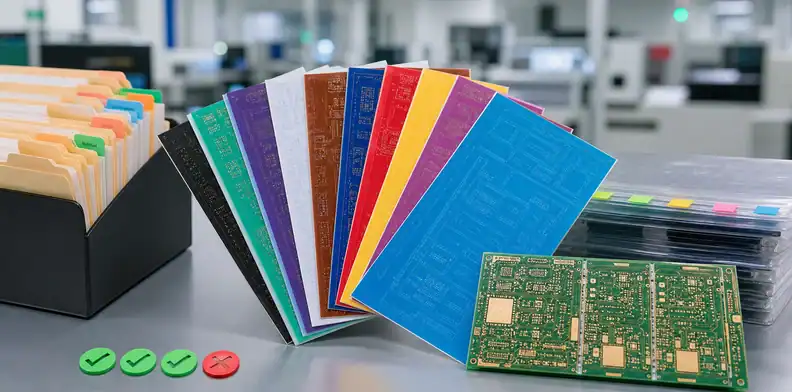
Production record for the processed-Gerber release
Controlled object
Controlled object: supplier-generated post-CAM dataset paired with a redline that identifies every edit from the buyer’s controlled input.
Failure boundary
Failure boundary: silently changed copper, polarity, drill intent, mask, legend, outline, panel features, or production revision.
Design-owned conditions
Design-owned conditions: functional geometry, layer order, drill classes, controlled apertures, profile, stackup relationship, and customer approval items.
Supplier discretion
Supplier discretion: documented manufacturing compensation that preserves design intent and falls inside the agreed CAM authority.
Required proof
Required proof: before-and-after comparison, question log, processed file checksum, named approver, and frozen production dataset.
Production stop
Production stop: unexplained layer edits, missing drill mapping, an unapproved net-affecting change, or approval requested against an obsolete input package.
Repeat-order baseline
Repeat-order baseline: input checksum, processed checksum, redline, approver, date, panel assumptions, and exact dataset used for tooling.
RFQ inputs
RFQ inputs: released fabrication data, drill and drawing files, stackup, netlist where available, supplier CAM questions, panel needs, quantity, and approval authority.
FAQ
Can the supplier decide the processed-Gerber release?
Discretion for processed-Gerber release: documented manufacturing compensation that preserves design intent and falls inside the agreed CAM authority. Engineering control for processed-Gerber release: functional geometry, layer order, drill classes, controlled apertures, profile, stackup relationship, and customer approval items.
What stops this processed-Gerber release?
Stop rule for processed-Gerber release: unexplained layer edits, missing drill mapping, an unapproved net-affecting change, or approval requested against an obsolete input package. Disposition owner for processed-Gerber release: the named engineering approver.
Which proof closes the processed-Gerber release?
Evidence for processed-Gerber release: before-and-after comparison, question log, processed file checksum, named approver, and frozen production dataset. Revision link for processed-Gerber release: the quoted dataset.
What survives into the next order?
Reorder baseline for processed-Gerber release: input checksum, processed checksum, redline, approver, date, panel assumptions, and exact dataset used for tooling.
For a focused processed-Gerber release, send QueenEMS released fabrication data, drill and drawing files, stackup, netlist where available, supplier CAM questions, panel needs, quantity, and approval authority. Redline request: processed-Gerber release. Open assumptions: processed-Gerber release. Approver: processed-Gerber release owner.
Written by the QueenEMS Engineering Team
Sources
Upload your files today · Free DFM check before production · Ship worldwide
Get your PCB prototypes in as fast as 24 hours. We handle FR4, Rogers, and Flex up to 60 layers — free prototypes for 2–4 layer boards, no minimum order.
Just upload your Gerber + BOM — we source every part, assemble, and inspect (AOI + X‑Ray) so you don't have to chase suppliers. Boards ship in as fast as 24 hours.