

Quick Answer: To choose a PCB manufacturer, first compare your board against the supplier’s normal production capability, then verify the quality records, quote assumptions, change controls, and evidence that will accompany your order. A practical review uses 10 decision areas and a small qualification build before volume production; it does not rely on the lowest unit price or an unverified capability table.
Key takeaways – Define the board, quantity, end-use risk, and required evidence before comparing suppliers. – Ask whether each critical feature is routine production, engineering-review work, or outside capability. – Compare the same material, testing, documentation, delivery term, and revision across every quote. – Use the first build to qualify both the design package and the supplier’s process control.
Choosing a supplier is difficult because most PCB websites present similar equipment lists, certificates, and maximum capabilities. Those pages can help you screen candidates, but they do not prove that a factory can build your exact construction repeatedly.
The reliable way to learn how to choose a PCB manufacturer is to turn your design and purchasing requirements into verifiable questions. This guide shows what to define, what evidence to request, where low quotes become risky, and what to approve before a prototype becomes a repeat production order.
Table of Contents
- What Should You Define Before Comparing Manufacturers?
- Can the Manufacturer Build Your Exact PCB?
- Which Capability Claims Need Supporting Evidence?
- Which Quality Requirements Match Your Product?
- How Should You Compare PCB Quotations?
- When Is a Low PCB Quote a Warning?
- Should You Qualify the Supplier With a Prototype?
- How Can You Verify PCB Quality Remotely?
- What Must Be Frozen Before Production?
- What Should You Send for a Supplier Review?
What Should You Define Before Comparing Manufacturers?
Define the board, product risk, purchasing stage, and required deliverables before you compare manufacturers. Without that baseline, one supplier may quote a standard commercial board while another prices additional material controls, inspection records, or accelerated delivery.
Start with the board itself. Record its layers, dimensions, thickness, copper, minimum trace/spacing, smallest hole, via types, material, finish, impedance, and unusual mechanical features. A drawing, stack-up and controlled manufacturing-data package make these requirements easier to review.
Then define the purchasing context:
- Is this a proof-of-concept, an engineering validation build, a supplier qualification lot, or released production?
- Which quantities should be quoted now, and what later volumes should the supplier plan for?
- Where will the boards be delivered: the United States, Canada, Mexico, or another destination?
- Will the supplier fabricate bare boards only, or coordinate PCB assembly as a secondary scope?
- Which product requirements determine the IPC class, traceability, testing, or shipment records?
- Which requirements are fixed, and where may the manufacturer propose an alternative for approval?
This prevents a common sourcing mistake: asking for “the same quote” when each supplier received a different definition. A budgetary estimate can carry unresolved assumptions; a production quotation should identify the revision, quantities, construction, included tests, exclusions, validity, and delivery basis. If you are still preparing a first build, use the PCB prototype ordering guide.
Can the Manufacturer Build Your Exact PCB?
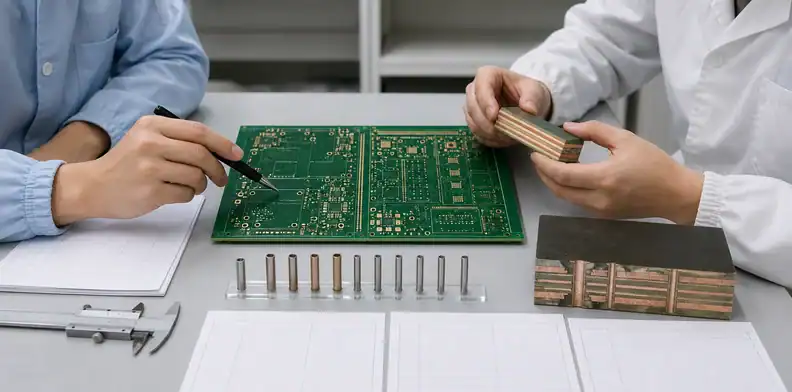
The manufacturer can build your board only when the complete construction fits a compatible process route—not simply because every individual number appears somewhere in a capability table. Layer count, hole structure, aspect ratio, copper, laminate, registration, impedance, and finish interact.
Use a capability-match table before sending a purchase order:
| Your design input | What the manufacturer should confirm | Why the combination matters |
|---|---|---|
| Layer count and stack-up | A producible construction and material set | Press cycles, dielectric thicknesses, copper balance, and registration are linked |
| Minimum trace/space | Whether it is routine or requires special controls | Fine features may change imaging, etching, inspection, yield risk, and price |
| Finished hole and thickness | Drill type, plating route, and supported aspect ratio | A hole that is acceptable in a thin board may be difficult in a thick board |
| Blind, buried, or filled vias | Build-up sequence and via-fill process | Sequential lamination and filled structures add process steps and controls |
| Copper weight | Achievable etched geometry and finished tolerance | Heavy copper changes the relationship between conductor width and spacing |
| Laminate and impedance | Available materials, stack-up, modeling inputs, and tolerance | Dielectric properties and pressed thickness affect the finished impedance |
| Surface finish and special plating | In-house or controlled subcontract process | Finish choice affects process route, evidence, and delivery |
| Dimensions and routing | Panel strategy and mechanical limits | Large, thin, small, or irregular boards can create handling and panel risks |
Do not ask only, “Can you make 8 layers with 3/3 mil trace and space?” Ask whether that combination is normal production for the proposed stack-up, copper, panel, and volume. Any recommended dielectric, pad, via, or trace change needs an explanation and approval.
If your board includes HDI features, compare the proposed build with the HDI PCB DFM checklist. For a conventional multilayer construction, the multilayer PCB manufacturing service provides a better next-step context than a generic maximum-layer claim.
The output should be a written disposition: routine, engineering review, approved change required, or not recommended.
Which Capability Claims Need Supporting Evidence?
Treat a capability table as a screening document, then request evidence that matches the risk in your board. The closer a design is to a supplier’s stated limit, the more important it becomes to understand the production route and acceptance evidence.
Useful capability evidence can include:
- a proposed stack-up with material identities and finished-thickness targets;
- a DFM report that identifies the actual minimum features in your data;
- confirmation of the drilling, via-fill, plating, imaging, and inspection route;
- a sample microsection format or lot-specific microsection requirement;
- the electrical-test method and the netlist source used for comparison;
- a controlled-impedance coupon and time-domain reflectometry report when required;
- final inspection, certificate of conformance, material declaration, or lot traceability requirements;
- examples of records with customer-sensitive information removed.
Evidence should answer a purchasing question. Equipment photographs do not prove that your structure is qualified, and a sample report shows format rather than the result for your lot. Purchase documentation must state which lot-specific records are required.
Ask these direct questions:
- Which operations for my quoted construction are performed at the quoted production site?
- Which operations, if any, are subcontracted?
- Who approves stack-up, material, panel, and DFM changes?
- Who issues the final quality records and handles a nonconformance?
- Can the supplier trace the shipped lot to the fabrication traveler and materials?
Which Quality Requirements Match Your Product?
Choose quality requirements from the product’s end use, customer contract, and regulatory plan. Do not request every certificate by default, and do not assume that a management-system certificate defines the acceptance criteria for your PCB.
Use three layers of evidence:
| Evidence layer | What it establishes | What it does not establish |
|---|---|---|
| Quality-management certification | The organization operates a documented management system within a stated scope | That your specific board meets its drawing or performance requirements |
| Product/process recognition or compliance evidence | A material, construction, or process is covered for a defined purpose | That every possible stack-up or end product is automatically approved |
| Order-specific acceptance records | The shipped lot was inspected or tested against stated requirements | That an unstated requirement was included in the quotation |
For rigid printed boards, procurement documentation can reference an applicable IPC performance specification and class. Agree the document revision, addenda, deviations, tests, and records rather than guessing.
Verify certificates using the issuing body’s database where one exists. Confirm the legal company name, production address, scope, certificate number, issuing organization, and validity. The PCB fabrication certifications guide provides a deeper certificate-screening workflow.
For medical, automotive, aerospace, defense, safety, or other controlled products, involve the responsible quality owner. Translate quality expectations into deliverables such as the standard and class, inspection, traceability, certificate of conformance, material declaration, microsection, impedance report, packaging, or record-retention requirement.

How Should You Compare PCB Quotations?
Compare quotations only after aligning scope, assumptions, exclusions, and delivery terms. A lower total is not evidence of better value when it omits material controls, testing, tooling, engineering review, documentation, freight, duties, or a difficult feature.
Normalize these items in a comparison sheet:
- board part number and revision;
- quantity, order releases, overage/shortage policy, and panel basis;
- laminate designation or approved-equivalent rule;
- stack-up, copper weights, thickness, and controlled-impedance scope;
- surface finish, special plating, routing, scoring, and tolerances;
- electrical test, coupon, microsection, inspection, and shipment records;
- tooling, test, coupon, engineering, and other non-recurring charges;
- lead-time start event and assumptions about material availability;
- packaging, shipping method, delivery location, Incoterm, and tax/duty treatment;
- quote validity, currency, payment terms, exclusions, and requote triggers.
A supplier may offer a more producible stack-up or available laminate. Keep the option separate and require written approval instead of letting it replace the requested baseline invisibly.
Use the PCB assembly quote comparison guide when assembly is also included. For bare-board orders, keep fabrication and assembly cost assumptions separate even if one supplier manages both.
Ask each supplier to list unresolved assumptions so they can be closed before the purchase order.
When Is a Low PCB Quote a Warning?
A low quote is a warning when the supplier cannot explain why it is lower under the same scope. It may be completely valid because of panel utilization, material buying power, capacity, process fit, or a more efficient route. The risk appears when the price depends on an unstated substitution or omission.
Investigate these differences:
| Low-price condition | Question to ask | Safe resolution |
|---|---|---|
| Material described only as “FR-4” | Which manufacturer, grade, performance values, and approval rule are assumed? | Record an approved material or equivalency criteria |
| No testing line item | Is electrical testing included, and what data source and coverage apply? | State the test requirement in the order |
| Impedance marked “included” | Are coupons, modeling, tolerance, and reports included? | Define the exact deliverable |
| Tooling is absent | Is it included, waived, reusable, or charged later? | State ownership and repeat-order treatment |
| Very short lead time | Which materials and processes are assumed available, and when does the clock start? | Confirm after engineering and material review |
| Freight looks unusually low | Which Incoterm and delivery point apply? | Compare the same landed-cost basis |
| Quote contains broad substitution rights | Which changes require buyer approval? | Add a written no-change or approval clause |
Reject or pause a quote when the supplier refuses to identify the construction, will not acknowledge critical notes, cannot explain exclusions, or pressures you to release production before engineering questions are closed. Also pause when a quote references a different revision or quantity than the package you sent.
If cost is the main concern, review the PCB fabrication cost drivers before removing a quality control. Changing panel utilization, via structure, material, or tolerance is safer than deleting an undefined inspection step.
Should You Qualify the Supplier With a Prototype?
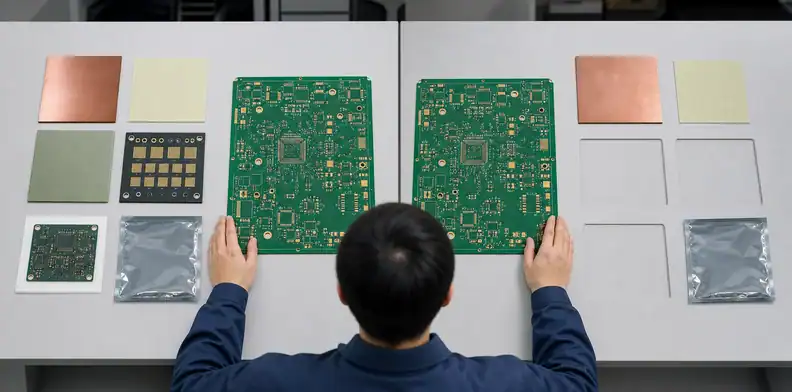
Yes, a controlled first build is usually the safest way to qualify a new supplier, but the quantity should match what you need to learn. A small prototype can reveal data, communication, and basic workmanship issues; it may not qualify the capacity, panel, sampling plan, or process controls intended for volume production.
Write the qualification objectives before ordering:
- confirming that the CAM team interprets the stack-up and notes correctly;
- reviewing DFM questions and approval discipline;
- checking dimensions, registration, finish, solder-mask, legend, and workmanship;
- verifying electrical-test, impedance, microsection, or material records;
- evaluating packaging, labels, traceability, and shipment documents;
- confirming delivery, nonconformance handling, and corrective-action communication.
Do not insert a deliberate design error as a hidden test. Provide a controlled question list or request a documented DFM review.
If the future order is much larger, add a pilot or supplier qualification lot using the intended production stack-up and controls. A five-board prototype built on a convenience panel does not automatically prove repeatability at 2,000 pieces. The prototype-to-production decision guide explains what should change—or remain frozen—during that transition.
Approve the supplier and design separately. Preserve samples and records so later investigations can separate design, fabrication, assembly, test, and handling causes.
How Can You Verify PCB Quality Remotely?
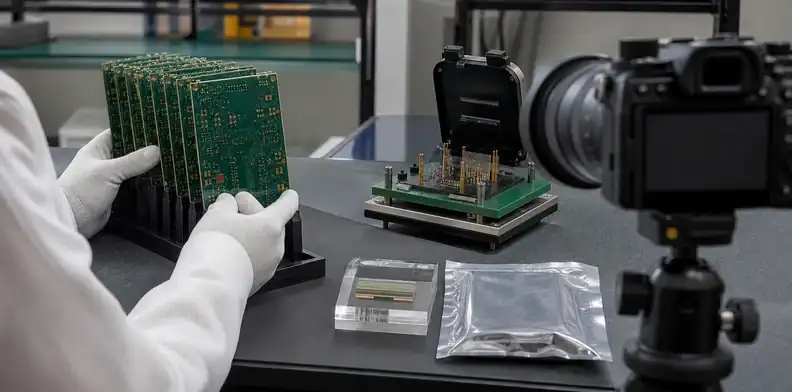
Remote qualification works when records support specific decisions and the first build provides order-specific evidence. Tours and photographs can help, but they do not replace controlled documentation.
Use a staged remote review:
- Identity and scope: Confirm the legal entity, production site, quoted processes, key contacts, and responsibility for subcontract work.
- Certificate verification: Check certificate numbers, addresses, scope, and validity using issuing or accreditation sources.
- Process review: Discuss the proposed route from incoming material through CAM, imaging, drilling, plating, lamination, finishing, electrical test, inspection, and packaging.
- Record samples: Review redacted examples of the reports you may require.
- Order evidence: Require the actual lot records stated in the purchase documentation.
- First-lot review: Compare the received boards and records with the approved design and supplier proposal.
Use the remote PCB quality evaluation guide or the formal PCB factory audit checklist when risk requires deeper assessment.
What Must Be Frozen Before Production?
Freeze the product definition, approved manufacturing interpretation, quality scope, and commercial assumptions before production release. A prototype approval is not enough if the volume order changes the stack-up, material, panel, factory, inspection plan, or revision.
Create an approval record covering:
- part number, revision, and released file-package hash or controlled archive;
- fabrication drawing and manufacturing notes;
- approved stack-up, laminate, copper, and impedance model;
- drill table, via structures, finished holes, and special processes;
- panel, finish, mask, markings, and packaging when controlled;
- applicable standards, class, customer deviations, and acceptance records;
- approved substitutions and changes that require written authorization;
- electrical-test source, coupons, reports, and retention;
- quantity, schedule, delivery term, and purchase-order reference.
State how engineering questions are approved. Email may be practical, but the final answer should be incorporated into a controlled release record rather than left in a salesperson’s inbox. Define which people can approve a material, stack-up, panel, dimensional, or delivery change.
If a manufacturer proposes a change after release, require a documented description, reason, technical impact, cost or schedule effect, and buyer approval before implementation. Silence should never be treated as approval for a controlled change.
What Should You Send for a Supplier Review?
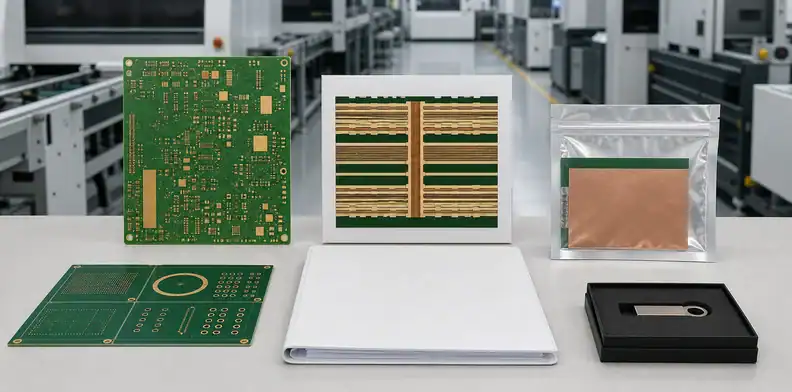
Send enough information for the manufacturer to match your board to a process, identify open risks, and quote the same scope you will later order. For an early capability review, a specification summary may be sufficient; for a production quotation, use controlled manufacturing data.
Use this submission checklist:
| Input | Early capability review | Production quotation |
|---|---|---|
| Layer count, dimensions, thickness, copper | Required | Required |
| Minimum trace/space and finished hole | Required | Derived and confirmed from controlled data |
| Via types and special processes | Required | Required in data/drawing |
| Material and surface finish | Required | Required with substitution rule |
| Impedance requirement | Target and interface information | Controlled table, stack-up basis, coupon/report scope |
| Gerber/ODB++/IPC-2581 and drill data | Optional when confidentiality limits initial review | Required in the agreed format |
| Fabrication drawing and notes | Summary acceptable | Controlled revision required |
| Quantity and product stage | Required | Required |
| Quality/test/document records | Risk summary | Exact deliverables required |
| Destination and delivery basis | Required for useful logistics review | Required |
For a board-specific assessment, send the layer count, dimensions, minimum trace/space, smallest finished hole, thickness, copper weights, material, impedance requirement, surface finish, quantities, and destination through the free PCB DFM review. Ask the reviewer to label each critical feature as routine, engineering-review, change-required, or unsupported.
For the final quotation, add the controlled fabrication files, drawing, stack-up, impedance table, standards, inspection and report requirements, revision identifier, and commercial scope. Use the QueenEMS contact page when the files require a direct project handoff.
FAQ
How do I know whether a PCB manufacturer can build my board?
Compare the complete construction—not isolated numbers—with the supplier’s normal production route. Ask for a proposed stack-up, a DFM disposition of critical features, the planned processes, and the order-specific evidence that will verify the build.
What should I ask before sending Gerber files?
Send a sanitized specification summary and ask whether the layer count, trace/space, holes, thickness, copper, material, impedance, finish, dimensions, volume, and special processes are routine or require engineering review. Full approval still requires controlled manufacturing data.
Is a prototype enough to approve a PCB supplier?
No. A prototype can qualify communication, data interpretation, and basic workmanship, but a separate pilot or qualification lot may be needed when production changes the panel, process route, volume, sampling, materials, or quality records.
How can I tell whether a supplier is a factory or a broker?
Ask which legal entity and site perform each process, which operations are subcontracted, who controls engineering changes, who releases quality records, and who owns the response to a defect. Transparency and responsibility matter more than the label.
Should I reject the lowest PCB quote?
No. First normalize the scope and ask why the price is lower. Reject or pause the quote when the supplier cannot explain material, testing, tooling, documentation, delivery, substitutions, exclusions, or the quoted revision.
Sources
- IPC document revision table: https://www.electronics.org/ipc-document-revision-table
- IPC-6012 rigid printed board specification overview: https://shop.electronics.org/ipc-6012/ipc-6012-standard-only/Revision-d/english
- Ucamco Gerber Job File overview: https://www.ucamco.com/en/gerber/gerber-job-file
- IPC-2581 Revision C announcement: https://www.ipc.org/news-release/ipc-releases-ipc-2581-revision-c-generic-requirements-printed-board-assembly-products
- UL Product iQ certification database: https://productiq.ulprospector.com/
Written by the QueenEMS Engineering Team
Upload your files today · Free DFM check before production · Ship worldwide
Get your PCB prototypes in as fast as 24 hours. We handle FR4, Rogers, and hybrid boards up to 40 layers in volume production, with advanced builds subject to engineering review — free prototypes for 2–4 layer FR-4 boards, no minimum order.
Just upload your Gerber + BOM — we source every part, assemble, and inspect (AOI + X‑Ray) so you don't have to chase suppliers. Boards ship in as fast as 24 hours.