
Quick Answer: Comparing PCB assembly quotes requires normalizing hidden costs, component markups, and shipping terms into a single standard. Turnkey quotes typically apply a 10% to 25% markup on components, charge $150 to $300 in one-time NRE fees, and face 2026 US import tariffs ranging from 30% to over 73%. You must demand an itemized breakdown and a DDP shipping quote to calculate the true landed cost.
Key takeaways:
- The cheapest 20% of quotes often exclude critical testing scopes or use grey-market parts.
- Stencil charges ($30–$100) and impedance control surcharges are frequent hidden fees.
- Calculate component markups by cross-referencing BOM prices against Digi-Key or Mouser.
- Always demand DDP shipping terms to lock in your exact final price without customs surprises.
Table of Contents
- Why Do PCB Assembly Quotes for the Same Design Vary by 300%?
- What Are the Core Line Items in a Professional PCBA Quote?
- How Do You Spot Hidden Costs That Inflate Your Final Invoice?
- How Should You Compare Component Pricing Across Quotes?
- What NRE and Tooling Fees Should You Actually Pay For?
- How Do Testing and Inspection Costs Differ Between Manufacturers?
- What Shipping, Tariff, and Landed Cost Traps Should You Watch For?
- How to Build a Side-by-Side Quote Comparison Spreadsheet?
- What Red Flags in a PCBA Quote Should Make You Walk Away?
Hardware engineers and procurement managers regularly send identical Gerber files to three different manufacturers and receive three wildly different prices. You select the lowest “per board” price, issue the purchase order, and suddenly face thousands of dollars in surprise setup fees, tariffs, and component overages. At QueenEMS, our internal data shows that 80% of new clients initially miscalculate their total project budget by at least 15% before utilizing our transparent PCB assembly cost framework. This guide breaks down exactly how to read, deconstruct, and compare quotes line-by-line so you never pay for hidden traps.
Why Do PCB Assembly Quotes for the Same Design Vary by 300%?
Quotes for the same PCBA design vary by up to 300% primarily due to five core factors: surface finish assumptions, testing scopes, NRE processing, lead time definitions, and material grades. The cheapest 20% of bids usually rely on cut corners, hidden fees, or unsustainable pricing models to win your initial order.
Engineers frequently post on forums asking why factory A quotes $12 per board while factory B quotes $35. Here is the reality behind the massive gap:
- Testing scope differences: One quote includes basic visual inspection, while another includes 3D AOI and X-ray for BGA components.
- NRE handling: Low quotes amortize NRE into the unit price, punishing you on volume, while high quotes itemize it correctly.
- Material grade: Submitting generic specs allows cheaper factories to substitute standard TG130 FR4 when your design needs high-temp TG170.
- Lead time definitions: Factory A quotes 10 calendar days. Factory B quotes 10 working days, excluding component sourcing time.
- Surface finish: Defaulting to cheap HASL instead of ENIG (Electroless Nickel Immersion Gold) artificially lowers the bare board price.
If a supplier cannot provide an itemized breakdown of these five factors, this is an immediate warning signal. A single lump-sum price hides the exact compromises they made to win your business.
Bottom line: Discard the cheapest 20% of your quotes immediately; they almost always require sacrificing reliability, testing coverage, or genuine component sourcing.
What Are the Core Line Items in a Professional PCBA Quote?
A standard turnkey PCBA quote contains four main cost buckets: PCB fabrication ($0.50–$5.00 per board), component sourcing (50%–70% of the total), assembly labor ($1.00–$4.00 per board), and NRE/tooling ($150–$300 one-time). Standardizing these buckets allows you to compare different manufacturers accurately.
Table 1: PCBA Quote Line Item Breakdown
| Line Item | Typical Cost Range | Should it be in the Base Quote? | Description |
|---|---|---|---|
| Bare PCB Fabrication | $0.50 – $5.00 / board | Yes | Cost of manufacturing the blank board. |
| Component Sourcing | 50% – 70% of total | Yes | BOM cost plus procurement markup. |
| Assembly Labor (SMT/THT) | $1.00 – $4.00 / board | Yes | Machine time and manual insertion labor. |
| NRE / Setup Fee | $150 – $300 one-time | No (Should be separate) | Programming, machine setup, and file prep. |
| Stencil Charge | $30 – $100 one-time | Varies | Laser-cut stainless steel paste stencil. |
| Electrical Testing | $0.10 – $0.50 / board | Varies | Flying probe or custom ICT fixture testing. |
Choose an itemized quote structure if you plan to order multiple batches, allowing you to track exactly which fees drop off after the first run. Choose a flat-rate quote only for rapid, one-off prototypes where tracking individual line items wastes administrative time.
Bottom line: A professional quote separates one-time setup costs from recurring unit costs so you know exactly what your second order will cost.
How Do You Spot Hidden Costs That Inflate Your Final Invoice?
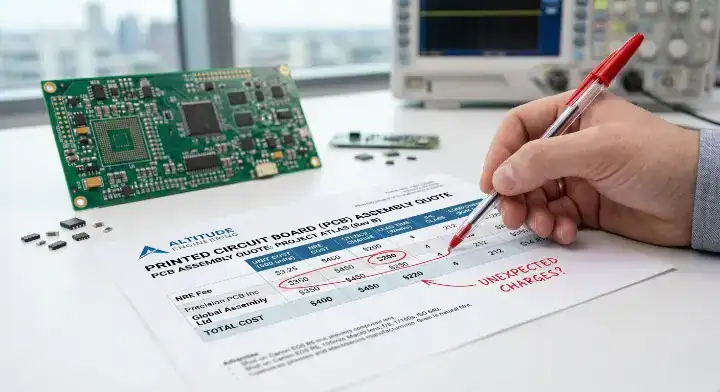
Hidden costs in PCB assembly typically add $200 to $800 to your final invoice if you accept a simple “per board” price without checking the fine print. Always demand an itemized breakdown before issuing a purchase order to expose deceptive labels.
Buyers constantly complain about final invoices blowing past the quoted amount. Pay close attention to the naming conventions manufacturers use to mask these fees. NRE fees appear under different labels across different factories: “setup fee,” “tooling charge,” or “processing fee” all describe the exact same machine preparation work.
Table 2: Hidden Cost Checklist
| Hidden Fee Name | Typical Amount | How to Spot It in the Quote | Defense Strategy |
|---|---|---|---|
| Stencil Charge | $30 – $100 | Check if “Tooling” lists “Stencil” specifically. | Ask outright: “Is the SMT stencil included?” |
| Expedite/Quick-Turn | +20% to +300% | Look at the defined working days vs sourcing days. | Verify if the timeline starts upon PO or component arrival. |
| Impedance Control | +10% to +15% | Missing from the bare board fabrication section. | Explicitly state impedance requirements in your Gerber notes. |
| Component Attrition | 2% to 5% BOM hike | “Overage” or “Attrition” line items. | Accept standard SMT overage, but question THT overages. |
| Minimum Order Penalty | $50 – $200 | Quote applies a “lot charge” for low volumes. | Order exact minimums or absorb the prototype premium. |
Some manufacturers include the $30 to $100 stencil fee in the base price, while others slip it into the final invoice. Another massive trap involves expedite fees. A “3-day turn” quote might carry a 300% premium, but the factory clock only starts after they receive all components, which takes 10 days.
Bottom line: Never sign a purchase order based on a single “total price”; mandate a line-by-line itemization to expose disguised setup and attrition fees.
How Should You Compare Component Pricing Across Quotes?
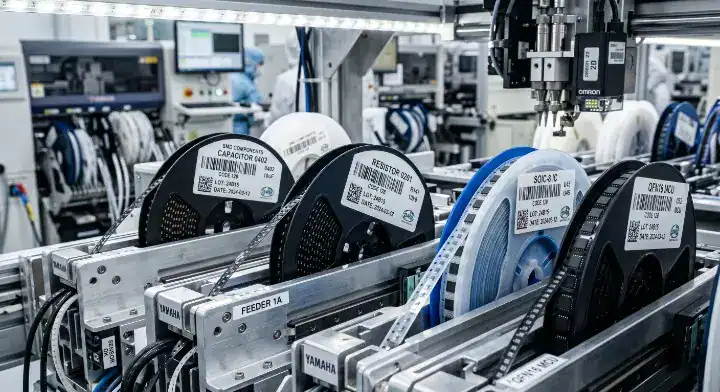
Turnkey assembly quotes derive 50% to 70% of their total cost from components, and a standard, acceptable markup ranges from 10% to 25% depending on volume. If a manufacturer refuses to provide component-level pricing upon request, treat that as an immediate signal to walk away.
Engineers struggle to verify if a factory is gouging them on parts. You can easily audit this by reverse-calculating the markup. Take 5 to 10 key ICs from your BOM, look up their standard 1,000-unit pricing on Digi-Key, Mouser, or LCSC, and compare that against the factory’s quoted component price.
For prototype runs (5–10 boards): expect a 20%–25% markup because the factory absorbs the labor of sourcing small quantities. For mid-volume production (100–500 boards): expect a 10%–15% markup. For high-volume (1,000+ boards): expect a 5%–10% markup, as the factory uses their direct manufacturer relationships.
Watch out for grey market traps. If a factory quotes a component price 30% below Digi-Key’s official list price, they are likely sourcing from unauthorized brokers. This introduces massive counterfeit risks. Always require your factory to state their sourcing channels. If you possess a mature supply chain and prefer to buy parts yourself to avoid markups, read our guide on turnkey vs consigned assembly to see which model saves you more money.
Bottom line: Calculate the exact BOM markup using public distributor pricing, and reject any factory that hides their component costs or sources from unverified brokers.
What NRE and Tooling Fees Should You Actually Pay For?
NRE (Non-Recurring Engineering) fees are one-time setup costs covering stencil fabrication, programming, and fixture creation, typically running $150 to $300 per unique design. You should only pay these once on your initial order, never repeatedly on exact reorders.
A major driver of hidden costs stems from poor panelization. Panelization efficiency directly impacts your bare board cost. Based on our factory floor data, optimizing panel utilization from 55% to 90% cuts bare board costs by up to 35%. Some cheap quotes assume terrible panel utilization and pass the raw material waste cost onto you. You can learn more about reducing these structural expenses in our breakdown of NRE costs.
- Programming: Costs $50–$100 to translate your centroid data for pick-and-place machines.
- Stencil: Costs $30–$100 for a laser-cut steel paste mask.
- Tooling: Costs $50–$150 for custom wave soldering pallets if your board has complex THT parts.
Bottom line: Force the supplier to confirm in writing that NRE fees are strictly one-time charges that will drop off your invoice for all future repeat orders.
How Do Testing and Inspection Costs Differ Between Manufacturers?
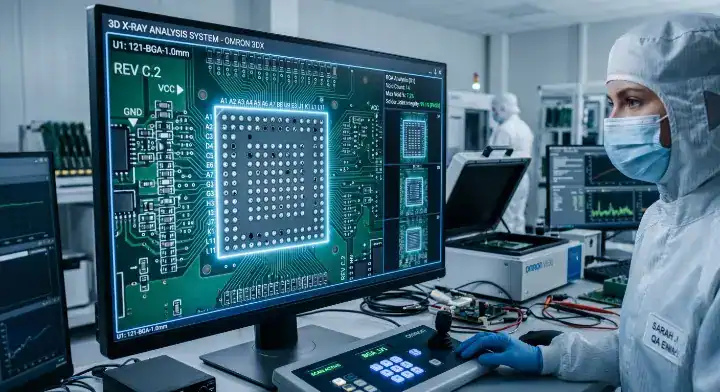
Electrical testing costs shift dramatically based on methodology, adding $0.10 per board for simple flying probe testing on small runs, or requiring a $1,000+ upfront investment for a custom ICT fixture on high-volume runs.
Manufacturers frequently manipulate testing scopes to lower their initial quote. A standard quote assumes basic IPC Class 2 visual inspection and AOI (Automated Optical Inspection). If your medical or aerospace product requires IPC Class 3, the factory must implement tighter tolerances, thicker plating, and rigorous X-ray inspection for every single BGA joint. Upgrading from Class 2 to Class 3 typically inflates the total assembly quote by 15% to 20%.
Here is how testing costs break down:
- Flying Probe: Slow but requires zero tooling cost. Best for prototypes (10-50 boards). Adds about $0.30–$0.50 per board.
- Bed of Nails (ICT): Fast but requires a $1,000–$3,000 custom fixture. Best for mass production (5,000+ boards). Drops per-board testing cost to $0.05.
- Functional Testing (FCT): Highly variable based on your specific test jig and software.
Many clients come to us after experiencing a 15% field failure rate with a cheaper supplier. We implement 3D AOI and X-ray inspection on every single BGA joint. As a result, our 99.7% first-pass yield rate drastically lowers the true cost of manufacturing compared to fixing defective boards later.
Bottom line: Specify your required testing method and IPC class explicitly in your RFQ; otherwise, factories will quote the cheapest, lowest-coverage visual inspection.
What Shipping, Tariff, and Landed Cost Traps Should You Watch For?
Importing PCBA from China to the US in 2026 subjects your order to tariffs ranging from 30% to over 73%, combining Section 301 rules, fentanyl surcharges, and MFN rates. An EXW quote looking 8% cheaper will actually cost you significantly more after calculating the true landed cost.
Buyers constantly suffer from “tariff shock.” You compare a US factory quote with a Chinese factory quote and see a 40% saving. But if the Chinese quote uses EXW (Ex Works) terms, you are responsible for shipping, insurance, customs clearance, and massive import duties.
Table 5: Incoterms Comparison for PCBA
| Incoterm | Who Pays Shipping? | Who Pays US Customs/Tariffs? | True Cost Visibility |
|---|---|---|---|
| EXW (Ex Works) | Buyer | Buyer | Very Low – Prepare for surprises. |
| FOB (Free on Board) | Buyer (from port) | Buyer | Low – You handle all import logistics. |
| DDP (Delivered Duty Paid) | Factory | Factory | High – What you see is what you pay. |
Choose EXW only if you have a massive, pre-existing logistics network and a dedicated customs broker. Choose DDP for 99% of standard commercial orders because it forces the manufacturer to calculate and absorb all shipping and tariff risks upfront. For detailed customs classification, refer to our HS code for PCB and PCBA guide.
Bottom line: Never accept an EXW or FOB quote for an international PCBA order; demand DDP terms to lock in your exact landed cost and avoid tariff surprises.
How to Build a Side-by-Side Quote Comparison Spreadsheet?
Normalizing different PCBA quotes requires stripping out NRE fees and standardizing the assumed lead time to create a true apples-to-apples comparison framework. You cannot compare a 5-day quote against a 15-day quote without factoring in the cost of time.
To build an accurate spreadsheet, you must normalize the data. First, isolate the NRE fees into a separate column. Second, calculate the per-board unit cost strictly based on PCB + Components + Assembly Labor. Third, verify that every supplier quoted the exact same BOM and did not substitute parts without permission. Make sure you supplied the exact same data package to everyone; missing files cause factories to guess and pad their margins. Check what files do you need for a PCBA quote to ensure your RFQ is tight.
Table 3: Quote Comparison Template
| Line Item | Supplier A (The Low-baller) | Supplier B (The Premium) | Supplier C (QueenEMS) |
|---|---|---|---|
| PCB Fab (Unit) | $2.50 | $4.00 | $3.20 |
| Components (Unit) | $15.00 (Grey market risk) | $18.50 (Auth disti) | $17.50 (Auth disti) |
| Assembly (Unit) | $1.50 | $3.50 | $2.20 |
| NRE / Tooling | $0 (Hidden in unit price) | $350 | $200 |
| Shipping Terms | EXW (Add 35% tariffs) | DDP | DDP |
| Normalized Cost (1k units) | **$25.75** (Plus hidden tariffs) | $26.35 | $23.10 |
If your priority is absolute lowest upfront cost and you accept high defect risks, choose Supplier A. If you want verified parts, predictable tariffs, and high first-pass yield, choose Supplier C.
Bottom line: Strip out one-time NRE fees and equalize the shipping terms (convert all to DDP) to reveal the actual per-unit production cost of your boards.
What Red Flags in a PCBA Quote Should Make You Walk Away?
A missing itemized breakdown, ambiguous component sourcing channels, and undefined IPC class standards are immediate red flags that signal potential quality issues or future price hikes.
When you evaluate a quote, look for warnings that indicate the factory is either inexperienced or actively trying to trap you.
Table 4: Red Flags vs Green Flags in PCBA Quotes
| Warning Signal (Red Flag) | Trust Signal (Green Flag) |
|---|---|
| Refuses to share component-level markup. | Provides BOM pricing matching Digi-Key/Mouser. |
| Groups NRE, PCB, and Assembly into one price. | Separates NRE clearly as a one-time charge. |
| Quotes EXW shipping for a $3,000 order. | Quotes DDP to give you a true landed cost. |
| Does not mention testing (AOI/X-ray) in quote. | Explicitly lists AOI and basic electrical testing. |
Watch out for these specific red flags:
- The 300% Price Gap: If one quote is drastically cheaper than the rest, they missed a critical component or plan to use counterfeit parts.
- “Equivalent” Part Swaps: The quote lists “factory standard” instead of your specified brand for capacitors or connectors without your approval.
- No DFM Mention: A quality factory will offer a free Design for Manufacturing (DFM) check. A bad factory will blindly print your flawed files and charge you for the ruined boards.
Bottom line: Walk away immediately from any supplier that refuses to itemize their quote or hides their component sourcing channels.
Start Quoting with Absolute Transparency
Failing to deconstruct a PCB assembly quote leads to inflated budgets, counterfeit components, and massive tariff surprises at the customs border. By normalizing NRE fees, calculating true BOM markups, and demanding DDP shipping terms, you protect your project from the 300% price variations that plague hardware manufacturing.
At QueenEMS, we eliminate the guesswork. We provide free DFM/DFA engineering reviews on every order, execute 3D AOI and X-ray inspection on all BGA joints, and source strictly from authorized distributors. We clearly itemize every tooling fee, component cost, and assembly charge so you know exactly what you pay for.
Partner with a factory that values your engineering intent. Visit the QueenEMS homepage today to upload your Gerber and BOM files for a transparent, line-by-line quote comparison.
Written by the QueenEMS Engineering Team
FAQ
Can I avoid paying NRE setup fees on my PCB assembly order? Yes, but only on exact repeat orders. NRE fees cover the physical creation of stencils and machine programming. You must pay this $150–$300 charge on the first prototype run, but a reputable manufacturer will waive it entirely for subsequent production runs of the exact same design. Check your quote to verify NRE is listed as a one-time charge.
Does a cheaper PCB quote mean worse quality? Yes, a quote priced 30% below the market average almost guarantees cut corners. Cheap factories lower prices by skipping X-ray inspection on BGA components, substituting specified parts with grey-market equivalents, or using low-grade FR4 material. Demand an itemized breakdown to see exactly where they cut the costs.
Should I buy components myself or let the manufacturer do turnkey assembly? It depends on your BOM complexity. Choose consignment (buying yourself) if you have an established supply chain and want to save the 10%–25% assembly markup. Choose turnkey assembly if your BOM has 50+ unique parts, as the manufacturer’s bulk purchasing power often offsets their markup while saving you 20 hours of procurement labor. Calculate your exact BOM cost on Digi-Key first to decide.
Upload your files today · Free DFM check before production · Ship worldwide
Get your PCB prototypes in as fast as 24 hours. We handle FR4, Rogers, and Flex up to 60 layers — free prototypes for 2–4 layer boards, no minimum order.
Just upload your Gerber + BOM — we source every part, assemble, and inspect (AOI + X‑Ray) so you don't have to chase suppliers. Boards ship in as fast as 24 hours.