Quick Answer: PCB fabrication certifications set the legal and performance boundaries for your hardware. Moving from standard IPC Class 2 to high-reliability Class 3 typically increases your board cost by 15% to 30%, while demanding automotive IATF 16949 documentation can spike quotes by 40%. A baseline ISO 9001 and UL 94V-0 rating is mandatory for commercial electronics, but aerospace projects legally require AS9100 and ITAR compliance to avoid severe penalties.
Key takeaways:
- About 30% of standard safety certificates presented by overseas brokers are expired, mismatched, or forged.
- IPC-6012 defines pass/fail performance criteria, while IPC-A-600 strictly governs visual acceptance.
- Upgrading to IPC Class 3 tolerances inflates bare board pricing by 20% to 30%.
- True certification validation requires checking surveillance audit records and matching exact factory addresses on PDF documents.
Table of Contents
- What PCB Fabrication Certifications Actually Matter for Your Project?
- What Does ISO 9001 Certification Mean for a PCB Manufacturer?
- Which Industry-Specific Certifications Should You Require?
- What Do IPC Standards (IPC-A-600, IPC-6012, IPC-A-610) Really Control?
- Why Does UL Certification Matter for PCB Fabrication?
- How Do You Verify a PCB Supplier’s Certifications Are Real?
- Does a Higher Certification Level Mean Higher PCB Cost?
- Which Certifications Does Your Project Actually Need?
- FAQ
You request a manufacturing quote and the supplier immediately sends back a zipped folder full of JPEG certificates. One shows ISO 9001, another mentions UL, and a third has a factory address that completely contradicts their website. If you guess wrong and select an under-certified facility, your hardware will fail its FDA or FCC regulatory audit months later. After processing 5,000+ assembly orders last year, we watch buyers constantly overpay for useless badges or miss the exact documentation they legally need. Here is how to read the paperwork and protect your production run.
What PCB Fabrication Certifications Actually Matter for Your Project?
PCB fabrication certifications define the exact quality control, material safety, and traceability standards a factory physically follows on the floor. Without these verified documents, your company faces severe legal liability if a batch of 10,000 boards fails in the field. General consumer devices require a baseline of ISO 9001 and UL 94, while specialized sectors demand strict ISO 13485 or AS9100 tracking.
Many hardware teams focus heavily on the assembly side but completely ignore the bare board fabrication facility. If your chosen shop lacks the proper documentation for the raw FR4 processing, your entire supply chain traceability collapses. Knowing the true PCB fabrication cost means calculating the price of this mandatory regulatory overhead.
Here’s the part that surprises most customers… many facilities hold certifications for their assembly floor but use uncertified third-party vendors to press their multi-layer boards.
- General Quality: ISO 9001 proves basic management consistency.
- Visual/Performance: IPC standards dictate acceptable manufacturing tolerances.
- Safety: UL ratings confirm fire resistance and electrical safety limits.
The Global Certification Landscape
Understanding the exact hierarchy prevents you from paying for unnecessary overhead.
| Certification Name | Issuing Body | Primary Scope | Target Industry | Mandatory? |
|---|---|---|---|---|
| ISO 9001:2015 | ISO | Quality Management System | All Sectors | Yes (Baseline) |
| IATF 16949 | IATF | Defect prevention & supply chain | Automotive | Yes |
| ISO 13485 | ISO | Medical device QMS | Medical | Yes |
| AS9100 | SAE | Traceability & risk management | Aerospace/Defense | Yes |
| UL 796 | UL | Printed wiring board safety | Consumer/Industrial | Yes (NA Market) |
This baseline breakdown shows that while ISO 9001 acts as the ticket into the game, it rarely satisfies strict regulatory bodies on its own.
Bottom line: Always match your required certifications directly to your end-market’s regulatory body; do not assume a single general ISO badge covers your legal liabilities.
What Does ISO 9001 Certification Mean for a PCB Manufacturer?

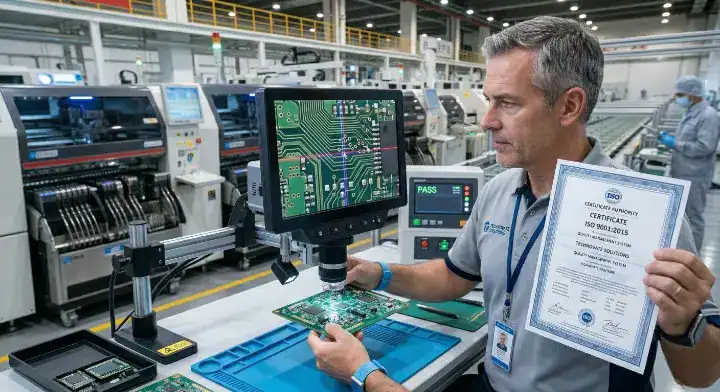
ISO 9001 certification means a PCB factory runs a strictly documented quality management system that standardizes how they handle errors, calibrate machines, and trace raw materials. It proves the vendor relies on repeatable processes rather than just hoping their technicians perform well on any given Tuesday.
Over 60% of new clients moving from basic ISO-certified brokers complain about misaligned vias that somehow passed visual inspections. We stopped relying purely on paper processes and made 3D AOI + X-Ray inspection mandatory on every BGA joint. This physical verification pushed our first-pass yield rate to 99.7%, proving that documentation must pair with aggressive hard testing.
When stepping into SMT assembly, the factory must prove they track every single component reel back to the original authorized distributor.
Want the honest answer? Having the ISO paper on the wall does not guarantee they will actually catch bad boards on the floor.
- Mandates documented corrective actions for every failed batch.
- Requires strict regular calibration of drilling and plating equipment.
- Forces the factory to trace raw FR4 materials back to the original supplier lot.
Beyond Basic Quality Management
While ISO 9001 covers the business processes, factories dealing with heavy copper and plating chemicals also need environmental tracking.
| QMS Standard | What It Proves | What It Fails to Prove |
|---|---|---|
| ISO 9001 | Consistent management and issue tracking | The actual physical quality of your specific board |
| ISO 14001 | Safe disposal of etching chemicals | The electrical performance of the copper traces |
A factory with ISO 9001 possesses the framework to fix mistakes, but you still need IPC standards to define what a manufacturing “mistake” actually is.
Bottom line: Treat ISO 9001 as a mandatory filter to eliminate amateur brokers, but rely on physical DFM checks and automated optical inspections to secure your actual board quality.
Which Industry-Specific Certifications Should You Require?
You should require exact industry-specific PCB fabrication certifications because an audit mismatch will instantly halt your product launch at customs. Over-certifying wastes thousands of dollars, while under-certifying brings heavy legal risks and product recalls.
Procurement managers on hardware forums frequently complain about this exact trap. One buyer demanded IATF 16949 (automotive grade) certification for a basic consumer USB hub, causing suppliers to artificially hike the quote by 40% to cover the extreme documentation overhead. Conversely, another team selected a shop with only ISO 9001 for a heart monitor project, causing an immediate failure during the FDA review process.
When you contract a partner for turnkey PCB assembly, their certifications must align perfectly with your target demographic.
If a sales rep tells you… “Our ISO 9001 covers all industries,” hang up the phone immediately. General certifications never replace industry-specific legal mandates.
- Consumer Electronics: ISO 9001 + UL + RoHS is sufficient.
- Automotive Electronics: IATF 16949 is a mandatory barrier to entry.
- Medical Devices: ISO 13485 acts as the absolute foundation for FDA clearance.
- Aerospace/Defense: AS9100 + IPC Class 3 + ITAR (if US military data is involved).
The Industry Decision Matrix
Matching your sector to the right standard stops budget bleed immediately.
| Industry Sector | Minimum QMS | Required IPC Level | Mandatory Safety |
|---|---|---|---|
| Consumer Electronics | ISO 9001 | Class 1 or 2 | UL, RoHS |
| Industrial Controls | ISO 9001 | Class 2 | UL, RoHS |
| Automotive | IATF 16949 | Class 2 or 3 | RoHS |
| Medical Devices | ISO 13485 | Class 3 | FDA Compliant QMS |
| Aerospace/Defense | AS9100 | Class 3 | ITAR (US data only) |
By consulting this matrix, you stop paying aerospace margins for a simple IoT device.
Bottom line: Define your specific industry requirements before asking for quotes; requesting unnecessary automotive or medical certifications will needlessly skyrocket your unit price.
What Do IPC Standards (IPC-A-600, IPC-6012, IPC-A-610) Really Control?

IPC standards act as the physical law for your boards; IPC-6012 sets the performance specifications defining pass/fail metrics, while IPC-A-600 dictates the visual acceptance criteria. Engineers constantly confuse these numbers in planning meetings, assuming they all mean the exact same thing.
Think of IPC-6012 as the recipe—it tells the factory exactly how thick the copper plating inside a via must be. IPC-A-600 acts as the photo gallery showing the inspector what an acceptable via looks like under magnification. When your boards move to the assembly stage, those rules vanish, and the factory strictly uses IPC-A-610 to judge the physical solder joints.
Nearly 80% of first-time designers submit Class 3 trace requirements on a tight Class 2 budget, causing production stalls. We established a free DFM/DFA engineering review on every order to catch these tolerance conflicts within 24 hours. This aggressive front-end check cuts our average quote-to-production time from 5 days to 2.
The real question is… do you actually need the zero-tolerance policy of Class 3?
- Class 1 (Consumer): Permits visual defects as long as the board functions properly.
- Class 2 (Industrial): Demands high performance and consistent lifespan for general electronics.
- Class 3 (High Reliability): Zero tolerance for plating voids or thin annular rings; required when failure is catastrophic.
IPC Class Tier Breakdown
Your chosen class dictates exactly how the factory runs its etching machines.
| IPC Classification | Typical Application | Plating & Via Tolerances | Price Impact |
|---|---|---|---|
| Class 1 | Cheap toys, disposables | Loose visual rules | Baseline cost |
| Class 2 | Laptops, home appliances | Strict performance | +5% to 10% |
| Class 3 | Medical implants, avionics | Zero Defect Tolerance | +20% to 30% |
You can actually negotiate custom acceptance criteria directly with your manufacturer if your design falls awkwardly between two classes.
Bottom line: Always specify IPC Class 2 for general commercial hardware, and reserve the expensive IPC Class 3 standard strictly for life-critical or aerospace applications.
Why Does UL Certification Matter for PCB Fabrication?
UL certification acts as a strict legal requirement for selling electronics in the North American market, confirming your bare board will not catch fire or cause electrical shock under stress. UL 796 specifically governs the printed wiring board itself, testing the maximum operating temperatures and trace breakdown limits.
Additionally, UL 94 grades the flammability of the raw plastic materials, with UL 94V-0 being the standard requirement proving the material stops burning within 10 seconds. Alongside UL, your boards must comply with RoHS directives to enter the European Union, which legally restricts the use of lead, mercury, and cadmium in the manufacturing process.
If you are requesting rapid PCB prototyping for an initial concept, you can sometimes skip full UL stamping to save a few days.
Here’s where it gets real… if your factory uses unlisted cheap laminate to save pennies, the UL inspector will flag the end product, forcing a massive recall.
- UL 796 tests the physical trace adhesion and maximum thermal limits.
- UL 94V-0 confirms the raw FR4 material self-extinguishes during a fire.
- RoHS compliance requires lead-free surface finishes like ENIG or Lead-Free HASL.
UL and Safety Requirements
Failing to secure these marks shuts you out of major international retail networks.
| Safety Standard | What It Tests | Geographic Market Requirement |
|---|---|---|
| UL 796 | Board trace integrity and thermal stress | North America |
| UL 94V-0 | Material flammability and fire resistance | North America / Global |
| RoHS | Restriction of hazardous heavy metals | European Union / Global |
Using a UL-certified factory means they maintain strict lot tracking for all their base laminates.
Bottom line: Never attempt to sell a commercial electronic device in the US without verifying your fabrication partner holds a valid, active UL file number.
How Do You Verify a PCB Supplier’s Certifications Are Real?

Industry import data shows roughly 30% of safety certificates presented by overseas brokers are expired, mismatched, or entirely forged. A legitimate factory will send a secure PDF directly from the issuing body, while dishonest vendors frequently rely on blurry JPEG images that hide altered expiration dates.
You must manually verify the certificate number directly on the UL or ISO official registry websites. Furthermore, buyers often get burned when brokers proudly display certificates that actually belong to their partner factories, leaving the buyer with zero direct legal coverage. We offer full turnkey service from component sourcing to final testing under one unified ISO-audited roof. By eliminating unvetted third-party handoffs, we drop compliance rejection rates at customs to zero.
But here’s what most guides won’t tell you… passing the initial audit means nothing; you must request their surveillance audit records to prove they maintain the standards year-round.
- Real certificates use PDF format; JPEG, PNG, or DOC formats act as immediate red flags.
- The company name and physical address on the certificate must exactly match the manufacturing floor.
- Certain UL certificates strictly cover specific materials or layer counts, not the entire factory output.
The Verification Checklist
Follow these exact steps before signing any high-volume manufacturing contract.
| Verification Step | Exact Action to Take | Common Red Flag Signal |
|---|---|---|
| File Format Check | Request the original PDF file. | Supplier sends a low-res JPEG or cropped screenshot. |
| Registry Lookup | Enter the ID into the ISO/UL database. | The ID does not exist or lists a different company name. |
| Address Match | Compare certificate address to the website. | The address belongs to a parent company or separate subsidiary. |
| Audit History | Ask for the latest surveillance audit log. | Supplier claims they only have the initial 3-year-old certificate. |
Taking 15 minutes to run these checks saves you months of legal nightmares when customs officials hold your shipment.
Bottom line: Always cross-reference the certificate number on the official issuing body’s website and demand recent surveillance audit records before transferring any funds.
Does a Higher Certification Level Mean Higher PCB Cost?
Securing advanced PCB fabrication certifications artificially inflates your board price because the factory must slow down their machines, run excessive testing, and maintain massive documentation trails. Upgrading from standard IPC Class 2 to IPC Class 3 immediately spikes your bare board cost by 20% to 30%.
This price jump happens because Class 3 requires a larger annular ring, forcing the factory to drill slower and scrap more boards to meet the zero-defect tolerance. When you mandate AS9100 or IATF 16949, the supplier builds the cost of their expensive yearly audits and dedicated compliance managers directly into your unit price.
Understanding the SMT assembly process helps you realize that tighter bare board tolerances reduce assembly errors later.
So what does this actually mean for your budget? You are paying a heavy premium for the documentation and the guaranteed scrap rate, not just the physical materials.
- IPC Class 3 requires intensive micro-section testing, which destroys sample boards.
- Automotive certifications demand detailed PPAP (Production Part Approval Process) paperwork.
- Medical standards require the factory to store your production records for up to 10 years.
Cost Impact by Certification Level
Every layer of compliance you add restricts the factory’s speed and yield.
| Certification / Standard | Estimated Cost Premium | Primary Driver of the Price Increase |
|---|---|---|
| ISO 9001 & IPC Class 2 | Baseline ($0) | Standard high-volume pooling processes. |
| IPC Class 3 | + 20% to 30% | Slower drilling, higher scrap rates, micro-section tests. |
| IATF 16949 (Automotive) | + 25% to 40% | PPAP documentation and strict defect prevention tracking. |
| AS9100 (Aerospace) | + 40% to 60%+ | Extreme traceability, dedicated lines, and ITAR compliance. |
If you demand aerospace-level tracking for a commercial product, you destroy your profit margins before the board even ships.
Bottom line: Only pay the 30% premium for Class 3 or AS9100 if your industry legally mandates it; otherwise, stick to Class 2 to keep your unit economics highly competitive.
Which Certifications Does Your Project Actually Need?

Selecting the correct compliance framework is a balancing act between legal safety and budget reality. Startups frequently cripple their R&D budgets by demanding medical-grade ISO 13485 tracking for early-stage prototypes that will never touch a patient.
The smartest hardware teams use a tiered approach. They build early functional prototypes using standard ISO 9001 / IPC Class 2 guidelines to move fast and fix bugs cheaply. Once the design is locked and ready for regulatory submission, they transition the files to the strict Class 3 or AS9100 lines for the final production run.
Now, here’s the part that surprises most customers… passing an audit does not mean the factory possesses the physical machines to build a 20-layer HDI board.
- Use Class 2 for rapid prototyping and minimum viable products (MVPs).
- Secure UL 94V-0 early, as changing materials later forces a complete redesign.
- Request sample boards from the factory to verify their actual capabilities match their paperwork.
Final Decision Framework
Use this matrix to lock in your requirements before requesting a quote.
| Project Stage & Type | Required Certifications | Action to Take |
|---|---|---|
| Early Concept / MVP | ISO 9001 | Focus on speed; use standard FR4 and Class 2 rules. |
| Commercial Launch | ISO 9001, UL 94V-0, RoHS | Verify the factory’s UL file number is active. |
| Medical/Auto Prototypes | ISO 13485 or IATF 16949 | Select the specialized factory now to avoid migrating later. |
Your certification requirements dictate exactly which factories are allowed to bid on your project.
Bottom line: Lock down your target market’s regulatory requirements first, then filter suppliers strictly by those exact documents to avoid quoting mismatches.
FAQ
Can I use a factory with only ISO 9001 for a medical device prototype? No. If your prototype is intended for actual clinical trials or FDA submission, it must be manufactured in an ISO 13485 certified facility. Changing factories between the prototype and production phase forces you to restart the costly validation process. Upload your BOM to us to secure compliant medical prototype pricing.
Does an IPC certification mean the factory will never ship a bad board? No. IPC certifications prove the factory understands the acceptable standards and trains their staff, but machines still drift. You must verify they run 100% automated optical inspection (AOI) and electrical testing on the floor to catch the physical defects. Request a free first-article inspection on your first order to verify their physical output.
How do I check if a Chinese supplier’s UL certification is valid? You must ask the supplier for their exact UL File Number (typically starting with an “E”). Go to the official UL Product iQ database, create a free account, and type in that number to confirm it matches the supplier’s exact factory address and covers the specific FR4 material you need. Get a transparent quote within 24 hours from our fully vetted engineering team.
Conclusion
Choosing the right manufacturing partner shouldn’t feel like guessing in the dark — now you have the exact framework to verify paperwork and avoid expensive compliance traps. You came here trying to understand why quotes vary wildly based on acronyms, and now you know exactly how Class 3 tolerances and AS9100 audits drive up your unit costs.
At QueenEMS, we back our ISO-certified processes with hard, physical verification. We offer a free DFM/DFA engineering review on every single order and mandate 3D AOI and X-Ray inspection on every BGA joint, securing a 99.7% first-pass yield rate. We even provide free 2-4 layer FR4 prototypes for new customers to prove our capabilities risk-free.
We believe every hardware team deserves a manufacturing partner who explains costs and compliance, not one who hides behind forged PDFs. Contact us today to get a detailed, side-by-side quote for your next compliant production run.
Written by the QueenEMS Engineering Team