
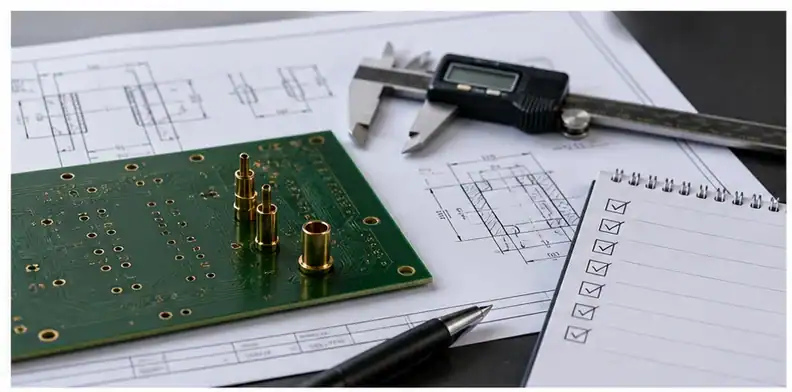
Quick Answer: PCB press-fit hole tolerance is a finished-hole decision tied to the connector manufacturer’s compliant-pin specification, plating thickness, hole quality, annular ring, board thickness, and inspection method. Do not quote press-fit boards from nominal drill size alone.
Key takeaways – Use the connector datasheet or application specification as the controlling input. – State finished plated-hole range, not only tool diameter. – Confirm inspection method, gauges, and sample qualification before production. – Treat press-fit changes as engineering decisions because they affect retention force and reliability.
Press-fit connectors can save assembly steps, but they move a lot of risk into the bare PCB. A small finished-hole change can make pins too loose, too tight, or damaging to the plated barrel. That is why the RFQ must connect the board fabrication requirement to the connector’s compliant-pin specification.
This article focuses on the buyer’s decision record. It does not invent a universal tolerance because connector families differ. Instead, it shows what evidence to collect before asking for price, what the supplier should confirm, and when a prototype qualification lot is safer than jumping straight to volume. For broader tolerance context, keep PCB fabrication tolerances nearby.
What this article covers
- Why finished hole size controls the risk
- Which connector evidence the supplier needs
- How plating and board construction affect tolerance
- What inspection evidence is worth asking for
- When prototype qualification is safer
- What to send for quotation
- Press-fit approval record for purchasing and engineering
Why finished-hole size controls press-fit risk
A press-fit hole is not just a drilled opening. It is a plated through hole with a finished diameter, copper barrel, surface finish, and surrounding laminate that must accept a compliant pin. The pin deforms during insertion and creates contact force. If the hole is too large, retention and electrical contact may suffer. If the hole is too small, insertion force can crack plating or damage the board.
The buyer should therefore avoid asking suppliers to “quote press-fit holes” without the connector requirement. Many connector makers publish recommended finished-hole ranges and board construction notes for their specific pin geometry. That document should be included in the RFQ or referenced by part number.
Finished-hole tolerance also affects yield. A board can meet a generic PCB tolerance and still fail the connector requirement if the connector window is tighter. The supplier needs to know which requirement controls acceptance.
Which connector evidence should drive the RFQ?
The most useful evidence is the connector manufacturer’s application specification, drawing, or datasheet page that defines compliant-pin hole recommendations. Include the connector part number, pin style, board thickness limits, finished-hole range, plating assumptions, and any insertion-force or retention-force requirement.
Bind every hole class to a connector revision
If the board uses more than one press-fit connector, treat each connector family separately. A power connector, signal header, and shield contact may not share the same requirement. The fabrication drawing can reference a hole table so the supplier sees which holes belong to which press-fit system.
When the connector evidence conflicts with board data, open a controlled engineering question using the PCB CAM questions workflow. Do not let purchasing approve a hole range unless engineering has confirmed the connector requirement.
| Evidence | Buyer purpose | Supplier use |
|---|---|---|
| Connector part number | Identifies the compliant pin | Confirms hole family |
| Finished-hole range | Controls fit and force | Sets drill and plating target |
| Board thickness note | Checks connector applicability | Confirms stack-up fit |
| Qualification method | Defines acceptance evidence | Plans sample inspection |
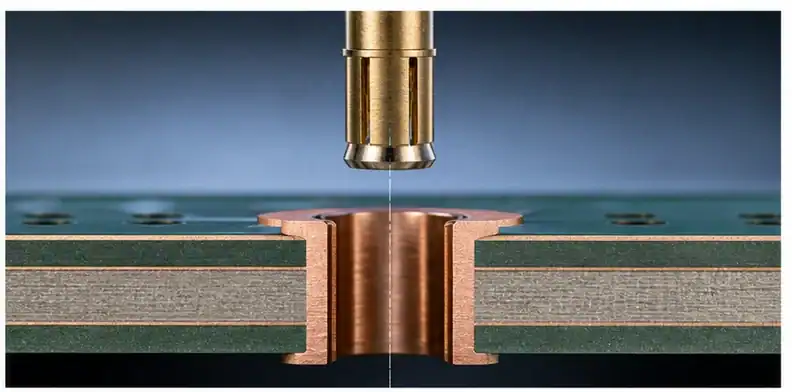
How plating, annular ring, and laminate affect the result
Finished-hole tolerance depends on drill quality, plating thickness, cleaning, surface finish, and process control. The nominal drill size is only a manufacturing input. The buyer cares about the finished range that the pin sees after plating.
Keep drill, plating, and finish assumptions consistent
Annular ring and pad design also matter. Press-fit insertion can stress the plated barrel and surrounding copper. If the design has small pads, tight copper spacing, or thick copper construction, DFM review becomes more important. The supplier may recommend test coupons, sample inspection, or adjusted tolerance assumptions.
Stack-up and material choices can also influence mechanical behavior. If a board is thick, high-layer-count, or uses special material, include the stack-up information and compare it with PCB stack-up design before requesting production price.
What inspection evidence is worth asking for?
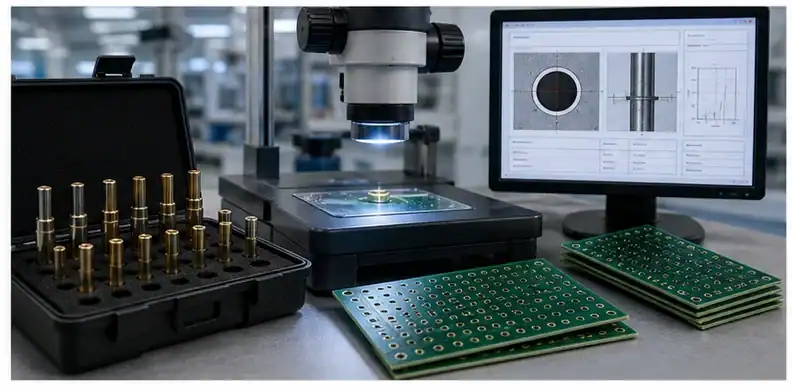
For low-risk prototypes, a basic finished-hole report or first-article check may be enough. For higher-volume or safety-sensitive builds, buyers may ask for gauge checks, cross-section evidence, sample insertion review, or documented outgoing inspection. The evidence should match the risk; too much paperwork slows a simple order, too little evidence makes a critical connector gamble.
QueenEMS buyers can connect this to PCB quality documents before shipment and PCB incoming inspection. Outgoing evidence helps catch manufacturing drift; incoming checks help verify the board after transit and before connector insertion.
Do not confuse every-hole measurement with good control. A practical plan may sample by lot, hole family, and risk level. The key is that the inspection method is agreed before production, not argued after parts fail to seat.
| Risk level | Practical evidence |
|---|---|
| Prototype fit check | Sample finished-hole measurement and insertion trial |
| Pilot production | Gauge record plus connector seating review |
| Repeat production | Lot-level inspection plan and controlled drawing |
| Customer audit | Stored reports, revision traceability, and shipment record |
When should buyers prototype before volume?
Prototype qualification is safer when the connector is new to the product, the tolerance window is tight, the board is thick, the press-fit field is dense, or the cost of failure is high. A pilot lot can confirm insertion force, retention, visual barrel condition, and assembly handling before the buyer locks the production route.
Prototype boards should not be treated as random samples if the process will change for volume. If panelization, surface finish, copper thickness, or supplier process changes, the qualification evidence may not transfer cleanly. The release record should say what is qualified.
If DFM changes the quote after the pilot review, use PCB quote changes after DFM to decide whether the change is valid scope, missing RFQ detail, or a supplier assumption that should have been clarified earlier.
What should the press-fit RFQ include?
Send the connector part number, manufacturer specification, finished-hole range, board thickness, copper and surface finish, quantity, stack-up, controlled hole table, and requested inspection evidence. If possible, provide the mating connector sample or insertion fixture plan for early review.
The RFQ should also say who can approve hole-range changes. Press-fit tolerance is a product engineering decision, not only a factory convenience. If the supplier recommends a change, ask what evidence supports it and whether the connector manufacturer’s requirement still holds.
For quotation, provide QueenEMS with the connector application specification, controlled board data, finished-hole classes, board thickness, finish, quantities, and evidence request. Ask for a press-fit manufacturability check that is tied to the named connector revision before the production release.
| RFQ field | Avoid | Use instead |
|---|---|---|
| Hole size | Nominal drill only | Finished plated-hole range |
| Connector data | “Standard press-fit” | Exact part number and specification |
| Inspection | “Check holes” | Gauge/sample plan by hole family |
| Approval | Email yes/no | Controlled engineering decision |
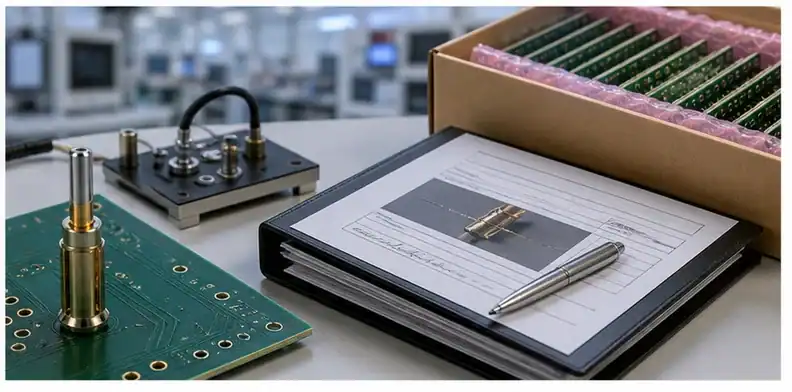
Press-fit approval record for purchasing and engineering
Do not let nominal drill size become the contract
Press-fit discussions often start with a nominal drill number because that is what appears in CAD or an old drawing. But the connector pin interacts with the finished plated hole, not the original drill tool. If the RFQ only states a drill size, suppliers may choose process assumptions that create different finished holes. One supplier may target the connector range; another may target a generic PCB tolerance and still believe it has followed the drawing.
The approval record should therefore name the finished-hole range and the controlling connector requirement. If the connector maker’s document says a specific range, quote that range or attach the document. If the design team has approved a different range, record the reason. This turns the requirement from a vague manufacturing preference into an engineering-controlled acceptance item.
Align bare-board evidence with connector insertion
A finished-hole report is useful, but it does not fully prove that the connector will insert correctly under real assembly conditions. The buyer should decide whether the order needs a bare-board gauge check only, a sample connector seating trial, or a pilot assembly run. The right level depends on risk: connector cost, board value, density of pins, safety requirements, and whether the connector has been used before.
When a press-fit connector is new to the product, ask for a small qualification loop before high-volume release. That loop can check hole size, visual barrel condition after insertion, retention behavior, and whether any pads lift or barrels crack. It can also reveal handling details, such as the need for a support fixture or insertion tooling. These issues are easier to solve during a pilot than after production boards and connectors are waiting on the line.
Record who owns tolerance changes
A supplier may recommend changing the hole target to improve yield or match its process window. That proposal is worth hearing, but it should not be accepted as a purely commercial decision. The connector requirement exists for a reason, and a small change can alter insertion force or reliability. The buyer should route the decision to the design owner or connector owner, then update the drawing if approved.
For repeat production, keep the connector document, finished-hole range, inspection plan, and approved supplier assumptions together. If purchasing later sends only Gerbers and quantity, the next quote may lose the context that made the first build successful. A clear record makes reorders faster because the supplier can quote the known acceptance window instead of rediscovering it during CAM.
Questions to ask before comparing press-fit quotes
Ask each supplier which finished-hole range they are quoting, which connector document they used, how they will verify the hole family, and whether their standard tolerance is tighter or wider than the connector window. Also ask whether the quote includes any sample insertion support or only bare-board measurement. These answers decide whether two prices are actually comparable.
If the supplier asks for the connector part number, treat that as a positive sign. It means the factory understands that press-fit is not a generic plated-hole requirement. If the supplier never asks for connector data and only quotes from the drill table, the buyer should slow down and clarify the requirement before placing the order.
When lower price can create higher assembly cost
A low bare-board price can become expensive if connector insertion causes cracked barrels, loose pins, rework, or line stoppage. Press-fit failure is especially painful because the problem may appear after boards, connectors, and assembly fixtures are already committed. That is why the quote should include the evidence needed to protect the assembly step.
Cost control is still possible. Buyers can separate prototype evidence from production evidence, sample only critical hole families, or run a pilot before committing to volume. But the decision should be explicit. If the buyer removes inspection to save cost, the team should know which risk it is accepting.
What QueenEMS should return in a useful review
A useful review should identify missing connector documents, drawing conflicts, hole families that need separate control, plating or annular ring concerns, and the recommended evidence level. The response should also say whether QueenEMS can quote immediately or needs engineering clarification. That honesty is more valuable than a fast price built on missing connector assumptions.
Release wording for repeat production
For repeat orders, the RFQ should not rely on memory from the first successful build. Keep the connector specification, finished-hole range, inspection method, and approved supplier assumptions in the controlled package. If the connector part changes, even within the same family, confirm whether the hole recommendation changed. If board thickness or copper construction changes, ask whether the insertion window is still valid.
This record also helps purchasing negotiate fairly. A supplier that includes gauge evidence, tighter control, and engineering review is quoting a different responsibility than one quoting only standard plated holes. Once that difference is visible, the buyer can decide whether the risk justifies the cost.
Approval record for reorders and supplier comparison
Press-fit reorders should start from the qualified connector-to-board interface. Save the connector part number and revision, compliant-pin style, finished-hole distribution, surface finish, board thickness, barrel metrology, insertion setup, and first-build evidence. If procurement changes the connector source or the board shop changes a plating assumption, reopen fit validation instead of treating the order as a price-only repeat.
A press-fit quotation is comparable only when each supplier prices the same connector-controlled hole window and qualification evidence. Ask whether the finished diameter accounts for the stated surface finish, whether barrel measurements are lot-based or sample-based, and whether insertion tooling and board support are inside the PCBA scope. A lower bare-board price can still move metrology or insertion risk to the assembler.
Release the board only after the connector part number, application-specification revision, compliant-pin variant, drilled-hole guidance, finished-hole range, board thickness and surface finish agree. The iNEMI Press Fit Roadmap notes that connector manufacturers specify drilled and finished hole sizes and that finish changes need validation. Keep the connector document beside the PCB revision so a purchasing substitution cannot silently change the interference fit.
FAQ
Can I use one generic tolerance for every press-fit connector?
No. Use the exact connector manufacturer’s application specification or drawing for that compliant-pin family. Different pin geometries and finishes can require different drilled and finished hole controls even on the same PCB.
Does an in-tolerance finished hole prove a reliable joint?
No. The joint also depends on barrel copper, hole quality, board thickness, surface finish, insertion depth, tooling support and the connector’s force window. Treat bare-board metrology and assembly insertion evidence as linked but separate records.
What should QueenEMS receive before quoting press-fit assembly?
Send the connector part number and revision, application specification, PCB stack-up, press-fit drill class, finished-hole callout, finish, quantities, insertion sequence and requested measurement or force evidence. Mark any connector substitution as engineering approval required.
For a press-fit quotation, send QueenEMS the connector application specification, PCB drill table, stack-up, finish, insertion sequence, and evidence requirement. The review should return one connector-specific hole interpretation rather than a generic fabrication tolerance.
Written by the QueenEMS Engineering Team
Upload your files today · Free DFM check before production · Ship worldwide
Get your PCB prototypes in as fast as 24 hours. We handle FR4, Rogers, and Flex up to 60 layers — free prototypes for 2–4 layer boards, no minimum order.
Just upload your Gerber + BOM — we source every part, assemble, and inspect (AOI + X‑Ray) so you don't have to chase suppliers. Boards ship in as fast as 24 hours.