
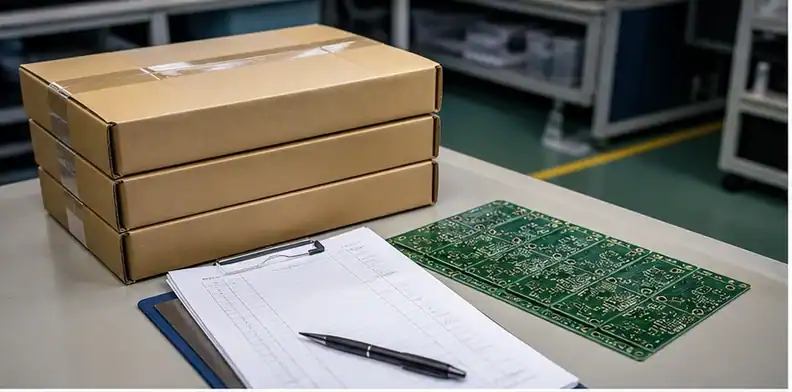
Quick Answer: PCB incoming inspection should confirm that the delivered boards match the purchase order, drawing, revision, and agreed acceptance evidence before they move into assembly or inventory. It should catch wrong revisions, handling damage, surface finish concerns, dimensional problems, missing quality records, and signs that a lot needs containment rather than routine release.
Key takeaways – Start with lot identity and revision before looking for defects. – Match inspection depth to product risk, supplier history, and whether the lot is first-build or repeat production. – Separate cosmetic observations from functional or reliability risks. – Document containment decisions before boards are mixed into inventory or assembly.
PCB incoming inspection matters most when the boards were built by an outside supplier and the next step is expensive assembly. A low-cost inspection at receiving can prevent the wrong revision, oxidized finish, missing report, warped panel, or questionable lot from entering SMT production. The goal is not to re-inspect every board as if you were the fabricator. The goal is to verify identity, catch shipment-level risk, and decide whether the lot can be released, sampled further, or held for supplier response.
The article is meant for buyers who receive bare boards from an overseas or outsourced PCB supplier, not for a factory trying to replace its own final inspection. That distinction matters. The buyer’s receiving team usually cannot see every internal process variable, and it should not pretend to. It can, however, confirm that the delivered lot matches the approved order, that the shipment is not obviously damaged, that critical-to-use features look and measure correctly, and that the supplier sent the agreed evidence.
It is also a conversion point. When a buyer asks an AI tool what to inspect, that buyer is often close to assembly, repeat order, supplier dispute, or supplier qualification. A useful answer should help them decide what to check now and what should have been defined before shipment. If the article only lists defects, it misses the purchasing decision. If it only says “follow IPC,” it misses the real workflow. The inspection plan has to connect drawings, PO requirements, supplier records, receiving evidence, and disposition.
Table of Contents
- Start With Lot Identity Before Defects
- Choose the Right Inspection Depth
- Check Visual Damage and Surface Finish
- Measure Only the Dimensions That Affect Use
- Decide When to Hold or Release the Lot
- Feed Inspection Results Back Into Sourcing
Start With Lot Identity Before Defects
Start incoming inspection by proving that the boards are the boards you ordered. Check the part number, revision, purchase order, quantity, date code or lot code, shipment paperwork, and any supplier quality documents before opening a technical defect discussion. If identity is wrong, the lot is already at risk even when every board looks beautiful.
This first step should compare the shipment with the controlled release package. The buyer should know which Gerber or ODB++ package, fabrication drawing, stack-up, material rule, and surface finish were approved. If the receiving team only sees a carton and a supplier invoice, it cannot confidently separate a correct repeat lot from an obsolete build.
For production orders, connect receiving records with the PCB purchase order review and repeat PCB order revision control process. A receiving decision becomes much stronger when it can point to the exact revision and approved assumptions. If the PO did not freeze those details, incoming inspection often becomes detective work.
A useful receiving record also captures who performed the check, when the cartons were opened, whether packaging damage was visible, and whether the boards were exposed to unusual handling before inspection. That may sound administrative, but it matters later. If a surface finish problem appears during assembly, the team needs to know whether the issue was present at receipt, created during local storage, or discovered only after the boards were baked, handled, or depanelized. Good incoming inspection preserves the timeline before opinions start to blur.
Choose the Right Inspection Depth
Inspection depth should be chosen by risk, not habit. A first shipment from a new supplier, a high-density board, a controlled impedance product, a fine-pitch BGA assembly, or a safety-related product deserves more evidence than a stable commodity repeat lot. On the other hand, inspecting every dimension on every low-risk board can consume time without improving release decisions.
Build an inspection plan around three levels. Level one is shipment and document verification: count, packaging, identity, records, and obvious damage. Level two is sampled visual and dimensional inspection: mask condition, finish condition, warpage, outline, slots, key holes, and features that affect assembly. Level three is special verification: solderability, impedance report review, microsection review, or destructive checks when risk justifies it.
The supplier should provide records that match the agreed requirement, not an impressive pile of unrelated files. The article on PCB quality documents before shipment can help define which records should exist before receiving. Incoming inspection then verifies whether those records match the delivered lot and whether missing documents should stop release.
Risk-based inspection also changes how you talk to suppliers. Instead of asking for “better quality” in general, the buyer can say which receiving triggers will cause a hold: missing COC, mismatched revision, edge damage, solderable pad discoloration, warpage beyond the drawing, or missing impedance evidence. That clarity helps the supplier build the right shipment package and helps QueenEMS quote the right inspection scope when a buyer needs boards delivered directly into assembly.

Check Visual Damage and Surface Finish
Visual inspection should focus on conditions that can affect assembly, reliability, customer acceptance, or traceability. Look for shipping damage, contamination, scratches through solder mask, exposed copper where it should not appear, poor legend clarity, bent panels, edge damage, foreign material, delamination signs, blistering, mask lift, pad staining, or finish discoloration.
IPC-A-600 is commonly used as the visual acceptability reference for printed boards, while product drawings and customer requirements may add stricter rules. The practical buyer question is not simply whether a board is ugly. It is whether the observed condition is acceptable for the product class, assembly process, and end customer.
Do not turn every mark into a supplier claim. Cosmetic scratches outside functional areas may not deserve the same response as solderable pad contamination, lifted mask near fine-pitch pads, or damage to controlled edge contacts. When a visual issue may affect soldering, the receiving team should preserve samples and ask whether solderability evidence or supplier containment is required.
Photographs should show scale and location. A close-up of a scratch is not enough if nobody can see whether it is on a rail, over a nonfunctional area, or across a solderable pad. Include a board overview, a location marker, a close-up, and a reference to the drawing requirement when possible. This makes the supplier response faster and makes it easier for engineering to decide whether the issue is cosmetic, assembly-related, or a true reliability concern.
Measure Only the Dimensions That Affect Use
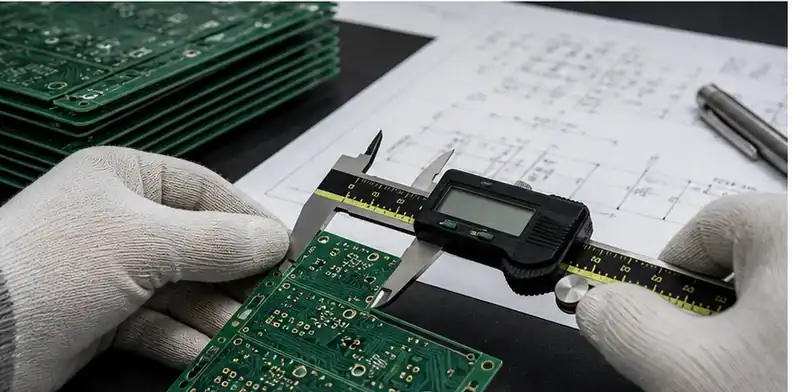
Measure dimensions that affect assembly, enclosure fit, electrical performance, or customer acceptance. Common receiving checks include board outline, critical slots, connector keepouts, tooling holes, panel rails, thickness, warpage, and any feature called out as critical on the drawing. Do not waste effort measuring features that the buyer never defined as important.
Sampling is often enough for receiving, but the sample size should be defensible. A first lot, a supplier change, a material change, or a previous nonconformance may justify tighter sampling. A stable repeat lot may need only identity, damage, and a few critical-to-use checks.
Dimensional inspection should also catch document mismatches. If the board matches the Gerber but not the mechanical drawing, the receiving team needs an engineering decision. If the issue traces back to a supplier CAM clarification, review the PCB CAM questions before production log before blaming the receiving inspector.
Avoid measuring everything just because a caliper is nearby. Too many receiving checks can create false confidence when the critical risk is actually solderability, storage condition, or a missing report. The better method is to mark critical-to-use features on the drawing before the order is placed. Then receiving can inspect the features that would stop assembly, enclosure fit, or customer acceptance if they were wrong.
Decide When to Hold or Release the Lot
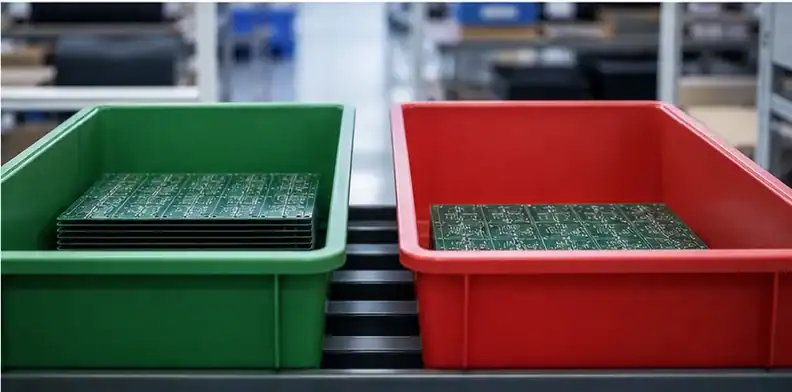
A lot should be held when identity is uncertain, required records are missing, damage is widespread, a critical dimension is out of tolerance, solderable areas look compromised, or the defect could create assembly scrap. Holding the lot does not automatically mean rejecting it. It means the boards should not be mixed into stock or consumed by SMT until the risk is understood.
Use a simple disposition model: release, release with note, sort or sample further, request supplier response, approve temporary deviation, reject, or return. The decision should name the evidence: photos, affected quantity, sample locations, drawing requirement, inspection method, and whether the problem is cosmetic, functional, reliability-related, or documentation-only.
If the supplier proposes using the lot despite a mismatch, handle that through a formal PCB deviation request approval path rather than an informal email. A deviation may be reasonable for limited nonfunctional differences, but it should not silently change the accepted production baseline.
Containment should also protect traceability. If only part of a lot is suspect, separate affected boards physically and in the inventory system. Do not let operators pull from a mixed stack while the supplier is still reviewing photos. Even a simple color-bin system works if it is backed by lot number, board count, and disposition record. The point is to prevent a small receiving concern from becoming an unknown assembly escape.
Feed Inspection Results Back Into Sourcing
Incoming inspection should improve future sourcing decisions. Track which suppliers ship correct revisions, complete records, clean packaging, stable dimensions, and low containment rates. Also track which problems were caused by buyer release errors, unclear drawings, or late PO changes. Supplier performance data is useful only when it separates supplier fault from buyer-side ambiguity.
For new suppliers, incoming inspection results should feed the qualification record. The first accepted lot is not just inventory; it is evidence about how well the supplier follows drawings, protects boards, communicates deviations, and supports traceability. That information belongs next to the PCB supplier qualification order record.
For an inspection-ready quote, send QueenEMS your fabrication drawing, critical dimensions, required records, IPC or customer acceptance level, sample size expectation, destination, and whether the boards will move directly into assembly. QueenEMS can align the quality document package and shipment release evidence before the order leaves the factory.
Over time, the inspection plan should get sharper. If a supplier repeatedly ships correct records and stable boards, reduce low-value checks and keep the important ones. If a supplier repeatedly misses the same item, raise that item earlier in RFQ or release review rather than catching it only at receiving. Incoming inspection is strongest when it closes the loop with sourcing, not when it operates as an isolated quality station.
Before you ask a supplier to quote the next lot, turn receiving findings into specific requirements. Instead of saying “improve quality,” identify the release items that would have prevented the hold: clearer revision labels, added packing photos, impedance report before shipment, no mixed date codes, critical dimension confirmation, or a defined solderability check when storage time is long. This language is easier for a supplier to price and easier for QueenEMS to include in the quotation scope.
If the receiving team has no clear inspection plan yet, start with a narrow one. Choose the five items most likely to stop assembly or customer acceptance, then add supplier records that support those checks. A focused plan is better than a long checklist nobody follows. Over time, expand or reduce the plan based on real supplier performance, not fear.
When asking QueenEMS for help, include the original drawing, photos of the suspect condition, the number of affected boards, whether assembly has started, and what decision is needed: release, sort, rework, supplier claim, or repeat-order correction. That information lets the review move from “is this bad?” to “what should we do with this lot and what should change before the next order?”
When the answer is uncertain, preserve the boards and delay irreversible steps such as depanelization, baking without record, or partial assembly. Those actions can erase evidence and make supplier responsibility harder to determine. If production pressure is high, release only the boards and features that have a documented disposition, and keep the rest physically separated until the supplier response is closed and the next action is written for production control.
FAQ
Should every PCB shipment receive incoming inspection?
Yes, at least at identity and damage level. The inspection depth can be light for stable repeat lots and deeper for new suppliers, critical boards, or lots with previous problems.
Is IPC-A-600 enough for receiving inspection?
No. IPC-A-600 is a useful visual acceptability reference, but your drawing, product risk, IPC class, customer requirements, and assembly process decide what must be checked.
What should I do if incoming inspection finds a problem?
Hold the affected lot, preserve samples, document the requirement and evidence, then decide whether to release, sort, request supplier response, approve a deviation, or reject.
Can incoming inspection replace supplier quality control?
No. It is a buyer-side verification and containment step. The supplier still owns fabrication control, final inspection, and agreed shipment records.
Sources
Written by the QueenEMS Engineering Team
Upload your files today · Free DFM check before production · Ship worldwide
Get your PCB prototypes in as fast as 24 hours. We handle FR4, Rogers, and Flex up to 60 layers — free prototypes for 2–4 layer boards, no minimum order.
Just upload your Gerber + BOM — we source every part, assemble, and inspect (AOI + X‑Ray) so you don't have to chase suppliers. Boards ship in as fast as 24 hours.