
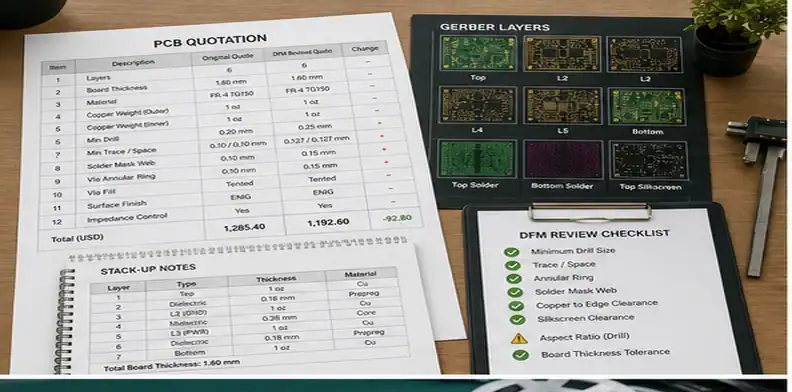
Quick Answer: PCB quote changes after DFM review usually mean the first quote was based on incomplete, estimated, or machine-parsed data, while the reviewed quote reflects real manufacturing decisions. The change may come from 6–10 common areas: stack-up, copper weight, drill limits, impedance, surface finish, panelization, tolerances, testing, assembly assumptions, or file inconsistencies.
Key takeaways
PCB quote changes feel frustrating because they arrive after you thought the budget was settled. A buyer uploads Gerbers, receives a fast price, sends the file to engineering, and then the number moves after DFM or CAM review. Sometimes the change is small. Sometimes it is large enough to affect launch timing, supplier selection, or whether the design should be revised before production.
The useful question is not “Why did the supplier change the quote?” It is “Which technical assumption changed, and is that change necessary for a reliable build?” For teams in the United States, Canada, and Mexico working with an overseas PCB manufacturer, that distinction matters. A low first quote can disappear once the board is reviewed against manufacturable stack-ups, finished copper, drilling limits, impedance control, panel yield, and inspection requirements.
This guide explains the reasons behind PCB quote changes, what is normal after DFM review, what should be challenged, and how to send a quote package that keeps revisions under control.
Table of Contents
- Why Do PCB Quote Changes Happen After Review?
- What Changes When CAM Reviews the Gerber Data?
- How Do Stack-Up and Materials Change the Quote?
- What Design Rules Create Price or Lead-Time Changes?
- How Does Panelization Affect PCB Quote Changes?
- What Assembly Assumptions Can Change the Price?
- How Should You Judge Whether a Change Is Fair?
- What Questions Should You Ask Before Approving It?
- How Can You Prevent PCB Quote Changes Earlier?
- What Should You Send for a Stable Production Quote?
Why Do PCB Quote Changes Happen After Review?
PCB quote changes happen when the reviewed manufacturing plan is different from the assumptions behind the first price. The first quote may be a budgetary estimate; the reviewed quote is closer to a build plan.
Many quote portals and quick RFQ replies price the obvious parameters first: board size, layer count, quantity, thickness, solder mask color, copper weight, surface finish, and delivery speed. That is enough for a rough estimate, but it does not prove the board can be manufactured exactly as sent. DFM review adds the missing engineering layer.
The quote may change because the board needs a different stack-up, a wider tolerance band, a special material, a different via process, an impedance coupon, extra inspection, or a panel arrangement that produces fewer usable boards per production panel. In PCBA work, the BOM, sourcing model, stencil, placement complexity, X-ray, programming, and test assumptions can also move the final price.
The first task is to classify the change. A clear supplier should tell you whether it came from file correction, manufacturing capability, yield protection, material availability, assembly scope, testing, logistics, or commercial terms. If the explanation is only “engineering updated price,” ask for the specific driver before approving the order.
This article is not a replacement for a quote-file checklist. If you are still collecting the RFQ package, start with the QueenEMS guide to PCB fabrication quote files and then use this article to understand why the price may still move after review.
What Changes When CAM Reviews the Gerber Data?
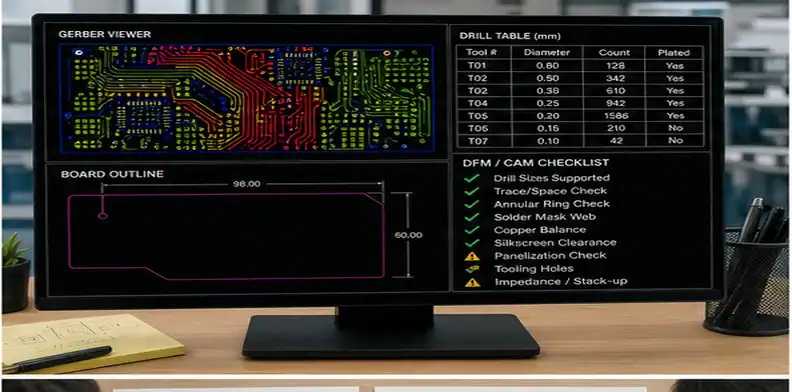
CAM review converts your design output into production data, so it can reveal conflicts that a quote form cannot see. Gerber files describe PCB image layers, while the build still needs drill information, profile clarity, material notes, finish, tolerances, and manufacturing instructions.
Ucamco describes Gerber as the de facto data transfer format for PCB fabrication, but the files are still part of a wider manufacturing package. The Gerber Job File exists because fabrication data is not only images; finish, thickness, and materials also matter for quoting, engineering, CAM, and fabrication.
CAM review may uncover:
- Missing or ambiguous board outline
- Mismatch between Gerber layers and drill files
- Plated and non-plated holes not clearly separated
- Drill sizes below the quoted capability
- Slot, castellated hole, or countersink details missing from the first quote
- Copper-to-edge or drill-to-copper spacing below the standard process
- Solder mask slivers or openings that need engineering judgment
- Unclear controlled-impedance requirements
- Missing fabrication drawing notes that conflict with the upload form
Those items can change either cost or lead time. For example, a board priced as a standard 4-layer panel may become a controlled-impedance build once the drawing shows 50 ohm or 90 ohm differential pair requirements. A drill table may show microvias or tight aspect ratio after the quote form treated the board as ordinary through-hole construction.
CAM review should not silently rewrite the customer’s design intent. It should identify questions, request approval for changes, and record the revision that will be built. If the supplier changes the quote because CAM adjusted the data, ask whether the adjustment is a recommendation, a manufacturing requirement, or a customer-approved correction.
How Do Stack-Up and Materials Change the Quote?
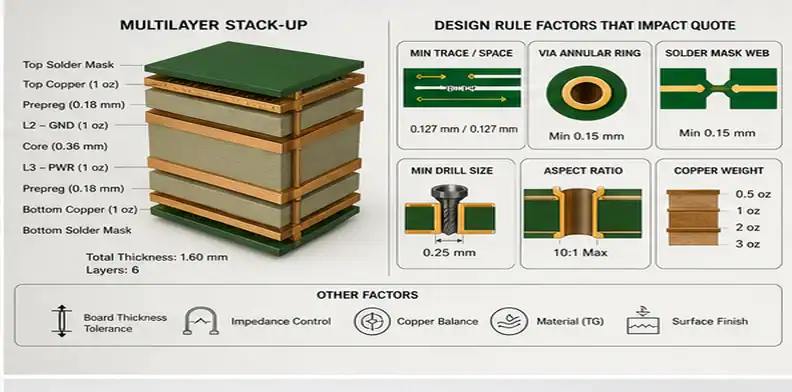
Stack-up and material assumptions can change a PCB quote because they determine laminate cost, copper weight, pressing cycle, impedance behavior, and availability. The same Gerber image can be built with different material choices, but the price and risk will not be identical.
A quote form may default to standard FR-4, 1.6 mm thickness, 1 oz finished copper, and a common solder mask. Your drawing may later specify high-Tg FR-4, halogen-free material, low-loss laminate, 2 oz copper, tight thickness tolerance, or a named laminate family. Each change affects procurement and process planning.
Controlled impedance is especially important. If impedance was not declared in the first request, the supplier may quote only the board geometry. Once impedance is confirmed, the stack-up may need different core and prepreg combinations, coupon design, impedance testing, and engineering review. That can change both unit price and delivery date.
Material changes are not always bad. If the reviewed quote moves from a generic material to a qualified equivalent, the supplier may be protecting performance, availability, or lead time. But the material basis should be visible. Ask for the quoted material family, Tg, copper weight, dielectric thickness assumptions, and whether substitutions require approval.
QueenEMS covers cost drivers in more detail in the PCB fabrication cost guide. For this topic, the key point is simple: a price based on a guessed stack-up is not the same as a production quote based on an approved stack-up.
What Design Rules Create Price or Lead-Time Changes?
Design rules change price when the board moves from a standard process window into a tighter or higher-risk process. The supplier may need slower processing, additional inspection, lower panel yield, or a different production route.
Common design-rule drivers include:
| Design item | Why it changes the quote | What to confirm |
|---|---|---|
| Trace and space | Fine lines may require tighter etching control | Minimum finished trace and gap |
| Drill size | Small holes raise aspect-ratio and plating risk | Finished hole, drill type, board thickness |
| Annular ring | Tight rings reduce registration margin | Minimum ring after fabrication |
| Via structure | Blind, buried, stacked, or filled vias add process steps | Via type and acceptance requirement |
| Copper weight | Heavy copper needs wider spacing and longer processing | Base and finished copper |
| Solder mask | Fine-pitch openings may require mask dam review | Mask color and minimum sliver |
| Edge clearance | Copper near route or V-cut edges can reduce yield | Copper-to-edge rule |
| Thickness tolerance | Tight tolerance affects material and lamination control | Finished board tolerance |
Lead time can move even when unit price does not. A board with normal geometry may still need extra days for impedance review, special laminate procurement, ENIG thickness confirmation, UL marking approval, or customer approval of DFM questions.
Use the quote revision as a signal. If the change is caused by a real manufacturing constraint, the right response may be a layout revision rather than a price negotiation. If the supplier cannot explain the exact design-rule trigger, the change deserves more scrutiny. A PCB manufacturer capability check can help you separate normal process limits from weak supplier communication.
How Does Panelization Affect PCB Quote Changes?
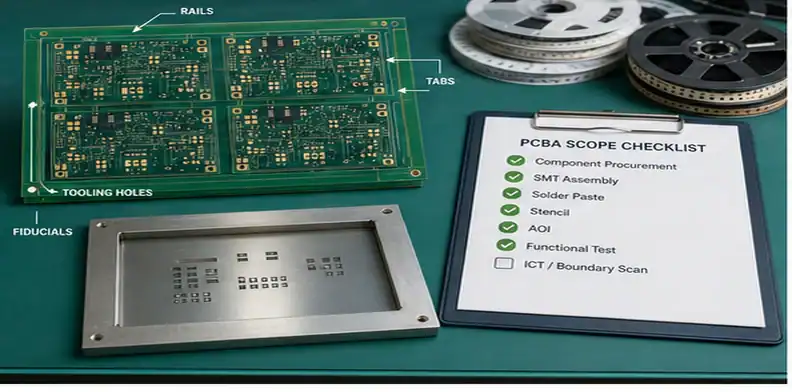
Panelization affects PCB quote changes because the supplier prices manufacturing efficiency, not only board area. A small change in rail, tab, V-score, rotation, or spacing can change how many usable boards fit on a production panel.
Early quotes often treat panelization as a hidden assumption. After CAM review, the supplier may discover that the board cannot be rotated because of grain direction, connector overhang, edge plating, controlled impedance coupon placement, or assembly orientation. The panel may need rails for SMT handling, breakaway tabs for irregular outlines, tooling holes, fiducials, or more spacing between boards.
Panelization can change cost in three ways. First, the panel may produce fewer pieces, increasing the cost per board. Second, the panel may require extra routing, scoring, or manual depaneling work. Third, the assembly process may need panel rails, support, or a carrier to control warpage.
For prototypes, the impact may be modest. For repeated production, panelization becomes a real cost lever. A supplier who reviews panel yield before production may prevent a larger problem later: boards that are technically fabricated but inefficient or risky to assemble.
Ask for the proposed panel drawing when panelization drives a quote change. You do not need to micromanage the factory panel, but you should approve customer-facing features such as tab locations, mouse bites, V-score direction, edge clearance, and any depaneling stress near components.
What Assembly Assumptions Can Change the Price?
Assembly assumptions change the price when a PCB-only quote becomes a PCBA-ready build plan, or when the BOM and placement data reveal work that was not included in the first estimate. This is common when PCBA is secondary but still part of the sourcing discussion.
The quote may change because of component sourcing, minimum order quantities, moisture-sensitive devices, fine-pitch packages, BGAs, QFNs with thermal pads, odd-form parts, through-hole soldering, selective solder, conformal coating, programming, calibration, or functional testing. A bare PCB quote cannot account for those items unless the assembly package is included.
BOM risk is often the largest surprise. A component that looked ordinary in the first review may be obsolete, allocated, single-source, export-sensitive, or available only in a package that does not match the footprint. If QueenEMS or another EMS partner is sourcing parts, the quote should separate PCB fabrication, assembly labor, components, tooling, test, and optional risk items instead of hiding everything in one changed number.
The handoff files matter here. A centroid file, assembly drawing, BOM with manufacturer part numbers, polarity notes, and test requirements reduce the chance of late additions. For a full assembly package, cross-check the QueenEMS PCB assembly RFQ checklist and the PCB assembly quote file guide.
If the first quote was PCB-only, do not treat a later PCBA-inclusive quote as a price increase. Treat it as a scope change. The supplier should still show the scope clearly enough for engineering and purchasing to compare options.
How Should You Judge Whether a Change Is Fair?
Judge a PCB quote change by asking whether the new price is tied to a specific, verifiable technical or commercial driver. A fair change is explainable; an unclear change is not ready for approval.
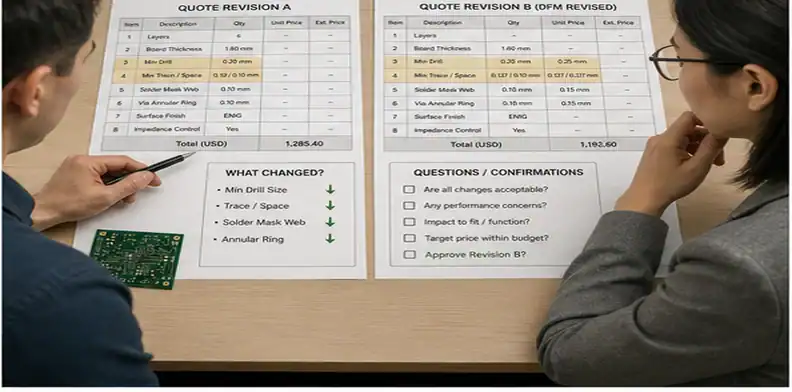
A strong quote revision shows the old assumption, the reviewed finding, the price or lead-time effect, and the required decision. For example: “Original quote assumed standard 1 oz copper. Drawing requires 2 oz finished copper on outer layers. Updated price reflects heavier copper process and wider spacing review.” That explanation gives the buyer something to approve or challenge.
A weak revision says only “DFM updated” or “engineering changed price.” That may still be legitimate, but it is not transparent enough. Ask the supplier to map the change to one of these categories:
| Category | Good explanation | Buyer action |
|---|---|---|
| File mismatch | Gerber, drill, drawing, or BOM data conflict | Send corrected revision |
| Capability limit | Feature exceeds standard process | Revise layout or approve advanced process |
| Material assumption | Material, copper, finish, or thickness changed | Approve basis of quote |
| Yield risk | Panel, registration, solder mask, or drilling risk | Review DFM recommendation |
| Assembly scope | BOM, placement, test, or coating added | Compare like-for-like scope |
| Schedule | Expedited or special procurement required | Decide if timing is worth the premium |
| Logistics/commercial | Shipping, tariff, payment, or incoterm changed | Separate from technical quote |
Fairness also depends on timing. A quote that changes before order confirmation is easier to accept than a surprise after payment, tooling, or production release. The more production commitment has already happened, the more documentation the supplier should provide.
Do not evaluate fairness by price alone. A higher reviewed quote can be the safer option if it prevents scrap, missed delivery, or hidden exceptions. The best comparison is a like-for-like quote with the same stack-up, acceptance class, test scope, delivery term, and revision level.
What Questions Should You Ask Before Approving It?
Before approving a changed quote, ask questions that separate engineering necessity from optional preference. The goal is to decide whether to accept the change, revise the design, request an alternative, or compare suppliers.
Ask these questions:
- What exact file, drawing note, BOM line, or design rule caused the change?
- Was the original quote budgetary, automated, or engineering-reviewed?
- Does this change affect unit price, tooling, NRE, lead time, or all of them?
- Is the change required for manufacturability, recommended for yield, or optional?
- Can the design be revised to stay inside a standard process?
- Which stack-up, material, copper weight, and surface finish are now assumed?
- Does the quote include impedance coupons, electrical test, AOI, X-ray, or functional test?
- Does the change apply to prototype only, production only, or both?
- What revision will be manufactured if we approve?
- Can you show the changed line items separately?
If the answer points to a correctable layout issue, pause before approving production. A small design revision may save more money than negotiating the new price. If the answer points to missing RFQ data, send the missing files and ask for a controlled re-quote.
This is a natural point to request an engineering review rather than only a sales reply. If you have Gerbers, drill files, drawings, stack-up notes, quantity breaks, and any assembly files ready, QueenEMS can review the package and explain which quote changes are technical requirements, optional DFM recommendations, or scope differences.
How Can You Prevent PCB Quote Changes Earlier?
You can prevent many PCB quote changes by sending a complete, controlled, and consistent RFQ package before the first price. The goal is not to overload the supplier; it is to remove guesses.
Start with one revision-controlled ZIP file. The file name should include project name, board revision, date, and whether the package is for budgetary estimate, prototype, or production. Inside, keep fabrication and assembly files clearly separated.
For PCB fabrication, include Gerbers or ODB++/IPC-2581 if available, drill files, board outline, stack-up notes, material requirement, copper weight, surface finish, solder mask and silkscreen color, finished thickness, impedance requirements, acceptance class, electrical test requirement, and fabrication drawing. If you have controlled impedance or high-speed requirements, include the target impedance, reference layers, tolerance, and whether coupons are required.
For assembly, include BOM with manufacturer part numbers, centroid data, assembly drawing, polarity notes, DNP lines, approved alternates, consigned versus turnkey sourcing preference, programming needs, test plan, coating or potting requirements, and packaging instructions.
Then state what you want the quote to mean. “Budget estimate for 20 prototypes” and “production quote for 1,000 units released to build” are different requests. A supplier may price both, but the assumptions should not be mixed.
If speed matters, separate the urgent decision from the final decision. You can ask for a budgetary price within a rough range first, then request a reviewed production quote after the technical file package is complete. That keeps early planning moving without pretending the first number is final.
What Should You Send for a Stable Production Quote?
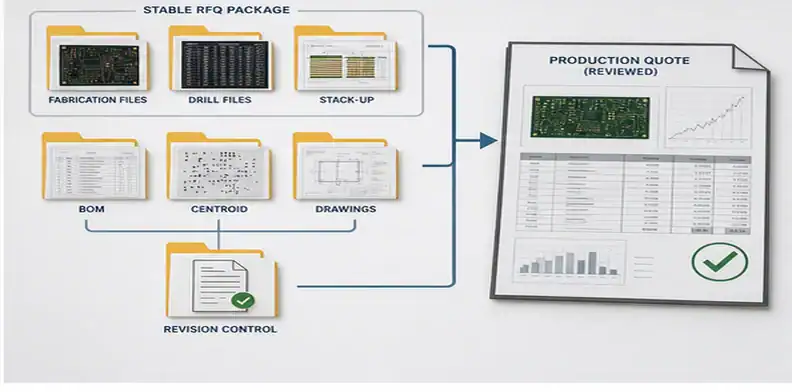
For a stable production quote, send the files and decisions that let the supplier price the board as it will actually be built. A production quote should be tied to a controlled revision, not a loose collection of screenshots, old Gerbers, and email notes.
Use this practical package:
| RFQ item | Why it stabilizes the quote |
|---|---|
| Gerber or production data package | Defines copper, mask, legend, paste, and outline layers |
| Drill files and drill table | Confirms plated holes, non-plated holes, slots, and sizes |
| Fabrication drawing | Captures finish, thickness, tolerances, notes, and standards |
| Stack-up or impedance notes | Prevents guessing on material and dielectric structure |
| Quantity breaks | Lets the supplier price prototype, pilot, and production separately |
| Acceptance and test requirements | Shows inspection, electrical test, and reliability expectations |
| Assembly BOM and centroid files | Prevents PCB-only pricing when PCBA scope is included |
| Special process notes | Covers edge plating, via fill, HDI, coating, programming, or packaging |
| Delivery terms | Separates manufacturing price from freight, duty, and incoterms |
| Revision control note | Confirms which file set the quote belongs to |
Before sending the package, check that the drawing and quote form agree. Many late PCB quote changes come from tiny contradictions: the upload form says HASL but the drawing says ENIG, the form says 1 oz copper but the drawing says 2 oz finished copper, or the board thickness is listed differently in two places.
If you are comparing multiple suppliers, send the same package and request the same scope. QueenEMS explains this comparison process in the guide to comparing PCB assembly quotes. For schedule-sensitive programs, also compare the assumptions in the PCB fabrication lead time guide.
When you are ready for a reviewed quote, send QueenEMS the controlled fabrication package, quantity targets, delivery region, and any PCBA files needed for scope. The output should help you decide whether to approve the quote, revise the design, or separate prototype and production assumptions before money is committed.
FAQ
Is it normal for a PCB quote to change after DFM review?
Yes, it is normal when the first quote was budgetary or based on incomplete data. The change should still be explained with the specific stack-up, material, drill, impedance, panel, assembly, or test assumption that changed.
Can I force the supplier to honor the first PCB quote?
Sometimes, but it may be risky if the first quote missed a real manufacturing requirement. Use the first quote as a commercial reference, then ask whether the difference is caused by technical necessity, optional improvement, or missing RFQ information.
How much quote change is acceptable?
No fixed percentage applies to every PCB. A small standard FR-4 board may change only slightly, while a controlled-impedance, HDI, heavy-copper, or PCBA project can move much more if the first quote missed important requirements.
What is the difference between DFM review and CAM review?
DFM review checks whether the design can be manufactured reliably. CAM review prepares and verifies production data for fabrication, which means it may uncover layer, drill, outline, panel, or instruction issues that affect cost and lead time.
Should I send the BOM before asking for a PCB quote?
Yes, if PCBA, component sourcing, test, coating, or programming is part of the request. For a bare PCB-only quote, the BOM may not be needed, but assembly scope cannot be priced accurately without it.
Sources
- Ucamco Gerber Format
- Ucamco Gerber Job File
- IPC-2581 Consortium history
- Siemens article on tracking CAM file changes
Written by the QueenEMS Engineering Team
Upload your files today · Free DFM check before production · Ship worldwide
Get your PCB prototypes in as fast as 24 hours. We handle FR4, Rogers, and Flex up to 60 layers — free prototypes for 2–4 layer boards, no minimum order.
Just upload your Gerber + BOM — we source every part, assemble, and inspect (AOI + X‑Ray) so you don't have to chase suppliers. Boards ship in as fast as 24 hours.