
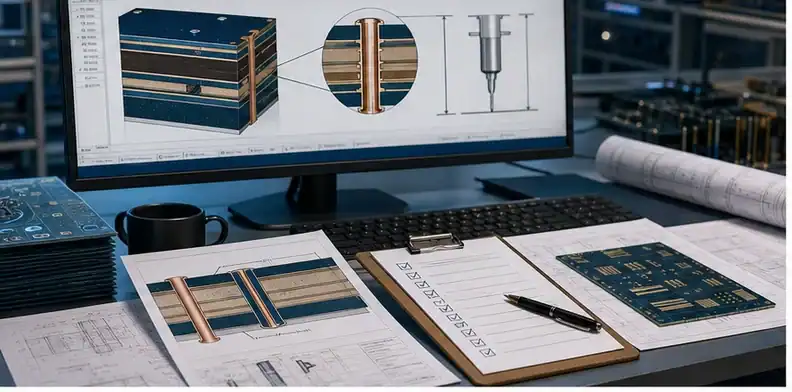
Quick Answer: PCB backdrill requirements should define which vias are backdrilled, from which side, to what stop layer or residual stub target, with what drill diameter, tolerance, stack-up evidence, and inspection record. Backdrill is a signal-integrity and CAM-control decision, not a generic note.
Key takeaways – Use backdrill only where via stubs create measurable high-speed risk. – Tie every backdrilled feature to stack-up, net class, start side, stop layer, and residual stub target. – Expect DFM questions when layer data, drill tables, and impedance requirements disagree. – Ask for inspection evidence that matches the risk and quantity.
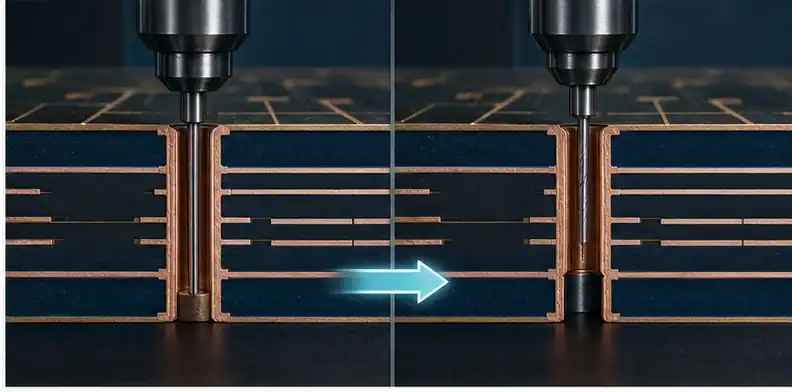
Backdrilling removes unused via stubs that can disturb high-speed signals. The concept is easy to explain, but the fabrication instruction can be ambiguous if it says only “backdrill high-speed vias.” A supplier still needs to know which vias, from which side, how deep, what clearance is safe, and what evidence should prove the result.
This article helps buyers turn a signal-integrity requirement into a quote-ready package. It is especially useful for telecom, networking, RF, server, and high-speed interface boards where a late CAM question can delay the release. Use it with controlled impedance PCB requirements and PCB stack-up design when the order includes impedance control.
Reader path
- Decide whether backdrill is needed
- Define depth, side, and residual stub
- Connect the stack-up and drill map
- Understand cost and lead-time drivers
- Request practical evidence
- Package the RFQ cleanly
- Backdrill decision record for high-speed buyers
When do via stubs justify backdrilling?
Backdrilling is usually considered when high-speed signals pass through vias and unused plated barrel length behaves like a stub. The risk depends on frequency, rise time, via geometry, stack-up, and acceptable signal margin. Not every multilayer PCB needs backdrill, and applying it everywhere can add cost and complexity.
The buyer should identify the net classes or via groups that require stub removal. If the signal-integrity owner has a residual stub target, include it. If the requirement comes from a layout rule but the actual risk is unclear, ask the design owner to confirm before quotation.
A supplier can advise manufacturability, but should not decide which high-speed nets can tolerate stubs. That decision belongs to the product design or signal-integrity owner.
What depth, side, and residual stub details are required?
A usable backdrill callout states the start side, target stop layer or remaining stub length, backdrill diameter, tolerance, and affected vias. If the board can be drilled from either side, say which option is allowed. If different via groups need different depths, separate them in the drawing or drill table.
Name the must-not-cut layer for every depth group
Residual stub is often the key requirement. The supplier may control depth by mechanical drilling tolerance and stack-up registration, but the buyer needs to state what result is acceptable. A vague note can lead to over-drilling, under-drilling, or a conservative quote that assumes worst-case handling.
Because these instructions touch production data, unresolved items should become PCB CAM questions before tooling.
| Backdrill item | Buyer decision | Why it matters |
|---|---|---|
| Start side | Top, bottom, or specified side | Prevents drilling the wrong stub |
| Target layer | Stop depth reference | Connects CAM to stack-up |
| Drill diameter | Clearance around via barrel | Controls risk to nearby copper |
| Residual stub | Signal-integrity target | Defines success condition |
How should stack-up and drill data connect?
Backdrill cannot be reviewed in isolation from stack-up. Layer thickness, dielectric build, copper weight, via span, and drill registration all affect the safe depth window. If the supplier receives only Gerbers without a controlled stack-up, it may be difficult to quote with confidence.
Keep via identities synchronized across all files
The drill map should identify backdrill candidates clearly. Some buyers provide separate backdrill drill files; others use drawing tables. Either can work if the data is unambiguous and matches the layer stack. What fails is a mismatch between CAD exports, PDF drawing, and email notes.
For high-speed orders, the same package should include impedance targets and test-coupon expectations where relevant. The supplier should not have to infer whether backdrill and impedance control apply to the same nets.
What drives cost and lead time?
Backdrilling can add operations, setup, inspection, and scrap risk. The cost depends on number of backdrilled holes, different depth groups, board thickness, layer count, drill diameter, depth tolerance, and required evidence. A small number of critical vias may be manageable; many depth classes across a dense board can change the quote significantly.
This is where buyers should connect DFM changes to commercial decisions using PCB quote changes after DFM. If the supplier asks to widen clearance or change a depth class, the change may be technically justified, but it should be tied to a specific risk and file revision.
Lead time can also shift if special cross-section review, first-article approval, or additional drilling setup is required. Ask early rather than after the purchase order is already urgent.
| Driver | Quote impact | Buyer control |
|---|---|---|
| Number of depth groups | More setup and CAM control | Combine groups when SI allows |
| Tight residual stub target | Higher process risk | Confirm actual SI need |
| Thick multilayer stack | Harder depth control | Provide controlled stack-up |
| Evidence requirement | More inspection time | Match evidence to risk |

Which inspection evidence is practical?
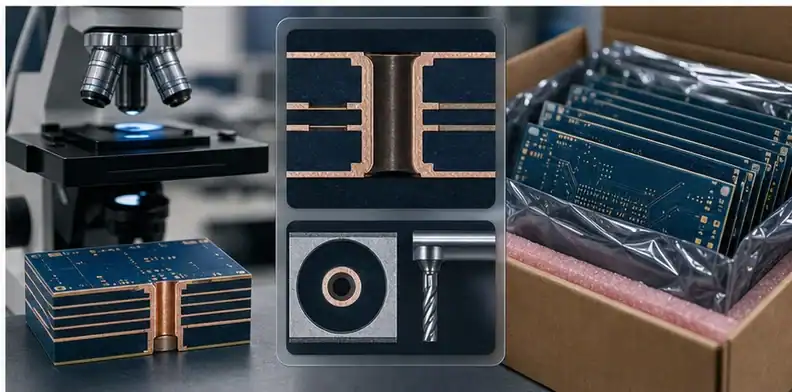
Inspection may include drill-depth records, cross-section samples, visual or microscope review, and coupon evidence. The right level depends on application risk and volume. A first prototype for a lab test may not need the same record as a production board for a networking customer audit.
Use PCB quality documents before shipment to decide what belongs in the outgoing package. Evidence should prove the specific backdrill requirement, not become generic paperwork.
If the buyer needs cross-section evidence, define the sample method before production. If the board has several backdrill classes, make sure the evidence covers the critical class rather than the easiest one.
What should the backdrill RFQ include?
The backdrill RFQ dataset should include the controlled fabrication layers, primary and secondary drill programs, approved stack-up, impedance classes, start-side and stop-layer table, residual-stub target, quantities, verification request, and first-article approval rule. Identify one governing revision for all of those records.
The supplier should respond with manufacturability comments, any clearance or tolerance concerns, cost and lead-time impact, and open questions. The buyer should not approve changes to high-speed requirements without signal-integrity review.
For the quotation, provide QueenEMS with the approved stack-up, controlled fabrication dataset, primary drill programs, backdrill groups, start sides, residual-stub targets, and quantities. Request a DFM review that reconciles every depth instruction with the high-speed net classes.
| RFQ input | Purpose |
|---|---|
| Backdrill drill file or table | Identifies exact vias |
| Stack-up | Controls depth feasibility |
| Residual stub target | Defines signal-integrity result |
| Inspection request | Defines shipment evidence |
Backdrill decision record for high-speed buyers
Avoid backdrill-by-label
Backdrill is sometimes added to a drawing as a label after the signal-integrity discussion has already happened elsewhere. That is dangerous because the fabricator receives the label without the reasoning. The supplier needs the via list, side, depth, diameter, stack-up, and residual stub target. Without those details, “backdrill high-speed vias” can become a guessing exercise.
The buyer should ask the signal-integrity owner which stubs matter and what maximum remaining stub is acceptable. If the answer is “follow layout rules,” export the layout rule into a fabrication-ready table or drill file. If the answer is “only these interfaces matter,” identify them. The goal is to avoid paying for backdrilling that does not matter while also avoiding missed stubs on critical nets.
Keep CAM and SI language connected
Signal-integrity teams may speak in terms of resonance, data rate, insertion loss, and eye margin. CAM teams speak in drill files, layer spans, registration, and clearances. A successful RFQ translates between the two. The drawing should not only state the SI reason; it should state what the factory must build.
For example, a residual stub target should connect to a specific layer reference and depth tolerance. A via group should connect to a drill symbol or file. A side selection should be clear for asymmetric stack-ups. If the supplier changes stack-up thickness during DFM, the backdrill target may also need review because the depth window has changed.
Choose evidence that proves the risky part
Backdrill evidence should focus on the requirement that matters most. If the risk is wrong-side drilling, an image of the correct side and drill map may help. If the risk is residual stub length, cross-section evidence or controlled-depth records may be more useful. If the risk is repeatability across a production lot, a sample plan tied to depth groups is stronger than one attractive microscope photo.
Buyers should also decide how much evidence is practical for the quantity. A small prototype may only need first-article confirmation. A production order for a customer audit may need stored records and traceability. The important point is to make the evidence request visible during RFQ, because adding it after production starts can change both lead time and cost.
Questions that prevent backdrill quote surprises
Ask whether the supplier sees a complete backdrill drill file or only a drawing note. Ask which side and depth groups are assumed, whether the residual stub target is manufacturable with the supplied stack-up, and what clearances are needed around backdrilled vias. Also ask whether evidence such as cross-section or depth record is included in the quoted scope.
These questions matter because backdrill cost is not driven only by board area. A board with many depth groups, tight targets, or unclear stack-up can require more CAM time and process control than a larger but simpler board. If the buyer compares only total PCB price, the quote may hide very different assumptions.
How to avoid over-specifying backdrill
Over-specification happens when every high-speed-looking via gets backdrilled without checking whether the stub matters. This can increase cost and complexity while providing little benefit. The better approach is to identify the critical interfaces and use the signal-integrity target to decide which vias need the operation.
Buyers should ask the design owner whether a looser residual stub target is acceptable, whether some nets can be excluded, and whether depth groups can be simplified. Each simplification should be checked technically, not chosen only for price. The result is often a cleaner quote and a more manufacturable design.
What QueenEMS should confirm before creating a draft order
A good QueenEMS review should confirm the stack-up, via list, start side, depth class, residual stub target, and evidence request. It should also list contradictions between drill files and drawings. If those contradictions exist, the safe next step is a CAM question, not a silent assumption.
How to phrase a high-speed backdrill RFQ
A strong RFQ names the signal reason and the manufacturing instruction. For example, it may say that specified high-speed via groups require backdrill from the top side to a defined layer with a maximum residual stub target, and that the supplier must confirm clearance and depth feasibility before production. The exact numbers belong in the buyer’s drawing and stack-up, but the sentence tells the supplier that this is not an optional cosmetic feature.
If the design team has not finished SI review, label the backdrill requirement as preliminary. The supplier can still estimate cost, but the buyer should not treat the price as production-ready. When SI review changes the via list or stub target, the quote may change. That is a normal scope update, not necessarily a supplier problem.
Evidence should follow the highest-risk depth class
When multiple depth classes exist, choose evidence for the class that is hardest or most critical, not only the easiest sample. If the buyer needs confidence in a deep backdrill close to an active layer, the evidence should address that risk. A generic inspection photo of a shallow class may look impressive but fail to answer the real question.
Approval record for reorders and supplier comparison
A backdrill repeat build is controlled by the stack-up and via-group map, not by the label on the purchase order. Retain the released stack-up, NC drill and backdrill files, depth table, start sides, must-not-cut layers, residual-stub criteria, tool assumptions, and first-article evidence. Compare those records before reusing an old quotation after any routing or stack-up revision.
Compare backdrill quotes by depth groups, affected-hole count, start side, residual-stub target, stack-up revision and verification plan. One supplier may include separate machine setup and a cross-section for the tightest group; another may assume a single nominal stop depth for every via. Those offers are not commercially equivalent even when both descriptions say backdrill.
The final release check is a data reconciliation: the SI owner’s via list must match the NC backdrill file or drawing table, every group must name its start side and must-not-cut layer, and the residual-stub rule must use the approved stack-up revision. Any mismatch should hold tooling because CAM cannot infer which electrical compromise the design team intended.
Archive the signed depth-group table with the fabrication release and identify who owns any exception. On a reorder, CAM can compare the current stack-up and drill data against that baseline before tooling begins.
FAQ
Does every high-speed via need backdrilling?
No. Apply it to via groups whose unused barrel length exceeds the signal-integrity budget for the channel. The SI owner should select the nets and acceptable residual stub; the fabricator should confirm whether that instruction is manufacturable.
Can CAM choose the backdrill stop layer?
CAM may calculate machine depth from an approved must-not-cut layer and stack-up, but it should not choose the protected layer or relax the stub target. Those changes alter the electrical design and require engineering approval.
What evidence is useful for several backdrill depths?
Ask for evidence that covers the highest-risk depth group, not merely the easiest hole. Depending on the project, that can include a depth record, representative cross-section, coupon, processed drill map, or first-article review tied to the relevant group.
For a backdrill quotation, send QueenEMS the approved stack-up, via-group list, NC backdrill data, start sides, must-not-cut layers, residual-stub targets, and evidence plan. The DFM reply should identify any depth-window or adjacent-copper conflict before production.
Written by the QueenEMS Engineering Team
Upload your files today · Free DFM check before production · Ship worldwide
Get your PCB prototypes in as fast as 24 hours. We handle FR4, Rogers, and Flex up to 60 layers — free prototypes for 2–4 layer boards, no minimum order.
Just upload your Gerber + BOM — we source every part, assemble, and inspect (AOI + X‑Ray) so you don't have to chase suppliers. Boards ship in as fast as 24 hours.