
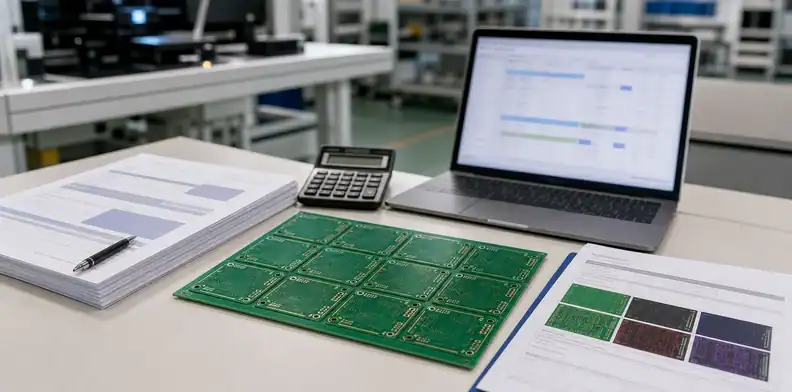
Quick Answer: A PCB purchase order review should confirm the exact board revision, quoted scope, quantity, delivery term, quality evidence, and change-approval rules before production starts. The goal is not to rewrite the quote, but to freeze the assumptions that will become the factory work order. If any file, material, stack-up, panel, test, or delivery condition changed after quotation, the PO should trigger a controlled clarification before the boards enter CAM or tooling.
Key takeaways – A PO should reference one controlled fabrication package, not only a price and quantity. – Quote validity, material availability, test scope, delivery term, and revision status must still match the supplier’s offer. – Quality documents and acceptance criteria should be named before shipment, not requested after a dispute. – Any design, material, stack-up, panel, or delivery change after quotation should be written as an approved change or requote.
PCB purchase order review is the last practical checkpoint before a custom PCB quote becomes a production build. By this point, the buyer usually believes the job is already settled: price accepted, lead time accepted, supplier selected. In reality, many defects and delays start in the quiet gap between “quote approved” and “factory released.”
A PO that says only “PCB boards, 500 pcs, per quote” leaves too much room for interpretation. Which Gerber revision? Which stack-up? Which controlled impedance tolerance? Are X-outs allowed in the panel? Is the delivery term DAP, DDP, FCA, or something else? Which inspection records must ship with the order? If those items are not frozen, the factory may still build something reasonable, but not necessarily the same thing the engineering team intended.
This article focuses on bare PCB and fabrication-led orders, with PCBA mentioned only when assembly scope changes the PO release. It is designed for buyers, hardware engineers, and operations teams preparing to release production with an overseas supplier.
Table of Contents
- What Should a PCB PO Freeze First?
- Does the Quote Still Match the Order?
- Which Revision and Files Should Be Named?
- What Quality Requirements Belong on the PO?
- How Should Delivery and Payment Terms Be Confirmed?
- What Should Happen Before Production Starts?
What Should a PCB PO Freeze First?
A PCB PO should first freeze identity, scope, and authority. Identity means the part number, board name, revision, and controlled file package. Scope means the quoted quantity, construction, material, surface finish, testing, documentation, packing, and delivery condition. Authority means who can approve changes after the PO is issued.
Start with the board itself. The PO should not depend on a vague file name such as final.zip, because a buyer, engineer, and supplier may each hold a different version of that “final” package. A safer PO names the part number, revision, fabrication drawing revision, Gerber or ODB++ package date, stack-up revision, and any approved supplier drawing that became part of the release.
Then freeze the commercial scope. The supplier priced a specific quantity, lead time, panel approach, material, copper weight, solder mask, finish, test scope, and delivery term. If the PO changes one of those items, the price may still be close, but the quote is no longer clean. The earlier article on PCB quote validity explains why a price can expire even when the board looks unchanged.
Finally, define decision authority. Purchasing can approve price and delivery. Engineering should approve geometry, stack-up, material, impedance, panel constraints, and functional requirements. Quality should approve acceptance level, required reports, concessions, and traceability expectations. When those roles are not clear, a supplier question may get answered by the fastest person rather than the right owner.
A practical PO review can use this first-pass table:
| PO item | What to confirm | Why it matters |
|---|---|---|
| Part identity | Part number, revision, board name | Prevents obsolete build release |
| Data package | Gerber/ODB++/IPC-2581 package and drawing revision | Prevents mixed file sets |
| Construction | Layers, thickness, copper, material, finish | Protects quoted manufacturing scope |
| Quantity | Individual boards or arrays | Avoids under-ordering or panel confusion |
| Testing | Electrical test, impedance, microsection, reports | Aligns cost and acceptance evidence |
| Delivery term | Incoterm, destination, shipping method | Separates factory price from landed cost |
| Change rule | Who approves deviations or substitutions | Prevents silent production changes |
Does the Quote Still Match the Order?
The quote still matches the order only if the PO repeats the same technical and commercial assumptions that were priced. If the buyer changed quantity, delivery date, panelization, material, finish, impedance requirement, or report scope, the supplier should review the quote before accepting the PO.
This is where many teams move too quickly. A quote may have been issued from preliminary Gerbers, then engineering updated the drill file, purchasing changed the order quantity, and operations requested a faster delivery date. Each change may be defensible, but together they create a different production order.
Quote match is especially important for custom PCB fabrication because cost is not driven by area alone. Tooling, panel utilization, minimum drill, aspect ratio, copper weight, surface finish, controlled impedance coupons, special inspection, laminate availability, and shipment method can all affect the final offer. If a supplier priced a standard lead time and the PO asks for an accelerated build, the acceptance email should not be treated as proof that the old quote still applies.
Use the PCB fabrication quote files article as the upstream package reference. During PO review, the question changes from “what should I send for a quote?” to “does the PO release the same package that was actually quoted?”
The review should catch five common mismatch patterns:
- the PO uses a newer revision than the quote;
- the order quantity changed from panels to individual boards, or the opposite;
- the buyer added impedance reports, coupons, microsections, or certificates after the first quote;
- the material or approved-equivalent rule changed after sourcing checked availability;
- the delivery term changed from factory shipping to landed delivery, or from standard air to urgent courier.
If one of these changed, do not hide it inside the PO note. Ask the supplier to confirm whether the change is included, whether the quote must be revised, and whether the lead time restarts after approval.
Which Revision and Files Should Be Named?
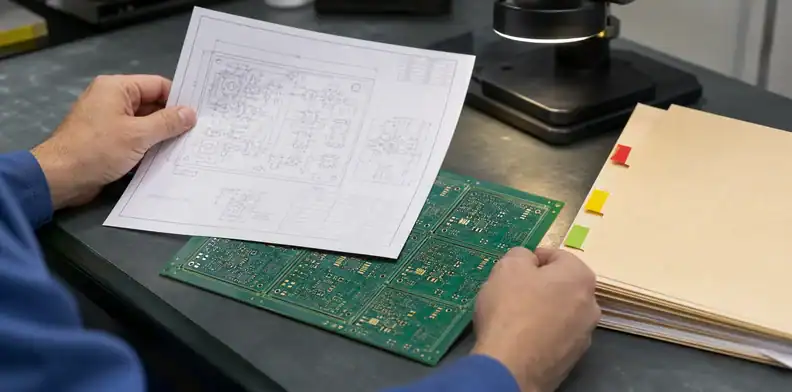
The PO should name the exact production data package, including the fabrication drawing, Gerber or ODB++ files, drill files, stack-up, impedance table, netlist if used, panel drawing if approved, and any special notes that override standard factory practice. The point is to make one file set the source of truth.
Gerber remains a common PCB fabrication data format, and Ucamco publishes the official Gerber resources and specifications. IPC-2581 is another manufacturing data exchange route when the buyer and supplier both support it. The format is less important than the control record: the supplier must know which package is authorized for this order.
A buyer can reduce confusion by using a release manifest. The manifest does not need to be complicated. It can be a one-page table with file name, revision, date, purpose, and status. For example, the fabrication drawing may be “released,” an old quote package may be “superseded,” and a supplier panel drawing may be “approved for this PO only.”
The PO should also state what happens when the supplier finds a conflict. If the drill table and NC drill file disagree, the supplier should not guess. If the stack-up drawing conflicts with the impedance table, the supplier should raise an engineering question. If the CAM team proposes a change, the buyer should handle it through a controlled response, as described in PCB CAM questions before production.
Do not rely on email history as the only release record. Email is useful for conversation, but production needs a final answer. A clean release says which files are current, which files are obsolete, and which supplier-generated files are approved.
For repeat builds, revision control deserves even more discipline. A previous successful lot is useful evidence, but it does not automatically prove that every material, panel, process, or drawing note is still approved. The repeat PCB order revision control page gives a tighter method for keeping a reorder identical to the accepted lot.
What Quality Requirements Belong on the PO?
Quality requirements belong on the PO when they affect acceptance, records, cost, shipment release, or future traceability. If the buyer needs electrical test reports, impedance reports, microsection photos, COC/COA documents, material records, lot traceability, special packing, or no X-outs in an array, the PO should say so before production.
This does not mean every order needs aerospace-level documentation. A simple prototype may need only standard electrical test and visual acceptance. A controlled production build may need a certificate of conformity, test confirmation, material declaration, impedance evidence, final inspection record, and traceability link to the shipment. The right level depends on product risk, customer requirements, IPC class, and whether the board will be used for qualification, pilot production, or repeat production.
Use this decision table during review:
| Requirement | Put it on the PO when | Evidence to request |
|---|---|---|
| IPC class | Customer or product risk defines acceptance level | Drawing note and inspection basis |
| Electrical test | Opens/shorts cannot be accepted | Test method or test confirmation |
| Controlled impedance | The design has impedance targets | Coupon/TDR report if required |
| Material control | A named laminate or equivalent rule matters | Material record or approved substitution |
| Microsection | Plating, HDI, high aspect ratio, or reliability risk is high | Microsection photo/report when agreed |
| Lot traceability | Future containment matters | Lot code and shipment linkage |
| Packing | Boards are moisture, finish, or handling sensitive | Packing requirement and label rule |
The PCB quality documents before shipment article is a useful support page when the buyer wants to define the release evidence. For stricter builds, the PO should also identify who can accept deviations. A supplier should not treat a cosmetic concession, material substitution, panel X-out, or missing report as acceptable unless the buyer has authorized that exception.
If a quality requirement is written only after shipment, it becomes a dispute request rather than a production requirement. That is uncomfortable for everyone. It is better to decide early which records are mandatory, which are optional, and which are unnecessary for this order.
How Should Delivery and Payment Terms Be Confirmed?
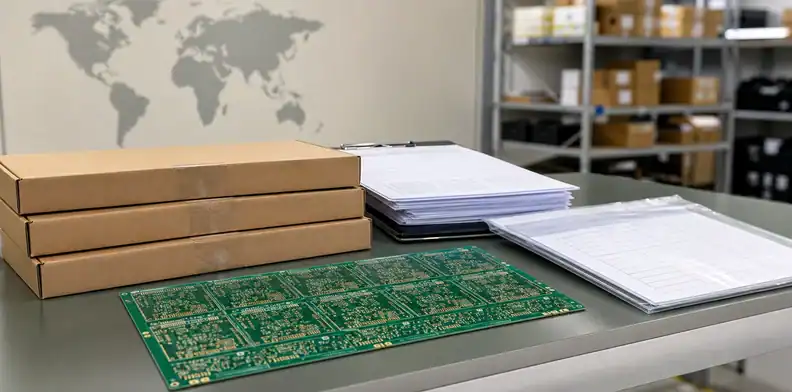
Delivery and payment terms should be confirmed by named place, Incoterm, currency, shipment method, tax or duty responsibility, and the documents required for customs or receiving. A PO that says only “air shipment included” may not tell the buyer who pays duties, who acts as importer, or what happens if customs needs additional information.
The International Chamber of Commerce publishes Incoterms rules to define buyer and seller responsibilities in international trade. For QueenEMS customers in the United States, Canada, and Mexico, the practical issue is not only freight cost. It is whether the quote is factory-level pricing, delivered pricing, or landed-cost support with duty and customs responsibilities clearly separated.
For PCB orders, the PO should confirm:
- destination country, city, and delivery address;
- Incoterm and named place;
- courier, forwarder, or customer account if required;
- declared product description and customs documentation responsibility;
- whether duty, tax, brokerage, and final delivery are included or excluded;
- payment currency, payment milestone, and invoice requirements;
- shipment release documents needed before dispatch.
If a buyer is comparing DDP and DAP offers, the DDP vs DAP PCB shipping article can support the commercial decision. The PO should then match the selected delivery model. A mismatch between quote and PO delivery terms can make one supplier appear cheaper even when the landed cost is not actually lower.
Payment terms also affect production timing. If production starts after deposit, after PO acceptance, or after engineering release, the PO should not leave that trigger ambiguous. For urgent builds, define the real start condition: complete files, accepted quote, payment status, material availability, and closed engineering questions.
What Should Happen Before Production Starts?
Before production starts, the supplier should acknowledge the PO, confirm the controlled file package, list any open engineering or commercial questions, and state whether the quoted price and lead time remain valid. Production should not begin while approval-required issues are still unresolved.
The best handoff is short and specific. It does not require a legal department for every order. It requires a shared record that purchasing, engineering, quality, and the supplier can all understand.
Use this final release sequence:
- Buyer sends PO with controlled package reference and quote number.
- Supplier confirms price, quantity, lead time, delivery term, and production start condition.
- Supplier identifies any CAM, material, panel, or quality question before tooling.
- Buyer assigns each question to purchasing, engineering, or quality.
- Buyer sends corrected files or written approval where needed.
- Supplier confirms the final production revision and start date.
- Buyer stores the release record for repeat orders, claims, or later changes.
This sequence is also a conversion opportunity. When a buyer sends a clean PO package, QueenEMS can check whether the order is truly ready for fabrication, whether the quoted assumptions still match, and whether any missing information should be resolved before production pricing or tooling starts.
For a production-ready review, send the quote number, PO draft, Gerber or ODB++ package, fabrication drawing, stack-up, impedance table if applicable, target quantity, required reports, delivery destination, and requested Incoterm through the QueenEMS contact page. QueenEMS can return a quote-scope check, missing-release-item list, and production assumption review before the build is released.
Related QueenEMS resources:
- PCB quote validity
- PCB CAM questions before production
- PCB quality documents before shipment
- Repeat PCB order revision control
FAQ
Is a PCB PO enough if the quote already lists the board details?
No. The quote may list the priced assumptions, but the PO should confirm the released revision, quantity, delivery term, and any required quality evidence. If anything changed after quotation, the supplier should confirm whether the quote still applies.
Should the PO include Gerber files as attachments?
Yes, or it should reference the exact controlled data package already sent through the supplier’s upload channel. The key requirement is that the supplier can identify one current package and ignore obsolete files.
Who should approve supplier questions after PO release?
Purchasing should handle price and delivery questions, engineering should handle design, stack-up, material, and impedance questions, and quality should handle acceptance records, concessions, and traceability requirements.
Can production start before all CAM questions are closed?
Only if the open questions are clearly informational and do not affect design intent, acceptance, price, or lead time. Approval-required questions should be closed before tooling or fabrication starts.
What is the difference between PO review and RFQ review?
RFQ review checks whether the supplier has enough information to quote. PO review checks whether the quoted, approved, and released order still matches the final production instruction.
Sources
- Ucamco official Gerber format resources
- IPC-2581 Consortium
- Incoterms 2020 from the International Chamber of Commerce
- Know Your Incoterms from the International Trade Administration
Written by the QueenEMS Engineering Team
Upload your files today · Free DFM check before production · Ship worldwide
Get your PCB prototypes in as fast as 24 hours. We handle FR4, Rogers, and Flex up to 60 layers — free prototypes for 2–4 layer boards, no minimum order.
Just upload your Gerber + BOM — we source every part, assemble, and inspect (AOI + X‑Ray) so you don't have to chase suppliers. Boards ship in as fast as 24 hours.