
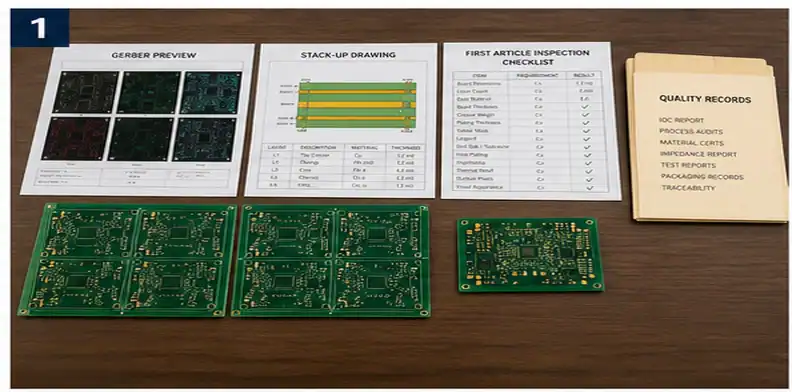
Quick Answer: A PCB supplier qualification order is a controlled first build used to decide whether a new PCB factory is ready for repeat or volume production. It is usually larger and stricter than a design prototype: define 5–10 approval outputs such as DFM findings, stack-up confirmation, first article inspection, electrical test, impedance data, microsection or quality records, packaging, delivery evidence, and corrective-action rules.
Key takeaways
A PCB supplier qualification order helps you decide whether a new factory can repeatedly build your board, not just whether one low-cost sample can arrive on your desk. For overseas sourcing, this step matters because you may be qualifying the board design, the manufacturing route, the supplier’s communication, and the quality evidence at the same time.
Many teams blur three different events: a prototype order to validate the design, a qualification order to approve a supplier, and a production order to satisfy customer demand. When those are mixed, purchasing may approve the cheapest prototype while engineering still has no evidence that the stack-up, material, inspection, delivery terms, and repeat-build controls are ready for 500 or 5,000 boards.
This guide explains how to structure a supplier qualification order before volume production, what evidence to request, when first article inspection applies, and what should be frozen before the next batch.
Table of Contents
- What Does a PCB Supplier Qualification Order Decide?
- When Is a Qualification Order Better Than a Prototype?
- How Many Boards Should You Order for Qualification?
- What Must Match the Future Production Build?
- Which Tests and Records Should Be Included?
- How Should First Article Inspection Be Used?
- What Evidence Should You Approve Before Release?
- When Should the Lot Be Rejected or Repeated?
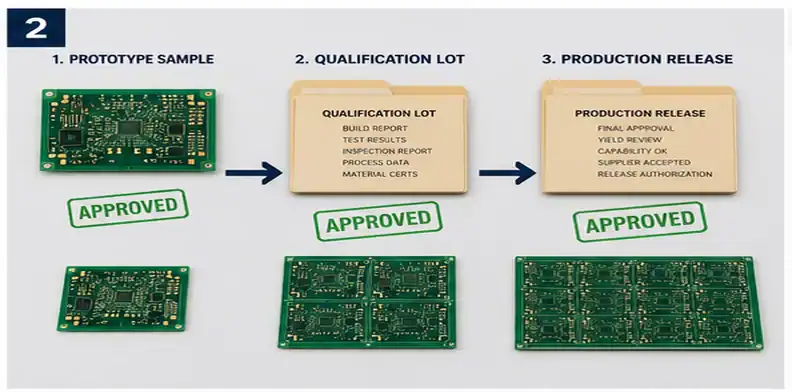
- How Do You Move from Qualification to Production?
- What Should You Send for a Qualification Quote?
What Does a PCB Supplier Qualification Order Decide?
A PCB supplier qualification order decides whether a specific supplier, process route, and documentation package are acceptable for the next controlled build. It is not a general statement that the supplier is good for every board.
The decision should answer four questions. Can the supplier manufacture this construction? Can the supplier document conformance? Can the buyer and supplier control changes before repeat orders? Can the shipping and communication process support the target market?
For a bare PCB, qualification may focus on stack-up, material, copper, hole quality, impedance, solder mask, surface finish, dimensions, electrical test, final inspection, packaging, and records. For a PCBA-inclusive build, the decision expands to BOM sourcing, stencil, SMT placement, soldering, AOI, X-ray, programming, functional test, and packing.
This is narrower than a complete supplier audit. A PCB factory audit checklist evaluates the company, quality system, and factory evidence more broadly. A qualification order evaluates whether one controlled project is ready to move forward.
Keep the output binary enough for purchasing: approve for production, approve with limits, repeat qualification after corrections, or reject the supplier for this board.
When Is a Qualification Order Better Than a Prototype?
A qualification order is better than a prototype when the design is technically stable enough to test the supplier, not only the circuit. If you still expect major layout, component, enclosure, or firmware changes, you may need another engineering prototype first.
Use a qualification order when:
- the board revision is close to release;
- the target stack-up and material are known;
- the same supplier may handle repeat production;
- customer quality records will matter later;
- the product has impedance, HDI, heavy copper, RF, safety, medical, industrial, or automotive risk;
- switching suppliers after launch would be expensive.
A normal prototype can use short cuts that make sense for learning: alternate material, small panel, relaxed reports, hand assembly, or limited testing. A qualification order should not rely on those shortcuts unless they will also be allowed in production.
The QueenEMS prototype vs production order guide covers when to change buying mode. This article takes the next step: once you are close to release, how do you buy the first lot so it proves supplier readiness?
How Many Boards Should You Order for Qualification?
There is no universal board count for a PCB supplier qualification order. The right quantity depends on the risk you need to observe: fabrication repeatability, assembly yield, test coverage, packaging, delivery, or customer sampling.
For a simple bare PCB, a small qualification lot may be enough if the construction is standard and inspection records are clear. For a complex board, the lot may need enough pieces to support engineering review, first article inspection, destructive or retained samples, customer evaluation, test development, and shipping validation.
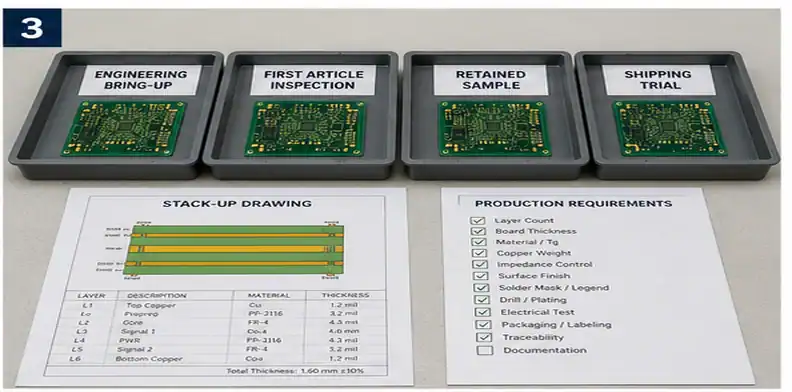
Think in sample purposes instead of a magic number:
| Sample purpose | Why it may be needed |
|---|---|
| Engineering bring-up | Confirms the design performs with the chosen board construction |
| First article inspection | Verifies the first production output against requirements |
| Electrical or functional test | Confirms the agreed test method and limits |
| Microsection or quality evidence | Checks internal construction when required |
| Customer or regulatory sample | Supports approval outside the engineering team |
| Retained reference sample | Gives both parties a comparison point for repeat lots |
| Packaging and shipping trial | Confirms protection, labeling, and import flow |
| Process reserve | Allows scrap, setup loss, or extra inspection without consuming all samples |
For PCBA, component attrition and test development can make the order size different from a bare-board-only qualification. If parts are expensive or limited, decide whether all boards need full assembly or whether some bare boards can be reserved for inspection.
Avoid ordering exactly the number of working samples you need for your own lab. A qualification lot should leave room for inspection, records, failures, and learning.
What Must Match the Future Production Build?
The qualification order should match the future production build wherever a difference could hide process risk. If a condition changes later, the qualification evidence may no longer apply.
Freeze these items before supplier qualification:
- board revision, drawing revision, and controlled file package;
- layer count, finished thickness, material family, copper weight, and stack-up;
- controlled impedance targets and test/coupon requirements;
- surface finish, solder mask, silkscreen, edge, slot, and mechanical features;
- IPC class or customer acceptance criteria;
- panelization ownership and breakaway method;
- electrical test, inspection, and required quality records;
- PCBA sourcing model, BOM revision, approved alternates, and test scope when assembly is included;
- packaging, labeling, shipment split, Incoterm, and delivery country.
Some differences are acceptable if they are documented. For example, you may qualify one quantity break and later place a larger production order, but the supplier should identify what changes with scale: panel utilization, material lot, tooling, electrical test method, production schedule, or packaging.
If you do not know whether a supplier can build the design unchanged, run a PCB manufacturer capability check before the qualification order. That prevents the first controlled lot from becoming a long DFM negotiation.
Which Tests and Records Should Be Included?
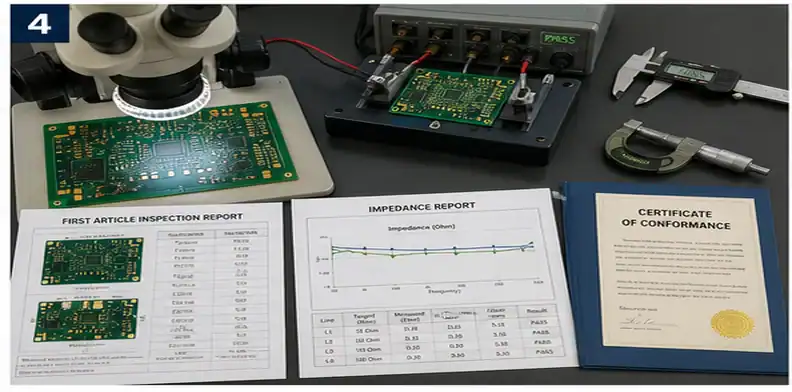
Include tests and records that prove the supplier followed the agreed process and that the boards meet your acceptance requirements. Do not request every possible report by habit; request evidence tied to risk.
For bare PCBs, useful records may include:
- final inspection result;
- electrical test confirmation;
- dimensional measurement for critical features;
- stack-up or material confirmation;
- impedance test report when impedance is specified;
- microsection report when required by class, customer, or risk;
- certificate of conformance;
- solderability or surface-finish evidence when relevant;
- packaging photos and labels;
- DFM or engineering question log.
For PCBA qualification, add assembly records such as AOI sample result, X-ray images for hidden joints, first article inspection, solder-paste/stencil confirmation, reflow profile when required, programming record, functional test result, serial-number or lot traceability, and rework records.
IPC-A-600 and IPC-6012 are often used together for printed board acceptance and performance requirements. IPC-A-610 is used for electronic assembly acceptance. The exact standard, class, revision, and customer exceptions should be named in the purchase documentation; a vague “IPC quality” note is not enough for qualification.
The QueenEMS guide to remote PCB assembly quality evaluation can support the evidence package when you cannot visit the factory.
How Should First Article Inspection Be Used?
First article inspection should be used as a documented verification that the first controlled output matches the approved requirements. It is especially useful when a supplier builds the part for the first time, a drawing or process changes, or the buyer needs formal evidence before release.
SAE AS9102 and IAQG 9102 define first article inspection requirements for aviation, space, and defense supply chains. A normal commercial PCB project may not require AS9102 forms, but the principle is still useful: verify the actual first production output against the drawing, specification, purchase order, and required records.
For a PCB or PCBA qualification order, define first article expectations before the PO:
| FAI decision | What to define |
|---|---|
| Trigger | New supplier, new revision, new process, long production gap, or customer request |
| Scope | Bare PCB, PCBA, mechanical features, coating, programming, test, or packaging |
| Sample basis | First piece, representative piece, or first batch sample |
| Characteristics | Dimensions, materials, finish, markings, workmanship, test points, or critical parameters |
| Records | Inspection report, photos, test data, certificate, drawing bubbles, and exceptions |
| Approval | Who reviews, what counts as pass/fail, and whether production can continue before approval |
FAI is not a substitute for design validation. A board can pass inspection and still fail because the circuit design, firmware, enclosure, or system requirement is wrong. Keep design validation and supplier qualification connected but distinct.
What Evidence Should You Approve Before Release?
Approve evidence that proves the supplier can repeat the controlled build, not only a sample that powers on. The evidence package should be easy for engineering, quality, purchasing, and management to read months later.
A practical approval file includes:
- approved quotation and assumptions;
- controlled Gerber, ODB++, IPC-2581, drawing, stack-up, and requirement files;
- DFM question log and buyer approvals;
- material, finish, copper, impedance, and acceptance-class basis;
- inspection and electrical test records;
- FAI or first-piece records when required;
- photos of boards, labels, packaging, and critical workmanship;
- shipping and delivery record;
- nonconformance and corrective-action log if issues were found;
- repeat-order controls: job number, approved revision, no-substitution notes, and approval owner.
For PCBA, include BOM purchasing status, approved alternates, test procedure, firmware or programming version, AOI/X-ray/test records, and rework history. If the product is regulated, safety-critical, or customer-qualified, add the customer’s required forms and retention rules.
Do not approve by email alone if the decision matters. Create one qualification summary that states the verdict, limits, next order conditions, and remaining risks. If the supplier is approved only for prototypes or only for a specific construction, say that clearly.
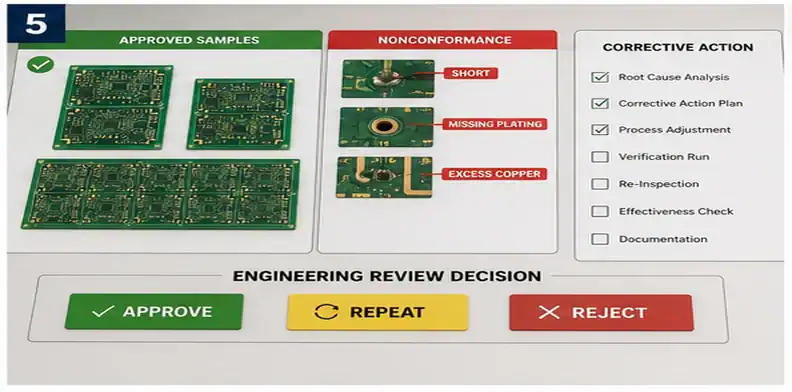
When Should the Lot Be Rejected or Repeated?
Reject or repeat a qualification lot when the evidence no longer proves the intended production process. This can happen even if some samples look usable.
Repeat the qualification decision when:
- the supplier used an unapproved material, stack-up, finish, or process;
- the drawing revision or Gerber package does not match the quoted build;
- critical dimensions, impedance, electrical test, or inspection results fail;
- the supplier cannot provide required records;
- board damage, packaging failure, or shipping problems affect product use;
- PCBA test failures show process instability rather than one isolated unit;
- corrective action changes the process enough to require verification;
- the buyer changes a requirement after the first lot.
Separate engineering rework from supplier failure. If your design has a flaw, the next order may be a design prototype or engineering validation build, not a supplier requalification. If the supplier missed an approved requirement, the next order should include corrective action and defined evidence.
For formal changes, connect the decision to the QueenEMS engineering change notice guide. A repeated qualification lot without revision control can create more confusion than the original issue.
How Do You Move from Qualification to Production?
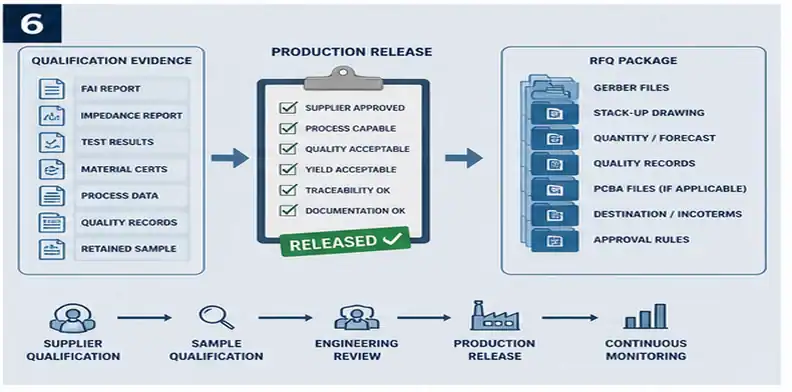
Move from qualification to production only after the release conditions are written down. The goal is to prevent the approved first lot from becoming a one-time success that cannot be repeated.
Create a production-release checklist:
- Confirm final board and assembly revision.
- Freeze stack-up, material rules, copper, finish, and impedance requirements.
- Freeze BOM, approved alternates, and sourcing model if PCBA is included.
- Approve the DFM log and all deviations.
- Approve first article, inspection, electrical test, and required quality records.
- Define what can change without approval and what cannot.
- Confirm production quantity, delivery schedule, destination, and Incoterm.
- Confirm packaging, labeling, and shipment documentation.
- Record the supplier job number and approved qualification evidence.
- Decide whether the next lot needs first article approval, normal inspection, or extra monitoring.
Repeat production should not require starting from zero, but it should reference the approved baseline. If laminate, copper foil, panelization, test method, or revision changes, decide whether the change triggers requalification or a smaller approval step.
This is where the qualification order becomes commercially useful. It gives purchasing a controlled basis for the next quote and gives engineering a record of what was actually approved.
What Should You Send for a Qualification Quote?
For a qualification quote, send the intended production requirements, not only prototype files. The supplier needs enough information to price the build and the evidence package.
Send:
| Input | Why it matters |
|---|---|
| Controlled fabrication files | Defines the board revision being qualified |
| Fabrication drawing and stack-up | Freezes material, finish, copper, thickness, tolerance, and impedance |
| Target production quantity | Helps the supplier recommend qualification scope |
| Qualification quantity target | Separates approval samples from production demand |
| Required standards/class | Defines acceptance and inspection expectations |
| Required records | Shows whether FAI, microsection, impedance, C of C, photos, or test reports are included |
| PCBA files if included | Adds BOM, CPL, assembly drawing, test, programming, and sourcing scope |
| Critical-to-quality features | Tells the supplier what must be measured or documented |
| Destination and delivery terms | Tests whether the supply route works for the target market |
| Approval rules | Defines who can approve deviations, substitutions, and next-batch release |
If the RFQ is bare-board only, use the QueenEMS PCB fabrication quote files checklist to confirm the file package. If assembly is included, use the PCB assembly RFQ checklist so BOM, placement, sourcing, and test scope are not missing.
Send QueenEMS your Gerber or ODB++ package, fabrication drawing, stack-up, target production quantity, qualification quantity, required records, and destination. The review should help decide whether the first order should be treated as a price-only prototype, an engineering validation build, or a true PCB supplier qualification order.
FAQ
Can I qualify a PCB supplier with only 5 boards?
Yes, if the board is low risk and the evidence you need can be collected from that quantity. For complex boards, PCBA, customer approval, destructive inspection, or retained samples, 5 boards may be too few.
Is first article inspection required for every PCB order?
No, not every PCB order needs formal first article inspection. Use it when the supplier, revision, process, customer requirement, or risk level makes documented first-output verification necessary.
Should the qualification lot use the final production stack-up?
Yes, unless the qualification is clearly limited to an engineering prototype. If the production stack-up changes later, the qualification evidence may not prove the final build.
What is the difference between supplier qualification and design validation?
Supplier qualification checks whether the factory can build and document the approved requirement. Design validation checks whether the product design works in the intended system or market.
What if the supplier passes the sample but misses the report package?
Treat the qualification as incomplete. A supplier qualification order should prove both product conformance and documentation control, especially before repeat or volume production.
Sources
- SAE AS9102 Aerospace First Article Inspection Requirement
- IAQG 9102 First Article Inspection Requirement
- IPC-A-600 Acceptability of Printed Boards program
- IPC-A-610 Acceptability of Electronic Assemblies
- ISO 9001 Auditing Practices Group guidance on external providers
Written by the QueenEMS Engineering Team
Upload your files today · Free DFM check before production · Ship worldwide
Get your PCB prototypes in as fast as 24 hours. We handle FR4, Rogers, and Flex up to 60 layers — free prototypes for 2–4 layer boards, no minimum order.
Just upload your Gerber + BOM — we source every part, assemble, and inspect (AOI + X‑Ray) so you don't have to chase suppliers. Boards ship in as fast as 24 hours.