
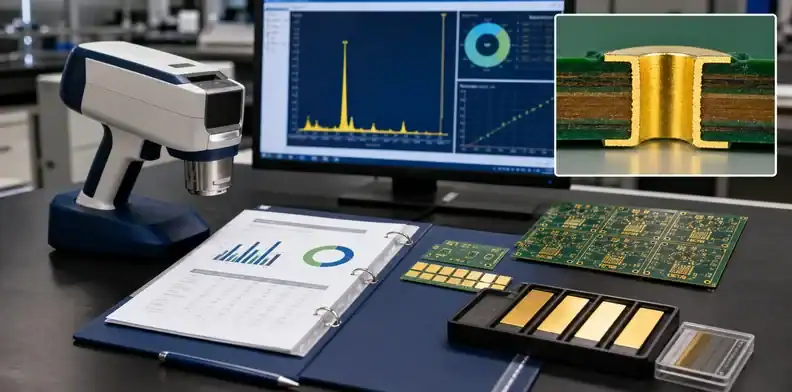
Quick Answer: An enig thickness spec should define nickel and gold thickness ranges, finish type, report evidence, XRF measurement expectation, and acceptance owner before fabrication release. For standard ENIG, IPC-4552-style orders often start around 3-6 um electroless nickel and 0.05-0.125 um immersion gold, but the customer drawing, standard edition, and product function control the final requirement.
Key takeaways
- ENIG thickness is a measurable requirement, not only a surface-finish name.
- The RFQ should separate ENIG, ENEPIG, hard gold, soft gold, HASL, and OSP decisions.
- Ask what XRF or finish report will ship with the lot when thickness matters.
- Treat low gold or wrong finish as an engineering disposition, not only a price dispute.
A buyer can order “ENIG” and still receive weak evidence if the quote does not define thickness range, report scope, or release rule. The better question is which finish property must be proven before the boards are assembled or sent to the customer.
Table of Contents
- Define the finish function before thickness
- Separate ENIG thickness from finish selection
- Ask for nickel and gold ranges in the RFQ
- Use XRF evidence carefully
- Know when ENEPIG or hard gold changes the rule
- Connect thickness to solderability and shelf life
- Handle low-thickness or missing-report replies
- Keep the finish record with the shipment
- Send QueenEMS the finish-thickness package
Define the finish function before thickness
The surface finish should be chosen for the job it must perform: soldering, oxidation protection, wire bonding, contact wear, shelf life, flatness, or customer acceptance. Thickness evidence matters most when that function can fail if the finish is too thin, too thick, or the wrong finish type.
For standard SMT soldering, ENIG is often chosen for flat pads, storage stability, and lead-free assembly. For edge contacts or repeated mating, hard gold may be more suitable. For cost-sensitive simple boards, HASL or OSP may be enough. The finish name should follow the functional requirement, not the other way around.
Buyers close to order release should ask what finish function is truly being controlled. If the customer only says “gold finish,” the supplier may need to know whether the design needs solderable ENIG, hard gold fingers, ENEPIG for wire bonding, or another option.
The HASL vs ENIG comparison can help during selection. This article starts after that choice, when the buyer needs thickness proof for the selected finish.
| Finish function | Thickness relevance | Buyer question |
|---|---|---|
| SMT soldering | Enough nickel and immersion gold | What ENIG range is quoted? |
| Edge contact | Wear resistance | Is hard gold required? |
| Wire bonding | Bond surface chemistry | Is ENEPIG or soft gold needed? |
| Long storage | Oxidation protection | What shelf-life and report apply? |
Decision rule: Define the finish job first; then ask which thickness evidence proves that job was built.
Separate ENIG thickness from finish selection
ENIG thickness is not the same topic as choosing ENIG. Selection asks whether ENIG is the right finish. Thickness control asks whether the ENIG actually meets the agreed nickel and gold range for the order.
Many search results explain the pros and cons of surface finishes. That helps early design, but the buyer at PO stage needs a different answer: what thickness range is included, whether a report is included, and what happens if the measured value is outside the agreed window.
If the design has a known finish requirement, the RFQ should state it clearly. A note such as “ENIG finish” may be enough for a low-risk prototype, but a controlled product should name the accepted range or the customer standard that controls it.
For product teams still comparing finish options, review ENIG vs hard gold vs soft gold. For purchasing release, keep the focus on the exact finish and proof expected for this lot.
Buyer call: Do not let a finish-selection discussion replace the order-level requirement for measurable thickness evidence.
Ask for nickel and gold ranges in the RFQ
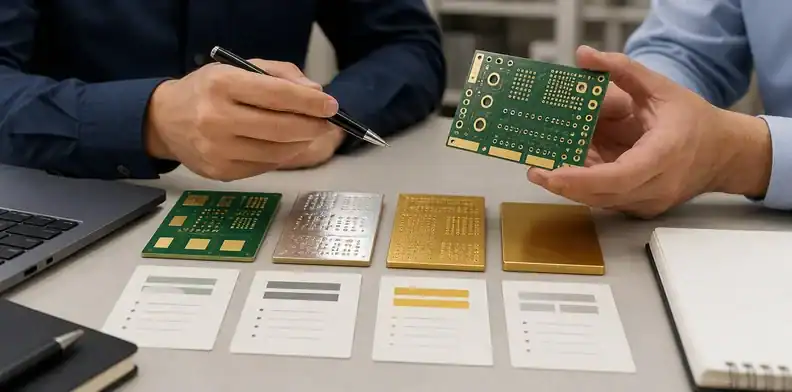
A strong ENIG RFQ states the nickel and gold thickness range or the standard/customer requirement that controls it. It also says whether the supplier must provide a finish thickness report, a certificate, or XRF measurement data before shipment.
For many ENIG orders, the starting reference is electroless nickel in the 3-6 um range and immersion gold in the 0.05-0.125 um range. Those figures are useful because they give purchasing and engineering a shared scale for reviewing an XRF report. They are not a permission to ignore the released drawing, the IPC-4552 edition named by the customer, or a special contact/wire-bonding requirement.
| ENIG layer | Common order-scale range | Buyer check |
|---|---|---|
| Electroless nickel | 3-6 um | Confirm barrier-layer range and units |
| Immersion gold | 0.05-0.125 um | Confirm solderability/storage evidence |
| Report scope | Lot or sample rule | Confirm XRF locations and disposition |
After reading the table, the buyer should decide whether the quote only names a finish or actually defines the measurable evidence that will ship with the boards.
The buyer should avoid writing a range that engineering has not approved. Too little gold can create solderability or storage risk; too much or the wrong finish can create cost and performance questions. Nickel thickness also matters because it forms the barrier layer under immersion gold.
A useful RFQ sentence is: “Quote ENIG per agreed drawing note; provide finish thickness evidence by lot with nickel and gold values, measured locations or sample rule, and any deviation before shipment.” That gives the supplier a clear reporting boundary without over-specifying their internal process.
For customer-controlled products, the buyer should copy the exact customer finish requirement into the quote package or attach the relevant drawing note. If the customer later asks for proof, the order record will show that the requirement was quoted from the beginning.
RFQ signal: The quote should say not only “ENIG,” but what thickness range and report evidence the buyer expects at release.
Use XRF evidence carefully
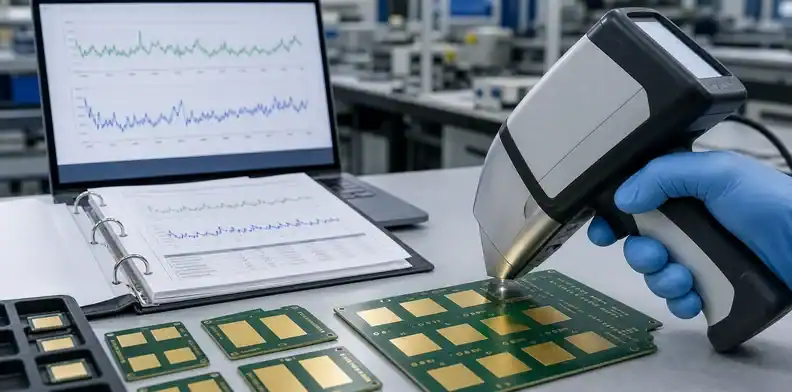
XRF measurement is commonly used to verify surface finish thickness, but the buyer should still read the report carefully. The report should identify the part, lot, finish, measurement location or sample rule, units, date, and measured values.
A report with one number and no context is weak evidence. A stronger report connects the measurement to the current order and tells the buyer whether the value is inside the accepted range. If the report is a supplier summary rather than raw data, the summary should still name the controlled finish and result.
Engineering should decide whether the measured locations represent the risk. Edge contacts, fine-pitch pads, large copper areas, and test coupons may not all behave the same way. The buyer does not need to micromanage every measurement location, but the chosen evidence should be reasonable for the product.
A missing XRF report is not always a defect. It may simply not have been included in the quote. The right time to settle that is before shipment, not after a customer asks for documentation.
| Report item | What to check | Why it matters |
|---|---|---|
| Finish type | ENIG, ENEPIG, hard gold, or other | Prevents wrong-finish acceptance |
| Nickel value | Barrier layer range | Controls soldering and reliability |
| Gold value | Surface protection range | Controls storage and solderability |
| Lot ID | Matches shipment | Supports traceability |
Evidence rule: XRF data is useful only when it is traceable to the order and measured against an agreed finish requirement.
Know when ENEPIG or hard gold changes the rule
ENEPIG, hard gold, and soft gold are not small wording variations. They serve different functions, use different layer structures, and carry different cost and evidence expectations.
ENEPIG may be used where wire bonding, solderability, and corrosion resistance requirements point beyond standard ENIG. Hard gold is often used for edge fingers or wear areas, not ordinary SMT pads. Soft gold may be requested for specific bonding or contact requirements. The buyer should not approve a supplier substitution without engineering review.
If the supplier proposes a different finish to reduce lead time or cost, the buyer should ask what function changes. Will solderability remain acceptable? Will contacts wear differently? Will a customer drawing be violated? Does the report format change?
This is where finish thickness becomes a decision tool. A quote with the correct finish name but no thickness evidence may still be weak. A quote with a different finish name may be acceptable only if engineering approves the functional tradeoff.
A buyer should also confirm whether the supplier can keep mixed finishes separated in artwork, traveler notes, and inspection records. That small documentation check prevents the right finish from being quoted but applied to the wrong area. Substitution boundary: Any move from ENIG to ENEPIG, hard gold, soft gold, HASL, or OSP should be treated as an engineering change, not a purchasing shortcut.
Connect thickness to solderability and shelf life
Surface finish thickness affects how boards survive storage and how pads behave during soldering. Thin or poorly controlled finish can create solderability concerns, while the wrong finish choice can raise cost without adding value.
A buyer should connect finish evidence to the assembly plan. Boards that will be assembled immediately may need a different evidence level than boards stored for months. Boards that will be shipped to a customer for later assembly need a clearer record because QueenEMS or the buyer may not control the final storage conditions.
For older stock or delayed production, pair finish review with PCB solderability testing and storage rules. Thickness evidence supports release, while solderability evidence may be needed if the boards have aged or packaging was opened.
The failure mode also matters. Black pad concerns, poor wetting, contact wear, and customer documentation gaps are different problems. A good quote package names the finish, thickness range, report evidence, and storage expectation so the supplier does not have to infer the risk.
Release signal: Finish thickness evidence should be stronger when boards face long storage, customer documentation review, or high-value assembly.
Handle low-thickness or missing-report replies
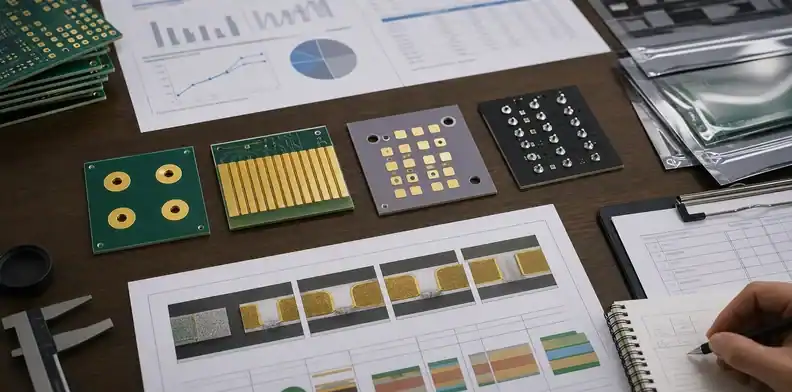
When a report shows low thickness, engineering should decide whether the result violates the order requirement and whether the product risk justifies hold, deviation, rework, remake, or customer approval. Purchasing should not settle the decision only through discount negotiation.
A missing report needs a different response. If the PO required it, ask for the missing evidence. If the PO did not require it, decide whether the shipment can proceed under the quoted scope or whether extra testing is needed before assembly.
The buyer should keep the communication factual. Ask which value is low, what range controls it, what location was measured, whether retest is possible, and what disposition the supplier proposes. This avoids an argument built around the word “thin” without a defined pass boundary.
If the finish issue may affect assembly, do not consume the boards until engineering has reviewed the evidence. Once components are mounted, a finish dispute becomes much more expensive.
Claim boundary: A finish-thickness dispute should be judged against the agreed drawing, quote, report, and engineering disposition, not only against a general expectation.
Keep the finish record with the shipment
The accepted finish record should stay with the shipment file. Include the drawing note, quote scope, report, supplier response, and any engineering waiver. Repeat orders then have a clear baseline.
This record is useful when a customer asks for proof after delivery or when the same design is reordered months later. The buyer can see whether the earlier lot used ENIG, ENEPIG, hard gold, HASL, or OSP and whether a report was required.
The record also prevents quiet drift. A supplier may propose a finish change during a lead-time crunch; the buyer can compare it against the controlled baseline and decide whether the change needs engineering approval.
For broader process context, the ENIG black pad article explains one failure area. The release record should still stay focused on the exact finish requirement and proof for this order.
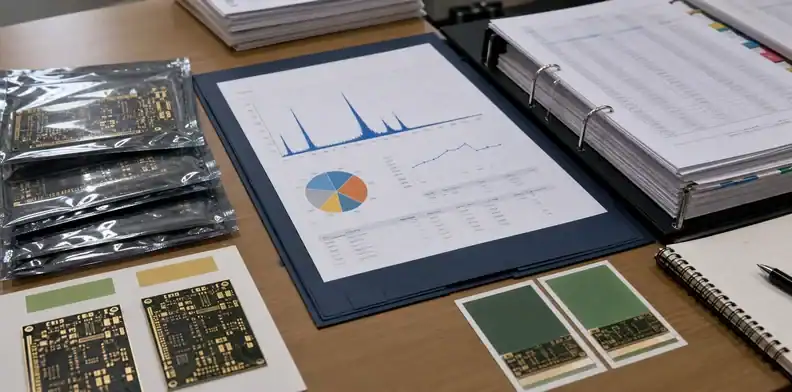
The record should also name any area-specific finish. If the board has ENIG pads and hard-gold fingers, the buyer should file which areas used each finish and what evidence was accepted. A future reorder can then repeat the same controlled construction instead of relying on a short email that only says “gold finish.” When a customer audits the build, this record lets the buyer answer with the drawing, quote, report, and acceptance decision together. That is stronger than sending only a certificate after the customer has already questioned the shipment. Record rule: Keep finish thickness evidence with the lot record so repeat orders do not depend on memory or informal emails.
Send QueenEMS the finish-thickness package
Send the fabrication drawing, surface finish note, customer finish requirement if any, target quantity, storage expectation, assembly plan, and any report format the customer asks for. QueenEMS can review whether the finish and thickness evidence are clear enough for quotation and shipment release.
For PCB work, the useful output is a finish note, report request, and deviation boundary. For PCBA work, the review also checks solderability, storage, component value, and whether a finish issue should hold assembly.
If your PCB or PCBA project depends on ENIG, ENEPIG, hard gold, OSP, HASL, or another controlled finish, contact QueenEMS with the files, finish note, customer requirement, and quantity so our team can help turn the surface-finish requirement into a quote-ready release package.
FAQ
Is an enig thickness spec needed if the drawing only says ENIG?
Sometimes the finish name is enough for low-risk work, but a controlled product should define the thickness range or standard that governs the order. The report then has a measurable pass boundary.
Can XRF testing prove every pad has the exact same thickness?
No. XRF evidence is normally a controlled measurement record, not a guarantee that every pad was measured. The buyer should check whether the sample rule and locations fit the product risk.
Should I switch from ENIG to hard gold for edge contacts?
Often yes for repeated mating or wear areas, but engineering should approve the decision. Hard gold is not a cheaper wording swap for standard ENIG pads.
What should QueenEMS review before quoting?
QueenEMS should review the drawing finish note, customer requirement, expected storage time, assembly plan, quantity, and requested report evidence. That allows the quote to separate normal finish cost from extra control.
Sources
- IPC standards include surface finish performance documents and printed-board acceptance frameworks used by PCB buyers and manufacturers: https://www.ipc.org/standards
- Bruker explains XRF measurement use for coating and plating thickness analysis in manufacturing control: https://www.bruker.com/en/applications/industrial/coatings-thickness-analysis.html
Written by the QueenEMS Engineering Team
Upload your files today · Free DFM check before production · Ship worldwide
Get your PCB prototypes in as fast as 24 hours. We handle FR4, Rogers, and Flex up to 60 layers — free prototypes for 2–4 layer boards, no minimum order.
Just upload your Gerber + BOM — we source every part, assemble, and inspect (AOI + X‑Ray) so you don't have to chase suppliers. Boards ship in as fast as 24 hours.