
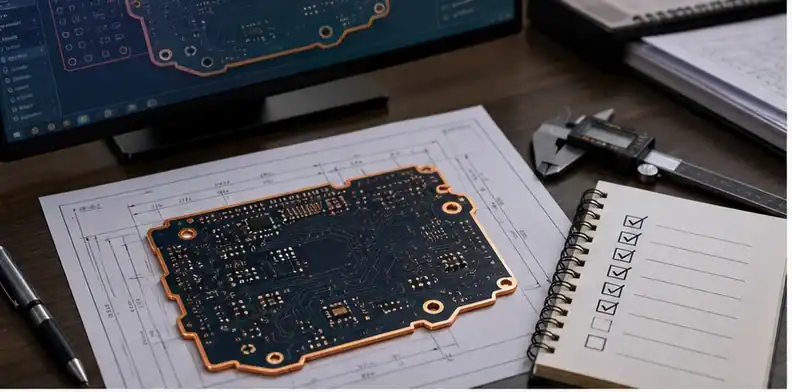
Quick Answer: PCB edge plating requirements should define which edges are plated, what copper connection is allowed, whether the plated edge is functional or shielding-only, what finish applies, and how inspection evidence will be recorded before shipment.
Key takeaways – Mark the exact plated segments on the fabrication drawing instead of saying “edge plating” in an email. – Separate edge plating used for shielding or grounding from decorative or mechanical edge finish. – Confirm routing, panel tabs, surface finish, and inspection evidence before the factory quotes production. – Treat unclear plated-edge scope as a CAM question that can affect cost, lead time, and yield.
When buyers ask for edge plating, the supplier has to translate a short phrase into several manufacturing decisions. A board may need copper around the entire profile, only along two RF shield edges, around castellated areas, or around a single chassis-contact zone. Those choices change routing strategy, panel retention, copper exposure, finish selection, inspection work, and sometimes the final price.
The commercial problem is simple: if the plated edge is not described clearly during RFQ, two suppliers may quote different constructions while using the same words. One quotation may include controlled routing and edge metallization after profile preparation. Another may assume a simpler copper exposure or a partial edge finish. The numbers look comparable until the CAM hold appears.
Use this article as an RFQ decision record. It does not replace your drawing, but it shows what a purchasing team, design engineer, and PCB supplier should align before release. For the full file package, start with PCB fabrication quote files and then add the plated-edge details below.
Table of contents
- When edge plating is actually needed
- What the drawing must specify
- How routing and panels affect the edge
- Which finish and inspection evidence matter
- What quote risks appear after DFM
- What to send for a clean RFQ
- Buyer decision record for plated-edge orders
When is edge plating actually needed?
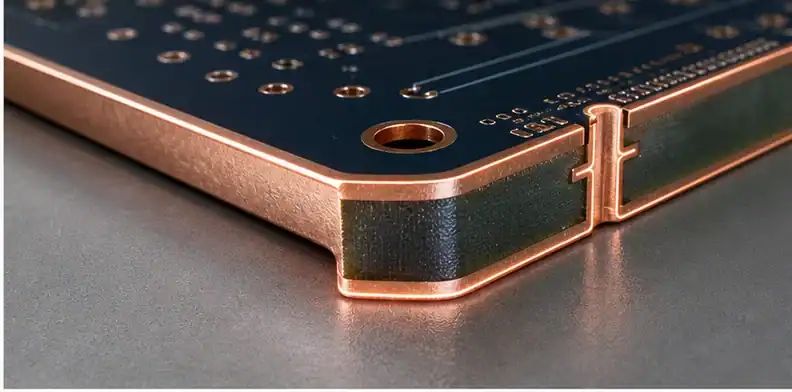
Edge plating is useful when the board edge becomes an electrical or mechanical interface. Common examples include RF shielding contact, chassis grounding, board-to-board side contact, module edges that must solder to a carrier, and designs where exposed copper at the board edge is intentionally part of the product. If the edge is not an interface, plating it may add cost without solving a real problem.
The first RFQ question is therefore not “Can you do edge plating?” but “Which edge performs a function?” A supplier can often plate an edge, but they cannot know whether every board outline segment needs copper, whether only the outer copper should wrap, or whether internal plane connection is allowed. That intent should be visible in the fabrication drawing.
For shielding, the edge usually needs a defined connection to ground. For solderable module edges, the plated area must match the assembly footprint. For mechanical wear, the finish and thickness assumptions matter. These are different use cases, so copying a note from another design can be risky.
If you are not sure whether the request is inside normal capability, compare the requirement with a broader PCB manufacturer capability check before sending the RFQ.
What must the fabrication drawing specify?
The drawing should show the plated segments directly on the board outline. Use dimensions, callouts, or a clearly marked layer note. Avoid a free-text note such as “edge plating required” when only one side or one small region is intended. A buyer may understand the shortcut, but a CAM engineer needs geometry.
Define plated segments from stable datums
Specify whether edge plating is continuous or segmented. If the board has slots, notches, chamfers, mouse bites, or nonfunctional cutouts, each area should be either included or excluded. Also state whether copper is allowed to connect to internal planes at the board edge, because accidental plane exposure can change grounding behavior and appearance.
A good drawing package also states the controlled document. If Gerber, ODB++, IPC-2581, PDF drawing, and email notes disagree, the supplier needs a precedence rule. QueenEMS treats conflicts as engineering questions before production; PCB CAM questions before production explains why that step protects both schedule and design intent.
| Drawing item | Why it matters | RFQ wording to avoid |
|---|---|---|
| Plated edge segments | Prevents over-plating or missing zones | “Plate edge as needed” |
| Ground connection rule | Prevents unintended electrical connection | “Make it grounded” |
| Finish on edge | Affects solderability, corrosion, and appearance | “Same as board” |
| Excluded cutouts | Protects routing and panel decisions | “All edges” |
How do routing and panel choices change the quote?
Edge plating is not only a surface finish step. The routing path, panel tabs, copper clearance, burr control, and sequence of plating relative to profiling can all change. If a supplier has to modify the panel strategy after CAM, the original price may no longer represent the real build.
Protect functional edges during panel breakup
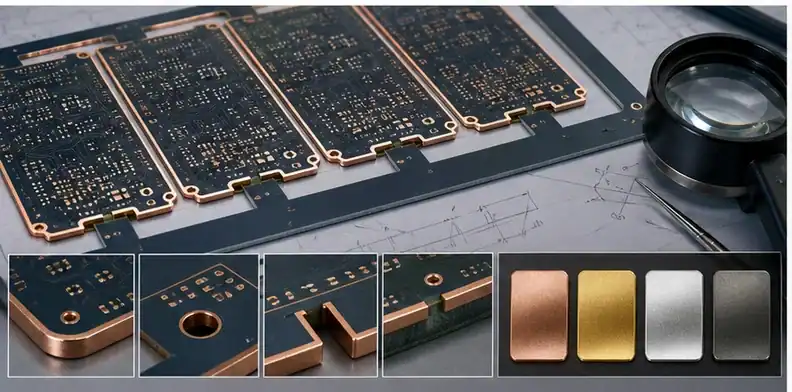
Tabs are especially important. A tab placed on a plated edge may interrupt the required metalized zone or create extra cleanup work. If the board must have a continuous plated perimeter, the panel drawing should show how the supplier may retain and release the board. If small breaks are acceptable, say so clearly.
The same principle applies to V-cut, mouse bites, and local notches. Some release methods are convenient for ordinary boards but poor for plated-edge cosmetics or electrical continuity. Buyers who only compare square-inch price often miss this manufacturing constraint until the first article arrives.
Which finish and inspection evidence matter?
The edge finish should match the function. A solderable castellated edge, a chassis-contact edge, and a cosmetic exposed edge do not have identical priorities. ENIG, immersion silver, HASL, hard gold, or another finish may be discussed depending on assembly and reliability requirements. The safest RFQ states the finish requirement and lets the supplier confirm manufacturability.
Inspection evidence can include visual review, continuity checks to the intended net, cross-section or sample photos when risk is high, and outgoing quality records. Use PCB quality documents before shipment when the buyer needs traceable proof rather than only a supplier promise.
Do not ask for unnecessary reports on every low-risk order. Instead, connect the evidence to the reason for edge plating. If the plated edge grounds a shield can, continuity and location matter. If it supports soldering to a carrier, wetting, burr condition, and geometry matter more.
| Use case | Useful evidence | Risk if missing |
|---|---|---|
| RF shield contact | Continuity and visual edge coverage | Intermittent grounding |
| Solderable module edge | Geometry and finish confirmation | Assembly opens or poor wetting |
| Chassis contact | Surface finish and burr review | Fit or reliability complaints |
| Cosmetic exposed edge | Visual acceptance sample | Appearance dispute |
What quote risks appear after DFM?
A DFM review may reveal that copper is too close to a routed edge, an internal plane will be exposed, tab positions interrupt the plated region, or the requested finish conflicts with the edge function. These are not always supplier mistakes. Often they are missing RFQ assumptions.
If the requirement changes after review, treat it as a controlled scope decision. The PCB quote changes after DFM page explains how to separate a justified requote from a surprise charge. For edge plating, the cleanest decision record states what changed, why it changed, and whether the new rule applies to repeat production.
The buyer should also avoid approving an email-only interpretation for a production order. If the plated edge affects product function, update the drawing or add a controlled purchase note. Otherwise the next repeat order may rebuild the old ambiguity.
What should you send for a clean RFQ?
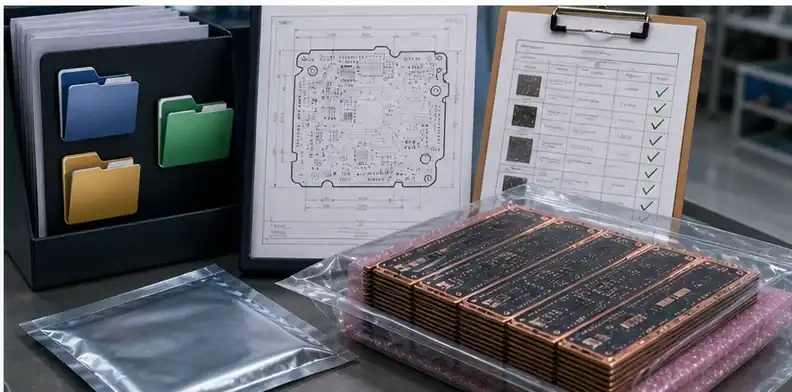
Send Gerber or ODB++ data, NC drill files, a fabrication drawing with marked plated segments, stack-up, surface finish requirement, panel preference if known, target quantity, and any inspection evidence required before shipment. If edge plating supports an assembly interface, include the mating part or carrier-board footprint information when possible.
A good RFQ also explains the decision owner. Purchasing can approve cost and schedule, but engineering should approve changes to plated segments, grounding, surface finish, and mechanical fit. This keeps fast communication from turning into uncontrolled design authority.
For a quotation-ready review, you can send the package through QueenEMS contact and ask for a plated-edge DFM check before production release. Keep the request narrow: which edges, what function, what finish, what evidence, and which file revision controls the build.
| RFQ input | Required? | Buyer note |
|---|---|---|
| Marked fabrication drawing | Yes | Show exact plated segments |
| Surface finish requirement | Yes | State if edge must be solderable |
| Panel constraints | Usually | Especially when continuous edge coverage matters |
| Inspection evidence | Risk-based | Tie evidence to function |
Buyer decision record for plated-edge orders
Separate electrical intent from visual appearance
The most common plated-edge mistake is treating a visible copper edge as proof that the electrical requirement has been met. A shiny plated edge may still be isolated from the intended ground net, interrupted by a tab, or located on the wrong board side for the mating contact. The buyer should therefore write the decision record around function first and appearance second. If the plated edge is for shielding, the record should say which ground net or copper feature connects to the edge. If the edge is for soldering, the record should say where solder fillets are expected. If the edge is cosmetic, the record should say what visual acceptance matters and what imperfections are acceptable.
This distinction also helps quotation comparison. Supplier A may include continuity review and edge-segment confirmation, while Supplier B may only price a visual exposed copper edge. Both may answer “yes” to edge plating, but they are not quoting the same risk. A buyer who wants comparable numbers should ask each supplier to confirm the plated segment map, the finish, the expected continuity or isolation rule, and any process limits before selecting on price.
Control partial edges like a drawing feature
Partial edge plating needs more control than full-perimeter plating because the start and stop points become features. If the plated region begins near a mounting hole, cutout, connector, or shield-can wall, the drawing should include enough dimensions to avoid interpretation. The goal is not to create an impossible drawing burden. The goal is to prevent an operator or CAM engineer from deciding the plated area by eye.
The buyer should also identify whether small gaps are acceptable. Some designs need a continuous ground contact; others only need several contact areas along one edge. If a gap is allowed at panel tabs or tooling features, say so. If no gaps are allowed, the supplier must plan the panel and routing path around that rule, which may change cost and lead time.
Decide when the supplier may propose an alternative
Sometimes the factory will propose an alternative such as partial copper exposure, selective edge plating, a different finish, or a changed tab location. These proposals may be good, but they should be approved against the product function. A purchasing team can ask whether the alternative affects cost and lead time, but engineering should decide whether the product still works.
For repeat orders, keep the final approved decision in the fabrication drawing or controlled purchase note. If the approval remains only in a message thread, the next batch may be quoted from the old files and rebuilt with the old ambiguity. That is one reason plated-edge orders benefit from a short “quote assumption” block inside the RFQ: exact plated segments, function, finish, panel restriction, and evidence required before shipment.
Questions that make supplier replies comparable
When the requirement is ready for quotation, ask suppliers to answer in the same format. First, ask whether the plated edge is quoted as full-perimeter, partial, or segment-specific. Second, ask whether panel tabs will interrupt any plated segment. Third, ask what finish is assumed on the edge and whether that finish matches the board surface finish. Fourth, ask what inspection record will be available before shipment. These questions sound simple, but they remove the biggest hidden differences between quotations.
If a supplier replies only with “yes, we can make it,” the buyer should ask for the assumptions behind the yes. A capable supplier will usually explain whether the drawing is clear, whether the copper-to-edge condition is safe, and whether routing or tabs need review. A vague answer does not automatically mean the supplier is bad, but it means the quote is not yet comparable.
How to handle cost pressure without losing control
Edge plating can be cost-sensitive on small and medium orders because the special handling is spread across fewer boards. If a cheaper quote excludes inspection, assumes fewer plated segments, or uses a different finish, the price difference may not be a real saving. The buyer should compare the total risk: engineering time, possible remake, assembly impact, and delay.
When cost must come down, discuss options openly. Maybe only the functional shield edge needs plating. Maybe a break at a nonfunctional tab is acceptable. Maybe an early prototype can use a simpler acceptance rule while production keeps the strict rule. These are valid engineering-commercial trade-offs, but they should be documented. The dangerous path is letting the supplier simplify the requirement silently to hit a target price.
What a good QueenEMS review should return
A useful QueenEMS response should identify whether the files clearly show the plated segments, whether additional drawing notes are needed, whether the panel approach may affect the edge, and what evidence can be provided before shipment. It should also identify open questions before tooling. The best result is not always an immediate price; sometimes the best result is one precise question that prevents a wrong build.
FAQ
When should I specify edge plating instead of castellated holes?
Use edge plating for a continuous or segmented metallized board edge used for shielding, grounding, chassis contact, or another defined interface. Use castellated holes when individual routed half-barrels act as solder terminals between a module and a carrier PCB.
Can a breakaway tab interrupt a plated edge?
Only when the released drawing permits that interruption. Put acceptable gaps and prohibited tab zones on the panel or fabrication drawing; otherwise the supplier cannot know whether continuity or appearance controls the edge.
What should the fabricator confirm before quoting?
The reply should identify the plated segments, connected nets or isolated copper, finish, panel-retention assumption, excluded cutouts, and any evidence tied to the finished interface. Inspection-only detail belongs on the separate edge-plating acceptance page.
For a plated-edge quotation, send QueenEMS the released outline, copper layers, marked edge segments, net intent, finish, and panel constraints. The DFM response should return any tab conflict, exposed-plane risk, or start/stop ambiguity before tooling.
Written by the QueenEMS Engineering Team
Upload your files today · Free DFM check before production · Ship worldwide
Get your PCB prototypes in as fast as 24 hours. We handle FR4, Rogers, and Flex up to 60 layers — free prototypes for 2–4 layer boards, no minimum order.
Just upload your Gerber + BOM — we source every part, assemble, and inspect (AOI + X‑Ray) so you don't have to chase suppliers. Boards ship in as fast as 24 hours.